
Last updated: October 10, 2026. Tax rules and state exemptions change - confirm current details with the IRS and your state revenue agency before you file.
If you collected unemployment benefits at any point during the year, those payments are considered taxable income by the IRS and by most state tax agencies. This catches millions of people off guard every year, especially those who have never filed for unemployment before and assume the benefits are similar to other government assistance programs that are not taxable. They are not. Unemployment compensation is treated the same way as wages for tax purposes, and failing to report it can trigger audits, penalties, and interest charges. Before you file your claim, use the unemployment benefits calculator for your state to estimate your total annual benefits, and then plan for the tax bill that comes with them.
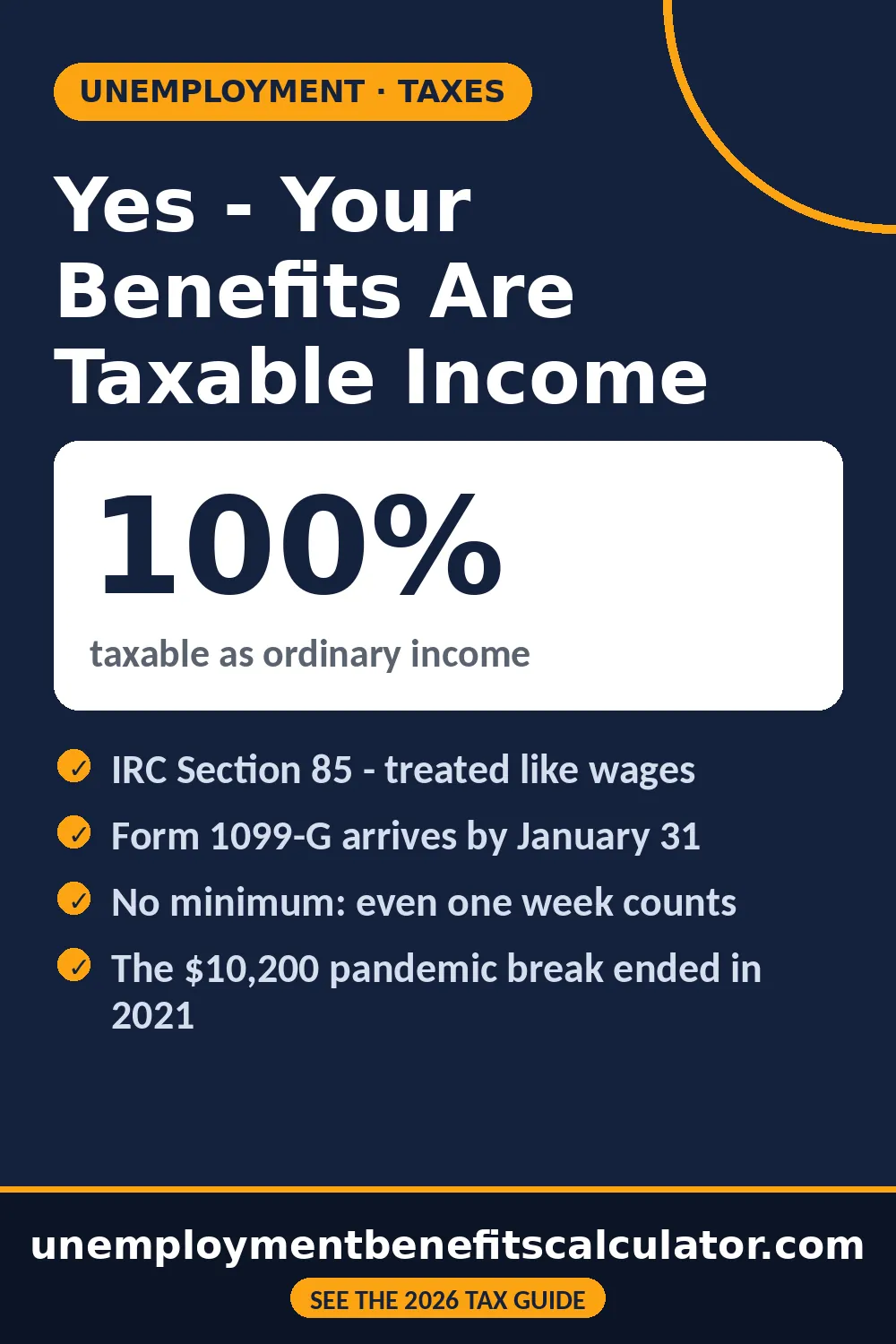
Yes, Unemployment Benefits Are Taxable Income
The IRS classifies unemployment compensation as taxable income under Internal Revenue Code Section 85. This includes regular state unemployment insurance benefits, Federal-State Extended Benefits, Trade Readjustment Allowances, and Disaster Unemployment Assistance. Every dollar you receive through these programs must be reported on your federal tax return, regardless of whether you chose to have taxes withheld during the year. The government does not give you a choice about whether to report the income — only about whether to prepay the tax through withholding. If you received benefits in a given calendar year, you will receive Form 1099-G from your state unemployment agency by January 31 of the following year, and the same amount will be reported to the IRS. There is no threshold or minimum amount below which reporting is unnecessary; even a single week of benefits is taxable.
This tax treatment often surprises first-time claimants because other government benefit programs they may be familiar with — such as Supplemental Security Income, SNAP food benefits, or Medicaid — are not taxable. Unemployment insurance is fundamentally different because it functions as a wage replacement program funded by employer payroll taxes, not a need-based welfare program. Understanding how the unemployment benefits system works means understanding that the IRS treats your benefits as a substitute for the wages you would have earned if you were still employed, and taxes them accordingly.
Form 1099-G: What It Is and How to Read It
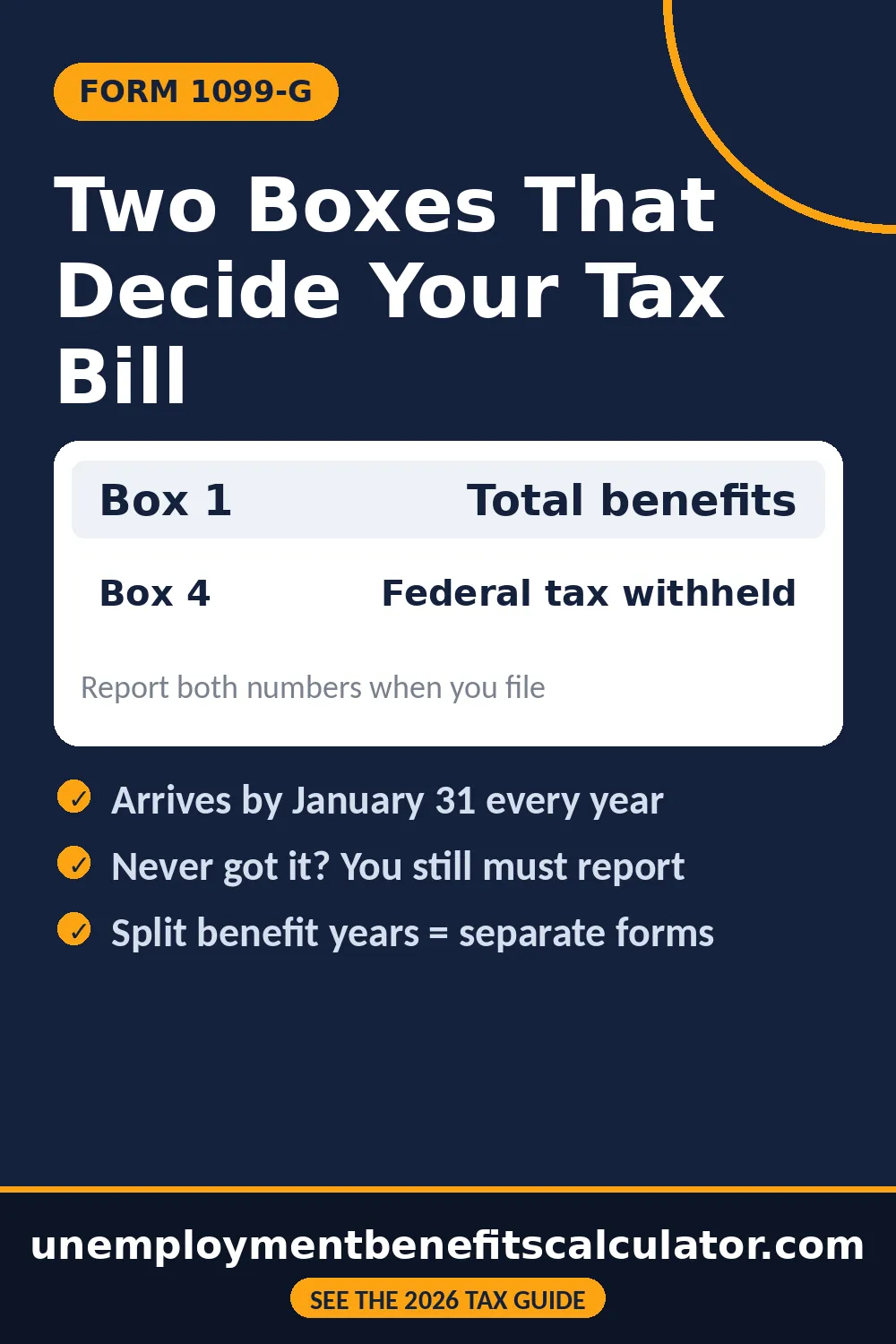
Every January, your state unemployment agency will send you Form 1099-G, Certain Government Payments. This form reports the total amount of unemployment compensation you received during the previous calendar year and any federal income tax that was withheld from your payments. Box 1 shows your total unemployment benefits, and Box 4 shows the federal income tax withheld. You need both numbers when filing your tax return — the total benefits go on your income line, and the withheld amount goes on your payments line, just like the withholding from a regular paycheck. If you do not receive your 1099-G by early February, contact your state agency immediately — you must still report the income even if the form never arrives, and claiming you did not get the form is not a valid defense against under-reporting.
One common problem with 1099-G forms involves benefit year transitions. If your claim started in one calendar year and continued into the next, you will receive separate 1099-G forms for each year, reporting only the benefits paid during that specific calendar year. This is not a mistake — you must report each year's amount on that year's tax return. Another issue arises if you received an overpayment that you later had to repay. If you repaid benefits in the same year you received them, the net amount should appear on your 1099-G. If you repaid benefits in a different year, you may be able to deduct the repayment as an itemized deduction or as a credit, depending on the amount. If you were disqualified from unemployment benefits and had to return payments, this repayment can affect your tax situation, and you should consult a tax professional for guidance on how to handle it correctly.
| Option | How it works | Upside | Trade-off |
|---|---|---|---|
| 10% federal withholding | Elect on your claim (Form W-4V in most states); 10% comes off each payment and is credited when you file | Set-and-forget; no April surprise; can start or change anytime during the claim | Weekly check shrinks while money is tightest |
| Quarterly estimated payments | Pay the IRS directly: April 15, June 15, September 15, January 15 (EFTPS or by mail) | Full weekly check stays in your pocket | Needs discipline; under the safe harbor (90% of this year or 100% of last year tax) you can owe an underpayment penalty |
| Pay in full at filing | Report everything on your return and settle the bill in spring | Maximum cash flow during the claim | Lump-sum bill plus a possible underpayment penalty (federal rate plus 3 points on what you underpaid) |
Options summarized from IRS rules as of October 10, 2026. Withholding availability and forms vary by state - confirm on your state agency site before you elect.
Your tax bill scales with what you collect, so start with a real estimate: our weekly benefit walkthrough shows how the formula turns your base-period wages into a number, and the first-check timeline tells you when that money starts arriving - which decides how many months of withholding or estimated payments you actually need to plan for.
Federal Tax Withholding: How It Works
When you file your initial unemployment claim, your state agency will ask whether you want federal income tax withheld from your weekly or biweekly payments. The standard withholding rate is a flat ten percent of your gross benefit amount, and you can elect this option at any time during your claim — you do not have to decide only at the beginning. If you choose withholding, the state will deduct ten percent from each payment before sending you the remainder, and the withheld amount will be credited toward your federal tax liability when you file your return. This is the simplest way to avoid a surprise tax bill in April, and for most claimants, it is the wisest choice. A claimant receiving four hundred dollars per week for twenty-six weeks would collect ten thousand four hundred dollars in total benefits, which at the ten percent withholding rate means the state would set aside one thousand forty dollars for taxes over the course of the claim.
The downside of withholding is that your weekly payment becomes smaller during a period when you likely need every dollar you can get. Ten percent of a modest benefit amount can feel significant when you are already struggling to cover rent and groceries. However, the alternative — owing the full tax bill in a lump sum when you file your return — can be far more painful, especially if you have returned to work by then and are trying to catch up on bills that accumulated during your unemployment. Some claimants try to split the difference by setting aside their own savings from each payment instead of using withholding, but this requires discipline that is hard to maintain when money is tight. If you are working part-time while collecting unemployment, your total income may be higher than you expect, which makes withholding even more important because your tax liability will be correspondingly larger.
State Tax Treatment: Where You Live Matters
While the federal government taxes all unemployment benefits, state tax treatment varies dramatically. Some states fully tax unemployment compensation just like the IRS does, while others partially exempt it, and a handful do not tax it at all. If you live in a state with no income tax — such as Texas, Florida, Nevada, Washington, Wyoming, Alaska, South Dakota, or Tennessee — you will not owe any state tax on your unemployment benefits because these states do not tax any type of income. On the other hand, states like California and New Jersey exempt a portion of unemployment benefits from state tax, while most other states tax the full amount. This means your total tax bill on the same benefits can differ by thousands of dollars depending entirely on where you live. Use the calculators for California unemployment benefits, Texas unemployment benefits, Florida unemployment benefits, or Washington unemployment benefits to understand how your state treats unemployment income.
State withholding for unemployment benefits follows the same general process as federal withholding, but the rates and availability differ. Not all states offer state tax withholding from unemployment payments, and the rates vary widely. Some states allow you to elect a flat percentage, others use their standard income tax brackets, and a few do not offer withholding at all, which means you will need to make estimated quarterly tax payments to your state if you want to avoid a bill at filing time. If you move to a different state during your claim period, your tax obligation may change mid-year, and you could end up owing taxes in both states depending on their reciprocal agreements. Always check your specific state's rules on the revenue department website, and consider making estimated payments if your state does not offer withholding from unemployment benefits.
How Unemployment Affects Your Tax Bracket
Receiving unemployment benefits can push you into a higher tax bracket if your total income for the year — including wages from employment before you lost your job, any severance pay, and your unemployment compensation — exceeds the threshold for your current bracket. The United States uses a progressive tax system with marginal rates, which means only the income above each bracket threshold is taxed at the higher rate, not your entire income. So if your unemployment benefits push your total income from the twelve percent bracket into the twenty-two percent bracket, only the dollars above the twelve percent threshold are taxed at twenty-two percent, not all of your income. This is a common misunderstanding that leads people to fear accepting benefits because they think their entire income will suddenly be taxed at a much higher rate, which is simply not how the system works.
However, there are real situations where unemployment income can have unexpected tax consequences beyond the bracket issue. If your benefits push your adjusted gross income above certain thresholds, you could lose eligibility for valuable tax credits such as the Earned Income Tax Credit, the Child Tax Credit, or education-related credits. You could also become subject to the net investment income tax or have your medical expense deduction reduced because the threshold for deducting medical expenses is tied to your adjusted gross income. These indirect effects can sometimes cost you more than the direct tax on the benefits themselves. When you know how long it takes to receive your first unemployment check and can estimate your total benefit amount for the year, you can run the numbers early and make informed decisions about withholding and estimated payments.
Estimated Tax Payments: What If You Did Not Withhold?
If you chose not to have federal or state taxes withheld from your unemployment benefits — or if your state does not offer withholding — you may need to make estimated tax payments throughout the year to avoid penalties for underpayment. The IRS generally requires you to pay at least ninety percent of your current year tax liability or one hundred percent of your prior year tax liability through withholding and estimated payments combined, whichever is smaller. If you fall short of these thresholds, you could be hit with an underpayment penalty when you file your return, even if you pay the full amount owed by the filing deadline. The penalty is calculated based on how much you underpaid and how long the underpayment lasted, using the IRS applicable federal rate plus three percentage points.
Estimated tax payments are due quarterly — typically April 15, June 15, September 15, and January 15 of the following year. If you started receiving unemployment mid-year, you can make a catch-up payment, but the penalty may still apply for the quarters you missed. The easiest way to make estimated payments is through the IRS Electronic Federal Tax Payment System, which allows you to schedule payments online or by phone. You will need to estimate your total tax liability for the year, which includes taxes on any wages you earned before becoming unemployed, your expected unemployment benefits, and any other income. If you also had to certify for unemployment benefits biweekly and received payments for only part of the year, your calculation should reflect only the weeks you actually received benefits.
Special Situations and Common Mistakes
Several special situations can complicate the tax treatment of unemployment benefits, and making mistakes in these areas can be costly. First, if you received a lump-sum payment for back weeks of unemployment — which can happen if your claim was initially denied and then approved on appeal — the entire amount is taxable in the year you receive it, not the year you should have received it. This can create a significant spike in your income for that year, potentially pushing you into a higher bracket and triggering the indirect tax consequences described earlier. Second, if you receive unemployment benefits from more than one state during the same year, you will receive multiple 1099-G forms and must report each one separately. The total across all forms must match what you report on your federal return.
A particularly common mistake is forgetting to report small benefit amounts. Some claimants receive only a few weeks of benefits before finding new employment, assume the amount is too small to matter, and leave it off their return. The IRS receives the same 1099-G that you do, and their automated matching system will flag any discrepancy, no matter how small. The resulting notice can take months to arrive, by which time you may have forgotten about the benefits entirely. Another mistake involves double-counting or misreporting when benefits were received in one year but the 1099-G arrived in the next — always use the year shown on the 1099-G, not the year you filed the claim or the year you received the form in the mail. Finally, some claimants incorrectly assume that because unemployment benefits were temporarily tax-free during the pandemic under the American Rescue Plan Act of 2021, that exemption still applies. It does not. The first ten thousand two hundred dollars of unemployment compensation was exempt from federal tax only for the 2020 and 2021 tax years. For 2022 and beyond, all unemployment benefits are fully taxable again with no exclusion.
Strategies to Minimize Your Tax Burden
While you cannot avoid paying taxes on unemployment benefits entirely, there are legitimate strategies to reduce the overall impact. The most effective approach is to elect the ten percent federal withholding as early as possible in your claim, ideally at the time you file. If you missed that window, most states allow you to start withholding at any point by updating your preference online or by phone. Even partial-year withholding is better than none, because every dollar withheld reduces the bill you will face at filing time. If your state offers withholding, sign up for that too — the combined federal and state withholding can cover most or all of your liability, depending on your total income and deductions.
Beyond withholding, look for opportunities to reduce your taxable income through deductions and credits. If you itemize deductions instead of taking the standard deduction, you may be able to deduct job-search expenses such as resume preparation, travel for interviews, and employment agency fees in certain situations, though the Tax Cuts and Jobs Act suspended the miscellaneous itemized deduction category through 2025 — check whether it has been reinstated for 2026. More reliably, contributions to a traditional IRA can reduce your adjusted gross income by up to seven thousand dollars if you are under fifty, or eight thousand dollars if you are fifty or older, and you can make contributions for the previous tax year up until the filing deadline in April. If you have significant medical expenses that exceed seven and a half percent of your adjusted gross income, the deductible portion increases as your income decreases, so lowering your income through IRA contributions can have a cascading effect on other deductions as well.
Frequently Asked Questions About Unemployment and Taxes
Do I have to pay taxes on unemployment benefits?
Yes. Unemployment compensation is fully taxable at the federal level under Internal Revenue Code Section 85, and the IRS receives the same 1099-G your state agency sends you. There is no minimum amount - even one week of benefits must be reported.
How do I report unemployment benefits on my tax return?
Use Form 1099-G, Certain Government Payments. Box 1 shows your total benefits, which goes on your income line, and Box 4 shows federal tax already withheld, which goes on your payments line - the same way withholding from a paycheck is handled.
What if I never received my 1099-G form?
Contact your state unemployment agency in early February - most let you download the form from your online portal. You must report the income whether or not the form arrives; not receiving it is not a defense against under-reporting.
Can I have taxes withheld from my unemployment checks?
Yes - most states let you elect a flat 10% federal withholding when you file, and you can start or change it at any point during your claim. The withheld amount is credited toward your federal tax liability when you file your return.
Which states do not tax unemployment benefits?
The eight states with no income tax at all - Alaska, Florida, Nevada, South Dakota, Tennessee, Texas, Washington, and Wyoming - never tax UI benefits. A few others partially exempt them, including California, New Jersey, Pennsylvania, and Virginia.
Is the pandemic unemployment tax exemption still active?
No. The $10,200 federal exclusion applied only to 2020 and 2021 tax years under the American Rescue Plan Act. From 2022 onward, all unemployment benefits are fully taxable again with no exclusion.
What happens if I do not report my unemployment benefits?
The IRS automated matching system compares every 1099-G to your return and flags discrepancies, no matter how small. The notice can take months to arrive, and the result is typically additional tax plus penalties and interest going back to the original filing date.
Can unemployment benefits push me into a higher tax bracket?
Only the dollars above a bracket threshold are taxed at the higher rate, not your whole income. The bigger risk is indirect: a higher adjusted gross income can reduce or eliminate credits like the Earned Income Tax Credit or the Child Tax Credit.

Wasim Akram
Verified AuthorFounder & Lead Researcher, UnemploymentBenefitsCalculator.com
Wasim personally researches, writes, and reviews every article on this site. His expertise spans unemployment benefits policies across all 50 U.S. states, drawn from systematic research into state workforce agencies and Department of Labor guidelines.
Frequently Asked Questions
Do I have to pay taxes on unemployment benefits?
Yes. Unemployment compensation is fully taxable at the federal level under Internal Revenue Code Section 85, and the IRS receives the same 1099-G your state agency sends you. There is no minimum amount - even one week of benefits must be reported.
How do I report unemployment benefits on my tax return?
Use Form 1099-G, Certain Government Payments. Box 1 shows your total benefits, which goes on your income line, and Box 4 shows federal tax already withheld, which goes on your payments line - the same way withholding from a paycheck is handled.
What if I never received my 1099-G form?
Contact your state unemployment agency in early February - most let you download the form from your online portal. You must report the income whether or not the form arrives; not receiving it is not a defense against under-reporting.
Can I have taxes withheld from my unemployment checks?
Yes - most states let you elect a flat 10% federal withholding when you file, and you can start or change it at any point during your claim. The withheld amount is credited toward your federal tax liability when you file your return.
Which states do not tax unemployment benefits?
The eight states with no income tax at all - Alaska, Florida, Nevada, South Dakota, Tennessee, Texas, Washington, and Wyoming - never tax UI benefits. A few others partially exempt them, including California, New Jersey, Pennsylvania, and Virginia.
Is the pandemic unemployment tax exemption still active?
No. The $10,200 federal exclusion applied only to 2020 and 2021 tax years under the American Rescue Plan Act. From 2022 onward, all unemployment benefits are fully taxable again with no exclusion.
What happens if I do not report my unemployment benefits?
The IRS automated matching system compares every 1099-G to your return and flags discrepancies, no matter how small. The notice can take months to arrive, and the result is typically additional tax plus penalties and interest going back to the original filing date.
Can unemployment benefits push me into a higher tax bracket?
Only the dollars above a bracket threshold are taxed at the higher rate, not your whole income. The bigger risk is indirect: a higher adjusted gross income can reduce or eliminate credits like the Earned Income Tax Credit or the Child Tax Credit.