Unemployment Calculator: Estimate Your Weekly Benefit
Enter your wage, pick your state, and see your estimated weekly check, total benefits, and how long they last. Every figure uses your state’s official 2026 formula — replacement rate, minimum, maximum, and duration — with no signup and no guesswork.
Calculate Your Weekly Unemployment Benefit
Enter your weekly wage and select your state. We apply your state’s own replacement rate, minimum, maximum, and duration rules — the same numbers your state agency uses.
Weekly Wage to Estimated Benefit (at a 50% Replacement Rate)
Most states replace roughly half of your weekly wage, up to a state maximum. The table below shows the standard 50% estimate for common wage levels — and where a state cap shrinks the check. Your exact number depends on your state’s rate and cap, which the calculator above applies automatically.
| Weekly Wage (before taxes) | Estimated Weekly Benefit | What Usually Happens |
|---|---|---|
| $400 | $200 | Capped lower in FL, TN, MS — many workers hit their state maximum |
| $600 | $300 | Most states pay this in full; a few low-cap states trim it |
| $800 | $400 | Full amount in most states |
| $1,000 | $500 | Capped in 20+ states — e.g. CA pays $450, NY $504 |
| $1,200 | $600 | Capped in most states — check your state row below |
| $1,500 | $750 | Capped in nearly every state except WA, MA, MN |
| $2,000 | $1,000 | Only Washington ($1,208 cap) and Massachusetts ($1,033) pay this fully |
| $2,500 | $1,250 | Everyone hits a cap — WA $1,208 is the national ceiling |
Pattern worth remembering: the closer your wage is to twice your state’s maximum benefit, the more likely you are to be capped. High earners in low-cap states lose the largest share. A $2,000/week worker in Mississippi ($235 max) keeps just 12% of wages, while the same worker in Washington keeps 60%.
How the Calculator Works
Three inputs, three seconds, zero signup. Here is exactly what happens behind the scenes when you press the button — the same math your state agency runs, minus the paperwork.
Enter your weekly wage
Use your gross pay (before taxes) from your last job. If your hours varied, average the last 6 months. Part-year workers can use the wage from their highest-earning quarter instead — states look at a 12-month base period, not just the final paycheck.
Select the state where you worked
You file in the state where you performed the work, not where you live. Commuters, remote workers, and multi-state employees should compare states carefully — our state pages explain the interstate claim rules that can raise your benefit.
Get your weekly estimate instantly
The calculator applies your state’s 2026 replacement rate, dependent allowances, minimum, and maximum. You get three numbers: the weekly check, the claim total, and the duration in weeks. Each result also links to your state’s detailed guide.
The Formula: Highest Quarter ÷ 26 (Then Your State’s Rules)
Every state starts from the same place: your base period — the first four of the last five completed calendar quarters before you filed. Within that window, states find your highest-earning quarter and divide it by 26 (half a year) to approximate half your weekly wage. The shortcut most agencies use:
1. Replacement rate
Most states pay 50% of your weekly wage. New Jersey pays 60%, Rhode Island about 58%, Alaska 55%. A handful use wage-bracket tables that approximate the same effect.
2. Dependent allowance
Roughly a dozen states add $10–$25 per dependent, up to a limit — Alaska, Massachusetts, Rhode Island, Maine, Maryland, and Pennsylvania among them. The calculator adds this automatically.
3. Min / max clamp
Your result is clipped to the state floor (e.g. $383 in Washington) and ceiling (e.g. $1,033 in Massachusetts, $1,208 in Washington). High earners always land on the ceiling — that is the cap badge you see in the result.
Two earnings rules can still change your award. First, most states require your total base-period wages to be at least 1.5× your highest quarter— that is how they filter short work histories.
Second, some states add an "absolute" test: total wages must exceed a fixed multiple of the weekly benefit. Fail either one and the state offers a reduced award or none at all, regardless of what a calculator shows.
Worked Examples: Three Real-World Scenarios
The cap and the floor matter as much as the formula. These three workers earn similar wages in different states and end up with very different checks — watch where each one lands.
Dana — retail associate, Texas
$800 × 50% = $400 — Texas max is $605, so no cap
Dana also qualifies for a training adjustment if she enrolls in a state-approved program, which can extend weeks in some cases.
Marcus — nurse, New Jersey
$1,600 × 60% = $960 — above NJ’s $813 cap, so it is capped at $813
Marcus is capped. His effective replacement rate drops to 51% even though New Jersey is the most generous state by rate.
Priya — restaurant server, Washington
$700 × 50% = $350 — above WA’s $383 minimum, so it is lifted to $383
Priya hits the state minimum instead of the formula amount — the floor exists so very low earners still receive a livable check.
Notice the pattern: Dana gets the formula amount, Marcus hits the ceiling, and Priya gets the floor. Two of three real claims never touch the raw 50% math — which is exactly why a state-aware calculator beats a back-of-napkin estimate.
2026 Maximum Weekly Benefits by State
Your state’s ceiling decides what high earners actually receive. The dozen most generous states are below, sorted by maximum weekly benefit. Each state name links to its detailed calculator page with formula, examples, and filing guide.
| # | State | Max Weekly | Min Weekly | Rate | Weeks | Details |
|---|---|---|---|---|---|---|
| 1 | Washington | $1,208 | $383 | 50% | 26 | View → |
| 2 | Massachusetts | $1,105 | $33 | 50% | 30 | View → |
| 3 | Minnesota | $948 | $38 | 50% | 26 | View → |
| 4 | New Jersey | $905 | $83 | 60% | 26 | View → |
| 5 | Oregon | $902 | $211 | 50% | 26 | View → |
| 6 | Colorado | $884 | $25 | 55% | 26 | View → |
| 7 | New York | $869 | $143 | 50% | 26 | View → |
| 8 | Hawaii | $868 | $5 | 50% | 26 | View → |
| 9 | Ohio | $842 | $176 | 50% | 26 | View → |
| 10 | Utah | $806 | $27 | 50% | 26 | View → |
| 11 | North Dakota | $800 | $43 | 50% | 26 | View → |
| 12 | Rhode Island | $777 | $82 | 58% | 26 | View → |
Washington’s $1,208 ceiling is the national outlier — Massachusetts ($1,033) and Minnesota ($857) follow. Mississippi sits at the bottom at $235. These are 2026 figures as published by each state agency; states adjust their tables every July, and we refresh this data as agencies announce changes.
Every State’s Calculator
Filed in one state but live in another? You generally claim where you worked, not where you live. Split your work across states and you may choose the higher-benefit "covering" state — our interstate claims guide walks through that choice.
The remaining 39 states are listed in the chips above with their current maximums.
Do You Qualify? The Four Eligibility Tests
A calculator can only estimate what your wages produce — you also have to clear your state’s eligibility rules. All four tests below must pass at the same time, and the agency checks them in this order when it processes a new claim.
Enough wages in your base period
States look at the first four of the last five completed quarters. Typical minimums: total base wages of 1.5× your highest quarter, and/or a fixed floor such as 40× your weekly benefit amount. Earners with a short or recent work history often fail this test even with a strong last quarter.
Job loss through no fault of your own
Layoffs and position eliminations qualify almost automatically. Being fired usually requires documented misconduct — attendance warnings, policy violations — before you are barred. Quitting needs "good cause" connected to the job: unsafe conditions, a documented medical necessity, or a substantial adverse change.
Able, available, and actively seeking work
You must be physically and legally able to work, and available for suitable offers. You must also search per your state’s weekly quota, commonly three employer contacts per week. Registering with your state job board is usually part of the requirement.
Weekly certification
Benefits are paid week by week. You certify (online or by phone) each week, report any earnings, and confirm you met the work-search rules. Miss two consecutive certifications and your claim can go dormant.
Special situations shift the rules. Recently self-employed workers may qualify through an alternate base period. Military members use W-2 wages from service, and federal employees file under UCFE.
If a denial surprises you, remember that roughly half of appealed denials get overturned. The appeals section below explains the window and the paperwork.
How Long Benefits Last: 12 to 30 Weeks
The standard benefit year runs 26 weeks in most states, but the actual span is a state decision and moves with the economy. Florida and North Carolina pay the shortest standard program at 12 weeks, while Massachusetts pays the longest at 30 weeks. Several states scale duration with the state’s unemployment rate, so a worker in a downturn can get more weeks than the printed maximum.
Shortest (weeks)
Florida and North Carolina. Total benefits are small: 12 × the weekly amount, so a $275 Florida maximum yields at most $3,300.
Standard (weeks)
The majority of states, including CA, TX, NY, and NJ. This is the number the calculator uses for your total unless your state deviates.
Longest (weeks)
Massachusetts, with Kansas (16), Missouri and Michigan (20), and South Carolina (20) also below the 26-week norm.
When regular benefits run out, Extended Benefits (EB) can activate automatically in states with elevated insured-unemployment rates. That program adds up to 13 or 20 more weeks; past recession programs needed new legislation and are inactive for 2026.
The practical takeaway: your claim’s dollar total is weekly amount × your state’s weeks. Both halves matter.
Working Part-Time? You Can Still Collect Partial Benefits
You do not need to be fully unemployed. Every state lets you earn some wages and keep a reduced check, but the deduction math differs. Most states ignore a small earnings allowance, then subtract either a fraction or all of the rest from your weekly benefit.
Worked example — New Jersey’s 50% rule
Report every dollar you earn during certification — states match payroll records and cross-check tax filings months later. An honest $190 week is fine; an unreported $100 week becomes an overpayment demand with penalties and possible fraud disqualification. Weeks where earnings exceed roughly 1.5× your weekly benefit typically count as "full-time" and consume no benefit week, which actually preserves your remaining balance.
Are Unemployment Benefits Taxed? Yes — Plan Withholding Now
Unemployment compensation counts as federal taxable income, the same as wages for tax purposes. It is exempt from Social Security and Medicare (FICA) taxes. No federal tax is withheld automatically — unless you ask for it.
Withhold 10% with W-4V
File Form W-4V (Voluntary Withholding Request) with your state agency to have a flat 10% set aside for the IRS. Most states offer the form in the same portal where you certify — the change takes effect from the next payment.
Watch for your 1099-G
Every January your agency issues Form 1099-G reporting total benefits paid the prior year. The IRS receives the same data, so the number must appear on your return whether or not you withheld. Discrepancies happen — fix them with the agency, not on your tax form.
State treatment varies widely. States with no income tax never touch the money. Several states, including California and New Jersey, exempt unemployment benefits; the rest tax them as ordinary income.
A practical rule of thumb from tax preparers: withholding 10% covers a typical filer’s liability. If you received a large severance, or a spouse’s income pushes your bracket up, raise your estimated payments. Otherwise expect a balance due in April.
6 Legitimate Ways to Maximize Your Weekly Check
None of these involve gray areas — they are timing choices, data fixes, and program rules most claimants simply do not know exist. Apply them before your determination is issued, because almost nothing can be renegotiated afterward.
Pick your covering state wisely
Multi-state workers can sometimes choose where to file. Comparing two states’ formulas takes a minute with the calculator and is worth thousands of dollars over a claim.
Audit your wage report before filing
Claims are computed from employer-reported wages. A missing or misattributed quarter is the #1 cause of low awards — dispute it with paystubs or W-2s before the determination locks in.
Claim every dependent you support
Dependent-allowance states include Alaska, Maine, Maryland, Massachusetts, Pennsylvania, and Rhode Island. Each qualifying dependent adds $8–$25 per week there — up to $650+ extra over a full claim.
File the week you lose the job
Claims generally start the week you file, not the week you were laid off. Most states do not backdate, and every idle week is a permanently forfeited check.
Keep certifying through appeals
If you are denied and appealing, continue weekly certifications for every week in question. Winning back pay for certified weeks is routine; winning it for weeks you never certified is nearly impossible.
Enroll in approved training
Many states waive the work-search requirement for participants in state-approved programs, and a few extend benefits. Department of Labor career centers help match programs that qualify.
What Makes This Calculator Different
There are dozens of unemployment calculators, and most of them give the same wrong answer: a flat half of your wage with no state logic. Here is what this tool does differently — and why the difference shows up in the final number.
State-aware, not one formula
Generic calculators multiply any wage by 50% and stop. Ours loads each state’s own replacement rate, dependent allowance, floor, ceiling, and duration — the four variables that decide your real check.
Shows the cap, not just the number
When a state maximum shrinks your benefit, you see a cap badge with the ceiling value. Knowing you are capped changes your planning: extra earnings that week cost you nothing in benefits.
Transparent math you can audit
Every result displays the inputs used — rate, weeks, min, max — and links to the state page with the worked examples. No black box, no email gate, no “contact an agent” wall.
Built for the way states actually pay
Base period quirks, alternate base periods, partial-benefit deductions — the guidance sections on this page cover the rules that generic tools silently ignore.
How to File Your Claim: 4 Steps From Zero to First Payment
Filing is free, takes 30–45 minutes the first time, and every step below has a mistake mode that costs weeks. Move in this order and your first payment typically lands 2–3 weeks after filing.
Gather your work history
Collect employer names, dates, and wages for the last 18 months — paystubs or W-2s speed this up. You will also need your driver’s license or state ID, and your bank routing number for direct deposit.
File in your work state’s portal
Every state runs an online claims system — most are fastest Sunday evenings through Tuesday mornings when queues are short. Phone filing still exists, but expect hold times measured in hours during layoffs.
Answer separation questions precisely
Your employer reports their side too. Mismatches — quit vs. laid off, reason codes — trigger fact-finding questionnaires. Stick to facts and dates; this is the step where most denials are born.
Certify every week and keep records
After approval, certify weekly and log each work-search contact (date, employer, method, result). States audit logs randomly and after unusual patterns; a clean log ends most investigations in one phone call.
Waiting on the determination letter? That document states your weekly benefit amount, your effective date, and the appeal window — read it line by line. If the number does not match this estimate by more than about 10%, request the wage breakdown your agency used before you start certifying.
7 Mistakes That Delay or Shrink Unemployment Checks
Every one of these is common, avoidable, and expensive. Read the list before you file. Claimants who avoid these mistakes typically see first payments one to three weeks faster.
Filing in your home state instead of your work state
Remote workers and cross-border commuters lose the most here. The claim belongs where the wages were taxed for UI purposes — filing in the wrong state means starting over after weeks of delay.
Guessing at wages instead of checking documents
Overstating wages sets up a painful clawback when the agency reconciles employer reports; understating them can fail the monetary test entirely. Ten minutes with your W-2s prevents both.
Skipping the waiting-week paperwork
Most states have a one-week waiting period that is unpaid unless payable after benefits end. Claimants who skip certifying for week one often forfeit that credit permanently.
Not reporting part-time earnings every week
States match payroll data retroactively. Unreported earnings become overpayments with 15%+ penalties and, in repeated cases, fraud disqualifications that follow you to future claims.
Missing the appeal deadline
Appeal windows run 10–30 days depending on state. A denied claim that sits past the deadline is final — no matter how strong the case was.
Stopping the job search during the claim
Weekly quotas are real requirements, not suggestions. Random audits ask for employer names and dates; “I was browsing listings” does not satisfy a work-search review.
Ignoring the determination letter
That letter contains the wage basis, the formula result, and the appeal window. Claimants who never open it routinely miss wage disputes and deadlines that were still fixable.
Unemployment Calculator FAQ
The questions people actually search for, answered with the same numbers the calculator uses. Still stuck? Every state page has agency contact details and filing specifics.
How much unemployment will I get if I make $1,000 a week?+
At $1,000 per week, the standard 50% formula produces $500. Your state’s ceiling decides the rest: Massachusetts, Washington, and Minnesota pay in full; California caps at $450, New York at $504, Florida at $275. Use the calculator above with your state selected — it applies the exact clamp automatically.
How much unemployment will I get if I make $600 a week?+
Six hundred a week sits below most state caps, so the 50% formula — $300 — is paid in full nearly everywhere. Only the lowest-ceiling states (Mississippi $235, Florida and Tennessee $275) trim it, and a few states with sub-50% rates pay slightly less. With the calculator you can confirm your state’s exact figure in seconds.
How much unemployment will I get if I make $2,000 a week?+
The formula says $1,000, but almost no state pays it. Only Washington ($1,208 cap) and Massachusetts ($1,033) come close, and even those shave the number. Everywhere else you receive the state maximum: $450 in California, $605 in Texas, and $275 in Florida, so plan around your cap.
How is unemployment calculated?+
States take your highest-earning quarter in the base period and divide by 26. Then they apply the replacement rate (usually 50%), add any dependent allowance, and clamp the result between the state minimum and maximum. Total benefits are the weekly amount times your state’s duration — 12 to 30 weeks depending on the state.
Which states have the highest unemployment benefits?+
Washington leads with a $1,208 weekly maximum, followed by Massachusetts at $1,033, Minnesota at $857, Rhode Island ($919), and North Dakota ($728). The lowest maximums are Mississippi ($235), Florida and Tennessee ($275), and Alabama ($275). Generosity also depends on duration — Massachusetts pairs its high cap with 30 weeks.
How long can I collect unemployment?+
Standard programs run 12 to 30 weeks: 26 weeks in most states, 12 in Florida and North Carolina, 30 in Massachusetts. Extended Benefits can add 13–20 weeks in states with high insured unemployment, and Congress has added emergency weeks during recessions. Your claim also expires after a benefit year (52 weeks) even if weeks remain.
Can I work part-time and still collect unemployment?+
Yes — every state allows partial benefits. You report gross earnings each week; the state ignores a small allowance and deducts a portion (often 50%) of the rest. In New Jersey, a $240 rate with $100 earned pays $190 — and weeks where earnings approach full-time pay usually don’t consume a benefit week.
Are unemployment benefits taxed?+
Federal yes, FICA no — benefits are taxable income on your federal return. Most states with an income tax tax them too, though some — like California and New Jersey — exempt them. File a W-4V with your agency to withhold a flat 10% federally, and expect a 1099-G in January showing the year’s total.
Can I get unemployment if I quit my job?+
Sometimes. Quitting must be for “good cause” connected to the work: an unsafe workplace, a documented medical necessity, or a substantial pay or hour cut. Simply disliking the job rarely qualifies, but constructive-discharge cases (your employer made staying impossible) often win on appeal.
Why does my state agency’s number differ from this calculator?+
Three common reasons: your base-period wages differ from the wage you entered, your state uses a wage-bracket table, or dependent allowances and rounding applied differently. If the gap exceeds ~10%, request the wage breakdown behind your monetary determination. Compare it quarter by quarter against your paystubs.
The Waiting Week: Why Your First Check Is (Technically) Unpaid
Most states impose a one-week waiting period at the start of a claim. You still certify for that week and receive credit for it — but no money moves until week two. The week is not wasted: in many states it becomes payable retroactively if your claim lasts its full duration or converts to Extended Benefits.
Which states skip it
A minority of states — Wisconsin among them — pay from week one with no waiting period at all. Check your state page before expecting a delay.
Why it exists
It filters very short claims and saves states roughly one week of payments per claimant. The rule predates modern payroll systems and survives because it spreads program costs down.
The classic mistake
Claimants who skip certifying during the waiting week lose the retroactive credit. Certify from day one, every week, no exceptions — the record matters more than the payment.
During the COVID emergency, federal legislation let states waive waiting weeks entirely, and a few states kept temporary waivers for months afterward. For 2026, standard rules apply everywhere: assume your first payment arrives about two to three weeks after filing, with the waiting week baked in.
What Unemployment Does Not Cover: Severance, PTO, Pensions
Separation packages create more claim confusion than any other topic. The four payment types below interact with benefits differently by state — and the differences swing thousands of dollars. When in doubt, ask the agency before signing anything.
Severance pay
Treatment splits by state. California ignores severance and lets the claim start immediately; New York, in most cases, treats it as allocated wages that postpone benefits week by week. Read the severance letter for an "allocation" clause — it determines how many weeks it blocks.
Accrued PTO and vacation payouts
Lump-sum PTO payouts are usually either deducted from early weeks or ignored entirely, depending on the state and whether the payout was legally required. Notice-period pay is treated more strictly than a voluntary payout, so timing your last day matters.
Pension and 401(k) withdrawals
A pension from the same employer that funded your UI wages can reduce benefits dollar-for-dollar (Social Security pensions usually do not). Regular 401(k) contributions and standard withdrawals do not count, but rolling a lump sum improperly can complicate a claim.
Holiday and bonus pay
Court-awarded back pay, return-to-work bonuses with signing conditions, and holiday pay tied to not working can each offset weekly benefits. Report them as the agency instructs — the definitions are narrower than employers assume.
One more boundary worth knowing: unemployment never pays for wage gaps you chose in ways the program does not recognize. That means sabbaticals, unpaid leave you requested, or business losses if you were self-employed without covered wages. The program insures involuntary job loss from covered employment, and every rule above flows from that single principle.
Denied? The Appeal Window Is 10–30 Days — Use It
Roughly half of appealed unemployment denials are eventually reversed, at least in part — but only claimants who file within the deadline get to play. The window is printed on the determination letter and runs from 10 to 30 days depending on the state. Appeals are free, do not require a lawyer for the first hearing, and can be filed online in every state.
File the appeal before the deadline — even a one-line reason
The notice itself preserves your rights; you can strengthen the argument later. Missing the window is fatal except for rare good-cause exceptions.
Keep certifying every single week
Back pay only flows to weeks you properly certified. Weeks you skipped are gone regardless of the outcome.
Build the evidence file for the hearing
Performance reviews, texts, schedules, the employee handbook, witness names. First-level hearings are informal — written proof beats testimony, and the employer carries the burden in misconduct cases.
If the first decision goes against you, most states offer a second-level appeal to a board or commission. Judicial review is possible beyond that in extreme cases. Our hearing preparation guide covers the script, the exhibits, and the three mistakes that sink winnable appeals.
Special Programs: Federal Workers, Veterans, Disasters, Gig Workers
Four groups sit outside the standard claim flow. Each follows a modified process — different forms, different wage sources, sometimes a different funding stream. The weekly amounts still come from the same state tables this calculator uses.
UCFE — federal employees
Federal civilian workers file under Unemployment Compensation for Federal Employees using Standard Forms 8 and 50 from the personnel file. Benefits are computed from federal wages and paid through the state where the worker files, usually matching that state’s regular program amounts.
UCX — ex-military
Service members separating under honorable conditions claim through Unemployment Compensation for Ex-Service members. DD Form 214 replaces the employer separation notice, and W-2 military wages feed the calculation. Active-duty earnings often produce a higher benefit than a civilian job would.
DUA — disaster victims
Disaster Unemployment Assistance activates after a presidential disaster declaration for workers and self-employed people who lose income and do not qualify for regular UI. DUA weeks, documentation deadlines, and proof-of-income rules are announced per disaster by FEMA and the state agency.
Self-employed and gig workers
Regular state UI still excludes most self-employed income — the pandemic-era PUA program was temporary. Today, gig workers with mixed W-2 wages may qualify on those wages alone. Some states offer alternate base periods that count the most recent quarters, which helps people with short histories.
The common thread: file as early as possible and let the agency route the claim. Every one of these programs pays retroactively only to the week you applied, and the documentation requirements (SF-50, DD-214, income proofs) take days to collect. Check your state’s page for the exact portal link and phone number.
From the Blog
Guides, eligibility deep-dives, and state breakdowns — updated weekly.
New Jersey UI Benefits: Complete Guide 2026
New Jersey pays up to about $1,000 a week for 26 weeks with no waiting week. Learn the two-thirds formula, dependent additions, filing steps, and the 10-day appeal window.
Michigan UI Benefits: Complete Guide 2026
Michigan pays up to $362 a week for 20 weeks through Michigan's UIA. Learn the 4.1 percent formula, biweekly certification, work search rules, and Michigan taxes.
North Carolina UI Benefits: Complete Guide 2026
North Carolina pays up to $350 a week for 12 weeks with no waiting week. Learn the formula, filing steps, the two-contact rule, and the 15-day appeal window.
Georgia UI Benefits: Complete Guide 2026
Georgia pays up to $375 a week starting at 14 weeks through GDOL. Learn the two-quarter formula, filing steps, the three-contact work search rule, and Georgia taxes.
Sources & Data
Benefit figures and formulas on this page are compiled from official state agency tables and federal program guidance for 2026:
- U.S. Department of Labor — Unemployment Insurance — Federal program rules, base-period guidance, and Extended Benefits triggers.
- CareerOneStop (DOL) — Benefit Finder — Official state-by-state agency links and contact information.
- Center on Budget and Policy Priorities — UI Policy — Independent analysis of state benefit adequacy and program changes.
- State agency publications — Each state page cites its own agency site — EDD, TWC, DOL, DES, and the rest.
This site is an independent educational tool and is not affiliated with any government agency. Figures are estimates for planning; your state agency’s determination controls your actual benefits.
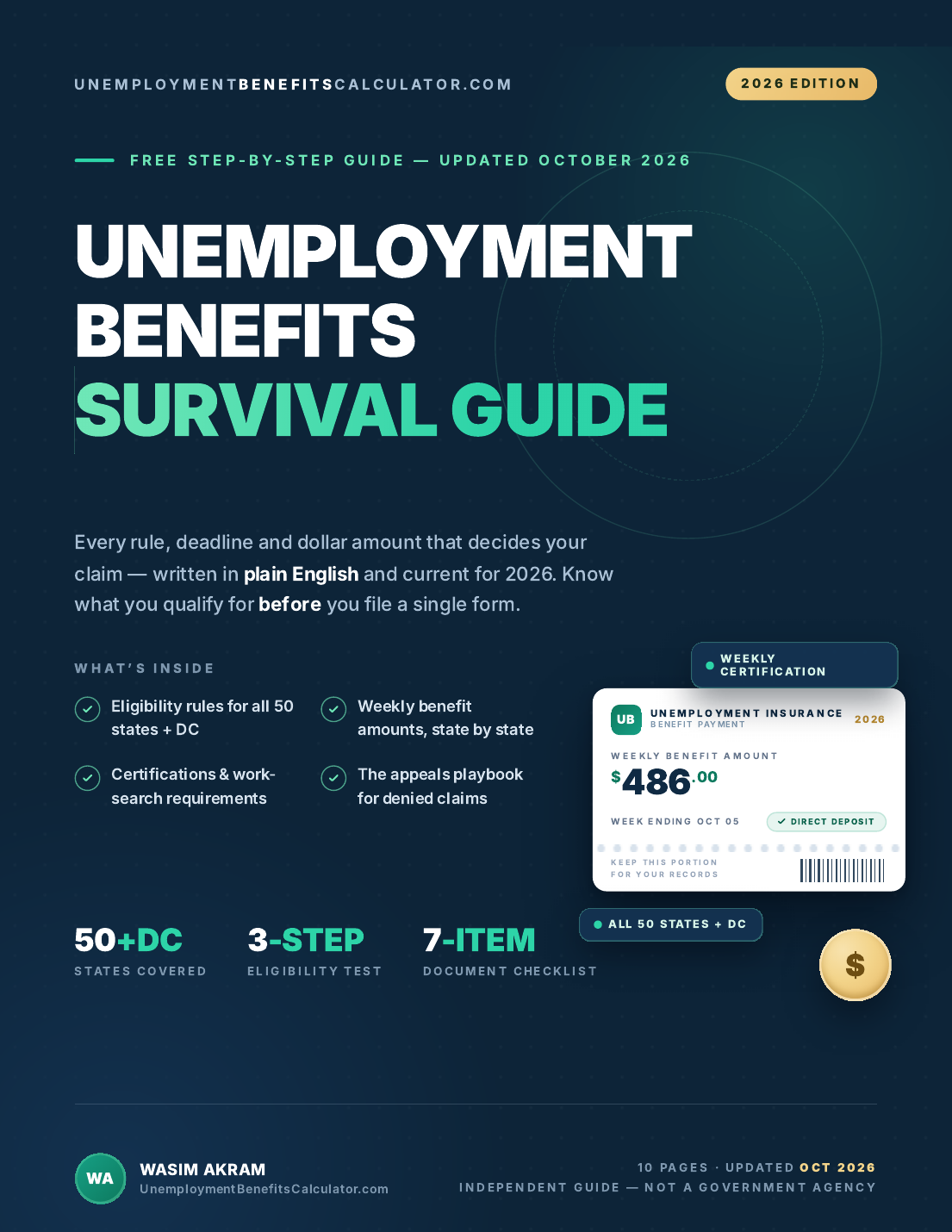
Unemployment Benefits Survival Guide 2026
Every rule, deadline and dollar that decides your claim — eligibility tests, the document checklist, weekly certification answers, appeals, and a 51-state filing directory. Free, printable, plain-English.
- Base-period math explained
- File-ready document checklist
- 51-state directory
100% free · 10-page printable guide
Ready to See Your Weekly Number?
Scroll back to the calculator, enter your wage, and pick your state. Thirty seconds — and you will know what to expect from your claim before the paperwork even starts.