Mississippi Unemployment Calculator: the Divide-by-26 Rule, the 40-Times Test, and the One-Third Pot
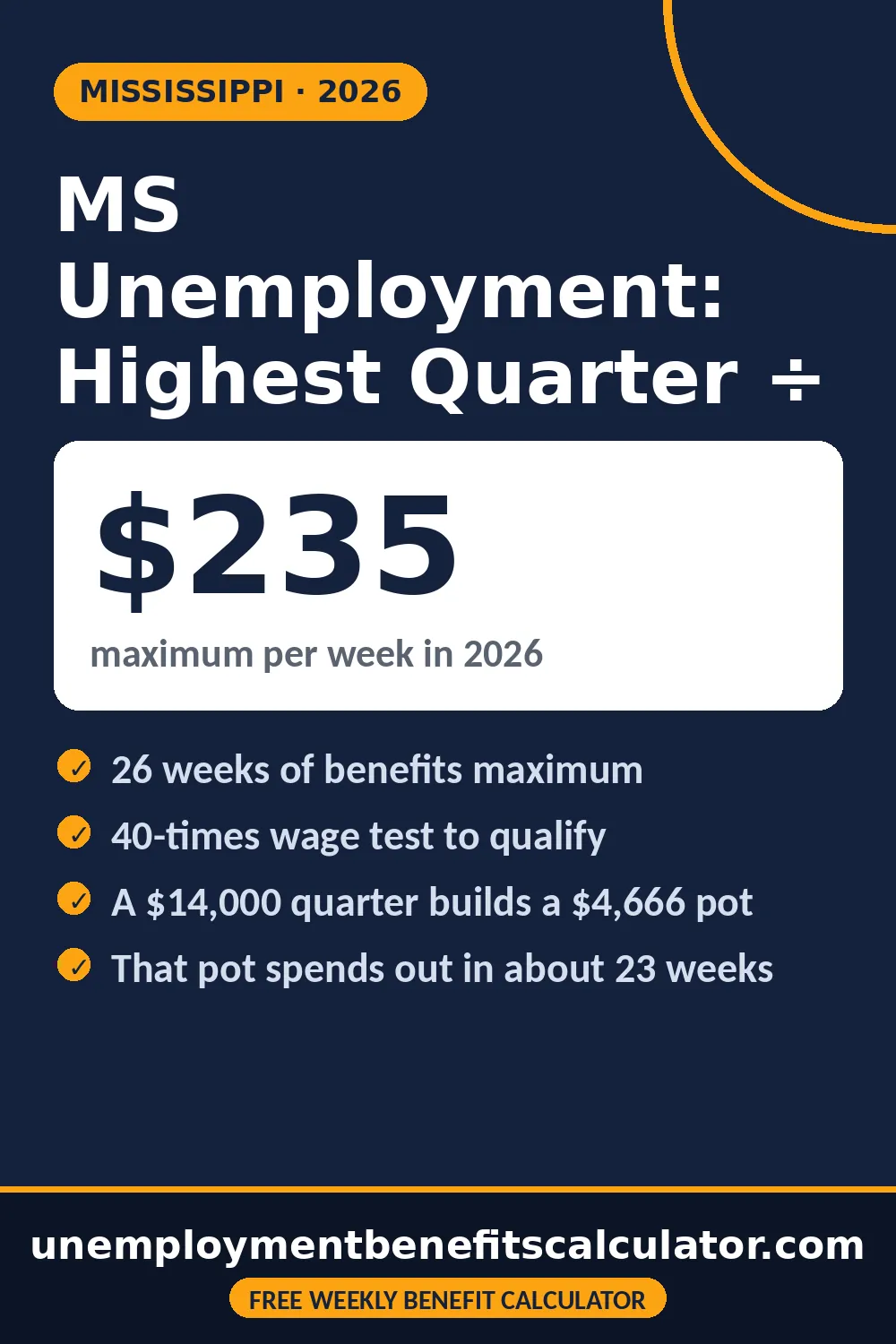
Mississippi prices a weekly check with one clean division: take your highest-earning base-period quarter, cut it by 26, and clamp the answer between $30 and $235. What makes the state different is everything the division feeds into — a 40-times wage test that trips lopsided work years, a one-third pot rule that can shorten a claim before the 26-week clock ever matters, and an unpaid first week. This page runs every one of those rules with you, at river speed.
Max weekly check
$235
a $6,110 high quarter hits the cap
Benefit year
26 weeks
unless the one-third pot binds first
Formula
HQ ÷ 26
highest quarter, one division
Waiting week
1 unpaid
served before checks begin
Verified against MDES sources · September 2026
Navigation chart · Benefit year 2026
Your claim, river mile by river mile
A Mississippi claim moves like the river it is named for — a steady current with a few bends you should see coming. The claim starts on the Sunday of the week you file, the first bend is the unpaid waiting week, the monetary determination posts while that week is still fresh, and from there it is a certification every Sunday until the pot runs dry. Each mile marker below opens into its own section on this page.
Mile 0
File the claim
effective that Sunday
Mile 1
Waiting week
filed, never paid
Mile 2
Determination
rate + wage sheet
Mile 3
First payment
deposit or card
Mile 26
Pot runs dry
or one-third binds
Weekly rate
high quarter ÷ 26
Total payable
26 × rate — or ⅓ of wages
Waiting week
unpaid
Last updated: October 10, 2026. Figures follow current MDES rules - confirm details with the agency before you file.
First tool
Mississippi unemployment calculator: two wages, one division
Mississippi’s formula needs exactly two figures from your wage history: the quarter where you earned the most, and everything you earned across the four-quarter base period. Pull both from pay stubs, the wage sheet MDES mails with your determination, or last year’s W2s, and enter them below. The register divides by 26, applies the $30 floor and the $235 cap, checks the $780 and 40-times tests, prices the pot under the one-third rule, and previews any part-time week at the $40 disregard. Nothing is stored or sent anywhere; the arithmetic happens in your browser.
MDES rate register · 2026
Price your Mississippi claim
Also required
Wages in at least two base-period quarters — one hot quarter alone cannot open a claim.
Enter two wages to run the register
The division, both wage tests, the one-third pot, the waiting week, and any partial week — priced in one pass.
Bar 1 · The division
How Mississippi turns one quarter into a weekly check
Most states average a full year of wages or read from a formula table. Mississippi makes one cut: find the base-period quarter where you earned the most, and divide it by 26. A $2,600 quarter pays $100. A $5,200 quarter pays $200. MDES states the rule plainly on its eligibility page — the weekly benefit amount is based on total wages in the highest quarter of your base period, divided by 26 — and the same division runs inside the state’s own determination, so if you can multiply by 26, you can predict your check to the dollar before you file.
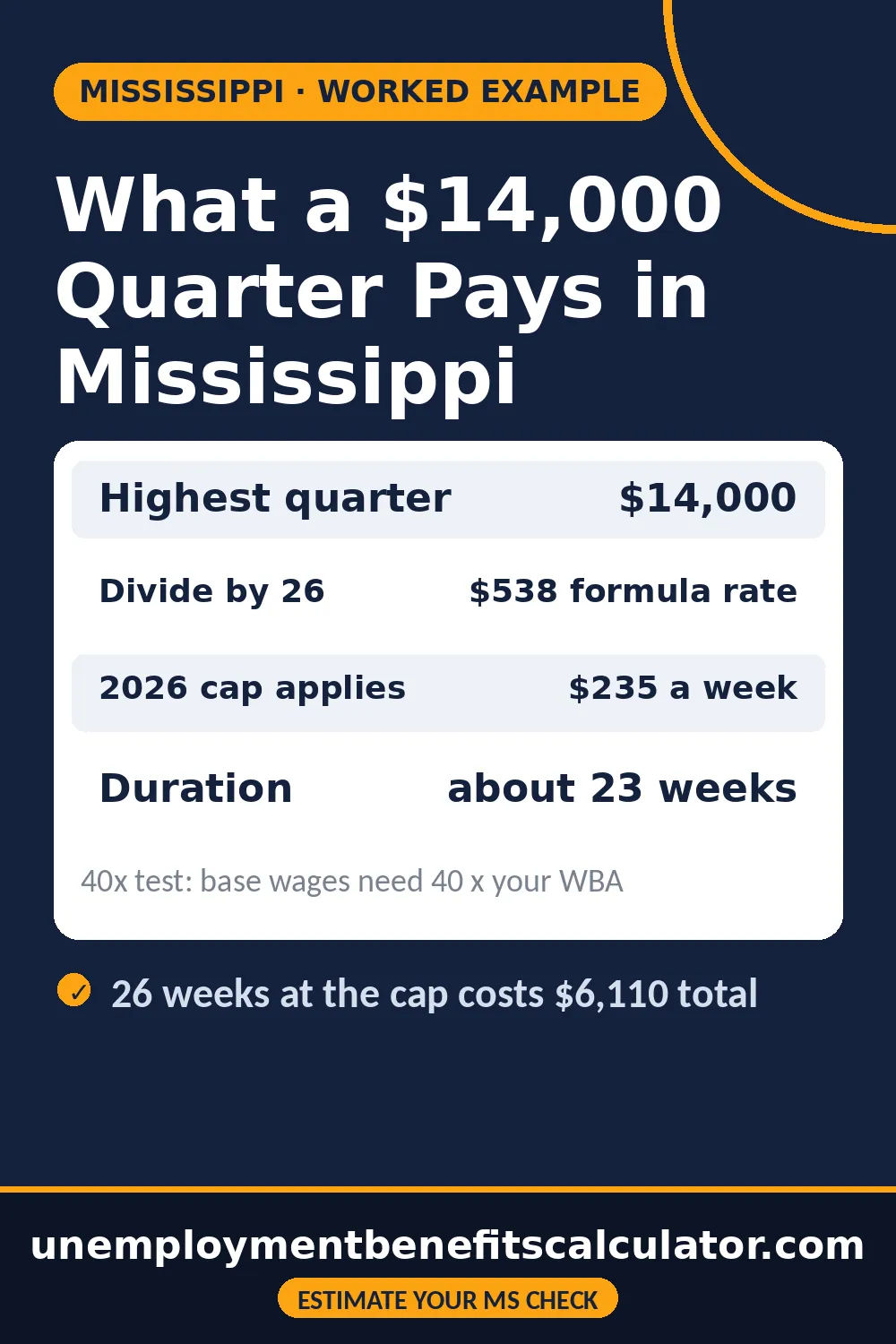
Two rails keep the figure inside state law. No check falls below $30, which catches the thinnest qualifying claims, and none rises above $235 — the ceiling Mississippi has kept for years, and the lowest maximum weekly benefit in the country. The cap starts binding at a high quarter of exactly $6,110, because 6,110 divided by 26 is 235. Every dollar earned above that line adds nothing to the weekly rate, though it still counts toward the 40-times wage test you will meet in the next bar.
| Highest quarter (HQW) | Raw ÷ 26 figure | Weekly check |
|---|---|---|
| $780 | $30 | $30 — the floor holds it |
| $1,300 | $50 | $50 |
| $2,600 | $100 | $100 |
| $3,900 | $150 | $150 |
| $5,200 | $200 | $200 |
| $6,110 | $235 | $235 — the cap lands here |
| $8,000 | $308 | $235 — the cap holds the line |
Read the first and sixth rows together. The $780 quarter is the smallest wage history Mississippi accepts at all, and it divides out to exactly the $30 minimum. The $6,110 quarter is where the $235 cap starts binding. A line cook whose best quarter hit $6,500 and a hospital administrator whose hit $12,000 both receive the same $235 — the division flattens everything above the cap, which is why the pot rules in Bar 3 matter so much here.
Bar 2 · The gates
Three wage tests stand between you and a check
The division only runs if your wage sheet clears three tests, and MDES checks all of them before a determination ever prints. Miss one and the claim is monetarily denied — even a worker with a huge salary can fail if the wages bunch into a single quarter. The three gates come straight from the state’s eligibility requirements page, and each one exists to prove the same thing from a different angle: that your unemployment is recent, real, and spread across a working year.
Gate 1
Wages in two quarters
You must have worked and been paid in at least two of the four quarters in your base period. A single blowout quarter with nothing around it fails here, because the program is built to backstop steady work, not one good season.
Gate 2
At least $780 in the high quarter
The highest quarter of your base period must clear $780. Below that line the claim cannot open at all — it is the floor that keeps micro-claims out of the system, and it divides by 26 into exactly the $30 minimum check.
Gate 3
Total wages of 40× your rate
Your total base-period wages must equal at least 40 times your weekly benefit amount. A $200 rate demands $8,000 across the base period. Lopsided years fail here most often, and the one-third pot rule in the next bar grows out of this same ratio.
If you want to see how these monetary tests compare with the rest of the country, the guide to monetary eligibility walks through wage credits, base periods, and the math states use to screen claims. Mississippi’s version is stricter than most at the bottom — that $780 high-quarter floor is why thin part-time years often cannot open a claim here — and the 40-times test is a cousin of the 1.5-times rules some neighbors run.
One more wrinkle worth knowing before you file: if MDES finds your base period short of wages, the claim is not dead forever. The state’s own guidance tells denied claimants to reapply after the quarter changes, because a new quarter can pull fresher, higher wages into the window — the lag calendar in Bar 4 shows exactly when those doors open.
Bar 3 · The pot
The one-third rule: Mississippi’s hidden claim limit
Most states price a claim as 26 weekly checks and stop there. Mississippi adds a second ceiling that quietly reshapes thousands of claims: the maximum payable during your benefit year is 26 times your weekly rate or one-third of your total base-period wages, whichever is less. The rule lives on MDES’s own eligibility page, and it means the 26-week clock is a ceiling, not a promise. Your real pot is whichever figure is smaller.
The arithmetic is simple once you see it. One-third of total wages compared against 26 checks means the clock binds whenever your wages run long and steady, while the one-third rule binds whenever your wages are bunched — a strong high quarter riding on thin surrounding work. A claimant with a $5,200 quarter and $21,000 in total wages holds a $5,200 pot at $200 a week: one-third of the wages is $7,000, the clock wins, and all 26 weeks pay. Cut the same wages to $14,000 and the pot drops to $4,666, which spends out in about 23 weeks with a partial final check.
| Total base wages | One-third figure | 26-week figure | Real pot |
|---|---|---|---|
| $21,000 | $7,000 | $5,200 | $5,200 — full 26 weeks |
| $18,000 | $6,000 | $5,200 | $5,200 — full 26 weeks |
| $15,600 | $5,200 | $5,200 | $5,200 — dead even |
| $14,000 | $4,666 | $5,200 | $4,666 — about 23 weeks |
| $10,000 | $3,333 | $5,200 | $3,333 — about 16 weeks |
The pivot point sits at three-halves of your weekly rate times 26 — in plain terms, total base wages equal to 39 times your weekly rate keep the full 26 weeks alive. Below that, every dollar of missing wage history trims the pot directly. The calculator above prices both ceilings and tells you which one bound, so you never have to guess which claim you are carrying.
Bar 4 · The window
The base period: which four quarters MDES reads
Every Mississippi claim looks backward, not at your last paycheck. The base period is the first four of the last five completed calendar quarters before your claim’s effective date — the most recent quarter, often called the lag quarter, is deliberately left out while employers finish reporting it. The claim itself is effective the Sunday of the week you file, so the day you walk into the process determines which wage window opens.
The five-quarter strip
Q − 4
used
Q − 3
used
Q − 2
used
Q − 1
used
Lag quarter
excluded
The oldest quarter drops off and the newest one rolls in every quarter change, which lands on the first Sunday of January, April, July, and October. Wages are reported by employers on a quarterly basis, so a quarter’s wages only become visible to MDES after it closes.
| Quarter change | What shifts for a new claim |
|---|---|
| January 4, 2026 | Q3 2025 wages (Jul–Sep) drop into the window for the first time |
| April 5, 2026 | Q4 2025 wages (Oct–Dec) join the base period |
| July 5, 2026 | Q1 2026 wages (Jan–Mar) join the base period |
| October 4, 2026 | Q2 2026 wages (Apr–Jun) join the base period |
| January 3, 2027 | Q3 2026 wages (Jul–Sep) join the base period |
The calendar is also a recovery tool. MDES tells claimants denied for insufficient wages to reapply once the quarter changes, because each change can add a fresher, heavier quarter to the window. A warehouse worker whose claim failed in June with thin 2025 wages might clear all three gates by filing in October, when two strong 2026 quarters are finally on the books. Timing a claim one week past a quarter change is one of the highest-leverage moves in Mississippi unemployment, and it costs nothing.
Bar 5 · The first bend
The waiting week: one unpaid week on every claim
Mississippi builds an unpaid waiting period into the front of every new claim. The first eligible week you file serves as the waiting week: you request it, you meet every eligibility rule for it, and MDES pays nothing for it. The state’s own claimant materials say the same thing three different ways — benefits cannot be paid for the waiting period week, the first check arrives after you file your second weekly certification, and the waiting week is a required step toward eligibility, not a delay you can skip.
It must be requested
The waiting week is a week you certify like any other. Skipping the first certification does not bank the week or push the waiting period aside — it simply starts your claim with a failed week.
It never converts
Unlike a handful of states that reimburse the waiting week at the end of a clean claim, Mississippi keeps the week unpaid for the life of a regular claim. Budget as if the pot is one check smaller than it looks.
Your money starts at week two
Expect the first deposit or card load after the second weekly certification clears. For a claim with no complications, that means real money roughly three weeks after the day you filed.
If the waiting week feels opaque, it is because every state treats it slightly differently. The national guide to the unemployment waiting week walks through which states pay it back, which skip it entirely, and why Mississippi sits in the uncompensated camp. The practical takeaway for a Mississippi claimant is blunt: one week of expenses should sit in savings before the first check lands, and the pot math in the calculator already accounts for it.
Bar 6 · Short weeks
Part-time work and the $40 disregard
Working reduced hours does not disqualify a Mississippi claim — it reprices it. The rule has two halves. First, report your total earnings before deductions for the week you actually performed the work, regardless of when the paycheck lands. Second, MDES disregards the first $40 of those weekly earnings and deducts anything above that dollar for dollar from your weekly benefit. The week still pays as long as gross earnings stay under your weekly rate plus the disregard.
The $40 disregard is small by national standards — several neighbors ignore half the check — but it is forgiving at the bottom, where most partial weeks actually live. Odd jobs count too. MDES allows claimants to accept odd jobs or part-time work and keep receiving benefits, provided every dollar is reported. The weekly certification asks for the gross figure, and employer wage matches run against it every quarter.
| Gross wages that week | Deducted | Check |
|---|---|---|
| $0 | $0 | $200 |
| $25 | $0 | $200 |
| $40 | $0 | $200 |
| $80 | $40 | $160 |
| $120 | $80 | $120 |
| $160 | $120 | $80 |
| $240 | $200 | $0 |
Notice the total-week column: once earnings pass $40, a partial week in Mississippi nets $240 — the $40 disregard plus the full weekly rate — and never more. A $240 wage week pays no check at all but preserves the week on your claim, which matters for the benefit year’s clock. Reporting net pay instead of gross is the classic error here, and the quarterly wage match turns every one of them into an overpayment letter.
Bar 7 · Beyond the math
Eligibility after the wage sheet clears
Passing the wage gates opens the claim; keeping it open is a weekly discipline. Mississippi’s eligibility rules require you to be unemployed through no fault of your own, to be able to work, to be available for work, and to be seeking full-time work each week you certify. MDES pairs those standards with two administrative requirements that catch new claimants off guard — registration at a WIN Job Center and periodic in-person Eligibility Reviews — and both can stall a perfectly funded claim when missed.
Registered at the WIN Job Center
Registration for work with MDES Employment Services is mandatory, and the state is explicit that failing to register can delay or deny benefits. Union membership or a private agency registration does not substitute — the WIN registration is its own box.
Able, available, seeking full time
Each certification asks whether you were able and available for full-time work. Mississippi defines actively seeking work as a good-faith effort, and the three-contact rule in the next bar is how the state measures it.
Eligibility Reviews in person
Periodically MDES schedules you to report in person, and the notice tells you the date and time. You will be asked to provide at least three places you have looked for work. Missing the review can affect the claim, so calendar it the day the letter arrives.
No fault, every week
The through-no-fault standard applies to the separation and to continuing eligibility. A refusal of suitable work can deny benefits for up to 12 weeks, and quitting without good cause restarts the investigation clock from the separation file.
These non-monetary standards are where most denials that surprise claimants actually happen — the money was there, but a week of unavailability or a missed review did the damage. The guide to non-monetary eligibility explains how states weigh ability, availability, and job-seeking week by week, and why the burden of proof sits with the claimant once the investigation opens.
Bar 8 · The search
Three employer contacts a week, logged like a captain’s log
Mississippi defines actively seeking work with unusual precision. Every certifying week you must contact three employers to apply for full-time work — the state sets the bar at 35 hours or more — and at least one of the three must be an actual completed application or resume. MDES honors a resume as the application when that is the employer’s accepted mode of applying. The work has to fit the labor market and your skills, so a restaurant line cook applying to machinist openings is not building credit.
What counts
A completed application or a submitted resume, delivered in person, by mail, or electronically. At least one of your three weekly contacts must reach that standard; the other two can be applications too — three applications a week is the cleanest pattern.
What to log
The weekly certification collects what you did, how you did it, the date, the company name, and the name and phone number of the person you spoke with. Phone contacts need the number, visits need the address, emails need the address, web contacts need the URL.
What gets checked
Every entry is subject to verification with the employer. MDES warns that incorrectly input work-search information can deny benefits for that week outright — treat the log like a legal record, because functionally it is one.
A paper trail turns an audit from a crisis into a formality. The work-search log template most claimants adopt takes five minutes a week and doubles as your Eligibility Review cheat sheet — three places looked, three contacts made. If a week ever comes up short, the guides on what happens when you fail the job-search requirements and whether networking or job fairs count toward your work search explain the recovery paths and which alternative activities Mississippi credits.
Bar 9 · Launch day
Filing the claim: Access MS, ID.me, and one honest phone line
The front door is mdes.ms.gov. New claims go through the Access MS portal, which runs around the clock and begins with identity verification through ID.me — clear that step the same day you file, with a driver’s license or passport within reach, because a claim sits untouched until identity clears. Claimants who prefer paper-to-voice can call the MDES Contact Center at 601-493-9427, Monday through Friday from 8 a.m. to 5 p.m. The claim is effective the Sunday of the week you file, which is one more reason not to drift a week past a quarter change.
Have on the desk
- Social Security card or number
- Driver’s license or state ID number
- Employer names, addresses, and phone numbers for the last 18 months
- Employment dates and the reason you left each job
- Alien registration or visa number, if applicable
Money moves
MDES pays by direct deposit or debit card. Direct deposit into a checking account is set up online under Benefits Maintenance, then Update Claimant Profile, then Payment options. The state’s Conduent debit card carries no monthly fee, no purchase fees, and no cashback fees, with a replacement line at 1-855-709-1077 if a card goes missing.
Filing is free, full stop. MDES does not charge a fee and never asks for credit card or bank account information to open a claim — the state warns claimants to use only www.mdes.ms.gov, because lookalike filing sites harvest exactly that data.
The 18-month employer window is worth respecting: separations older than that shape the story but not the claim, while everything inside it feeds the wage sheet and the investigation file. File honestly the first time — every separation reason you give is checked against the employer’s version, and mismatches are what turn a clean claim into a scheduled fact-finding call.
Bar 10 · The rhythm
The Sunday certification: the heartbeat of the claim
Mississippi’s benefit week runs Sunday through Saturday, and the certification for a finished week opens right after midnight into Sunday. File it online through the Access MS system — available 24 hours a day, 7 days a week — or by phone through the Contact Center on weekdays. The state’s warning is blunt: failure to file the weekly certification in a timely manner will affect your benefits, and claims filed late may be denied. Most claimants build a Sunday-morning habit, the same hour every week, work-search log already filled in.
Each certification reports the week’s gross earnings, the three work-search contacts, and your continuing ability and availability. Consistency is the whole game: a week that pays zero should still be requested to keep the chain unbroken, because a skipped week is a hole an auditor will find. Payments post after the certification clears — direct deposit typically lands fastest, the card follows the same rhythm — and the first check of a new claim only arrives after that second certification clears the waiting week.
When a payment that should have posted does not, resist the urge to re-file the week. The guide to delayed unemployment payments walks through the usual culprits — a pending identity step, an eligibility review, a bank holiday — and the exact order to call MDES in. What you should never do is certify the same week twice or let the next week slide while you wait; the claim punishes silence more than anything else.
Bar 11 · The separation
Fired or quit: how Mississippi reads the last day
Every separation that is not a simple lack of work sends MDES digging, and the definitions come straight from the state’s FAQ. Misconduct is an act which is either willful or an intentional disregard of the employer’s interest — a standard that separates deliberate violations from ordinary poor performance. A discharge for connected misconduct disqualifies the claim, while a layoff for lack of work sails through. The line between a bad attitude week and willful disregard is exactly what the investigator is paid to find.
Quits carry their own test: you must prove good cause for leaving your employment, and Mississippi reads good cause narrowly — circumstances attributable to the work, or pressures a reasonable person could not be expected to stay under. Refusing an offer of suitable work sits in the same family: benefits may be denied for up to 12 weeks when the refused job was suitable. Whatever the separation, MDES gathers statements from you and the employer before issuing a determination, and either side can appeal within 14 days of the mailing date.
The separation file rewards preparation. Dates, warnings, texts, the exact wording of a resignation letter — all of it matters more than the story’s arc. The state-by-state guide to good cause for quitting shows how narrowly Mississippi’s neighbors draw the same line, and why a quit documented the day it happened beats a persuasive explanation assembled months later.
Bar 12 · The long river
Appeals: fourteen days and a four-step ladder
Disagreeing with a determination starts a clock: you have 14 days from the mailing date of the decision to request an appeal, through the MDES Call Center or in writing to the Appeals Department at P.O. Box 1699, Jackson, MS 39215-1699. No attorney is required, and the hearing itself is a structured conversation — statements from you and the employer, documents into the record, questions from the officer. The Administrative Appeals Officer can reverse, modify, or sustain the original decision, and a written decision usually follows within 14 days of the hearing.
Administrative Appeals Officer
Hearing after the 14-day request; written decision usually inside 14 days.
Board of Review
The next appeal, in writing to the address on your letter or through the Call Center.
Circuit Court
File in the county where you live; non-residents use the employer’s county, the cause of action, or the county of employment.
Mississippi Supreme Court
The final rung for a Circuit Court loss — rare, but the ladder exists.
Two habits keep an appeal alive. First, keep certifying every week while the case pends — if the decision swings your way, only certified weeks can be paid, and the state confirms payments continue during an appeal unless the original decision is reversed. Second, calendar the 14-day window the day the letter arrives; Mississippi does not extend it for intent. The preparation guide for unemployment hearings covers evidence order, witness handling, and how to answer without volunteering damage.
The whole claim on one sheet
Darla in Tunica: a casino week that becomes a claim
Darla spent six years dealing tables at a Tunica casino before the floor she worked was consolidated in March 2026 — a clean lack-of-work layoff. Her base period wages totaled $14,000, with a high quarter of $5,200 from the holiday season. Filing through Access MS on a Sunday, she ran the same arithmetic this page runs, and the determination MDES mailed two weeks later matched it line for line. Her wage sheet, exactly as the state prices it:
| Line | Figure |
|---|---|
| Highest quarter ÷ 26 | $5,200 ÷ 26 = $200 weekly rate |
| Gate 1 — two quarters of wages | Pass — wages in all four |
| Gate 2 — $780 high-quarter floor | Pass — $5,200 clears it easily |
| Gate 3 — total wages of 40× rate | Pass — $14,000 vs the $8,000 needed |
| 26-week figure | 26 × $200 = $5,200 |
| One-third figure | 1/3 × $14,000 = $4,666 |
| The pot (lesser wins) | $4,666 — one-third binds |
| Weeks of checks | 23 full weeks + a $66 partial final week |
| After the waiting week | $4,666 − $200 = $4,466 payable |
| A part-time week at $120 wages | $200 − ($120 − $40) = $120 check |
Darla’s claim shows the one-third rule doing exactly what it was written to do. On paper she had a full 26-week year; in reality her wages clustered into one brilliant quarter and a thin shoulder season, and the pot trimmed to match. The waiting week cost her one $200 check, her Sunday certifications kept the chain unbroken, and a ten-hour-a-week floor job in May produced $120 weeks that stretched the remaining pot further. Nothing about the claim was generous — but every dollar of it was predictable, which is what this page is for.
Seven tracks that skip
The mistakes Mississippi claimants keep making
Mississippi’s program is simple at the top — one division, three gates — and unforgiving in the details. These are the seven skips MDES sees every week, and every one of them is avoidable with a calendar, a folder, and an honest gross-earnings figure.
Filing one week past a quarter change
A claim filed just after the first Sunday of a quarter can pull a fresh, heavier quarter into the base period. The same claim filed a week earlier can fail Gate 3 entirely. Check the calendar in Bar 4 before you file.
Skipping the waiting-week certification
Assuming the first week is automatic leaves a hole the claim cannot repair. The waiting week must be requested like every other week, and the first real check only follows the second certification.
Reporting net pay instead of gross
The certification asks for gross earnings before deductions. Net figures understate wages, and the quarterly employer wage match turns every one of them into an overpayment letter with a disqualification attached.
Logging three contacts without one application
Three phone inquiries are not a week of searching. At least one of the three weekly contacts must be a completed application or resume, and all three must target full-time work of 35 hours or more.
Ignoring the WIN Job Center registration
The state is explicit that failing to register can delay or deny benefits. Union books and private agencies do not substitute. Register the same week you file.
Missing the ID.me or Eligibility Review step
The claim sits untouched while identity verification pends, and an in-person Eligibility Review missed on schedule can affect the claim. Both take one afternoon — calendar them the day the notice arrives.
Letting the 14-day appeal clock die
Mississippi’s appeal window runs from the mailing date of the determination, not the day you read it. A denial you meant to contest becomes final because two weeks passed quietly. Calendar it the day the letter lands.
Placement on the map
Mississippi against the typical state
Every state shares a federal frame, but the details diverge sharply. The table below sets Mississippi’s rules against what most of the country does, using the same verified numbers this page carries. The state’s fingerprint is unmistakable: the lowest maximum check in the nation, a one-third pot rule almost no other state runs, and a work-search standard measured in specific, verifiable employer contacts.
| Rule | Mississippi, 2026 |
|---|---|
| Weekly check formula | High quarter ÷ 26, $30–$235 |
| Claim pot | Lesser of 26 checks or one-third of total base wages |
| Wage screens | Two quarters, $780 HQ floor, 40× total test |
| Duration | Up to 26 weeks |
| Waiting week | One unpaid week on every initial claim |
| Part-time rule | First $40 disregarded, then dollar-for-dollar |
| Work search | 3 full-time employer contacts, 1 actual application |
| State tax on benefits | Taxed — flat 4% on taxable income above $10,000 |
If you are comparing offers or planning a move, the neighboring claims are worth a look: Louisiana, Arkansas, Tennessee, and Alabama all run their own formulas, and the same wage sheet can price very differently across a state line. The states grid covers all fifty.
The collector’s share
Taxes: Washington takes, and Jackson does too
Unemployment income is taxable from both directions for a Mississippi claimant. Federally, every benefit dollar counts as income — you can elect 10 percent withholding on each weekly certification or settle the bill at return time, and the IRS treats the election as all-or-nothing for the year. Mississippi sides with the majority of states that tax benefits too: the Department of Revenue’s income tax FAQ answers the question directly — unemployment is taxable — and the state’s individual rate is a flat 4 percent for 2026 on taxable income above $10,000.
Two practical notes keep the April bill from surprising anyone. The 1099-G covering the year’s payments arrives by late January, and it reports the gross — the $40 disregard and the waiting week never reduced what counts as income. And while the 4 percent flat rate is scheduled to keep stepping down under the 2025 tax-cut law, budgeting at the current rate is the safe play. A claimant who drew Darla’s $4,466 would set aside roughly $180 for the state at the full rate, plus whatever the federal bracket demands.
If the withholding decision feels high-stakes, the guide to how unemployment benefits are taxed walks through the federal election, the state variations, and the safe-harbor math for claimants who skip withholding entirely. The one move to avoid is ignoring the paperwork: unreported benefits are the most common tax notice MDES claimants receive, and the 1099-G matches what the state already knows.
The undertow
Overpayments and fraud: how claims go underwater
An overpayment occurs when a claimant receives benefits they were not entitled to, and Mississippi treats the cause as seriously as the amount. The routine path is accidental — a net-pay figure here, a missed wage there — and it resolves through repayment arrangements once the notice lands. The expensive path is a pattern. Failing to report earnings brings an overpayment assessment plus a disqualification of up to one year on top of the debt, and the state’s claimant handbook adds that fraud can carry a disqualification of up to 52 weeks, a collection warrant, and garnishment of future wages.
The defense is unglamorous and effective: report gross earnings for the week the work was performed, log the three contacts honestly, and answer every fact-finding letter by its deadline even when the answer is complicated. MDES forgives the first two far more readily than the third, and silence is the only answer the system cannot process. A claimant who disputes an overpayment keeps the same appeal right as any other determination — 14 days, in writing or through the Call Center.
Straight answers
Mississippi unemployment questions, answered
How much unemployment will I get in Mississippi?
Mississippi takes the wages from your highest base-period quarter, divides them by 26, and holds the answer between $30 and $235 a week. A high quarter of $5,200 pays $200, while any quarter at or above $6,110 lands on the $235 cap. The calculator at the top of this page runs the same division, checks both wage tests, and prices the whole claim including the one-third pot rule.
How long do Mississippi unemployment benefits last?
A benefit year can pay up to 26 weeks, but the state caps the total pot at the lesser of 26 times your weekly rate or one-third of your total base-period wages. A claimant with a $5,200 best quarter and $14,000 in total base wages would run a $4,666 pot, which spends out in about 23 weeks at $200 — one-third of the wages binds before the 26-week clock does.
Why was my Mississippi claim denied when my coworker was approved?
Money is only half the test. Mississippi requires wages in at least two base-period quarters, a highest quarter of at least $780, and total base wages equal to at least 40 times your weekly rate. Beyond the math, the separation matters: a discharge for misconduct connected with the work, or a quit without good cause, triggers an investigation that can deny the claim entirely even when the wage sheet is strong.
What is the waiting week in Mississippi?
The first eligible week on every new claim is an unpaid waiting period week. You file for it and meet every rule, but no check is issued, and the first real payment arrives after you file your second weekly certification. Plan one week of expenses on savings, because the waiting week never converts to payment on a regular Mississippi claim.
Can I work part-time and still collect Mississippi unemployment?
Yes. Mississippi disregards the first $40 of weekly earnings, then deducts anything above that dollar for dollar from your check. A $200 weekly rate ignores the first $40 of a part-time wage, so $120 of earnings leaves a $120 check. Report gross wages for the week you actually worked, not the week you were paid — every dollar is matched against employer records.
How many job searches does Mississippi require each week?
Three employer contacts every week, each aimed at full-time work of 35 hours or more, and at least one of the three must be an actual completed application or resume. You must also stay registered for work with Mississippi Works. Log what you did, how, the date, the company, and a contact name and number — MDES verifies the details with employers, and a bad entry can cost the whole week.
What happens if I was fired or I quit in Mississippi?
Both separations trigger a review. Mississippi defines misconduct as an act that is willful or an intentional disregard of the employer’s interest, and a discharge for connected misconduct disqualifies the claim until the disqualification is served. A quit needs good cause attributable to the work. Refusing suitable work can cost up to 12 weeks of benefits. MDES takes statements from you and the employer, and either side can appeal within 14 days.
How do I file a claim in Mississippi?
File online at mdes.ms.gov through the Access MS portal, which is open around the clock and starts with an ID.me identity check, or call the MDES Contact Center at 601-493-9427 Monday through Friday from 8 to 5. Gather your Social Security card, driver’s license or state ID, and employer details for the last 18 months. The claim is effective the Sunday of the week you file and is never backdated.
Does Mississippi tax unemployment benefits?
Yes, twice. Federal income tax applies to every benefit dollar, and the Mississippi Department of Revenue confirms unemployment compensation is taxable on the state return as well. Mississippi uses a flat 4 percent individual rate for 2026 on taxable income above $10,000. You can elect 10 percent federal withholding on your weekly claims; the state share is settled when you file your Mississippi return.
How do I appeal a Mississippi unemployment decision?
You have 14 days from the mailing date on the determination to request an appeal — through the MDES Call Center or in writing to the Appeals Department in Jackson. A hearing follows before an Administrative Appeals Officer, who usually mails a decision within 14 days. From there the ladder runs to the Board of Review, your county’s Circuit Court, and finally the Mississippi Supreme Court. Keep certifying every week while the appeal is pending.
Where every number comes from
Sources & verification
Every figure on this page was checked against Mississippi government sources in September 2026. The weekly benefit range, the division formula, the three wage gates, the one-third pot rule, the waiting week, the $40 disregard, the three-contact work search, and the 14-day appeal window all trace to MDES publications, with tax treatment confirmed by the Department of Revenue and independent trackers. This site is not affiliated with, endorsed by, or operated on behalf of the Mississippi Department of Employment Security or any government agency.
- 1.MDES — Benefit Eligibility Requirements — the $235 maximum and $30 minimum, HQ ÷ 26 formula, $780 high-quarter floor, 40× total-wage test, 26×WBA-or-one-third pot limit, base period definition, waiting week, WIN Job Center registration. Accessed September 15, 2026.
- 2.MDES — Unemployment FAQs — 26×WBA maximum payable, $40 partial-earnings disregard, 12-week refusal disqualification, federal taxation and withholding, 14-day appeal window, misconduct definition, direct deposit and Conduent debit card, 18-month employer history. Accessed September 15, 2026.
- 3.MDES — Worksearch Requirements — Mississippi Works registration, three weekly employer contacts for full-time work (35+ hours), one actual application, logging fields and employer verification. Accessed September 15, 2026.
- 4.MDES — Weekly Claims Procedures — Sunday–Saturday benefit weeks, certification timing after the week closes, online filing around the clock. Accessed September 15, 2026.
- 5.MDES — Access MS portal — the claimant login, ID.me identity verification, weekly certification and work-search record submission. Accessed September 15, 2026.
- 6.MDES — ReEmploy MS waiting period notice — the first week of a new, eligible claim is an unpaid waiting period week. Accessed September 15, 2026.
- 7.MDES — Getting Started — register and file by phone at 601-493-9427; the two weekly duties of every claimant. Accessed September 15, 2026.
- 8.MDES — Benefit Information hub — benefit chart access, overpayment and appeals navigation, WIN Job Center links. Accessed September 15, 2026.
- 9.Mississippi DOR — Individual Income Tax FAQ — the state’s confirmation that unemployment compensation is taxable on the Mississippi return. Accessed September 15, 2026.
- 10.Tax Foundation — State Income Tax Rates 2026 — the flat 4.00 percent individual rate on taxable income above $10,000 as of January 1, 2026. Accessed September 15, 2026.
- 11.IRS — Topic 418, Unemployment Compensation — federal taxation of every benefit dollar and the 10 percent elective withholding. Accessed September 15, 2026.
- 12.CBPP — How Many Weeks of Unemployment Compensation Are Available? — independent confirmation that Mississippi tops out at 26 weeks in the regular program. Accessed September 15, 2026.
- 13.FRED / BLS — Mississippi unemployment rate (MSUR) — 3.6 percent seasonally adjusted, July 2026. Accessed September 15, 2026.
- 14.Mississippi Bar — Unemployment Benefits for Unemployed Workers — independent legal summary of the $235/$30 range and the eligibility tests. Accessed September 15, 2026.
- 15.20 Miss. Code R. § 101-300-305.02 (Cornell LII) — the administrative rule behind the active weekly search for full-time work. Accessed September 15, 2026.
- 16.CareerOneStop — American Job Center network — job-search and training resources cited for work-search planning. Accessed September 15, 2026.
Editorial note: this calculator and guide are independent tools for Mississippi workers. MDES’s Access MS system and the mailed monetary determination are the controlling sources for any real claim, and rounding differences of a dollar or two can occur between this page’s arithmetic and the state’s systems.