The North Star Ledger
Verified against uimn.org & Minnesota Statutes · September 2026
Minnesota Unemployment Calculator: Half Your Wage, Up to $948 a Week
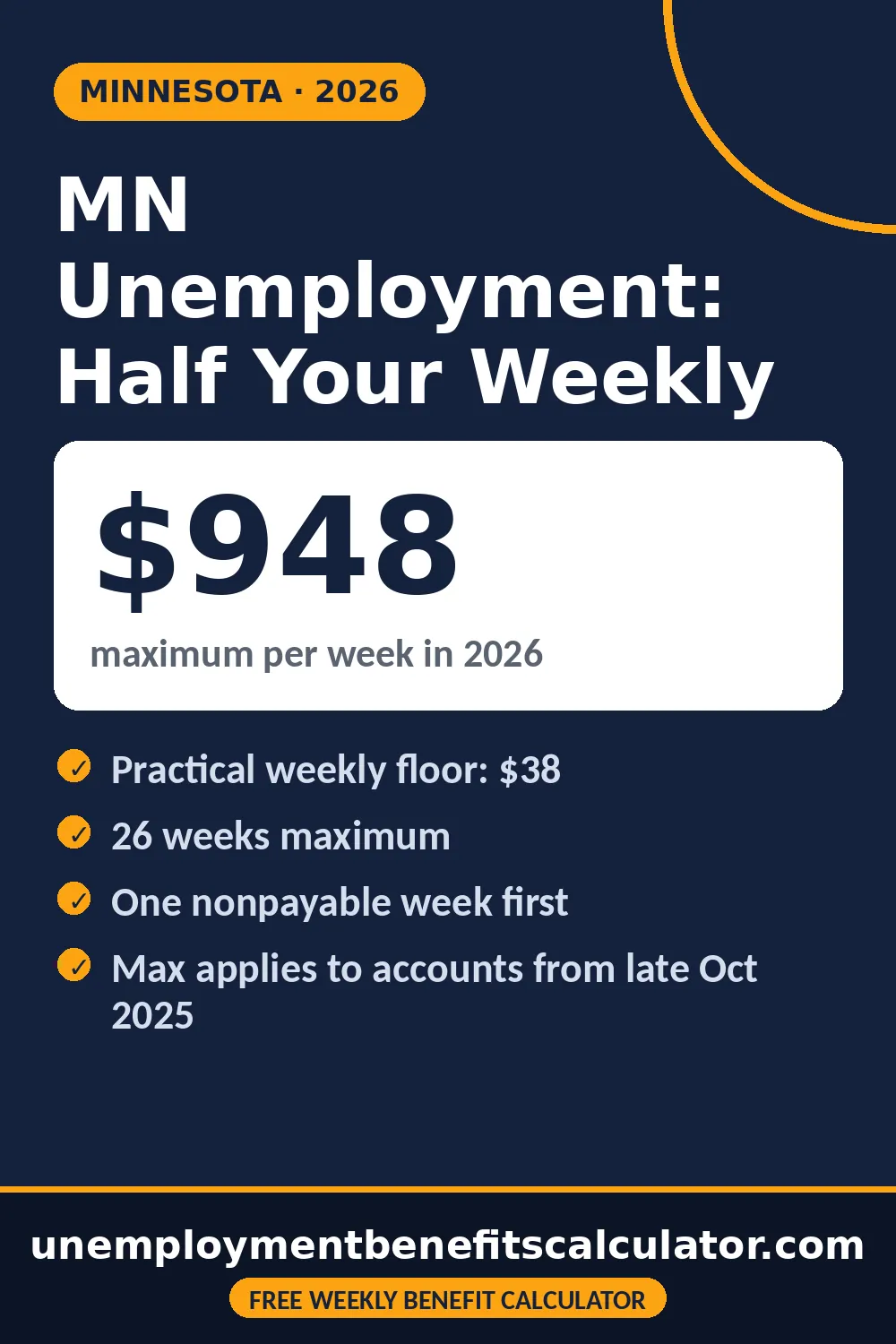
Minnesota replaces about half of your paycheck, and the 2026 ceiling stands at $948 a week.
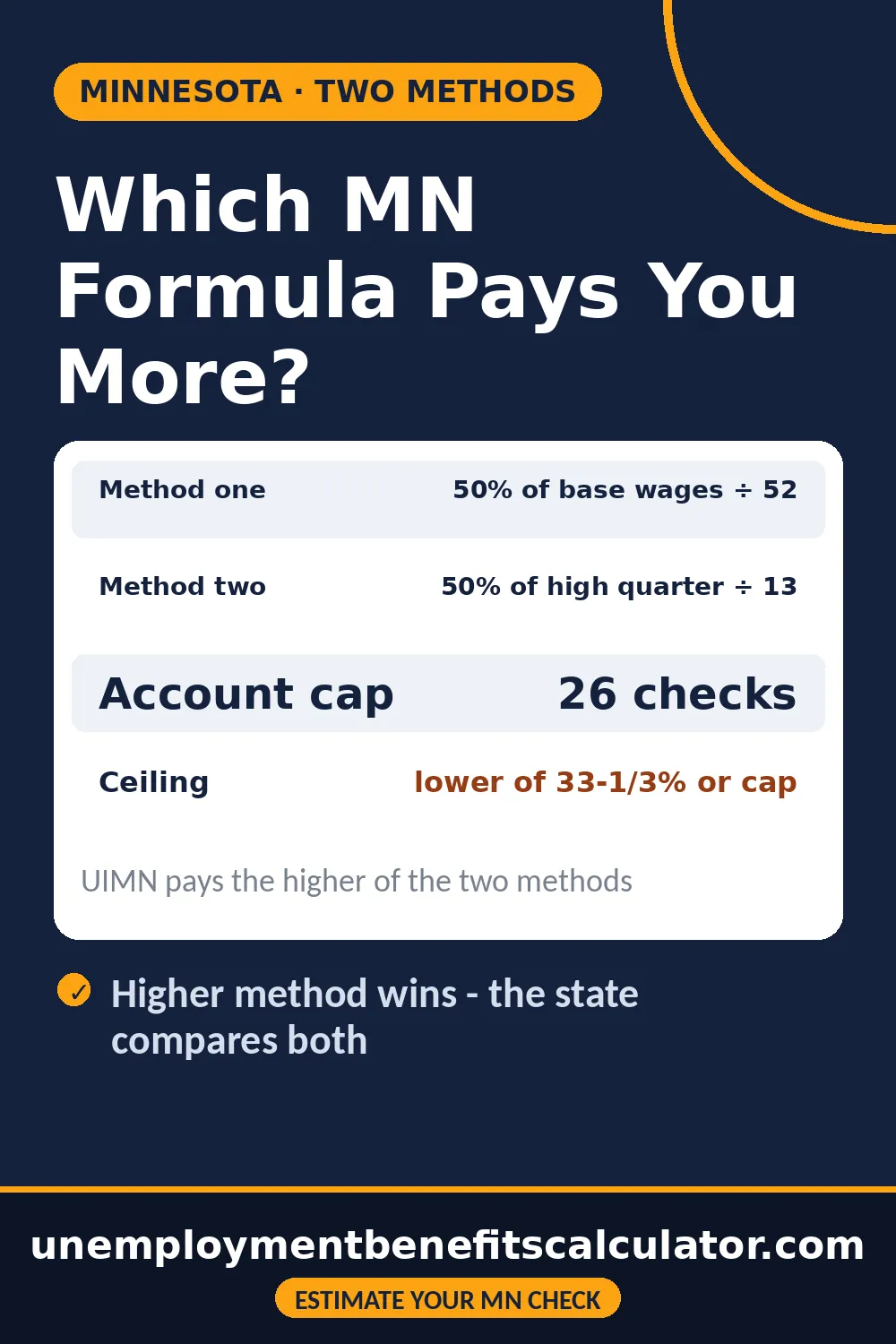
The state runs two formulas side by side and pays whichever lands higher, so guessing one formula costs money.
The tool below runs both methods, the one-third account rule, and the part-time check in a single pass.
$948
max weekly rate
$38
weekly floor
26
weeks at most
1
nonpayable week
Last updated: October 10, 2026. Figures follow current DEED / UIMN rules - confirm details with the agency before you file.
Run Your Minnesota Numbers
The two-method engine behind every figure on this page.
Polaris Estimator
Two-method engine · $948 cap · one-third account rule · 26-week ceiling
Weekly rate
$400
M1 $269 · M2 $400
Benefit account
$9,333
one-third rule or 26× rate
Weeks paid
23
from your account
Part-time week
$400
no earnings entered
Estimates round down and assume a clean wage record. DEED's determination controls; the first payable week follows one nonpayable week.
The Quick Answer for 2026
Minnesota unemployment pays roughly half of your recent wages, within a $38-to-$948 weekly band.
Your money lives in a benefit account, not an open-ended promise. The account equals one-third of your base wages.
A second cap holds too: the account can never exceed 26 times your weekly rate. Both limits are statute.
Divide the account by your weekly rate and you have your week count. Twenty-six is the hard ceiling.
Every new claim also serves one nonpayable week before the first check arrives. Minnesota is one of the few states that keeps it.
Waypoint Note
The $948 maximum applies to accounts established on or after the last Sunday in October 2025.
It stays fixed for a full year, even if the statewide figures move again next October.
The Two-Method Formula, Worked
Minnesota Statutes 268.07 runs two math paths and pays the larger result.
Method one takes half of your total base-period wages spread across 52 weeks. Steady earners score well here.
Method two takes half of your high-quarter wage across 13 weeks. A strong best quarter pulls this number up.
DEED computes both and pays the higher one. Each method also carries its own ceiling tied to the statewide average wage.
The ladder below assumes even wages, four equal quarters with the quarter shown as the best one.
| Highest quarter | Method 1, even wages | Method 2, half of HQ | Benefit account | Weeks paid |
|---|---|---|---|---|
| $4,000 | $153 | $153 | $3,978 | 26 weeks |
| $6,500 | $250 | $250 | $6,500 | 26 weeks |
| $9,100 | $350 | $350 | $9,100 | 26 weeks |
| $12,480 | $480 | $480 | $12,480 | 26 weeks |
| $15,600 | $600 | $600 | $15,600 | 26 weeks |
| $20,800 | $800 | $800 | $20,800 | 26 weeks |
With wages spread evenly, both methods always agree, because four equal quarters make the two ratios identical.
Even wages also ride the 26-times cap, so the account lands on your best quarter and pays the full 26 weeks.
Concentrated wages split the pattern. A fat quarter lifts the check but shortens the run, as the worked claims below show.
Waypoint Note
Roughly $24,600 in a single quarter pushes the raw math past $948, where the state ceiling takes over.
Why the Ceiling Moves Every October
Minnesota resets its maximum on the last Sunday in October, not in January.
Each June 30, the labor commissioner totals the prior year's covered wages from employer wage reports.
That sum produces the state's average annual wage and, divided by 52, the average weekly wage.
On the last Sunday of October, new accounts start using the fresh figures. The cycle repeats every year.
The 2025-26 cycle put the maximum at $948, up from $914 the year before. Once your account is set, the number locks.
Later October changes never reach into a running claim. A claim filed in November rides its own figure all year.
Thin Ice Warning
Old guides still quote $857 or $890 for Minnesota. Both figures lag the current cycle by a year or more.
The handbook on uimn.org publishes the live maximum. Trust the agency page, not the archive.
Base Period and the Entry Gate
One wage test decides whether DEED opens an account at all.
Your base period is the first four of the last five completed calendar quarters. The newest quarter sits out.
Apply in January, April, July, or October and the calendar shifts. DEED then reads the four most recently completed quarters.
The entry gate is a wage-credit floor. Minnesota requires at least 5.3 percent of the state average annual wage.
The figure rounds down to the next lower $100, and it works out to roughly $4,000 in base-period earnings today.
Clear the gate and your weekly rate still has a floor. The smallest checks Minnesota pays run about $38.
Waypoint Note
Fail the standard test near a quarter boundary? Ask about the alternate base period before giving up.
It swaps in more recent quarters, and newly earned wages sometimes flip a denial into a claim.
Your Week Count: the One-Third Rule
Minnesota writes the duration math into 268.07, and it rewards even earners.
Start with one-third of your total wage credits. That product is the first candidate for your account.
Now multiply your weekly rate by 26. The smaller of the two becomes your benefit account.
Divide the account by your weekly rate to get your weeks. The quotient can land anywhere up to 26.
A near-minimum account produces the longest run at a small rate. A fat quarter produces a rich check that burns faster.
Extended Benefits would add 13 weeks nationally if unemployment spiked. Minnesota's trigger is cold, and DEED confirms no extensions are active.
Waypoint Note
Plan on the regular 26-week frame. If Congress or the legislature revives extensions, the extra weeks arrive as a separate program.
Minnesota's Nonpayable Week
One unpaid week sits at the front of every benefit account.
Minnesota law requires a nonpayable week before benefits can start. The first week you are eligible goes unpaid.
For most applicants, the second week is the first payable one. You request it during the third week of the account.
Only one nonpayable week exists per 52-week benefit year. Returning to work and requalifying does not reset it.
First payments can still slip past week three. Earnings above your rate, or 32-plus work hours, both delay the clock.
Thin Ice Warning
Request benefits every single week anyway. Skipped weeks are lost weeks, and the nonpayable week still needs your request.
Part-Time Work and the 50% Trim
Statute 268.085 lets you earn a little and still draw most of a check.
Part-time hours do not end a claim. Minnesota reduces the check instead, by a fixed statutory formula.
Earn less than your weekly rate, and DEED deducts 50 percent of those earnings. The rest of your check survives.
Earn your full weekly rate or more, and the week simply pays nothing. The week still counts as requested.
Some pay never counts against you. National Guard and reserve duty, volunteer fire and ambulance service, jury duty, and election-judge pay are exempt.
Example: Astrid's part-time week
Astrid's rate is $400. A $150 dock shift trims $75, leaving a $325 check.
A $390 week trims $195 and pays $205. A $410 week pays nothing at all.
Report gross earnings every week, before the paycheck actually lands. DEED matches wage reports later.
Waypoint Note
Holiday pay and paid time off count as earnings. Vacation, severance, and back pay follow their own offset rules.
Filing Your Minnesota Claim
The application takes about 30 minutes if your work history is at hand.
File online at ui.mn.gov, Sunday through Friday, 6 a.m. to 8 p.m. The system schedules your request day automatically.
Prefer a voice? Call 651-296-3644 in the Twin Cities or 1-877-898-9090 across greater Minnesota, weekdays 8 to 4:30.
Have the last 18 months of employers ready: names, addresses, dates, pay rate, and the reason each job ended.
Your account effective date is the week you file, not the week you lost the job. File early to protect the week.
DEED mails a benefit determination afterward. It shows your rate, your account, and your weekly request schedule.
Waypoint Note
Independent contractors and gig workers are usually outside Minnesota's covered employment.
If a company directed your hours and tools, protest the wage record — misclassification is a real, fixable thing.
The Weekly Request Rhythm
Minnesota runs on calendar weeks, Sunday through Saturday. Each weekly request covers exactly one of those weeks.
Your account assigns a request day. Log in at ui.mn.gov, answer the week's questions, and confirm before the deadline.
The questions cover work and earnings, other income, availability, and your work-search effort for the week.
Request benefits every week even while an appeal is pending. Won weeks only pay if you requested them.
Approved money moves by direct deposit or a reloadable prepaid card, usually a couple of business days after processing.
The payment clock, start to finish
- File the application and serve the nonpayable week.
- Request your first payable week on the assigned day.
- Funds reach your bank or card a few business days later.
Work Search and Availability
Statute 268.085 expects a genuine weekly effort, not a ritual.
Each week you request benefits, DEED asks whether you actively sought suitable work and remained available.
Keep a running log of every contact: the employer, the date, the method, and the outcome. DEED audits those records.
When it is reasonable, you must also ask your former employer about recall. Layoff rehires count as real leads.
Restrict yourself to full-time openings only, and expect a questionnaire. Minnesota expects reach that matches your market.
Suitable work follows your training and your labor market. Distance, hazards, and your prospects all factor in.
CareerForce locations run across the state, near fifty of them, with workshops, listings, and staff who review resumes.
Thin Ice Warning
Soft work search is the quietest way to lose benefits. Notices arrive weeks after the thin week.
Log contacts the same day you make them, and answer every DEED questionnaire before its deadline.
Quits, Firings, and the 30-Day Trap
Statute 268.095 decides most contested Minnesota claims.
Quitting without a statutory reason disqualifies you. The strongest exception is good reason caused by the employer.
Good reason means the average worker would have quit too, and the employer knew, or should have known, the situation.
Other recognized quits include serious illness, family safety concerns such as domestic abuse, and verified moves with a spouse.
Firings turn on misconduct. Minnesota defines it as intentional, negligent, or indifferent conduct that seriously violates workplace standards.
Ordinary mistakes, poor fit, and honest inability do not meet that bar. Employers carry the burden of proving it.
Thin Ice Warning
Here is the trap almost nobody sees. Quitting within 30 days of a notified layoff date disqualifies you.
If the layoff is on the calendar, stay employed until it lands. The statute treats the early exit as a quit.
Waypoint Note
Lost your job and found new work already? Earning $1,950 in new covered wages requalifies you after another separation.
Overpayments, Penalties, and Waivers
An overpayment is money DEED paid that the law later says you owed back. Most start with honest reporting mistakes.
DEED recovers nonfraud debts by holding back future benefits, commonly half or all of each check, until the balance clears.
A waiver exists for nonfraud debts. If repayment would be against equity and good conscience, DEED can absorb the loss.
Fraud is a different universe. A finding means full repayment plus a penalty equal to 40 percent of the overpaid amount.
Willful misrepresentation can also bring criminal charges under Minnesota law. Intent is the line between debt and penalty.
Thin Ice Warning
Never pay a third party to release or speed up benefits. DEED never charges claimants, and fee scams are common.
Everything official runs through ui.mn.gov, the numbers above, and letters from St. Paul.
The 45-Day Appeal Ladder
Minnesota gives one long clock, then moves fast once a hearing is set.
A determination arrives by mail with a mail date. Your appeal window runs 45 calendar days from that date.
File online, by fax, or by mail, and say plainly what the determination got wrong. Attach anything that proves it.
An unemployment law judge hears the case, usually by phone, with both sides sworn and exhibits on the record.
The written decision typically follows within about 20 days of the hearing. Either party can then request reconsideration.
Beyond that sits the Minnesota Court of Appeals, but most disputes end at the judge. Keep certifying throughout.
Waypoint Note
Winning on appeal pays the weeks you requested during the fight. Skipping requests quietly erases those weeks.
Taxes: Minnesota Taxes Benefits Too
Unemployment counts as income for the IRS and for Minnesota's income tax. A 1099-G arrives each January.
At application, DEED offers three withholding choices: 15 percent for federal plus state, 10 percent federal only, or none.
You can change the election later from your online account. Many claimants raise it once they see the January total.
A full year at the cap is $948 times 26, about $24,648, before any withholding. Set aside a share if you chose none.
Waypoint Note
Download the 1099-G from your ui.mn.gov account each January. Mailed copies travel the same window.
School Employees and Seasonal Work
Two Minnesota carve-outs trip workers every year.
Between two academic terms, workers with reasonable assurance of return generally cannot use school wages.
The 2023 law change moved the line for support staff. Hourly employees outside instructional, research, and administrative roles can qualify between years.
Paras, cafeteria staff, custodians, and transportation workers file like anyone else now, if no reasonable assurance exists.
Seasonal hospitality runs on its own rule. A designated seasonal employee works 150 days or fewer across any 52-week stretch.
Seasonally unemployed claimants can also be offered lower-skilled temporary work paying about their weekly rate. Refusing it risks disqualification.
Waypoint Note
Resort town winters and lakeside summers make these rules real money here. Read the determination, not the rumor.
Seven Mistakes That Cost Minnesotans Real Money
Each one shows up in DEED files every week.
These are the errors that turn approved claims into delays, denials, or surprise debts. All seven are avoidable.
- Skipping the request during the nonpayable week. Skipped weeks are never recovered later.
- Quitting inside the 30-day window before a notified layoff. The statute reads that exit as a quit.
- Reporting net pay instead of gross. DEED matches employer wage reports, and the mismatch overpays you.
- Letting the work-search log go thin. Restored benefits after an audit can take weeks to restart.
- Ignoring the alternate base period after a denial. New quarters often flip the answer.
- Missing the 45-day appeal clock. The judge must dismiss late appeals, however strong the case is.
- Choosing zero withholding and saving nothing. A $948-a-week year is about $24,648 of taxable income.
Thin Ice Warning
Two of these create overpayments that are hard to claw back: gross-versus-net reporting and skipped request weeks.
The other five mostly cost time, which still matters when rent is due on the first.
For Minnesota Employers: 2026 Rates
The 2026 taxable wage base is $44,000 per employee, about 60 percent of the state average annual wage.
Experience-rated accounts run from 0.0 to 8.9 percent. The rating period for 2026 covers July 2021 through June 2025.
New employers start at 1.0 percent outside construction, with construction rates set higher by industry group.
Benefit charges follow layoffs, so contested separations move your rate. Answer DEED notices on time, every time.
Waypoint Note
Wage detail reports feed the state wage figures behind the $948 maximum. Filing them late skews more than your account.
Three Minnesota Claims, Worked
The two-method formula, the account rule, and the cap, run three ways.
Astrid — dock worker in Duluth, one child
Her best quarter paid $10,400 and her base total is $28,600. Method two wins at $400 a week.
One-third of her wages is $9,533, which beats nothing and loses to the $10,400 cap, so the account is $9,533.
That buys about 23 weeks. A $150 weekly dock shift trims $75, leaving $325 those weeks.
Nolan — machinist in Mankato, no dependents
Nolan's quarters were nearly flat: $39,000 total, with $8,450 the best. Method one wins at $375.
Method two only reaches $325, so the 52-week view pays him $50 more every single week.
His account caps at 26 times $375, which is $9,750, and that runs the full 26 weeks.
Wren — office manager in Bloomington, two kids
Wren's best quarter hit $14,950 with a $44,000 base. Method two pays $575 a week.
One-third of her wages is $14,666, just under the 26-times figure, so her account is $14,666.
That runs about 25 weeks at $575, and each check carries her dependents' costs into the budget.
Minnesota Against Its Neighbors
The upper Midwest, priced four different ways in 2026.
Minnesota's $948 ceiling leads the neighborhood by a wide margin. Iowa and North Dakota trail near $790 and $786.
Duration matters too. Iowa now runs 16 weeks on new claims, while Minnesota holds the full 26.
| State | Max weekly | Max weeks | How the rate is built |
|---|---|---|---|
| Minnesota | $948 | up to 26 | higher of two wage methods, one-third account rule |
| Wisconsin | $497 | up to 26 | half the two highest quarters, averaged |
| Iowa | $790 | up to 16 | about a sixth of your two best quarters |
| North Dakota | $786 | up to 26 | highest two and a half quarters over 65 |
| South Dakota | $575 | up to 26 | about half your high-quarter weekly wage |
Neighbor figures were verified in September 2026 against each state's agency or legislature. Caps drift every season.
Don't Confuse UI with Minnesota Paid Leave
Two programs, two applications, both new money in 2026.
Minnesota Paid Leave started January 1, 2026, and it is not unemployment insurance.
It covers your own serious health condition and family care, up to 12 weeks each and 20 combined per year.
Wage replacement is partial, and the job is protected once you clear 90 days with the employer.
Self-employed Minnesotans can opt in, something regular unemployment never offered here.
Losing work is a UI claim. Stopping for health or family is Paid Leave. Pick the right door before you apply.
Waypoint Note
Both programs can matter in the same year. Apply for each separately and read the notices from both offices.
Minnesota Unemployment FAQ
Twelve answers, each pulled from the statutes and handbook pages above.
How is unemployment calculated in Minnesota?
DEED runs two formulas and pays the higher one. Method one is half your total base wages across 52 weeks. Method two is half your best quarter across 13 weeks, capped at $948.
How much does unemployment pay in Minnesota in 2026?
Weekly benefits run from a $38 floor to a $948 ceiling. That range applies to accounts established on or after the last Sunday in October 2025.
How many weeks of unemployment do I get in Minnesota?
Your account is one-third of your base wages or 26 times your weekly rate, whichever is less. Weeks equal that account divided by your weekly rate, up to 26.
What wages do I need to qualify in Minnesota?
You need wage credits of at least 5.3 percent of the state average annual wage. The figure rounds down to the next lower $100, earned during the standard base period.
Why is my first Minnesota payment delayed?
Minnesota law requires one nonpayable week. Most people are paid starting with the second week, requested during the third week of the account.
Can I work part-time and still collect?
Yes. If weekly earnings stay under your benefit rate, half of them are deducted. Earnings at or above the rate make the week ineligible.
Can I get unemployment if I quit in Minnesota?
Only for a statutory reason, most commonly good reason caused by the employer. Quitting within 30 days of a notified layoff date disqualifies you.
What happens if I was fired for misconduct?
Discharge for employment misconduct disqualifies you. Minnesota defines misconduct as intentional, negligent, or indifferent conduct that seriously violates standards.
How long do I have to appeal a denial?
Forty-five calendar days from the mail date of the determination. The unemployment law judge usually mails a written decision within about 20 days of the hearing.
Does Minnesota tax unemployment benefits?
Yes, both the IRS and Minnesota tax them. You can elect 15 percent withholding for federal plus state, 10 percent federal only, or none at all.
Do school employees qualify during summer break?
Teachers with reasonable assurance of return do not. Hourly support staff in non-instructional roles have qualified since the May 28, 2023 law change.
Where do I file my Minnesota claim?
Online at ui.mn.gov Sunday through Friday, 6 a.m. to 8 p.m., or by phone at 651-296-3644 in the Twin Cities or 1-877-898-9090 statewide.
Ledger Terms: a Minnesota UI Glossary
Wage credits
The gross covered wages DEED counts in your base period. They set the account and both formula methods.
Base period
The first four of the last five completed calendar quarters. Apply near a quarter boundary and it shifts.
Alternate base period
More recent quarters DEED can swap in. It rescues claims that miss the standard wage gate.
Weekly benefit amount
Your per-week payment: the higher of the two statutory methods, floored near $38 and capped at $948 in 2026.
Benefit account
The total pot: one-third of your wage credits or 26 times your weekly rate, whichever is less.
Nonpayable week
The one unpaid week at the front of every account. Request it like any other week.
Deductible earnings
Weekly earnings under your rate. Half is deducted from the check; at or above the rate, nothing pays.
Reasonable assurance
A school-term promise of return work. It blocks between-terms claims for most instructional staff.
Unemployment law judge
The judge who hears appeals from DEED determinations, usually by phone, with a mailed written decision.
Benefit year
Fifty-two weeks from your application date. A second account needs new wages in later quarters.
Reach DEED and File
| Channel | Detail |
|---|---|
| Apply online | ui.mn.gov, Sunday through Friday, 6 a.m. to 8 p.m. |
| Customer service, Twin Cities | 651-296-3644, weekdays 8 a.m. to 4:30 p.m. |
| Customer service, greater Minnesota | 1-877-898-9090, weekdays 8 a.m. to 4:30 p.m. |
| Appeals | Online, by fax, or by mail, within 45 days of the mail date |
| Employer questions | 651-296-6141 or 1-866-814-1252 |
Sources and Verification
Every number on this page traces to one of these documents.
- Minnesota Statutes 268.07 — benefit accounts, the two-method formula, and the account caps
- Minnesota Statutes 268.035 — average wage computation and the October cycle
- Minnesota Statutes 268.085 — deductible earnings, school employees, and work search
- Minnesota Statutes 268.095 — quits and discharges
- Minnesota Statutes 268.105 — appeals and the 45-day window
- Minnesota Statutes 268.18 — overpayments and the 40 percent fraud penalty
- UIMN handbook — After You Apply (the $948 maximum)
- UIMN handbook — Your First Payment and the nonpayable week
- UIMN — Eligibility requirements and wages used to establish an account
- UIMN — Seeking suitable employment
- UIMN — Reasons you are unemployed, including the $1,950 requalification wage
- UIMN — Appeal hearings and decisions
- UIMN — Benefit overpayments and fraud
- UIMN — Tax withholding options and year-end 1099-G
- UIMN — Extended benefits status
- UIMN — Unemployment tax rates, 2026 wage base and experience ranges
- Minnesota Paid Leave — program basics and self-employed opt-in
- Minnesota DLI — 2026 minimum wage rates
- Joint Economic Committee — Minnesota Employment Update, September 18, 2026
- Wisconsin 2025 Assembly Act 532 / Senate Bill 515 — the $497 cap
- Iowa Workforce Development — process changes and maximum amounts
- South Dakota DLR — wage requirements and benefit amounts, July 2026
- Nolo — Collecting unemployment in North Dakota (2026 update)
- CBPP — How many weeks of unemployment compensation are available
- IRS — Topic 418, unemployment compensation