2026 MO DES Rules · Updated September 2026
Missouri Unemployment Benefits Calculator
Type in your weekly wage and see what Missouri’s Division of Employment Security would likely pay you each week. Every figure on this page follows the 2026 rules, from the $35 floor to the $320 cap.
DES runs unemployment for the Show-Me State. It pays benefits for up to 20 weeks while you search for new work, and it sets every rule explained below.
Show-Me spec sheet
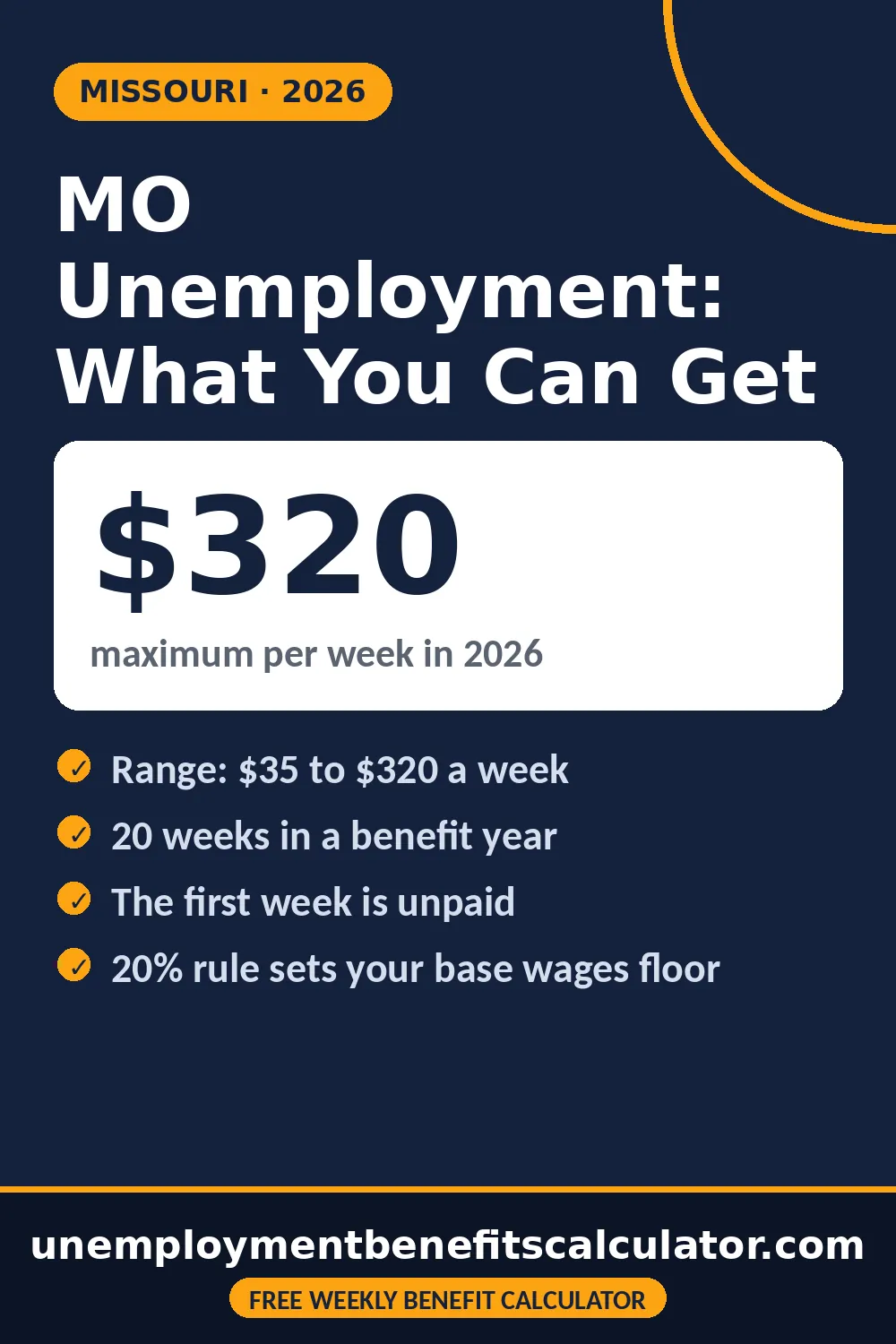
2026Maximum weekly benefit
Set by Missouri law for 2026
$320
Benefit formula
4% of the two highest quarters, averaged
4%
Claim length
Benefit year cap, minus 1 waiting week
20 wks
Last updated: October 10, 2026. Figures follow current MO Department of Labor rules - confirm details with the agency before you file.
Start here
Missouri Unemployment Calculator
Enter the gross weekly wage from your last job. The estimate runs the 2026 Missouri formula against the $35-$320 range so you know exactly what to plan around.
MO DES Benefit Estimator
Missouri Unemployment Calculator
Official method: Missouri pays 4 percent of the average of your two highest base-period quarters, between $35 and $320. This calculator runs the same math from your weekly wage, so the estimate lands in the same zone Missouri DES will. Missouri pays no dependents add-on.
No account needed
The estimate appears instantly and nothing is stored.
2026 DES numbers
Bounded by the $35 floor and $320 cap.
Planning aid only
DES issues the official amount after you file.
Know before you file
Missouri Unemployment Quick Facts
These are the numbers Missouri claimants ask about most. Every one comes from DES publications and state law, current for the 2026 benefit year.
$320 / wk
Maximum weekly benefit
Claims with the highest base-period wages land here.
$35 / wk
Minimum weekly benefit
The floor for anyone who monetarily qualifies in Missouri.
20 weeks
Benefit-year maximum
The most DES can pay in one benefit year — no 26-week standard here.
4%
The benefit formula
Taken from the average of your two highest quarters.
3 searches
Weekly work search
Required activities, reported with every weekly request.
30 days
Appeal window
From the date printed on your determination notice.
The 2026 picture
Missouri Unemployment at a Glance
One year of Missouri claims in four numbers. They explain why the average check looks the way it does, and why so many full-time workers land at exactly the same weekly amount.
$320
Weekly maximum
The ceiling since 2026 rules — most full-time claims reach it.
$35
Weekly minimum
Paid to qualified claimants with the lightest wage records.
20
Weeks per year
Benefit-year maximum, one week of it unpaid.
4%
Formula rate
Applied to the average of the two highest quarters.
Behind the number
How Missouri Figures Your Weekly Check
Missouri skips the wage tables most states publish. One formula, two quarters, and a clamp between $35 and $320 decide your entire check.
Find your two best quarters
DES looks inside your base period and picks the two calendar quarters with the highest wages.
Average them, take 4%
The two quarters are averaged, and 4 percent of that average becomes your weekly benefit amount.
Clamp between $35 and $320
Anything below the floor rises to $35. Anything above the cap falls to $320. That is your check.
The formula on paper
weekly benefit = 4% × ( two highest quarters ÷ 2 )
planning shortcut = weekly wage × 13 × 4% ≈ 52% of your wage
A full-time quarter holds about 13 weekly paychecks, so 4 percent of the two-quarter average lands near half your wage before the clamp.
On paper that reads generous. In practice the $320 cap intercepts most full-time paychecks, because Missouri has kept the ceiling flat while wages around the state kept climbing. A warehouse worker, a hospital tech, and a mid-level office manager in Kansas City all funnel into the same $320 top band.
The cap also makes Missouri’s replacement rate fall as income rises. At $400 a week the formula replaces about half your pay. At $900 it replaces barely a third. Higher earners should budget for the gap rather than expect the calculator’s percentage to hold.
Estimates by wage
Weekly Benefit Estimates for Missouri Wages
The table below runs the 2026 formula across common Missouri paychecks. The $20-week column shows the full benefit-year pot before the waiting week is carved out.
| Weekly wage | Estimated weekly benefit | 20-week total |
|---|---|---|
| $300 | $156 | $3,120 |
| $400 | $208 | $4,160 |
| $500 | $260 | $5,200 |
| $600 | $312 | $6,240 |
| $650 | $320at the cap | $6,400 |
| $800 | $320at the cap | $6,400 |
| $1,200 | $320at the cap | $6,400 |
Where the cap bites
The formula pays about 52 percent of your weekly wage before clamping. Paychecks above roughly $615 a week all produce the same $320 estimate. Below that line, every extra dollar of prior wages adds about 52 cents to the estimate until the cap closes.
Show me the math
Worked Example: Dana in Springfield
Dana earned $720 a week before her warehouse shift was cut. Here is her claim, worked exactly the way DES will work it.
Dana’s claim sheet
2026Her two strongest quarters hold about $9,360 each. Averaged, that is $9,360, and 4 percent of it is $374 — over the $320 line. The cap pulls her check down to $320.
Across the benefit year she collects $6,080 in payable checks, because the first week is the unpaid waiting week. Her coworker Ravi, who earned $520 a week, stays under the cap: his formula lands at $270.
The waiting week, counted
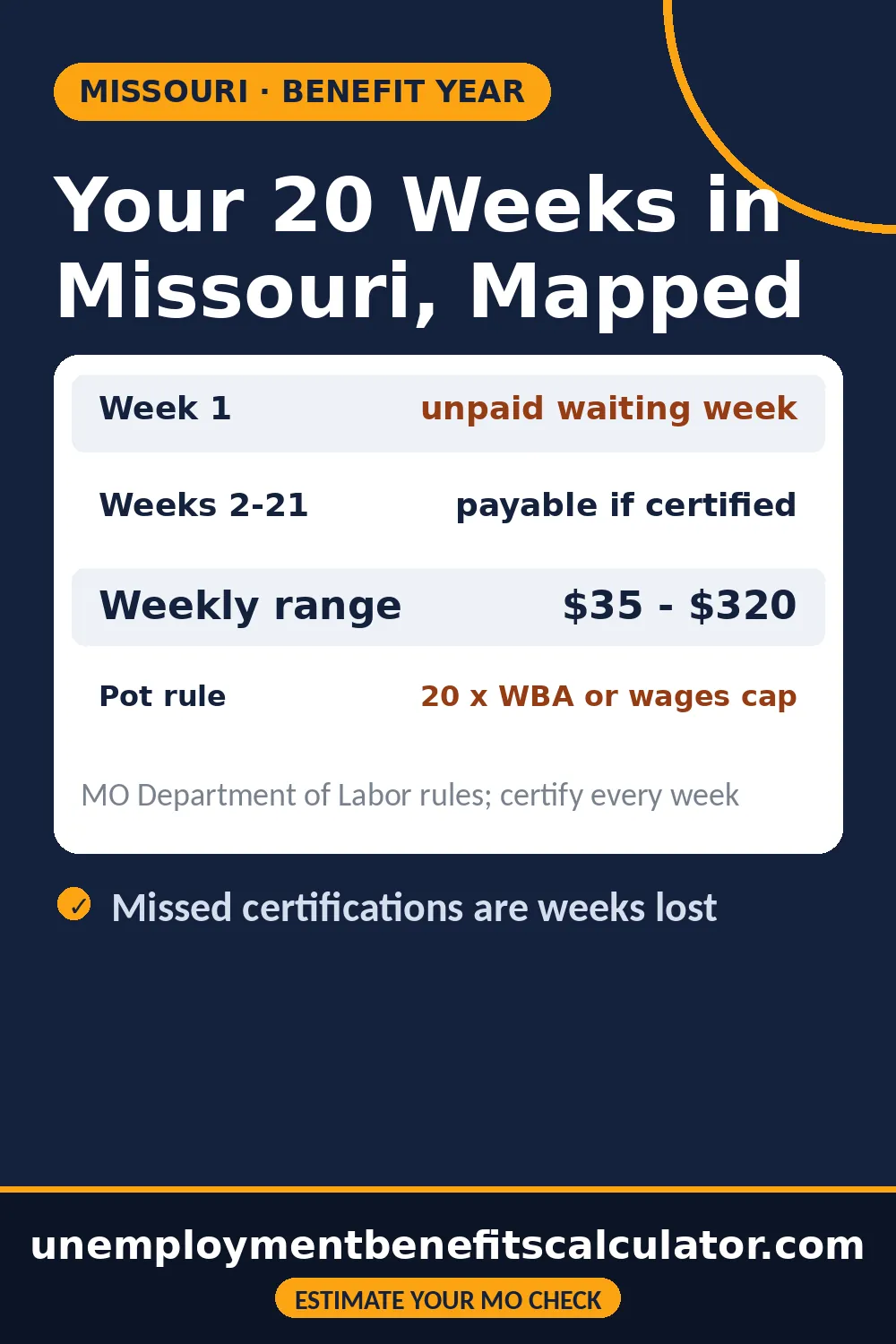
Missouri pays 20 weeks in a benefit year but the first one is unpaid. Certified correctly, it consumes no benefit balance. Skipped, it cannot serve as the waiting week and every payment shifts a week later.
Money gates
The Three Money Gates Missouri Checks First
Before DES asks why you left your job, its system runs three wage tests on your base period. Clear all three and your claim is monetarily valid.
$2,250
Total base-period wages
The minimum earned across all four base-period quarters, from any covered employer.
1.5×
Wage-spread rule
Total base wages must reach one and a half times your single highest quarter.
$19,500
Two-quarter alternative
Or clear the test outright with at least this much earned across two of the four quarters.
The 1.5-times rule exists to filter short work histories. One blockbuster quarter followed by three empty ones fails, because the rule demands wages spread across the base year. The $19,500 escape hatch catches the opposite case: steady six-figure earners whose pay is concentrated in two quarters clear automatically.
Wages from covered employment count — salaried work, hourly shifts, and reported tips all flow into the quarter totals. Cash jobs with no reported wages count for nothing here, which is why DES keeps telling workers to report all hours. What disqualifies a claim beyond the math is its own list, and money is only the first filter.
The window that matters
Your Base Period: The Five-Quarter Window
Missouri reads your wages from the first four of the last five completed calendar quarters. The most recent quarter is deliberately skipped, because employers have not reported it yet.
Q
oldest quarter
counted
Q+1
second quarter
counted
Q+2
third quarter
counted
Q+3
newest counted
counted
Q+4
latest quarter
skipped
File in a month that sits early in a new quarter and your window shifts, sometimes usefully. A strong quarter that just closed may still be too fresh to count, which surprises seasonal workers most. Construction crews, school-adjacent staff, and holiday retail all see claims swing on timing alone.
If your determination letter says the math came up short, read which quarter it flagged. A missing wage report from a former employer is common, and DES can correct the record when you send pay stubs or W-2s. How much unemployment you will get depends entirely on this window, so it pays to understand it before you file.
Start the claim
How to File Your Missouri Claim
Missouri files everything through UInteract, the DES online portal, which stays open around the clock. The whole first filing takes most people under an hour.
Create your UInteract account
Register with your Social Security number and work history at uinteract.labor.mo.gov. Choose a login you can reach, because every later notice lands inside this portal.
File the initial claim
Answer the wage and separation questions for your last 18 months of employers. File in the first week you are truly unemployed — claims never start before the date you submit.
Request payment each week
After every week ends, file a weekly request for payment. Miss a week and you must explain why before DES will pay it, so calendar a standing appointment.
Regional Claims Centers
Before you call
- UInteract answers most status questions faster than any phone line.
- Have your SSN and employer list in front of you either way.
- Monday wait times run longest; midweek afternoons clear quickest.
What happens next
After You File: Determinations and the Waiting Week
Filing starts a clock, and Missouri mails the milestones. Here is the first stretch of a typical claim, week by week.
Day 0 — claim filed
UInteract timestamps your claim and opens your benefit year, which stays active for 52 weeks no matter how early you exhaust it.
Week 1 — the waiting week
You file a weekly request for your first week as usual, but no check moves. The week is required, and certifying it on time is what makes it count.
Week 1 to 2 — determination arrives
DES mails a monetary determination showing your base-period wages and weekly amount, plus a separate notice if your separation needs review.
Week 2 to 3 — first payment
With the separation clear, approved weeks pay by direct deposit or debit card, usually two to three business days after your weekly request.
Read every letter
Determinations carry deadlines. Appeal windows, certification schedules, and overpayment notices all count from the mail date, and DES assumes delivery. Log into UInteract twice a week so nothing sits unseen past its window.
Every week you claim
The Weekly Rhythm: Certification and Work Search
Unemployment pays weekly, and each week asks the same small set of questions. Treat it like a part-time job with a one-hour schedule.
3
Work-search activities
Three every week — applications, interviews, or registered help at a Missouri Job Center count.
1
Weekly request
Filed after each week ends, answering the availability and wage questions honestly.
0
Excused gaps
Weeks skipped need a documented good cause before DES will release the money.
Keep a private log of every employer you contact, with dates and outcomes. DES audits work-search records long after the weeks pay, and claimants who cannot produce the list get assessed overpayments with interest. A notes app with one entry per application is enough.
The certification questions also cover availability: you must be able to work, available for full-time work, and actively seeking it. Answer carelessly and the system flags the week for review. Saying you were out of state, or only looking for remote work, does exactly that. How weekly certification works walks through each question, and work search rules in all states shows how Missouri’s three-contact rule compares.
Working reduced hours
Working Part-Time? The Partial-Benefit Math
Cut hours do not cancel the claim. Missouri pays a reduced check as long as your wages stay under the weekly line the law sets.
RSMo 288.060, in plain numbers
payment = weekly benefit − ( wages − greater of $20 or 20% of benefit )
The disregard is the state’s allowance for working. Everything you earn above it comes off the check dollar for dollar.
Example on a $320 check
Dana picks up $150 one week. The disregard is the greater of $20 or $64 — 20 percent of her benefit — so $64 of her wages are ignored. Her partial payment: $234.
When the week pays nothing
Wages that swallow the whole benefit stop the payment for that week, though the week may still count toward the claim. Report every dollar — DES matches employer wage reports quarterly, and unreported earnings become overpayment bills.
Partial weeks also stretch your money. A week you work still consumes little or none of your balance. Claimants who ease back into work through temp assignments often collect longer than the calendar suggests. How firings affect a claim matters at the start, but reduced hours shape the weeks after.
April follows January
Taxes on Missouri Unemployment Benefits
Every dollar Missouri pays is income in the eyes of two governments. Plan for it before the checks start, not after.
Federal taxes apply
Unemployment benefits count fully as federal taxable income. Nothing is withheld automatically unless you ask.
Missouri taxes them too
The state taxes benefits as ordinary income on your Missouri return, alongside your other wages.
The 1099-G arrives in January
DES reports your total benefits for the year on Form 1099-G, and UInteract posts it electronically.
You can withhold 10%
Elect federal withholding through UInteract and 10 percent of each check goes to the IRS before it reaches you.
On a full $320-week, 20-week claim, that is $6,400 of income landing in one tax year. The 10 percent election covers the federal bill for many claimants, though higher earners may still owe more in April. There is no Missouri withholding election for benefits, so set aside a share of each check for the state return.
If the answer is no
Denied? Your 30-Day Appeal Path
A denial letter is a deadline, not a verdict. Missouri gives you 30 days from the determination date to start the appeal, and most early losses come from missed windows rather than weak cases.
Step 1 — Appeals Tribunal
File within 30 days online through UInteract or in writing. A referee holds a hearing where you present witnesses and documents, then mails a written decision.
Step 2 — the Commission
Disagree with the referee? Appeal in writing within 30 days to the Labor and Industrial Relations Commission, which reviews the hearing record rather than holding a new one.
Step 3 — the courts
A further challenge goes to the Missouri Court of Appeals. Representation is common here, and the record from step 1 is what the court reviews.
Keep claiming while you wait
File your weekly requests during the appeal. If you win, DES pays the weeks on record. If you stop certifying and win later, those skipped weeks usually cannot be paid retroactively.
Free help exists
Missouri Job Centers and legal aid clinics review denial letters at no cost. Bring the determination and your separation paperwork, and get the 30-day clock respected first.
Expensive habits
Seven Mistakes That Stall Missouri Claims
Most Missouri delays are self-inflicted and avoidable. Each of these shows up in DES overpayment notices and stalled claims every month.
Skipping the waiting-week certification
The unpaid first week still must be certified. Miss it and your whole schedule slides a week later.
Logging fewer than three searches
Two applications and a plan to look tomorrow does not satisfy the weekly work-search rule.
Hiding part-time wages
DES receives employer wage reports every quarter and matches them. Unreported earnings become overpayment debts.
Ignoring UInteract messages
Questionnaires and determination notices sit in the portal. Unanswered separation questions freeze payments.
Missing the 30-day appeal window
Late appeals are dismissed without a hearing on the merits, however strong the case was.
Answering availability questions loosely
Being out of state, or unable to accept full-time work, makes the week unpayable when the answers say so.
Filing weekly requests late
Certification weeks left open past the window need good-cause review before any money moves.
Who runs the program
Missouri Department of Labor Contact
Unemployment in Missouri is administered by the Division of Employment Security inside the Department of Labor and Industrial Relations. Start with UInteract — the phone lines exist for what the portal cannot do.
Official channels
Online portaluinteract.labor.mo.gov
Main sitelabor.mo.gov
Claimant questions800-320-2519
Benefit formula FAQHow benefits are figured
When to call instead
- Your identity verification failed in UInteract and the portal locked.
- A determination is missing after two weeks of silence.
- You need a language interpreter for a Tribunal hearing.
Common questions
Missouri Unemployment FAQ
Ten questions Missouri claimants ask most, answered with the 2026 rules. Every answer reflects the DES publications listed in the sources section below.
How much unemployment will I get in Missouri?
Your weekly check comes from your past wages, not your bills. Missouri pays 4 percent of the average of your two highest base-period quarters. The result is bounded by the $35 floor and the $320 cap. The calculator at the top of this page turns that formula into a fast estimate from your weekly wage alone.
How does Missouri calculate my weekly benefit amount?
Missouri DES finds the two calendar quarters in your base period with the highest wages, averages them, and takes 4 percent of the average. A full-time quarter is about 13 weeks of pay. So the formula works out to roughly half your weekly wage before the state clamps it between $35 and $320.
How long do Missouri unemployment benefits last?
Twenty weeks of benefits is the maximum allowed during your 52-week benefit year — shorter than the 26-week standard most states run. Your maximum benefit amount is the lesser of 20 weekly checks or one-third of your base-period wages, whichever is smaller. A 2026 bill to extend Missouri to 26 weeks (HB 2494) did not advance.
Why do most full-time workers land at the $320 maximum?
The formula pays about 52 percent of your weekly wage before the cap. Wages of roughly $615 or more per week hit the $320 ceiling. Missouri has kept its benefit range flat while average wages climbed, and only a handful of states now pay a lower top weekly amount. Plan around the cap rather than your full salary.
What are the money rules to qualify in Missouri?
Three gates. You need at least $2,250 in total base-period wages, plus base wages reaching 1.5 times your highest quarter. Alternatively, qualify outright with at least $19,500 earned across two of the four base-period quarters. Fall short on all three and the claim fails on money alone.
What is the Missouri waiting week?
The first week of your benefit year is an unpaid waiting week. You still file a weekly request for it, and it counts toward your claim. Skip that certification and the week cannot serve as your waiting week, which pushes every later payment back.
Can I work part-time and still get Missouri unemployment?
Often yes. Missouri ignores the greater of $20 or 20 percent of your weekly benefit when it counts part-time wages, then subtracts the rest from your check. A $320 benefit with $150 in weekly wages still pays about $234. Once your wages eat the whole benefit, the week pays nothing.
How many work searches do I need each week in Missouri?
Missouri requires three work-search activities every week you claim benefits, reported with each weekly request for payment. Keep your own list of employers contacted, dates, and results. DES can audit your log months later and order refunds on weeks you cannot document.
How do I appeal a denied Missouri claim?
File within 30 days of the determination date, online through UInteract or in writing to the Appeals Tribunal. A referee holds the hearing and mails a new decision. Lose there and you have 30 more days to appeal in writing to the Labor and Industrial Relations Commission, and then to the courts.
Are Missouri unemployment benefits taxed?
Yes, twice. Federal law counts unemployment benefits as taxable income, and Missouri taxes them as ordinary income on the state return too. DES issues a 1099-G form every January. You can also ask for 10 percent federal withholding through UInteract instead of facing a surprise bill in April.
Verified against the record
Sources and Verification
Every number on this page was checked in September 2026 against the Missouri Division of Employment Security publications, state statute, and federal references listed here.
- Missouri DOL — How are my benefits figured?
The 4% two-quarter formula and the $320 weekly maximum, stated by the agency that applies them.
- Missouri DOL — How is eligibility determined?
The $2,250 minimum, the 1.5-times wage-spread rule, and the $19,500 two-quarter alternative.
- Revised Statutes of Missouri — RSMo 288.060
The partial-benefit disregard: the greater of $20 or 20 percent of the weekly benefit amount.
- Missouri DOL — How to file an appeal
The 30-day Tribunal window and the Commission review that follows it.
- U.S. Department of Labor — Unemployment Insurance
Federal program rules, taxable treatment, and the state-federal framework behind every claim.
- CBPP — How many weeks of unemployment compensation are available?
May 2026 table listing Missouri among the states that provide up to 20 weeks of UI.
Accuracy commitment
Benefit ranges and agency rules change with legislation. If Missouri updates its figures and this page trails behind, send us a correction — pages on this site are reviewed and updated against primary sources on a rolling basis.
Compare the borders
Unemployment Calculators for States Near Missouri
Missouri sits at the low end of its neighborhood — Illinois, Iowa, and Nebraska all pay more per week. Compare before you relocate for work.
Run Your Numbers Before You File
The estimate takes ten seconds, and every section above tells you what happens after. Know your weekly range, then file with confidence.
Back to the Calculator