Kansas Unemployment Benefits Calculator
Kansas keeps one number on the ledger for every claim: 4.25 percent of your best quarter.
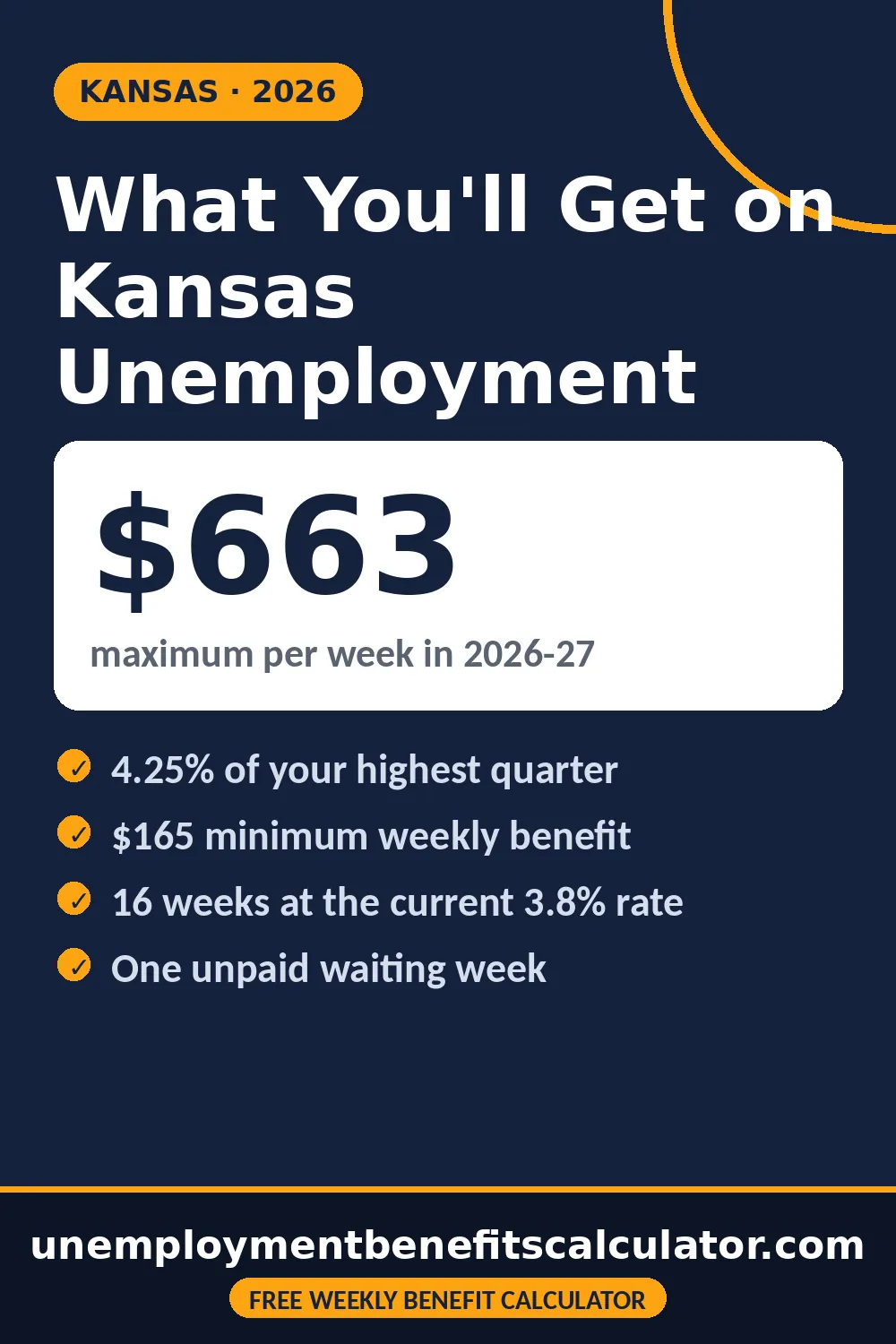
The 2026–27 book pays $165 to $663 weekly. Sixteen weeks follow one unpaid week. This Kansas calculator runs the whole row.
Updated October 2026 — every figure re-checked against dol.ks.gov and K.S.A. 44-704 on October 8, 2026.
Kansas unemployment calculator (2026)
The direct answer: Kansas pays 4.25% of your highest quarter in unemployment wages, floored at $165 and capped at $663 a week. That single multiplication is the whole formula — there is no dependent add-on and no per-week deduction.
Enter your best quarter, the year’s total, and any part-time wages. The ledger prices the week, account, and waiting week together.
Estimates mirror KDOL’s published method. The wage determination KDOL mails after you file is the binding row.
One percentage, written once, applied twice
Every Kansas claim starts the same way. KDOL takes your highest base-period quarter and multiplies it by 4.25 percent.
A $9,000 quarter lands near $382 a week. A $6,500 quarter lands near $276, and the arithmetic never changes mid-year.
Kansas attaches no dependent add-on to that figure. Households of six and single claimants carrying the same quarter draw the same check.
Weekly amount = highest quarter × 4.25%, floored at $165, capped at $663.
Source: K.S.A. 44-704(b), re-verified October 8, 2026; Kansas Legislative Research Department trust-fund report, August 25, 2026.
Two clamps guard the line. The $165 floor catches tiny quarters — anything under $3,882.35 pays the minimum — and the $663 cap catches the top of the market.
So if you are asking “how much would I get in unemployment?” in Kansas, the answer is always three lines long: find your highest quarter, multiply by 4.25 percent, then let the clamps do what they do. The wage ladder in Entry Nº 4 prices every rung of that spread.
How much unemployment will I get if I make $1,000 a week?
A steady $1,000 weekly salary writes a $13,000 quarter — thirteen weeks of pay per calendar quarter. Run that through the Kansas ledger: $13,000 × 4.25% = $552.50 a week.
No clamp touches that number. It sits well above the $165 floor and well under the $663 cap, so $552.50 is the check — before taxes and before any part-time wages you report.
Two checks must pass. Wages must appear in at least two base-period quarters — a steady salary clears that easily — and total base wages must reach 30 times the weekly amount, $16,575 for a $552.50 reading. A year at $1,000 a week books about $52,000, so the 30× test only bites on scattered or part-year work.
Sixteen certified weeks at $552.50 book $8,840 — but the waiting week takes the first one. Fifteen payable checks put $8,287.5 in the plan.
If your $1,000 weeks were not steady, work from the quarter, not the wage. A stretch of overtime that pushed the best quarter past $15,600 runs into the $663 cap — and every dollar above that quarter adds nothing to the check.
Kansas unemployment quick facts
The 2026–27 benefit year opened July 1, 2026. These are the rows that matter before you file.
Weekly benefit amounts by wage
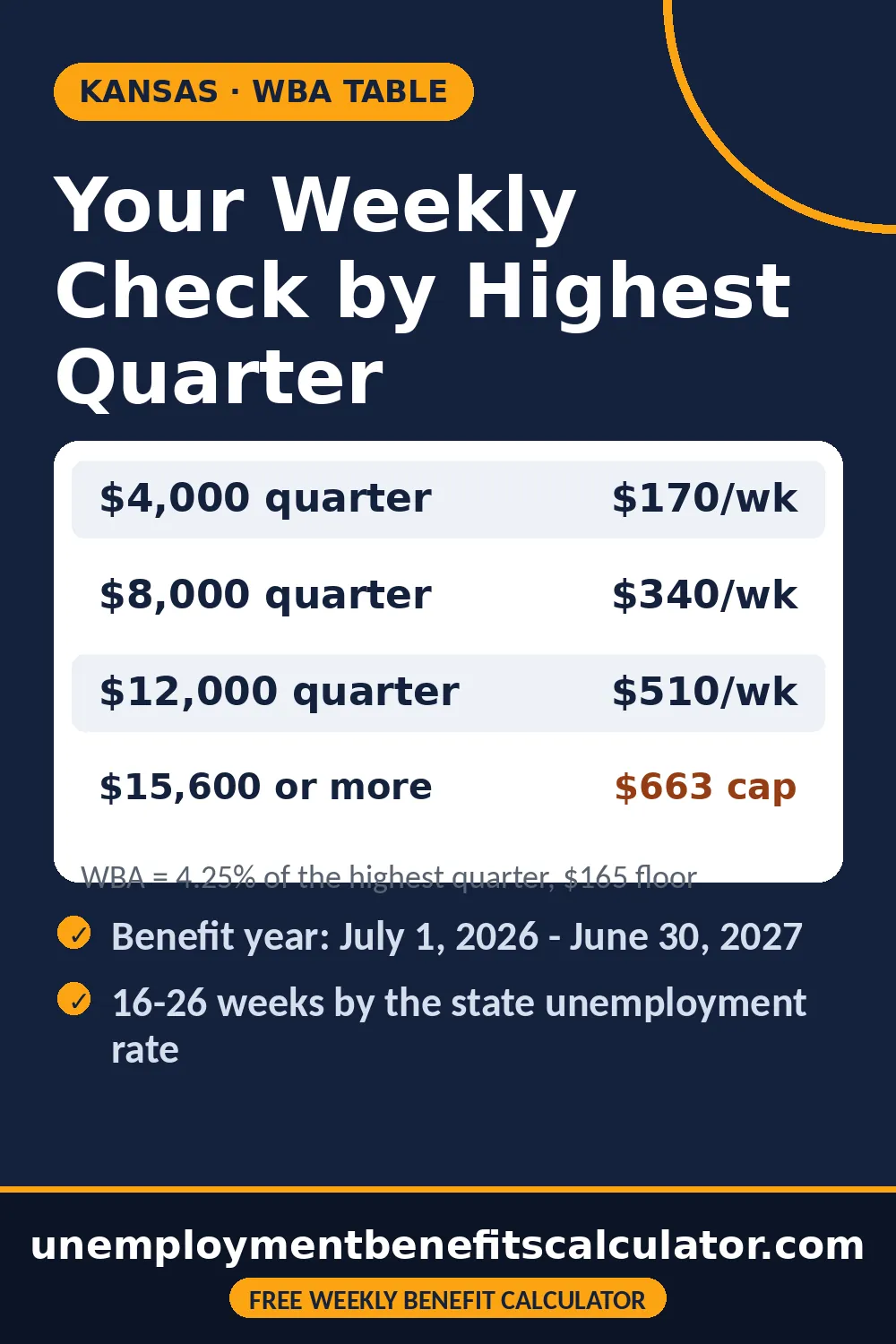
Read your highest quarter off KDOL’s wage determination, then find its row. The table carries the full 2026–27 spread.
| Highest quarter | 4.25% raw | Weekly check | What bites |
|---|---|---|---|
| $3,500 | $148.75 | $165.00 | $165 floor lifts it |
| $4,000 | $170.00 | $170.00 | raw rate stands |
| $6,000 | $255.00 | $255.00 | raw rate stands |
| $8,000 | $340.00 | $340.00 | raw rate stands |
| $10,000 | $425.00 | $425.00 | raw rate stands |
| $12,000 | $510.00 | $510.00 | raw rate stands |
| $13,000 | $552.50 | $552.50 | a $1,000-a-week salary lands here |
| $14,000 | $595.00 | $595.00 | raw rate stands |
| $15,600 | $663.00 | $663.00 | cap threshold, exactly |
| $19,400 | $824.50 | $663.00 | $663 cap trims $161.50 |
The cap threshold matters more than the cap itself. Any quarter above $15,600 adds a dollar of rate for nothing. Below the ladder’s first rung, quarters under $3,882.35 all pay the same $165 minimum.
Your base period: four quarters, five counted back
Kansas reads the first four of the last five completed calendar quarters. The quarter you are living in never counts.
File in October 2026 and the window runs July 2025 through June 2026. Last year’s holiday quarter may carry the whole claim.
New hires hit this trap every year. Six strong months can sit inside the excluded quarter, leaving the ledger thin.
Two monetary rows must hold. Wages must appear in at least two of the four counted quarters — one blowout quarter alone cannot open a claim. And the total across the base period must reach 30 times the weekly amount your best quarter prices, which is how KDOL sizes the whole account.
Pull the quarterly statements before you file. Knowing the high quarter first turns the determination letter into a formality.
The duration ladder: 16, 20, or 26 weeks
Kansas ties benefit weeks to the statewide unemployment rate. State law, K.S.A. 44-704, fixes the three rungs, and KDOL’s FAQ names the trigger: the seasonally adjusted, three-month average unemployment rate in Kansas at the time your claim is effective.
The rate sat at 3.8 percent in July 2026, so new claims draw 16 weeks. The economy, not KDOL, picks the rung — and your rung locks in when the claim starts, not when you certify.
| Average Kansas rate | Weeks available | Status for new claims |
|---|---|---|
| Under 5.0% | 16 weeks | current rung — Kansas at 3.8% (July 2026) |
| 5.0% to 5.9% | 20 weeks | activates if the rate climbs a band |
| 6.0% or higher | 26 weeks | the recession-era ceiling under the same law |
Divide the maximum benefit amount by the weekly rate and you get the approximate weeks the claim carries — 16 at today’s rung.
Only a few states pay fewer weeks than 16. Arkansas pays 12, as do Florida and North Carolina.
The waiting week: your first certification pays nothing
Kansas still runs a waiting week. The first week you certify is usually an unpaid stub at the front of the claim.
You must still file that certification on time and stay otherwise eligible. Skip it and the clock, and the unpaid row, restart.
Budget like the first check arrives in week three. Week one waits, week two pays, and the bank cycle lags behind both — KDOL normally releases payment two to three business days after a clean certification.
Sixteen certified weeks mean fifteen paychecks. Price the mortgage against fifteen, not sixteen, before the month turns.
Worked example: Roy in Wichita
Roy ran CNC machines on a fuselage line until the aerospace cutback. His best quarter read $13,000 on the wage statement.
The ledger multiplies $13,000 by 4.25 percent and lands on $552.50. No clamp touches him, so that is the check.
The 30× test passes too — total base wages must reach $16,575, and Roy’s three working quarters cleared that. Sixteen weeks at $552.50 book $8,840, minus the waiting week: fifteen payable checks put $8,287.5 in the plan.
Roy picks up ten hangar hours for $180 a week. That is $41.87 over his $138.13 shield. Checks drop to $510.63.
Worked example: Celia in Dodge City
Celia led a packinghouse line until the season wound down. Her best quarter totaled $5,400 across four scattered employers.
Four and a quarter percent of $5,400 is $229.50. Wages appear in three quarters, so the two-quarter rule passes — and the 30× test needs $6,885 in total base wages, which her scattered year clears.
Her 25 percent shield is worth $57.38. A $120 weekend job eats $62.62 of it, leaving $166.88 for those weeks.
Report the wages every week she works. Unreported earnings surface in the cross-match and claw the money back with interest.
Worked example: Marta in Overland Park
Marta managed telecom rollouts until her division reorganized. Her best quarter hit $19,400, well past the cap threshold.
The raw math says $824.50, but $663 is the ceiling. The cap trims $161.50 a week that her record cannot recover.
Her account books at $10,608 across sixteen weeks. Even a quarter of $25,000 would not move the number a dollar.
High earners should plan around $663, not around the percentage. The 55 percent cap law, not the wage record, draws the line — each July 1 KDOL recomputes it from statewide average weekly wages.
Why Kansas claims get approved or denied
KDOL weighs three questions on every new claim, and the wage ledger is only the first.
Denials usually trace to the third row. Missed certifications and thin work-search logs sink claims that the wages already passed.
How to apply for unemployment in Kansas (GetKansasBenefits)
Every Kansas claim opens on KDOL’s unemployment portal — GetKansasBenefits, online at KansasUI.gov — any hour, any day. File the day the job ends: the claim’s start date is the Sunday of the week you file, and every later start burns real weeks.
Misfiled wages skew the rate, and corrections take weeks. Fix errors in the first call, not the fourth appeal.
After you file: determinations and the weekly rhythm
The unemployment week runs Sunday through Saturday. Certify each week starting with the first Sunday after you file — and you can file any day of the week after that, though earlier filings move the money sooner.
Answer every question truthfully, including any work and any money earned that week. The earnings question carries the partial shield with it, and vacation, holiday, bonus, pension, or separation pay can reduce or delay a week too — report those when you file and each time they land.
Fourteen calendar days without a certification or other claim activity deactivates everything. Reactivating takes a fresh round of paperwork.
Payments land by direct deposit or the U.S. Bank ReliaCard, normally two to three business days after a clean certification. Holidays move the money, never the deadline.
Work search and My Reemployment Plan
Kansas registers every claimant on KANSASWORKS, the state job board, and expects documented search activity each claimed week.
Log the week as you live it, not on Sunday night. KDOL audits logs after payments, and reconstructions rarely match memory.
Some claimants also receive My Reemployment Plan notices. The assigned tasks — a résumé, assessments, coaching — carry a 14-day clock.
KANSASWORKS reports the 14-day result straight to KDOL, which must then deny benefits. Treat the MRP letter as a court date.
The portal’s activity log is the official ledger. Keep private notes too, but the KANSASWORKS entries are the ones KDOL reads.
Part-time work and the 25 percent disregard
Kansas lets you earn a quarter of your weekly rate before the check feels it. That slice is the disregard.
Earnings inside the shield change nothing. Earnings above it come off dollar for dollar. Wages over the full rate zero the week.
| Weekly wages | Against $400 rate | Check that week |
|---|---|---|
| $80 | inside the $100 shield | $400.00 |
| $150 | $50 over the shield | $350.00 |
| $395 | $295 over the shield | $105.00 |
| $401 | over the full rate | $0.00 |
A zeroed week still counts against the sixteen. Wage it only when the shift outpays the rate.
Taxes: the 1099-G and the 5.58 percent question
Unemployment checks are taxable income. The IRS takes its share, and Kansas taxes benefits under its own brackets.
Kansas withholding is optional. Many claimants skip it, then meet the full bracket in April, so decide during the first certification instead.
KDOL mails the 1099-G every January and posts it in the portal. It prints what you were paid, not what you kept.
Received a 1099-G for benefits you never filed? Report the fraud to KDOL immediately and dispute the form in writing.
Fired or quit: misconduct and good cause
K.S.A. 44-706 draws Kansas’s separation lines. A discharge for misconduct, or gross misconduct, disqualifies the claim.
Gross misconduct covers theft, fraud, and intentional damage to property. Ordinary misconduct includes repeated rule violations after warnings.
Quits need good cause attributable to the work. A hostile workplace or a documented health conflict can qualify; a better commute cannot.
The employer carries the first burden of proof. Your written record — warnings, emails, schedules — decides how the referee hears it later.
Overpayments: the $67.4 million letter wave
An overpayment is money KDOL paid that the ledger later disallows. The bill follows the claimant, not the employer.
In April 2026 KDOL mailed notices chasing $67.4 million in overpayments. Nearly half the balances exceeded $5,000, with liens and garnishment threatened.
Fraud changes everything. KDOL may apply 100 percent of future benefits to a fraud debt and pursue collection through state set-off programs.
Answer the first letter, and answer it in writing. Waivers exist for no-fault debts where recovery defeats equity and welfare.
Denied? The 16-day appeal window
A determination is not a verdict. Kansas gives you 16 calendar days from the mail date to appeal to an Appeals Referee.
File through the portal or email KDOL.Appeals@ks.gov. State the determination number, the decision, and why you dispute it.
Hearings run mostly by telephone. The referee swears in witnesses, weighs documents, and writes the decision that becomes the record. The ladder climbs from there: a further appeal goes to the Employment Security Board of Review within another 16 days of the referee’s mailing, and district court sits above that.
Keep certifying while the appeal runs. A win pays the held weeks; a silent ledger pays nothing back for the silence.
Seven mistakes that stall Kansas claims
Most stalled claims fail on paperwork, not eligibility. Seven rows catch nearly all of them.
For employers: the $15,100 wage base and Shared Work
Kansas raised the taxable wage base to $15,100 for 2026, up from $14,000, and the base now indexes toward statewide wages.
Experienced rates run as high as 6.95 percent for 2026, with new employers paying a 1.75 percent entry rate until a record builds — 5.55 percent in new construction.
Firms expanding into Kansas may request an alternate rate based on out-of-state history. Ask before the first rate notice arrives.
The Shared Work program offers a softer lever than layoffs. Employees keep partial hours, partial benefits, and their jobs.
Charges tied to each claim feed the experience record. Contest weak claims inside the window, or the rates absorb them silently.
Kansas Department of Labor contact
The Contact Center answers weekdays — Monday through Wednesday 8 a.m. to 4 p.m., Thursday 8 a.m. to 3:15 p.m., Friday 8 a.m. to 4 p.m. Central — with no in-person service. Online always moves faster than the phone lane.
| Channel | Details |
|---|---|
| Toll-free claims line | 1-800-292-6333 |
| Topeka local line | 785-575-1460 |
| Kansas City line | 913-596-3500 |
| Wichita line | 316-383-9947 |
| Hours | Mon–Wed 8 a.m.–4 p.m., Thu 8 a.m.–3:15 p.m., Fri 8 a.m.–4 p.m. Central |
| Online portal | GetKansasBenefits at kansasui.gov, with the Amelia virtual assistant |
| Agency site | dol.ks.gov, the page for forms and FAQs |
| Appeals email | KDOL.Appeals@ks.gov, with the determination number |
Keep every determination letter and every reference number. Screenshots of portal pages settle most arguments later.
Four checks before the first certification
Kansas unemployment FAQ
How much is unemployment in Kansas right now?+
Claims filed July 1, 2026 through June 30, 2027 pay $165 to $663 a week. The 4.25 percent formula sets your spot: KDOL multiplies your highest base-period quarter by 4.25 percent and applies the floor and cap.
How is the weekly amount figured?+
Kansas law (K.S.A. 44-704) sets the weekly benefit at 4.25 percent of the wages in your highest base-period quarter. A $10,000 quarter reads $425 a week. The $165 floor lifts small quarters and the $663 cap trims anything above a $15,600 quarter.
Do dependents raise my Kansas benefit?+
No. Kansas skips the dependent add-on entirely, so your wage record alone decides the weekly number. Households of six and single claimants carrying the same quarter draw the same check.
How long does unemployment last in Kansas?+
Sixteen weeks while the state’s three-month average unemployment rate stays under 5 percent. The ladder stretches to 20 weeks at 5.0 to 5.9 percent and 26 weeks at 6 percent or higher. Kansas sat at 3.8 percent in July 2026, so new claims draw 16 weeks.
Is there a waiting week in Kansas?+
Yes. Your first certified week is an unpaid waiting week, so the first check covers week two. You must still file that certification on time for it to count as the waiting week.
Can I work part-time and still get paid?+
Yes. You can earn up to 25 percent of your weekly amount without affecting the check. Earnings above that come off dollar for dollar, and wages over the full weekly rate zero the week.
What wages do I need to qualify?+
You need wages from insured work in at least two quarters of the base period, with total base wages of at least 30 times your weekly benefit amount. That total-wages test is how KDOL sizes the maximum benefit account.
What do I have to do each week?+
File a weekly certification for every week you claim — the week runs Sunday through Saturday, and you can file any day of the week, starting with the first Sunday after you apply. Log your KANSASWORKS work-search activity as you go. Fourteen calendar days without certification or other claim activity deactivates the claim.
What is My Reemployment Plan?+
Selected claimants get MRP tasks — a résumé and assessments — due 14 days after notice, or benefits stop. KANSASWORKS reports the result to KDOL directly, so treat the letter as a deadline, not a suggestion.
What if KDOL denies my claim?+
Appeal within 16 calendar days of the mail date, through the portal or to KDOL.Appeals@ks.gov with the determination number. Keep certifying while the appeal runs — a reversal pays the held weeks, and only weeks you claimed can ever be paid.
Does Kansas tax unemployment benefits?+
Yes. The IRS taxes benefits, and Kansas taxes them too, with a top bracket of 5.58 percent. Expect the 1099-G each January, also posted in the portal.
Where do I file the claim?+
Online on KDOL’s GetKansasBenefits portal at KansasUI.gov, any hour of any day. The Contact Center takes claims at 1-800-292-6333 on weekdays, though hold times run long on Mondays.
The ledger’s trail · Sources
Sources & verification
Every figure on this page was re-checked against primary sources on October 8, 2026 — the KDOL pages and statute below were fetched live that day. Agency pages and statutes outrank summaries here.
- 1KDOL Unemployment Insurance Division — the $663 cap and $165 floor for the 2026–27 benefit year; certification and Contact Center hours
- 2KDOL Unemployment FAQs — the $165 to $663 range, the 30× total-wages rule, ReliaCard and direct deposit, payment timing, and the 14-day rule
- 3KDOL Eligibility — the three criteria, the two-quarter rule, the 25% partial disregard, and the waiting week
- 4KDOL Apply for Benefits — the filing entry point behind the GetKansasBenefits portal
- 5KDOL Appeals — the 16-calendar-day window, the Board of Review, and district court
- 6Kansas Legislative Research Department trust-fund report, Aug 25, 2026 — the 4.25% formula and duration bands
- 7K.S.A. 44-704 — the 4.25% formula, the 16/20/26-week ladder, and the 55% cap law
- 8K.S.A. 44-706 — misconduct, gross misconduct, and the good-cause standard for quits
- 9KDOL Employer Services — the $15,100 wage base, the 6.95% rate ceiling, and the 1.75% new-employer rate
- 10KDOL Overpayments — the fraud repayment rule and the state set-off process
- 11KDOL 1099-G page — the January mailing and the portal copy
- 12KDOL Contact Center — phone numbers and weekday service hours
- 13Kansas Labor Information Center — the 3.8% statewide rate for July 2026 (carried from the September 2026 verification)
- 14CBPP — how many weeks of unemployment compensation the states offer
- 15Kansas Reflector — the April 2026 report on $67.4 million in overpayment notices
- 16IRS Topic 418 — unemployment compensation taxed at the federal level
Editorial note: this page is an independent calculator guide, unaffiliated with any government agency. Verification trail: dol.ks.gov and ksrevisor.org captures dated October 8, 2026.
Keep reading while the claim runs
Unemployment calculators for states near Kansas
Kansas shares lines with four states, and Kansas City straddles the Missouri line. Combined-wage claims can pull those quarters back home.
| State | Max weekly | Duration | Method |
|---|---|---|---|
| Missouri | $320 | up to 20 | 4% of your two best quarters, averaged |
| Nebraska | $582 | up to 26 | half your high-quarter weekly wage |
| Oklahoma | $649 | up to 16 | 1/23 of base wages plus dependent add-ons |
| Colorado | $884 | up to 26 | half the average weekly wage, formulas clash |