Last updated: October 10, 2026. Misconduct standards are state law and vary widely - confirm how your state classifies your situation with your unemployment agency before you file.
Losing your job is stressful enough without having to wonder whether you will be able to pay rent next month. If you were fired, you probably have two questions running through your mind right now: can I get unemployment, and will my former employer try to block my claim? The short answer is that being fired does not automatically disqualify you from receiving unemployment benefits. In fact, most terminated workers qualify for benefits because the vast majority of firings are not for the type of serious misconduct that triggers a denial. The key distinction that determines your eligibility is whether the unemployment agency classifies your termination as a no-fault separation or as a discharge for misconduct, and understanding this difference before you file can save you weeks of uncertainty and frustration. The basic eligibility requirements for unemployment apply to all claimants, but the specific question of whether being fired disqualifies you depends entirely on the circumstances of your termination and how well you can present your side of the story.
Fired vs. Laid Off: What Is the Real Difference?
The unemployment system draws a sharp line between employees who lose their jobs through no fault of their own and those who are terminated because of something they did wrong. When you are laid off, the reason is economic — the company lost a contract, downsized, eliminated your position, or shut down entirely. Nobody is blaming you, and your eligibility for unemployment is essentially guaranteed as long as you meet the monetary requirements. When you are fired, the situation is more complicated because the employer is attributing the separation to your behavior or performance rather than business conditions. However, this attribution is not always accurate or fair, and the unemployment agency does not simply take the employer's word for it. The agency conducts its own investigation, contacts both parties, and makes an independent determination based on the evidence.
Many workers are surprised to learn that poor performance is generally not considered misconduct under unemployment law. If you were fired because you could not meet sales targets, made too many errors, lacked the skills the employer expected, or simply were not a good fit for the role, you will almost always qualify for benefits. Misconduct requires something more deliberate — a willful disregard of the employer's interests, a knowing violation of company policy, or a conscious decision to neglect your duties. An honest mistake, a genuine inability to perform, or a reasonable difference in judgment does not rise to the level of misconduct. This is a critical distinction that works in your favor, and it is one of the most misunderstood aspects of how the unemployment benefits system works for terminated employees.
What Counts as Misconduct After Being Fired
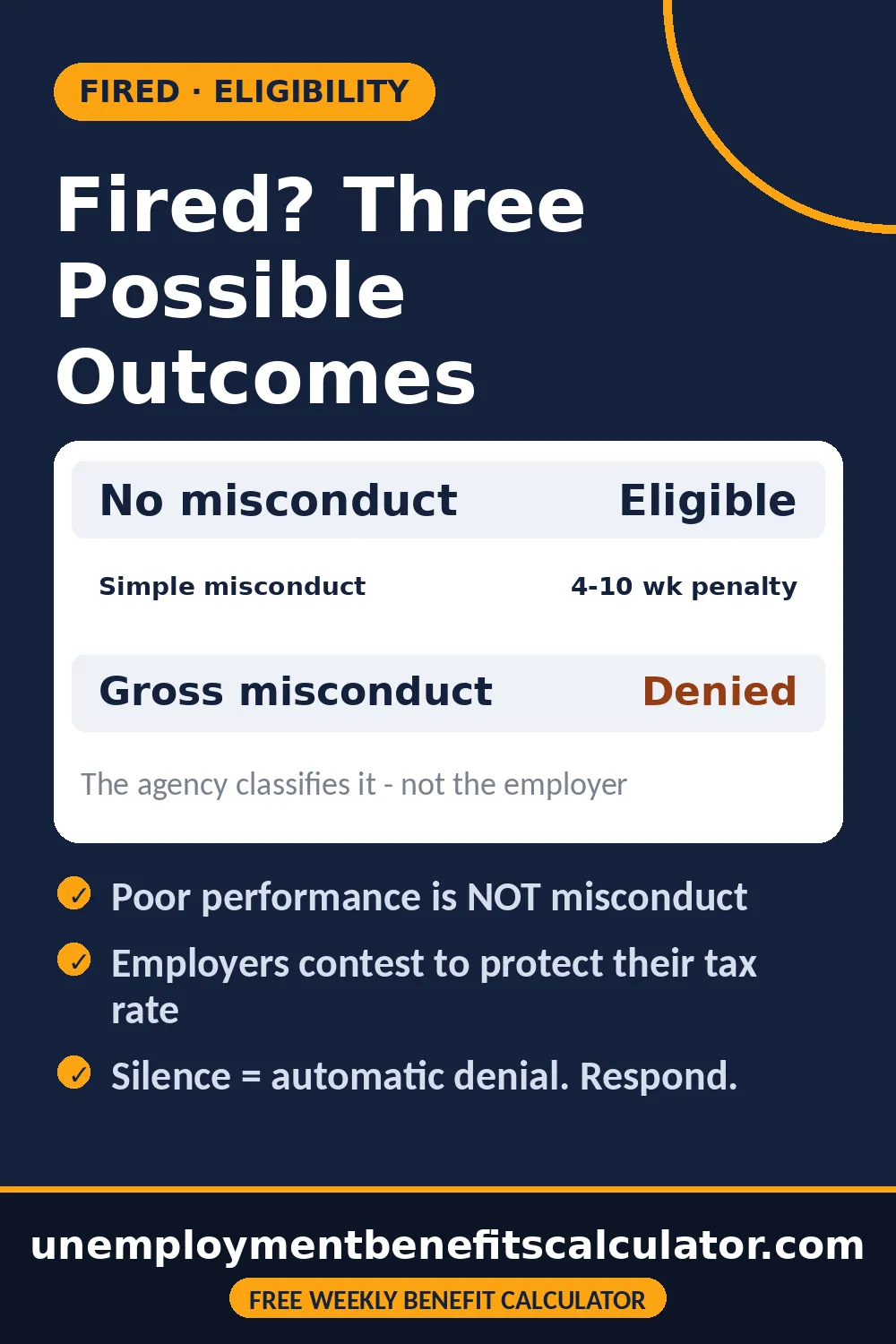
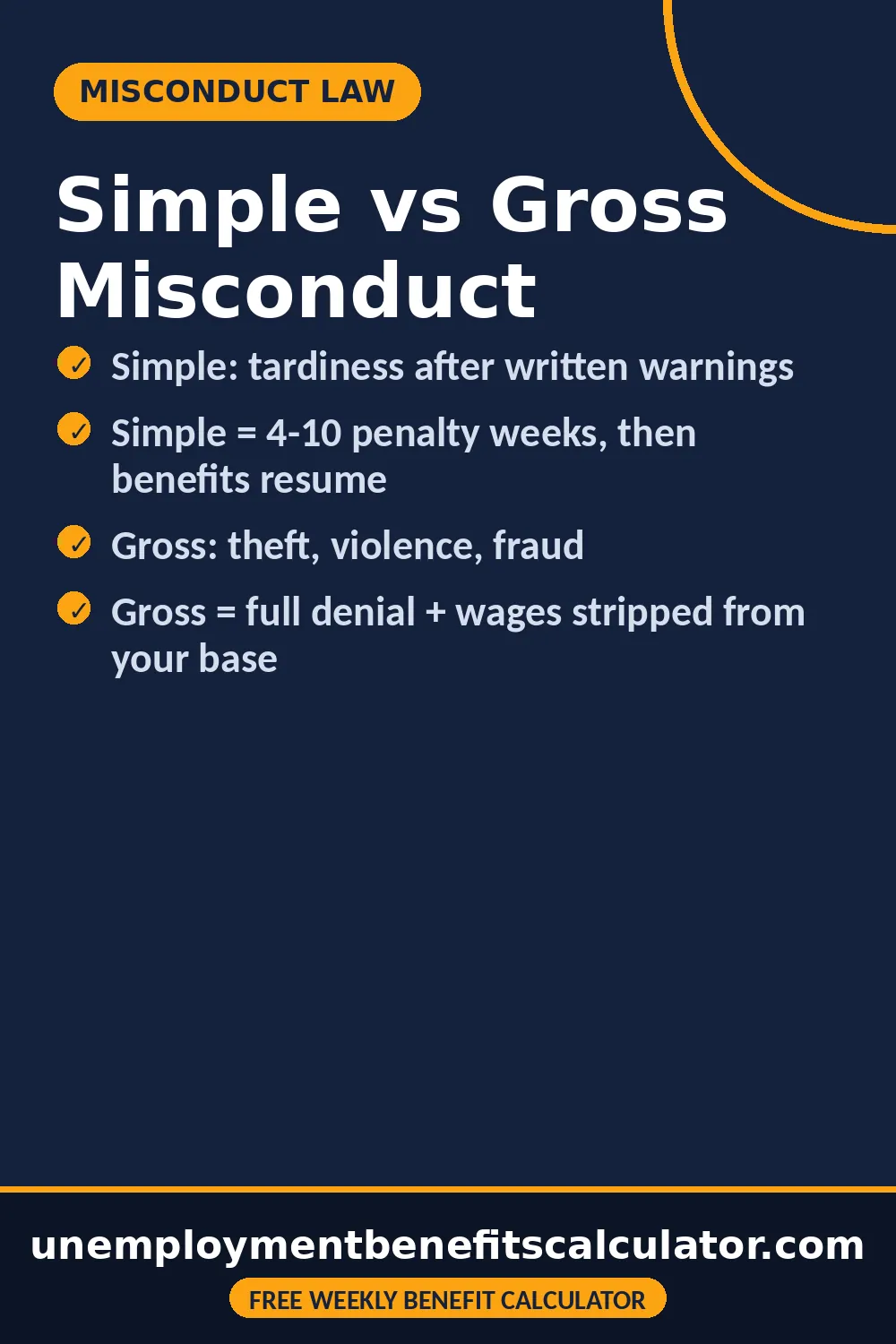
Each state has its own legal definition of misconduct, but most follow a framework established by case law that distinguishes between three categories: simple misconduct, gross misconduct, and no misconduct at all. Simple misconduct involves behavior that shows a disregard for the employer's standards but is not so severe as to demonstrate outright hostility or intentional harm. Examples include arriving late repeatedly after receiving a warning, violating a minor company policy that you knew about, failing to follow a direct instruction on a single occasion, or having an unexcused absence that was not related to a protected reason like illness or family emergency. In most states, a finding of simple misconduct does not permanently disqualify you from benefits — instead, it triggers a penalty period of four to ten weeks where you cannot receive payments, after which your benefits resume. This means even if the agency agrees with the employer that your behavior constituted simple misconduct, you will still collect most of your entitlement.
Gross misconduct is a different story entirely. This category covers the most serious workplace violations: theft or embezzlement of company property, physical violence or credible threats against coworkers or customers, willful destruction of company assets, reporting to work under the influence of drugs or alcohol after a prior warning, fraud or falsification of employment records, and disclosure of confidential trade secrets for personal gain. If the agency determines that you were fired for gross misconduct, your entire claim is denied, your base period wages from that employer are removed from your benefit calculation, and you may face additional penalties. Understanding what can disqualify you from unemployment benefits in detail helps you anticipate how the agency will categorize your termination and prepare your response accordingly.
| Classification | Typical examples | Effect on your claim |
|---|---|---|
| No misconduct | Poor performance, bad fit, personality conflict, single honest mistake, policy you were never told about | Eligible - benefits approved like any no-fault separation |
| Simple misconduct | Repeated tardiness after warnings, violating a minor known policy, one refusal of a direct instruction, unexcused absence | Penalty period of 4-10 weeks in most states, then your remaining benefits resume |
| Gross misconduct | Theft or embezzlement, violence or credible threats, fraud or falsified records, working under the influence after a warning | Claim denied and that employer's wages removed from your benefit calculation |
Framework summarized from state misconduct law as of October 10, 2026. Claimant-friendly states (CA, WA, OR, NY, IL) read these categories narrowly; FL, GA, TX, and the Carolinas read them broadly.
If the agency sides with the employer, the case is not over - our guide to appealing an unemployment denial walks through deadlines, evidence, and hearing strategy, and the weekly benefit formula shows what is financially at stake in the classification decision.
When Your Employer Contests Your Claim
Employers have a strong financial incentive to contest unemployment claims filed by fired workers, because their unemployment insurance tax rate increases when former employees collect benefits. This means that even when the employer knows the termination was not truly for misconduct, they may still dispute your claim to protect their tax rate. When an employer contests a claim, the unemployment agency sends you a notice and conducts a fact-finding interview, usually by phone, where both you and the employer present your versions of what happened. The adjudicator then makes a determination based on the testimony and any documentary evidence either side provides. It is important to understand that the employer does not get to decide whether you receive benefits — only the state agency has that authority, and the agency is required to evaluate the facts impartially.
If the employer contests your claim, the most important thing you can do is respond promptly and provide your side of the story in detail. Many claimants lose their cases not because the facts are against them but because they fail to respond to the agency's inquiry within the required timeframe, which results in an automatic denial based on the employer's uncontested version of events. When you respond, be specific about the circumstances of your termination. If the employer claimed you were fired for attendance but you have medical documentation showing your absences were excused, say so and provide the records. If the employer alleged insubordination but you were actually asking a clarifying question about an assignment, explain the context. The adjudicator is looking for evidence, not just assertions, and documentation always carries more weight than verbal claims from either side. If your initial claim is denied despite your response, you still have the right to appeal the unemployment denial through a formal hearing, where you can present witnesses and cross-examine your employer under oath.
Specific Termination Scenarios and Your Eligibility
The outcome of your unemployment claim depends heavily on the specific reason your employer gave for your termination, and some scenarios are far more favorable to you than others. If you were fired because of a personality conflict with your supervisor, you will almost certainly qualify for benefits because interpersonal disagreements do not constitute misconduct unless they escalate into insubordination or hostile behavior. If you were terminated during a probationary period for not meeting performance expectations, you are still eligible because failing to meet expectations is not the same as willful neglect of your duties. If you were let go because the employer discovered you lacked qualifications they originally believed you had, that is their hiring mistake, not your misconduct, and benefits should be approved.
More complicated scenarios include being fired for violating a company policy you were never told about, which most states treat as a no-fault termination because you cannot willfully violate a rule you did not know existed. Similarly, if you were terminated for a single mistake that did not cause significant harm — such as sending an email to the wrong recipient or entering incorrect data in a spreadsheet — this is almost always classified as an error rather than misconduct, and your claim should be approved. On the other hand, being fired after a progressive discipline process where you received multiple written warnings for the same issue is harder to defend, because the employer can show you were aware of the problem and chose to continue the behavior. If you quit before being fired, which some people do to avoid having a termination on their record, you should understand that voluntary quitting affects your unemployment eligibility differently and is often harder to justify than being fired for poor performance.
State-by-State Differences in Misconduct Standards
While the general framework for misconduct is similar across the country, individual states apply these standards with varying levels of strictness, and this can have a meaningful impact on whether your claim is approved after being fired. States that are considered claimant-friendly — including California, Washington, Oregon, New York, and Illinois — tend to define misconduct narrowly and give workers the benefit of the doubt in close cases. In these states, the employer must demonstrate that you engaged in deliberate or reckless behavior that violated a known policy, and isolated incidents of poor judgment are rarely sufficient to deny benefits. States with stricter standards — such as Florida, Georgia, Texas, and the Carolinas — tend to give more weight to the employer's version of events and may classify borderline behavior as misconduct more readily. If you are filing in a state with tougher standards, having solid documentation of your performance history and the circumstances of your termination becomes even more critical.
Some states also have unique rules that affect fired workers specifically. For example, a few states impose a disqualification period for any firing, regardless of the reason, which means you may have to wait several weeks before benefits begin even if your claim is approved. Other states distinguish between being fired from your most recent employer versus a previous employer, treating the former as more suspicious than the latter. Because these rules change and vary so significantly, checking the specific requirements for your state — whether you are applying for California unemployment benefits, Texas unemployment benefits, Florida unemployment benefits, or Oregon unemployment benefits — is always worthwhile before you file your claim.
How to File After Being Fired and What to Expect
The process for filing an unemployment claim after being fired is the same as filing after a layoff — you apply through your state's unemployment agency online, by phone, or in person, providing information about your employment history, earnings, and the reason for your separation. The critical difference is that when you indicate you were fired, the agency will flag your claim for a fact-finding review, which adds time to the processing period. During this review, the adjudicator will contact both you and your employer to get each side of the story, and they may request documentation such as your termination letter, performance reviews, written warnings, and any correspondence related to your firing. While this review is underway, your claim is held in a pending status, and you will not receive payments until the determination is made. If the determination is in your favor, you will receive back pay for all the weeks you were eligible during the review period.
While you wait for the determination, it is essential to continue meeting all ongoing certification requirements, which means you must file your weekly or biweekly claims, report any earnings you receive, and document your work search activities as required by your state. Failing to certify during the review period is one of the most common mistakes fired workers make, because they assume that since their claim is under review, there is no point in certifying. This is wrong — if your claim is eventually approved, you can only receive back pay for weeks where you properly certified. If you are unsure about the certification process, our guide on how to certify for unemployment benefits each week walks you through every step. You should also start looking for work immediately, because most states require you to be actively seeking employment from the week you file your claim, and you will need to provide a record of your job search activities when you certify.
Constructive Discharge: When Being Pushed Out Counts as Being Fired
Some employers who want to avoid the unemployment insurance consequences of firing a worker will instead make the workplace so intolerable that the employee feels forced to resign. This is called constructive discharge, and the law treats it as a termination rather than a voluntary quit because the employee did not truly have a free choice about leaving. If your employer drastically cut your hours, demoted you without cause, transferred you to an impossible commute, subjected you to harassment that they refused to address, or changed your job responsibilities in ways that made it unreasonable for you to continue working, you may have a constructive discharge claim. Proving constructive discharge is more challenging than proving a straightforward firing, because you need to show that a reasonable person in your position would have felt compelled to leave and that you attempted to resolve the situation before quitting.
If you believe you were constructively discharged, document everything before you leave and ideally while the situation is still happening. Keep copies of emails showing unreasonable demands, schedules showing impossible hours, complaints you filed with human resources and their responses, and any medical documentation showing the toll the situation was taking on your health. When you file your unemployment claim, explain that you did not voluntarily quit but were forced out by intolerable working conditions that the employer created or failed to remedy. The agency will evaluate whether the conditions you describe meet the legal standard for constructive discharge, and if they do, you will be treated as a terminated worker rather than someone who quit without good cause. You can use the unemployment benefits calculator for your state to estimate what you might receive while your constructive discharge claim is being evaluated.
Your Benefit Amount After Being Fired
If your claim is approved after being fired, your weekly benefit amount is calculated the same way it would be for any other type of separation — based on your earnings during the base period, using your state's specific formula. Being fired does not reduce your benefit amount or shorten your benefit duration compared to someone who was laid off. The only financial difference is that if your termination is classified as simple misconduct rather than no-fault, you may lose four to ten weeks of benefits as a penalty before your regular payments begin. During those penalty weeks, you still need to certify and meet all other eligibility requirements, and once the penalty period ends, your full weekly benefit resumes. If you want to know exactly how much you will receive each week in benefits, the calculation depends on your state, your earnings history, and whether you have dependents who qualify for supplemental allowances.
It is also worth noting that if you find part-time work while collecting unemployment after being fired, your benefit will be reduced but not necessarily eliminated. Most states allow you to earn a portion of your weekly benefit without any reduction, and anything above that threshold reduces your benefit dollar-for-dollar or by a set percentage. This means you can supplement your reduced income with part-time earnings, and in some cases, your combined income from part-time work and partial unemployment may actually exceed your full benefit amount. Our guide on working part-time while collecting unemployment explains the exact formulas and reporting requirements so you can maximize your total income during this transition period.
Frequently Asked Questions About Unemployment After Being Fired
Can you get unemployment if you are fired?
Yes - in most cases. Being fired does not automatically disqualify you. The agency distinguishes between no-fault terminations (poor performance, bad fit, honest mistakes), which qualify, and misconduct discharges, which trigger penalty weeks or denial depending on severity.
Is poor performance considered misconduct for unemployment?
Generally no. Inability to meet targets, errors, or a skills mismatch is not willful misconduct. Misconduct requires a deliberate or reckless disregard of the employer's interests - a knowing policy violation or intentional neglect of duties - not just doing the job poorly.
What is the difference between simple and gross misconduct?
Simple misconduct - like repeated tardiness after warnings - usually costs you a 4-10 week penalty period, after which benefits resume. Gross misconduct - theft, violence, fraud, or working under the influence after a warning - denies the entire claim and strips that employer's wages from your calculation.
Can my employer block my unemployment claim?
The employer can contest it, but only the state agency decides. Employers have a tax-rate incentive to dispute claims, so expect a fact-finding interview. Respond before the deadline with specific facts and documentation - silence results in an automatic denial based on the employer's version.
Will being fired reduce my weekly benefit amount?
No. If your claim is approved, the benefit is calculated exactly as it would be for a layoff - same base period, same formula, same duration. The only financial difference is a possible 4-10 week penalty if the finding is simple misconduct.
What happens if I was fired during a probationary period?
You are still eligible. Failing to meet performance expectations during probation is a no-fault termination, not misconduct - the same rule applies to being let go because you lacked qualifications the employer thought you had. That is the employer's hiring assessment, not your misconduct.
What is constructive discharge?
It is when an employer makes working conditions so intolerable that a reasonable person would feel forced to resign - drastic hour cuts, demotion without cause, unaddressed harassment. The law treats it as a termination, not a quit, but you must document the conditions and any attempts to resolve them before leaving.
Should I quit before I get fired to protect my record?
No - this usually backfires. A voluntary quit faces a much harder good-cause standard than a firing, where the burden falls on the employer to prove misconduct. If conditions are intolerable, document them and frame the claim as constructive discharge instead of quitting first.

Wasim Akram
Verified AuthorFounder & Lead Researcher, UnemploymentBenefitsCalculator.com
Wasim personally researches, writes, and reviews every article on this site. His expertise spans unemployment benefits policies across all 50 U.S. states, drawn from systematic research into state workforce agencies and Department of Labor guidelines.
Frequently Asked Questions
Can you get unemployment if you are fired?
Yes - in most cases. Being fired does not automatically disqualify you. The agency distinguishes between no-fault terminations (poor performance, bad fit, honest mistakes), which qualify, and misconduct discharges, which trigger penalty weeks or denial depending on severity.
Is poor performance considered misconduct for unemployment?
Generally no. Inability to meet targets, errors, or a skills mismatch is not willful misconduct. Misconduct requires a deliberate or reckless disregard of the employer's interests - a knowing policy violation or intentional neglect of duties - not just doing the job poorly.
What is the difference between simple and gross misconduct?
Simple misconduct - like repeated tardiness after warnings - usually costs you a 4-10 week penalty period, after which benefits resume. Gross misconduct - theft, violence, fraud, or working under the influence after a warning - denies the entire claim and strips that employer's wages from your calculation.
Can my employer block my unemployment claim?
The employer can contest it, but only the state agency decides. Employers have a tax-rate incentive to dispute claims, so expect a fact-finding interview. Respond before the deadline with specific facts and documentation - silence results in an automatic denial based on the employer's version.
Will being fired reduce my weekly benefit amount?
No. If your claim is approved, the benefit is calculated exactly as it would be for a layoff - same base period, same formula, same duration. The only financial difference is a possible 4-10 week penalty if the finding is simple misconduct.
What happens if I was fired during a probationary period?
You are still eligible. Failing to meet performance expectations during probation is a no-fault termination, not misconduct - the same rule applies to being let go because you lacked qualifications the employer thought you had. That is the employer's hiring assessment, not your misconduct.
What is constructive discharge?
It is when an employer makes working conditions so intolerable that a reasonable person would feel forced to resign - drastic hour cuts, demotion without cause, unaddressed harassment. The law treats it as a termination, not a quit, but you must document the conditions and any attempts to resolve them before leaving.
Should I quit before I get fired to protect my record?
No - this usually backfires. A voluntary quit faces a much harder good-cause standard than a firing, where the burden falls on the employer to prove misconduct. If conditions are intolerable, document them and frame the claim as constructive discharge instead of quitting first.