
Last updated: October 10, 2026. State formulas and maximums change every January in many states - confirm the current numbers with your state unemployment agency before you budget.
One of the first questions anyone asks after losing a job is simple and urgent: how much money will I actually receive each week from unemployment? The answer depends on a formula that every state uses to translate your past earnings into a weekly benefit amount, and while the basic structure is similar across the country, the specifics — how much of your income counts, which time period they look at, and what the maximum and minimum payments are — vary dramatically from one state to another. Understanding this formula before you file is not just about satisfying your curiosity; it directly affects your financial planning during a period when every dollar matters. If you have already started your claim and are wondering when your first unemployment check will arrive, knowing your expected amount also helps you spot errors early, because if the payment you receive does not match what the formula should produce, something went wrong in the calculation and you need to address it immediately.
The Base Period: Which Earnings Count
Every state calculates your weekly benefit amount using a specific window of your employment history called the base period. Understanding which months fall into your base period is the single most important step in estimating your benefit, because only wages earned during this window are included in the calculation. The standard base period in almost every state is the first four of the last five completed calendar quarters before you file your claim. Calendar quarters run January through March, April through June, July through September, and October through December. So if you file your claim in July 2026, your base period would be April 2025 through March 2026 — the quarters that completed before the current quarter began. This means the most recent three months of work before you file might not count at all, which catches many people off guard.
Some states offer an alternate base period that includes more recent wages, typically the last four completed quarters, if using the standard base period would result in a lower benefit or make you monetarily ineligible. The alternate base period exists to help workers who had their highest earnings in the most recent quarter leading up to their job loss, which is common in seasonal industries and for people who recently received a significant raise. If your recent earnings were substantially higher than your older earnings, ask your state agency whether they use an alternate base period and whether it would increase your weekly amount. You can get a precise estimate for your situation using the unemployment benefits calculator for your state, which applies the correct base period and formula based on where you live and when you file.
The Weekly Benefit Formula Explained
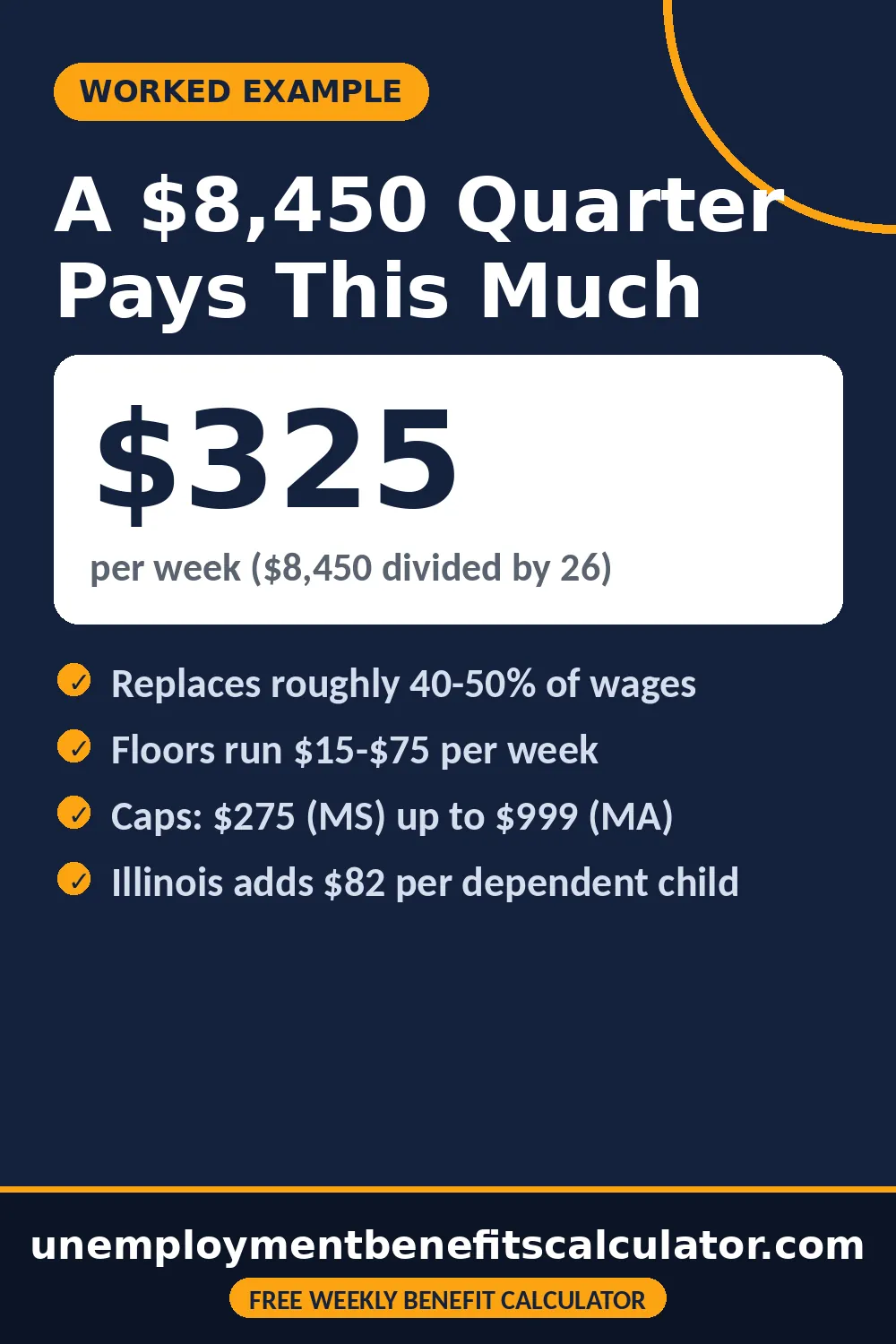
Once your base period is established, the state identifies your highest-earning quarter within that period. Most states then apply a simple formula: they take a percentage of your wages in that highest quarter and divide it to produce a weekly figure. The most common approach is to divide your high-quarter wages by twenty-six, which effectively gives you approximately half of your average weekly earnings during your best quarter. For example, if your highest quarter earnings were $8,450, dividing by twenty-six produces a weekly benefit amount of approximately $325. Some states use slightly different fractions — a few divide by twenty-five, others apply a percentage like fifty percent to the average weekly wage rather than using the quarter method — but the general principle is the same across the country: your benefit replaces roughly forty to fifty percent of your previous earnings, subject to a state-specific maximum.
A few states look at your total base period wages rather than just your highest quarter. These states typically require that you earned a certain minimum amount across the entire base period in addition to having sufficient earnings in one quarter, which prevents someone who worked only a few weeks at a high salary from qualifying for the same benefit as a steady earner. The purpose of these requirements is to ensure that benefits go to workers who have a genuine attachment to the labor force, not to people who had brief or sporadic employment. If you are unsure whether your work history is sufficient, understanding how the unemployment benefits system works in your state can clarify the monetary eligibility thresholds you need to meet.
| Step | What the state does | Example (2026 rules) |
|---|---|---|
| 1. Set the base period | First four of the last five completed calendar quarters before you file | File in July 2026 - base period is April 2025 through March 2026 |
| 2. Find your highest quarter | Totals your gross wages in each base-period quarter and picks the biggest | Highest quarter: $8,450 |
| 3. Apply the formula | Divides high-quarter wages by 26 in most states (a few divide by 25 or use a percentage of average weekly wage) | $8,450 divided by 26 = about $325 per week |
| 4. Apply the floor and ceiling | Caps the result between the state minimum and maximum WBA | Floors run about $15-$75; ceilings from $275 (MS) to $999 (MA) |
| 5. Add dependents allowance | Adds a per-dependent amount in the states that offer one | Illinois adds $82 per child; Maine adds $10 per dependent up to $50 |
Steps reflect the standard state formula as of October 10, 2026. Roughly 40-50% of your prior earnings is the national replacement norm - your state page has the exact divisor and caps.
Once you have your estimate, two guides close the loop: the first-check timeline tells you when the money starts, and how unemployment affects your taxes shows what you will actually keep after withholding or estimated payments.
Maximum and Minimum Benefits by State
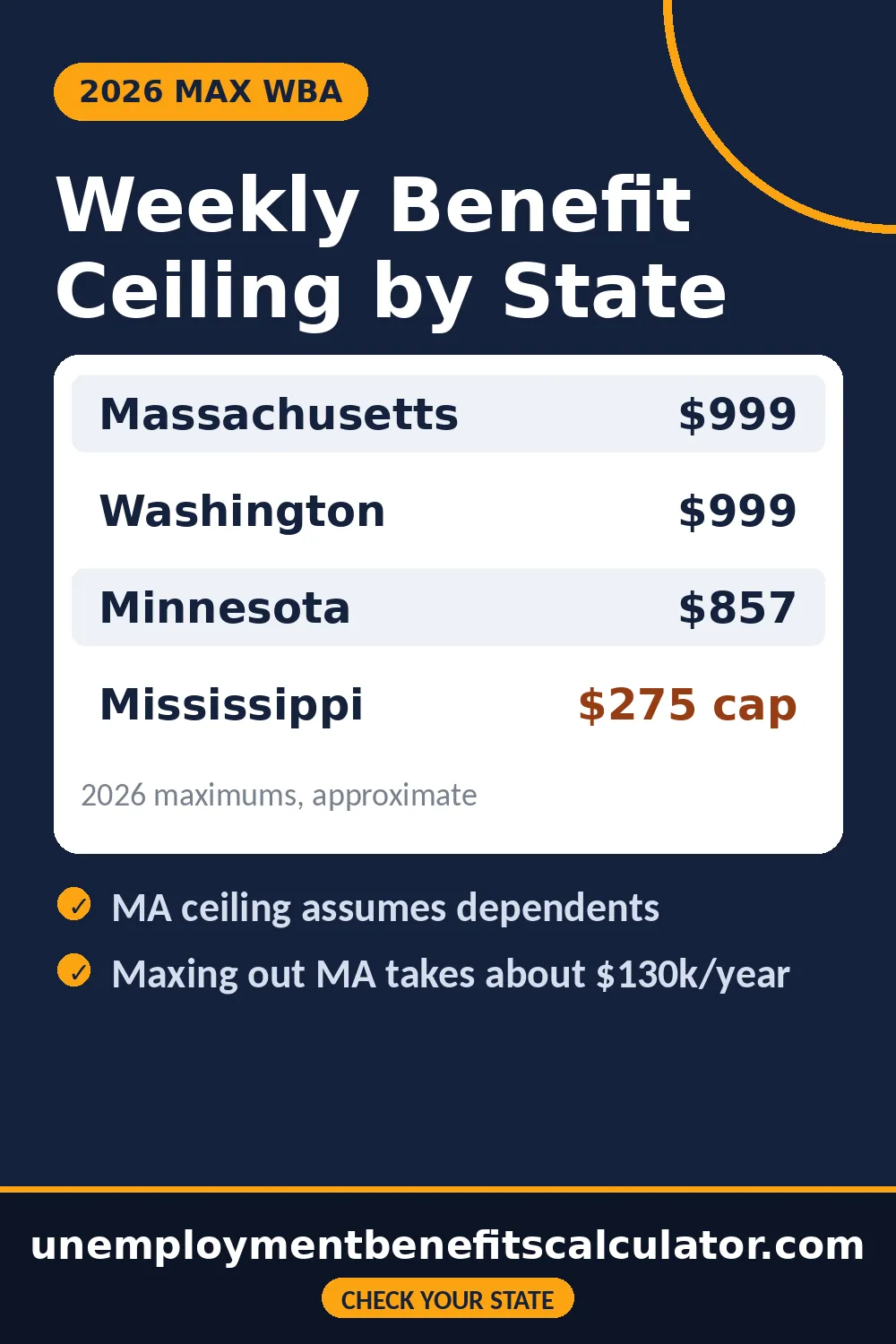
Every state sets a maximum weekly benefit amount that no claimant can exceed regardless of how much they earned, and this cap varies enormously across the country. As of 2026, the highest maximum weekly benefits are found in Massachusetts at approximately $999 per week for claimants with dependents, followed by Washington at around $999, Minnesota at roughly $857, and New Jersey at about $854. At the other end of the spectrum, Mississippi caps benefits at just $275 per week, Arizona at $320, and Louisiana at $285. These differences mean that two workers who earned identical salaries could receive dramatically different benefits simply because they live in different states, which is one of the most frustrating aspects of the unemployment system for workers in low-benefit states.
States also set minimum weekly benefits, which typically range from about $15 to $75 per week. If the formula produces an amount below the state minimum, some states will pay you the minimum while others will determine that you are monetarily ineligible and deny your claim entirely. The minimum benefit threshold is one reason why very low-wage workers and people with limited recent employment history sometimes cannot qualify for unemployment even though they lost their job through no fault of their own. For specific numbers, you can check the benefit details for your state — whether that is California unemployment benefits, Texas unemployment benefits, Florida unemployment benefits, or any other state page on our site — to see the exact maximum, minimum, and formula that applies to your claim.
Dependents Allowances and Supplemental Benefits
Several states recognize that a worker with children or other dependents needs more support than a single person receiving the same base benefit, and they provide dependents allowances that increase your weekly payment beyond the standard formula amount. The way these allowances work differs significantly by state. Some states add a flat dollar amount per dependent per week — for instance, Illinois adds $82 per child up to a certain number of dependents, while Maine adds $10 per dependent with a maximum of $50 additional per week. Other states, like Massachusetts and Maryland, incorporate dependents into their base formula, which means your maximum benefit is higher if you have children than if you do not. If you have dependents, it is critical that you report them accurately on your initial claim application, because failing to do so means you will receive less than you are entitled to, and most states will not pay retroactive dependents adjustments if you add them after your claim is already established.
Beyond dependents allowances, a handful of states offer supplemental benefits in specific circumstances. Some provide additional compensation during periods of high unemployment through programs called extended benefits or state-triggered supplements, while others offer training allowances that increase your benefit amount if you are enrolled in an approved education or training program. These supplemental programs change frequently based on economic conditions and state budgets, so checking with your state agency or using a current state-specific benefits calculator is the best way to find out if any supplements apply to your situation right now.
How Part-Time Work Reduces Your Benefit
If you earn income while collecting unemployment, your weekly benefit will be reduced — but not necessarily eliminated. Most states allow you to earn a portion of your weekly benefit amount without any reduction, often called the earnings disregard, and then reduce your benefit dollar-for-dollar or by a percentage for earnings above that threshold. This means you can supplement your unemployment income with part-time work and actually come out ahead financially, which is one reason why working part-time while on unemployment is often a smart strategy both financially and for maintaining your skills and professional network. However, you must report your earnings every week when you certify, and the timing rules are strict: most states require you to report earnings in the week you earned them, not the week you were paid, which is a distinction that trips up many new claimants.
For example, suppose your weekly benefit amount is $400 and your state has a 25 percent earnings disregard. If you earn $300 from part-time work in a given week, the first $100 of those earnings (25 percent of your $400 benefit) is disregarded, and your benefit is reduced by the remaining $200. You would receive $200 in unemployment plus your $300 in earnings, for a total of $500 that week — more than your benefit alone but less than your previous full-time income. If you earn $500 or more in a week, your benefit would be reduced to zero, and that week would count against your total benefit duration even though you received no payment. Understanding this math is essential for making informed decisions about how many hours to work part-time, and you must report your earnings accurately during biweekly certification to avoid overpayment problems that can follow you for years.
How Long Do Benefits Last and Total Amount
Most states provide up to twenty-six weeks of unemployment benefits during a standard benefit year, which means your total potential benefit equals your weekly benefit amount multiplied by twenty-six. A worker receiving $400 per week would be eligible for up to $10,400 in total benefits over the course of their claim, assuming they remain eligible the entire time and do not have their benefit reduced by part-time earnings. Some states provide fewer than twenty-six weeks — Florida and North Carolina currently offer only twelve weeks of benefits in normal economic conditions, while Kansas, Missouri, and several others have variable durations that fluctuate based on the state unemployment rate. When unemployment is high, these states add weeks; when it is low, they subtract them.
It is important to understand that your total benefit amount is not a lump sum that you receive regardless of circumstances. Each week you certify and meet all eligibility requirements — being able and available for work, actively searching for employment, and not refusing suitable offers — you receive one weekly payment. If you fail to meet these requirements in any given week, you do not receive payment for that week, but the unused weeks typically remain available in your benefit year for you to claim later. If you are unsure whether something in your situation might threaten your eligibility, reviewing common reasons people get disqualified from unemployment before you run into trouble can save you from losing weeks of benefits you would otherwise be entitled to collect.
Strategies to Maximize Your Benefit Amount
While you cannot change the formula your state uses, there are several timing and filing strategies that can legitimately increase the weekly benefit amount you receive. The most impactful one is timing your claim filing to optimize which quarters fall within your base period. Because the base period is determined by when you file, not by when you lost your job, filing at the start of a new quarter can shift an older, lower-earning quarter out of your base period and replace it with a more recent, higher-earning quarter. For a worker whose income was rising before their job loss, this shift can mean the difference between a $300 weekly benefit and a $400 weekly benefit — which adds up to $2,600 over the full twenty-six weeks. Before you file, sit down with your pay records and calculate what your benefit would be under the current base period versus what it would be if you waited a few weeks for the next quarter to begin.
Another strategy is making sure all your wages are properly reported to the state. Employers sometimes fail to report all compensation to the unemployment agency, particularly bonuses, commissions, overtime, and tips. If you received any of these forms of compensation during your base period and they are not reflected in the wage records the state has on file, your benefit will be calculated on an artificially low number. You can request a wage transcript from your state agency to see exactly what wages they have on record for you, and if anything is missing, you can submit pay stubs, W-2 forms, or bank statements as proof to get your benefit recalculated. If your claim is denied or your benefit seems too low and you believe the calculation is wrong, you have the right to appeal an unemployment denial or incorrect determination through your state's formal appeals process.
Tax Implications of Your Benefit Amount
Unemployment benefits are fully taxable as ordinary income at the federal level, which means the amount you actually keep after taxes will be significantly less than your nominal weekly benefit. A worker receiving $400 per week in benefits who does not elect tax withholding will owe approximately $2,000 to $3,000 in federal income tax over a full twenty-six-week claim, depending on their total income and tax bracket for the year. Most states also tax unemployment benefits, though a handful — including California, New Jersey, Pennsylvania, and Virginia — exempt some or all unemployment compensation from state income tax. You can elect to have ten percent of each payment withheld for federal taxes by filling out Form W-4V when you file your claim, and this is strongly recommended to avoid a surprise tax bill the following April. For a thorough breakdown of how benefits interact with your tax situation, including estimated payment strategies and state-specific exemptions, our guide on how unemployment benefits affect your taxes covers everything you need to know.
Frequently Asked Questions About Your Weekly Benefit Amount
How is the weekly unemployment benefit amount calculated?
Most states take your highest-earning quarter from the base period, divide it by 26, and cap the result between a state minimum and maximum. A highest quarter of $8,450, for example, produces about $325 per week before any caps or dependents allowances.
What is the base period for unemployment benefits?
It is the first four of the last five completed calendar quarters before you file. If you file in July 2026, the base period is April 2025 through March 2026 - which means your most recent three months of work may not count at all.
What is the maximum unemployment benefit by state?
The 2026 range runs from $275 per week in Mississippi to about $999 in Massachusetts and Washington for claimants with dependents. Minnesota ($857) and New Jersey ($854) sit near the top; Arizona ($320) and Louisiana ($285) sit near the bottom.
Why is my unemployment check less than I expected?
The four most common reasons: your highest quarter was lower than you think because the base period excludes recent months, your wage records are missing bonuses or commissions, the state maximum cap clipped your formula amount, or part-time earnings reduced the check.
Do dependents increase my unemployment benefit?
In several states, yes - Illinois adds $82 per child, Maine adds $10 per dependent up to $50 per week, and states like Massachusetts and Maryland build dependents into their base formula. Report dependents on the initial claim; most states will not add them retroactively.
How does part-time work affect my weekly benefit?
Most states disregard a portion of your earnings (often 25%) and reduce the benefit dollar-for-dollar above that. With a $400 benefit and a 25% disregard, earning $300 means you keep $200 in benefits plus $300 in wages - $500 total for the week.
How many weeks can I collect unemployment?
Most states provide up to 26 weeks, so a $400 weekly benefit is worth up to $10,400 total. Some states run shorter in normal conditions - Florida and North Carolina offer 12 weeks - and a few tie the duration to the state unemployment rate.
Are unemployment benefits taxable income?
Yes - fully taxable federally. A worker receiving $400 per week without withholding can owe roughly $2,000-$3,000 in federal tax over a 26-week claim. Elect the 10% federal withholding (Form W-4V) or make quarterly estimated payments to avoid the April bill.

Wasim Akram
Verified AuthorFounder & Lead Researcher, UnemploymentBenefitsCalculator.com
Wasim personally researches, writes, and reviews every article on this site. His expertise spans unemployment benefits policies across all 50 U.S. states, drawn from systematic research into state workforce agencies and Department of Labor guidelines.
Frequently Asked Questions
How is the weekly unemployment benefit amount calculated?
Most states take your highest-earning quarter from the base period, divide it by 26, and cap the result between a state minimum and maximum. A highest quarter of $8,450, for example, produces about $325 per week before any caps or dependents allowances.
What is the base period for unemployment benefits?
It is the first four of the last five completed calendar quarters before you file. If you file in July 2026, the base period is April 2025 through March 2026 - which means your most recent three months of work may not count at all.
What is the maximum unemployment benefit by state?
The 2026 range runs from $275 per week in Mississippi to about $999 in Massachusetts and Washington for claimants with dependents. Minnesota ($857) and New Jersey ($854) sit near the top; Arizona ($320) and Louisiana ($285) sit near the bottom.
Why is my unemployment check less than I expected?
The four most common reasons: your highest quarter was lower than you think because the base period excludes recent months, your wage records are missing bonuses or commissions, the state maximum cap clipped your formula amount, or part-time earnings reduced the check.
Do dependents increase my unemployment benefit?
In several states, yes - Illinois adds $82 per child, Maine adds $10 per dependent up to $50 per week, and states like Massachusetts and Maryland build dependents into their base formula. Report dependents on the initial claim; most states will not add them retroactively.
How does part-time work affect my weekly benefit?
Most states disregard a portion of your earnings (often 25%) and reduce the benefit dollar-for-dollar above that. With a $400 benefit and a 25% disregard, earning $300 means you keep $200 in benefits plus $300 in wages - $500 total for the week.
How many weeks can I collect unemployment?
Most states provide up to 26 weeks, so a $400 weekly benefit is worth up to $10,400 total. Some states run shorter in normal conditions - Florida and North Carolina offer 12 weeks - and a few tie the duration to the state unemployment rate.
Are unemployment benefits taxable income?
Yes - fully taxable federally. A worker receiving $400 per week without withholding can owe roughly $2,000-$3,000 in federal tax over a 26-week claim. Elect the 10% federal withholding (Form W-4V) or make quarterly estimated payments to avoid the April bill.