Massachusetts Unemployment Benefits Calculator
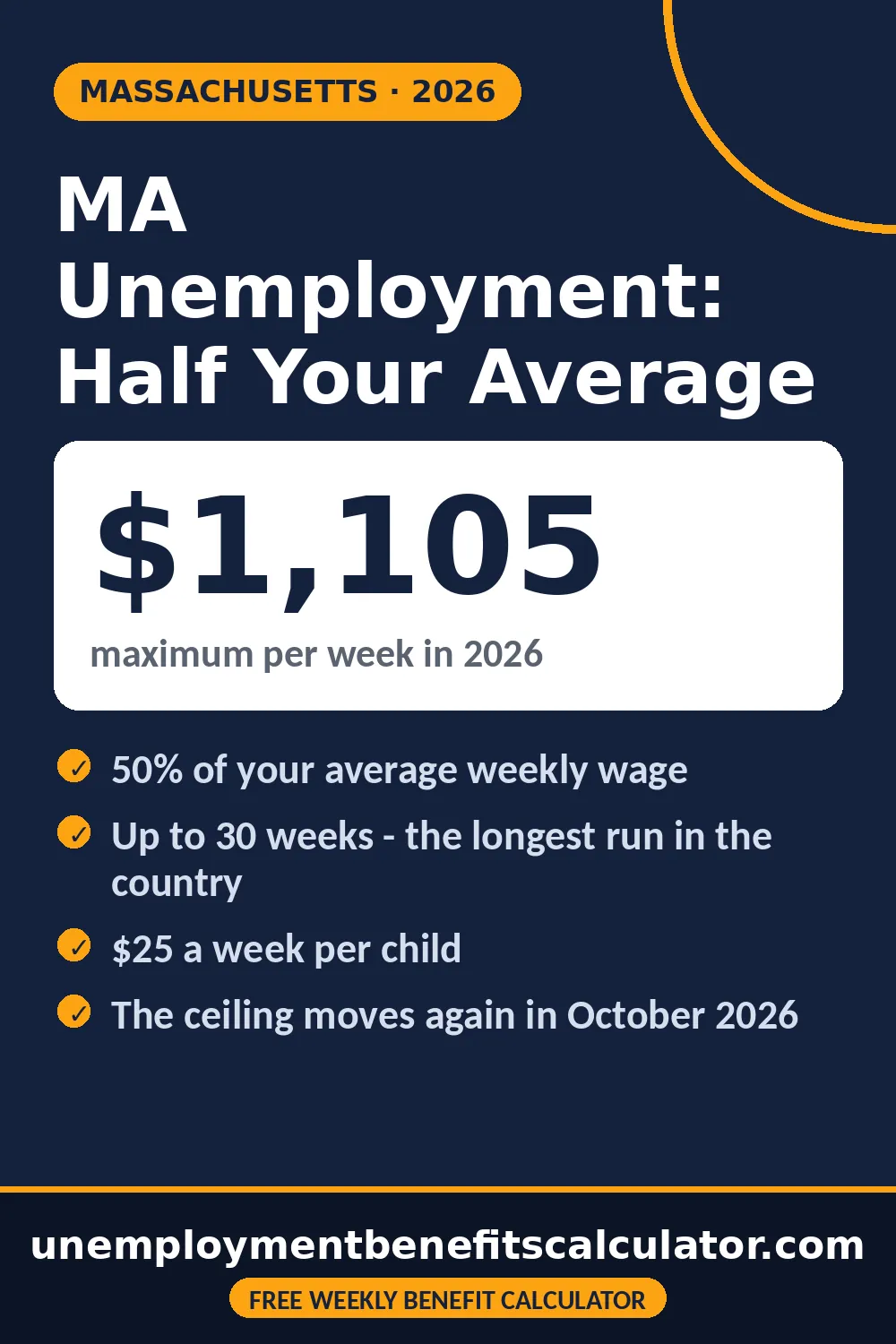
Massachusetts halved the math and doubled the runway: the weekly check is one half of your average weekly wage — the two best base-year quarters combined, divided by 52 — and the claim can run a full 30 weeks, longer than any other state. Enter your top two quarters, count your children, and the almanac below does the rest.
Last updated: October 10, 2026. Figures follow current Massachusetts DUA rules - confirm details with the agency before you file.
Almanac Nº 1 · The calculator
Price the week: two quarters, the kids, the other income
The engine below mirrors DUA’s three-step computation: pair your two best quarters, divide by 26 for the average weekly wage, then halve it. Add children for the $25 allowances, gross part-time wages for the one-third disregard preview, and the four-quarter total if you know it — that drives the 36% pot test and the eligibility gates.
This almanac follows the published formula; the Notice of Monetary Determination DUA mails after you apply is the document that actually pays. Where a wage report looks short, the affidavit process in Almanac Nº 11 is the fix.
Almanac Nº 2 · The formula
Two best quarters, divided by 52 — the whole rate in one division
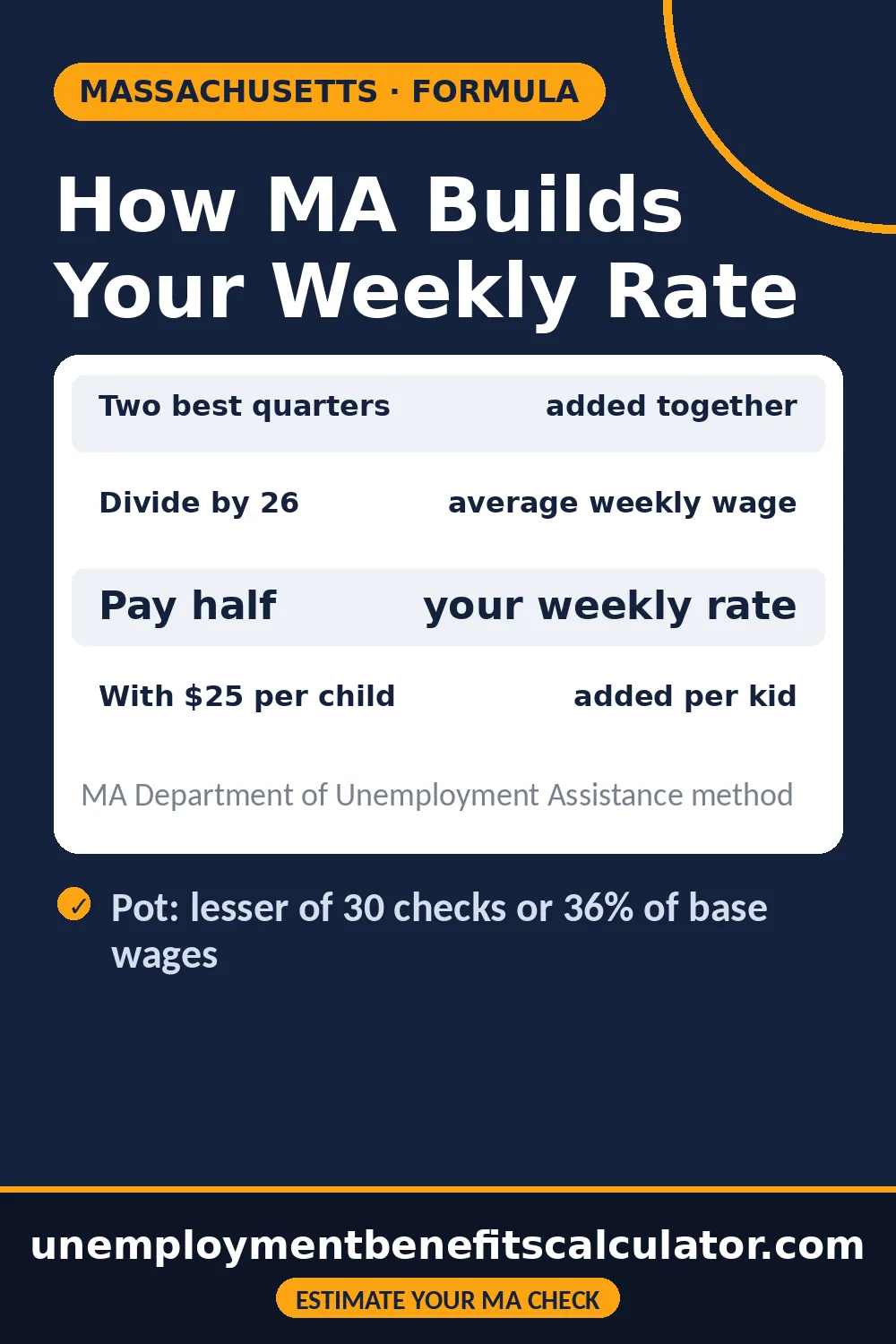
Massachusetts computes the benefit in three published moves. Step one takes the two calendar quarters in your base period where wages ran highest. Step two adds them and divides by 26 — the number of weeks in those two quarters — which yields the average weekly wage. Step three pays half of that average, rounded to the nearest dollar. Combine the steps and the shorthand is exact: top-two-quarters total ÷ 52 = weekly benefit.
The shorthand also gives you the exchange rate. Every additional $52 spread across that top pair lifts the check by $1 a week, which makes back-of-the-envelope pricing trivial before DUA’s determination ever arrives. A warehouse worker whose best quarters came in at $14,900 and $13,700 holds a $28,600 pair: $28,600 ÷ 52 = $550 a week, straight down the line.
Massachusetts re-prices the maximum every fall from state wage data, and the figure now in force — $1,105 — dates from the reset effective October 5, 2025. The ceiling moves again in October 2026, so a claim filed in late September and one filed three weeks later can legally ride different maximums. Unlike most states, there is no January adjustment here; the autumn reset is the only one.
| If your two best quarters total… | Average weekly wage (÷26) | Weekly benefit (÷2) |
|---|---|---|
| $20,800 | $800 | $400 |
| $33,800 | $1,300 | $650 |
| $46,800 | $1,800 | $900 |
| $57,460+ | $2,210+ | $1,105 — capped |
Claiming the full $1,105 takes a two-quarter pair worth at least $57,460 — the cap multiplied by 52. Half the workers who hit the ceiling in Massachusetts do so on overtime-heavy winter quarters; the ladder above shows exactly how much paired earning each rung costs.
Almanac Nº 3 · The short-history trap
Worked only one or two quarters? The divisor changes — and so does the trap
Claimants with a short work history don’t get the friendly version of the formula. When wages landed in only one or two quarters of the base period, Massachusetts computes the average from the highest single quarter divided by 13 instead of a pair divided by 26. Halving still follows, so a lone $7,800 quarter prices an average of $600 and a benefit of $300.
Here is why advocates call this formulation punishing. Eligibility requires base-period earnings of at least 30 times the weekly benefit. On the two-quarter path, your own wages naturally clear that bar as the pair grows. On the one-quarter path, the $7,800 quarter must clear 30 × $300 = $9,000 — more than the quarter itself. The math fails by construction whenever the quarter is small, and the people it fails are precisely those with interrupted, seasonal or slow-start employment. The practical cure is wage-filed in a second quarter: even modest W-2 earnings landing in an adjacent quarter flip the claim back onto the two-quarter division.
Self-employment, consulting and commission income sit outside the formula entirely in Massachusetts — they cannot build a claim, and they cannot rescue a short-history one. Only covered W-2 wages count toward both the quarters and the 30-times test.
Almanac Nº 4 · The gates
What it takes to open a claim at all
DUA lists the entry conditions without decoration. You lost the job — or saw your hours cut hard — through no fault of your own. You earned at least $6,300 over the last 12 months. You were authorized to work in the United States, the income was earned in Massachusetts, and you are able, available and actively looking. On top of the dollar floor sits the structural one: base-period earnings must reach 30 times the weekly benefit the formula produces.
Twelve months of covered W-2 earnings below $6,300 closes the door before the formula is even run. Part-year workers with three thin quarters land here most often.
The base period must hold at least 30 × your computed weekly rate. At $400 a week that means $12,000 in base wages; at the $1,105 cap it means $33,150.
Layoffs and cut hours qualify directly. Quitting without good cause, or discharge for deliberate misconduct, routes the claim into the separation review in Almanac Nº 13.
The claim stands on Massachusetts-covered employment. Nonprofit, religious, training-program, 1099 and seasonal earnings are excluded from the arithmetic that builds it.
One more width of rope exists for workers whose standard base period comes up short: the alternate base period. Drop the oldest completed quarter, add the most recent incomplete one, and if that four-quarter window either qualifies you where the primary window failed — or produces a benefit credit at least 10% higher — DUA runs the claim on the alternate window. It is a rescue lane for people whose final working weeks were their strongest.
Almanac Nº 5 · The pot
Thirty times the rate, or 36% of the year — whichever is smaller
Massachusetts calls the benefit-year total the maximum benefit credit, and it is built as a contest between two ceilings. Ceiling one: 30 times your weekly benefit. Ceiling two: 36% of every dollar in your base period. Whichever comes out smaller is all you can draw before the benefit year closes — and the one that wins tells you a lot about the shape of your working year.
A level year keeps the two close. A top-heavy year — big quarters early, thin ones late — pushes total wages down relative to the rate, and the 36% side starts binding. When it does, the claim runs out of money even though weeks nominally remain. The table shows the crossover for a $550 rate:
| Base-period total wages | 30 × $550 = $16,500 | 36% of wages | Pot that applies |
|---|---|---|---|
| $41,000 | $16,500 | $14,760 | 36% side — $14,760 |
| $47,000 | $16,500 | $16,920 | 30× side — $16,500 |
| $52,000 | $16,500 | $18,720 | 30× side — $16,500 |
Duration is then simple division: pot ÷ weekly benefit. At $550 with the $14,760 pot, the check runs 26.8 weeks; at the same rate with a pot above $16,500, it runs the full 30. Every dollar of weekly rate you add by the ÷52 formula also inflates the 30-times ceiling, which is why strong base years almost always fund the maximum span.
Almanac Nº 6 · The runway
30 weeks — the last state standing beyond 26
When the pandemic-era federal programs expired, nearly every state returned to its standard frame. Massachusetts went further and stayed there: the state now underwrites up to 30 weeks of benefits in a benefit year, a full six weeks past the 26-week standard, and the Center on Budget and Policy Priorities counts it as the only jurisdiction still offering more than 26. For a claimant running the maximum, that is a month and a half of extra coverage nobody else in the country gets.
Behind the standard frame there is currently nothing. DUA’s FAQ says it directly: no benefit extension programs are available right now, and claimants whose weeks are about to run dry are pointed to mass211.org, the state’s community-resource line, for housing and food help. Planning on extensions as if they were automatic would be a mistake; treat 30 as the wall.
Massachusetts also runs WorkShare for employers who cut hours instead of heads: with an approved plan, the difference is made up pro rata from UI, and your benefit is based on the exact percentage of hours your employer shed. It keeps paychecks partial instead of absent.
Almanac Nº 7 · The waiting week
The first week you claim is the week you don’t get paid
DUA’s FAQ is blunt about the opening move: the first week you file a weekly claim is a waiting week, it pays nothing, and your first actual payment covers the second week you claim. There is no trick to avoid it and no repayment at the back end — one unpaid week per benefit year, served up front while you certify and search like any other week.
Timing still matters around it. File the initial claim in the week you become unemployed rather than a week later, because the waiting week consumes a claimed week regardless of when you start — late filings simply shift the whole calendar right. Combined with the two-business-day payment rhythm after each weekly claim, the realistic span from “lost my job” to “money in the account” lands near three weeks even when nothing goes wrong.
Almanac Nº 8 · The family line
$25 a week per child — with the details that decide it
The dependency allowance is $25 per week for each child you are the main support of, and the definitions do real work here. A qualifying child is under 18, or under 24 and enrolled full-time in school, or of any age and unable to work because of a mental or physical disability. Spouses are expressly out — this is a children’s allowance, not a household one — and being the main support is the operative test, which a parent paying most of a child’s expenses generally satisfies even where custody is shared.
Two structural points keep the allowance honest. First, the base rate is figured as if no dependents existed — the ÷52 formula never sees them. Second, the combined allowance cannot exceed half of the weekly benefit: at a $550 rate, even a large family adds at most $275, and every realistic count of children lands under it. The ceiling only begins to pinch on very small checks — at a $200 weekly rate, the cap holds the allowance to $100, trimming the sixth child’s increment.
| Children chiefly supported | Weekly allowance at $550 rate | Total check |
|---|---|---|
| 1 | +$25 | $575 |
| 2 | +$50 | $600 |
| 3 | +$75 | $625 |
Almanac Nº 9 · Working part-time
The one-third disregard — Massachusetts’s most claimant-friendly math
Massachusetts lets part-time work coexist with a full check up to a generous line: on weeks you work, wages at or below one-third of your weekly benefit are ignored entirely, and only the excess is deducted dollar for dollar. DUA’s own example shows the mechanics — a $300 benefit, $105 in wages for the week, one-third of $300 is $100, so $5 comes off and $295 pays. Shifts for rideshare or meal-delivery apps count as part-time work and must be reported at certification like any other wages.
The line moves with your rate, which makes low-benefit weeks fragile and strong ones roomy. At $550 a week, the free zone runs to $183; a $160 shift week pays the full $550 untouched, while a $250 week gives up $67 and nets $483. Crossing the line entirely — earnings at or above the benefit itself — zeroes the week, though reporting it correctly still matters: a zero week can preserve your standing, and the record of honest reporting is what DUA reviews when questions arise.
| Gross wages this week | Excess over $183.33 | Benefit that pays |
|---|---|---|
| $120 | — (under the line) | $550 — full check |
| $160 | — (under the line) | $550 — full check |
| $250 | $66.67 → $67 | $483 |
| $400 | $216.67 → $217 | $333 |
| $550 | $366.67 → $367 | $183 |
Full-time work ends the claim outright — DUA instructs claimants to stop filing the week full-time begins. Between those poles, other money also reduces weeks: severance, vacation pay, sick pay and pension distributions all count against the week they land in, and child-support obligations and prior overpayments can be intercepted, the latter at up to half your weekly benefit until the debt clears.
Almanac Nº 10 · The weekly rhythm
Three searches, one log, and a certification that pays in two days
Each week you claim, DUA expects proof of at least three job-search activities, recorded on a work-search log you keep and can produce on request. The MassHire career centers that administer the requirement treat the log as a living document — employer names, contact channels, dates and outcomes — and claimants selected for audits or the RESEA program are asked to produce it in full. Three is a floor, not a quota to game; repeats of the same application to the same employer in one week do not diversify the record.
The certification itself runs weekly through UI Online, or by phone on the TeleCert line at (617) 626-6338, open daily 6 a.m. to 10 p.m. You certify that you are able, available and actively looking, report any wages from the week the work happened, and submit the search record. Payments then move fast by national standards: DUA issues approved payments about two business days after the weekly claim, by direct deposit or the debit card. RESEA — the federal reemployment program — selects a rotating share of claimants for a scheduled session, and participation is mandatory for the weeks it touches.
Almanac Nº 11 · The letter and the shavings
Reading the Notice of Monetary Determination — and what takes a bite out of it
After you apply, DUA mails the Notice of Monetary Determination: your computed weekly benefit, your benefit-year pot, and the wage reports every base-period employer filed. Read it against your own pay stubs. Employers misreport wages more often than anyone likes to admit — hours coded wrong, quarters shifted, entire stretches missing — and every missing dollar shrinks the ÷52 base. The notice carries the fix: an Affidavit to Correct Wages, filed per its instructions, pulls the record into truth before the draw begins.
Even a correct check gets shaved by outside obligations. Child support owed in any state can be withheld from weekly benefits and must be disclosed at application. Prior overpayments — here or in another state — can be recovered at up to 50% of your weekly benefit until the balance clears. Severance, vacation, sick pay and pensions reduce the weeks they touch, as Almanac Nº 9 covered. None of these are reasons to skip reporting; concealment converts an administrative nuisance into a fraud problem with repayment, penalties and disqualification attached.
Almanac Nº 12 · Opening the claim
File on UI Online the week the job ends — not a week later
The application lives at unemployment.mass.gov, reached through a MyMassGov account, and DUA’s standing advice is to file as soon as the layoff or hour-cut happens — you can apply the same week your employment ends. Have employer names, dates, and wage details ready, since the application captures the work history the ÷52 formula will run against. Documents the process asks for can be uploaded from a phone. If the online path is blocked, the call center at (877) 626-6800 takes applications Monday through Thursday, 8:30 a.m. to 4:30 p.m., with relay service through 711.
| DUA contact lane | Number | What it does |
|---|---|---|
| Call Center | (877) 626-6800 | Applications and general help, Mon–Thu 8:30–4:30 |
| TeleCert | (617) 626-6338 | Weekly certification, daily 6 a.m.–10 p.m. |
| Payment Status | (617) 626-6563 | Where a payment stands |
| PIN Selection | (617) 626-6943 | Set or reset your 4-digit PIN |
| Direct Deposit | (617) 626-6570 | Start, change or cancel deposit |
Some applications sit in “pending” longer than others while DUA verifies identity, awaits an employer’s wage response, or reviews documents — the FAQ’s instruction is to keep filing your weekly claims throughout the review, because claimed weeks during a pending period are the ones that get paid once it clears. In-person help exists at the Boston Re-Employment Center at 2 Avenue de Lafayette, by appointment only.
Almanac Nº 13 · How it ended
Layoffs sail through; quits and discharges get a hearing
A layoff with no attached blame is the easy case — the employer reports it, the claim proceeds, and the money starts on schedule. The two hard cases get separated out for review. A discharge for alleged misconduct or a deliberate policy violation puts the burden on the employer to show what happened; disqualifications, when they stick, are measured in weeks and can be lifted by fresh covered earnings. A quit requires good cause attributable to the employer or to circumstances a reasonable person would have left over — unsafe conditions, a material change in the job, documented harassment with no remedy offered.
The practical playbook is the same for both: tell the true story in the application, attach what corroborates it — messages, schedules, medical notes, final pay records — and expect an employer to answer with its own version. DUA decides on the paper first; hearings come later and only when the paper disagrees with someone. If a disqualification lands, the appeal lane in Almanac Nº 15 is the remedy, and it works often enough that silence is never the better answer.
Constructive dismissals — quits that were really firms pushing you out — are judged on their facts. Keep the evidence trail from the first bad day, not the last one.
Almanac Nº 14 · A worked claim
Derek in Brockton — a warehouse year, priced line by line
Derek drove a forklift for a distribution center south of Boston until the night shift was cut in March. His four base-period quarters read $14,900 / $9,100 / $13,700 / $3,300 — a $41,000 year with two strong quarters at the top. Here is the whole claim, the way the almanac computes it:
pick the pair The two highest quarters are $14,900 and $13,700. Combined: $28,600.
average them $28,600 ÷ 26 weeks = a $1,100 average weekly wage.
halve it $1,100 ÷ 2 = a $550 weekly benefit. The ÷52 shorthand agrees: $28,600 ÷ 52 = $550.
the family line Two children chiefly supported: +$50 a week. The check becomes $600 while the allowance stays under its half-of-rate ceiling.
the pot 30 × $550 = $16,500. 36% × $41,000 = $14,760. The smaller figure governs: a $14,760 pot.
the runway $14,760 ÷ $550 = 26.8 weeks of payable draws — inside the 30-week frame, with the 36% side binding.
The part-time picture, since Derek picks up weekend hauling for a landscaping crew: at $160 gross for a week, he stands under the $183 free line and the full $600 pays. A $250 hauling week exceeds it by $66.67, so about $67 comes off and $533 lands. Both weeks get reported the week the work happened — the log keeps the three-search requirement fed while the side work runs.
Almanac Nº 15 · The appeal fuse
Ten days from the mailbox — the shortest window on this site
Every DUA determination — benefit amounts, disqualifications, overpayments — carries a 10-day appeal window counted from the mailing date printed on the letter, and Massachusetts counts calendar days where most states grant two or three weeks. Miss it and the door narrows to a 30-day good-cause application: the request can still be considered if it arrives within that month and the lateness had a real reason. After a hearing decision, the next rung is the Board of Review, which must receive an application for further review within 30 days of the hearing decision’s mailing date, with the courts beyond that.
The procedural discipline is identical at every rung: keep certifying your weekly claims while the appeal runs, because a reversed decision pays the preserved weeks and a suspended claimant collects nothing retroactively. Ten days is enough time to file — the initial appeal is a written request, not a case — but not enough time to be casual about it. The day the letter arrives is the day to check the calendar.
Almanac Nº 16 · Taxes
Two governments tax the check — both withholdings are optional
Unemployment compensation is ordinary income to the IRS, reported each January on a 1099-G, and DUA will remit 10% to the federal government if you elect withholding rather than letting the bill pool until April. Massachusetts taxes benefits on the state return too, at the Commonwealth’s flat income-tax rate, and voluntary state withholding is available for claimants who prefer the tax to be pre-paid — an election worth making for most households, since Massachusetts is one of the states that does not exempt UI from income tax.
The withholding elections live in UI Online and can be changed mid-claim, but they only apply forward — a season of untaxed checks cannot be retroactively covered. Anyone drawing a full $1,105 should run the arithmetic honestly: at the maximum, benefits approach $33,000 over a 30-week draw, which is real taxable income in a year the household also lost its wages.
Almanac Nº 17 · The employer ledger
Who pays for it: the $15,000 wage base and the 2026 rates
Benefits are financed entirely by employer contributions on the first $15,000 of each employee’s annual wages — the taxable wage base for 2026. New employers registered less than three years pay 2.42% on those wages, rising to 6.08% for new construction-industry employers, while established firms carry rates DUA recalculates annually from their experience record and the standing of the trust fund. Quarterly reports and contributions are due April 30, July 31, October 31 and January 31 — by 3 p.m. — and late payment accrues 12% interest until paid.
The system’s flexibility valves: eligible employers can defer up to 34% of the first two quarters’ contributions, and can make voluntary contributions to burnish their experience rating before the next rate notice. Rate notices go out by January 31 each year through the employer portal, and a rate review can be requested before June 20 when the record looks wrong. None of this touches the claimant’s side of the ledger — employees pay nothing into the fund — but the employer’s reported wages are the raw material of every ÷52 calculation on this page.
Almanac Nº 18 · The market you are searching in
Massachusetts labor, late summer 2026
The state’s unemployment rate has been holding at 4.4% through mid-2026 — June’s report showed the rate dropping to that mark, and July held it while payroll gave up 4,600 jobs, according to the EOLWD release and the federal update from August. That is a fraction above the national rate, a reversal of the Commonwealth’s usual advantage, and it frames the three-searches-a-week requirement as more than ceremony: hiring is slower than it was, and searches need to be spread across employers and weeks to produce interviews.
Wages, though, remain among the strongest in the country, which is why the $1,105 maximum exists at all — it is half of an average weekly wage that only a few states match. The floor wage under the market is $15.00 an hour, unchanged since 2023, with the tipped service rate at $6.75. For a claimant replacing a $15-an-hour job, the ÷52 formula prices benefits near $600 for a steady full year of it — roughly 86% of gross take-home at that wage, the highest replacement share you will see on a real claim.
Almanac Nº 19 · The expensive seven
Seven mistakes that cost Massachusetts claimants real money
The waiting week consumes a claimed week whenever you start, so every week of delay shifts the whole draw right. File the week the job ends.
The monetary determination is built from employer filings that are sometimes wrong. One missing quarter can drop the ÷52 base — and the affidavit fixes it, but only if you read the letter.
Consulting, freelance and commission earnings cannot open or rescue a claim here. Build the year on covered W-2 wages before the layoff, not after.
Massachusetts runs the shortest appeal window on this site. Ten calendar days from the mailing date, then a good-cause scramble. Calendar the letter the day it comes.
The phone line runs 6 a.m.–10 p.m. daily, but UI Online is the steadier path. A missed certification is a week at risk, and phone-only claimants hit the most jams.
The disregard is a fraction of your own rate, not a fixed dollar amount. At $550 the free zone is $183; at $300 it is $100. Guess high and you report wrong wages.
A denied or disputed claim still wants weekly claims. Appeal wins pay the preserved weeks; claimants who went quiet during the process collect nothing retroactively.
Almanac Nº 20 · The comparison
Massachusetts against the typical state
| Feature | Massachusetts, 2026 | The typical state |
|---|---|---|
| Weekly formula | half the average weekly wage — top two quarters ÷ 52 | high-quarter fractions from 1/25 to 1/26 |
| Weekly range | capped at $1,105 since October 5, 2025 | floors near $5–$113, caps between $235 and $1,100 |
| Maximum duration | 30 weeks — the only state past 26 | 12–26 weeks, or pot formulas that bind earlier |
| Benefit-year pot | lesser of 30× the rate or 36% of base wages | weeks-based frames or one-third-of-wages pots |
| Dependent allowance | $25 per child, up to half the check | roughly a dozen states pay add-ons at all |
| Waiting week | yes — the first claimed week, unpaid | about half the states hold one |
| Partial rule | earnings over one-third of the rate deducted | flat disregards from $25 to $100 are common |
| Work search | 3 logged activities weekly + RESEA sessions | 1–5 contacts weekly depending on the state |
| Appeal deadline | 10 days from the mailing date | 15, 21 or 30 days in most other states |
| Rate reset | every October from state wage data | January or July resets elsewhere |
The one-sentence version: Massachusetts pays a richer check for a longer time and asks for three searches a week in return — the most claimant-generous frame on this site, guarded by the shortest appeal fuse and a 36% pot that trims top-heavy years.
Almanac Nº 21 · Questions
Massachusetts unemployment FAQ
How does Massachusetts figure my weekly unemployment check?+
Take the two quarters in your base period where you earned the most, add them together, divide by 26 to get your average weekly wage, and DUA pays half of that, rounded to the nearest dollar. In shorthand: your two best quarters combined, divided by 52. A pair totaling $28,600 prices out at $550 a week. Every extra $52 earned across that top pair moves the check up a dollar.
What is the maximum weekly benefit in Massachusetts for 2026?+
The current maximum is $1,105 a week, the figure DUA has published since the annual reset that took effect October 5, 2025. Massachusetts re-runs its maximum every October from state wage data — not in January like most states. Claiming the full $1,105 takes two top quarters worth about $57,500 combined. The next reset lands in October 2026.
How long can I collect unemployment in Massachusetts?+
Massachusetts allows up to 30 weeks in a benefit year — the longest standard run of any state, six weeks past what the other 49 offer. Your actual duration is the benefit-year pot divided by your weekly rate, and the pot is the smaller of 30 times your weekly benefit or 36% of everything you earned in the base period. A $550 rate with a $14,760 pot runs about 26.8 weeks.
Does Massachusetts have a waiting week?+
It does. The first week you file a weekly claim serves as an unpaid waiting week, and the first check covers your second claimed week. The FAQ puts it plainly: you will not get paid for that week. There is currently no extension program behind it either — DUA points claimants whose benefits run out toward mass211.org for local housing and food assistance.
How does the $25-per-child dependency allowance work?+
Add $25 a week for each child you chiefly support — under 18, under 24 and a full-time student, or any age if a disability keeps them from working. Spouses never count. The combined allowance cannot exceed half your weekly benefit rate, a ceiling that only matters on very small checks: at a $550 rate, two children add the full $50. The allowance sits on top of the base rate, which is figured before dependents enter the picture.
What happens if I work part-time while claiming?+
Massachusetts lets you keep the full check when your gross wages for the week stay at or under one-third of your weekly benefit. Everything above that line comes off dollar for dollar. On a $300 benefit, one-third is $100, so $105 in wages trims the payment to $295 — the exact arithmetic DUA publishes. Rideshare and meal-delivery shifts count as part-time work and must be reported when you certify.
Which kinds of pay can’t start a Massachusetts claim?+
Several: earnings from nonprofit or religious employers, wages from state or federal training programs such as YouthWorks or Job Corps, real-estate and insurance commissions, independent contracting and consulting fees, self-employment income, college work-study, service as an elected official, and certified seasonal employment. If your last year was built on 1099 work, W-2 wages from another employer usually have to carry the claim.
What if I disagree with the benefit amount DUA calculated?+
Two moves. First, the Notice of Monetary Determination explains how to submit an Affidavit to Correct Wages when an employer under-reported what you were paid — worth checking, because missing wages shrink the check. Second, any determination you disagree with can be appealed within 10 days of the mailing date on the letter, with a 30-day good-cause window behind it. Keep filing your weekly claims throughout.
Does Massachusetts tax unemployment benefits?+
Both governments want their share. The IRS taxes benefits as ordinary income, and you can ask DUA to hold back 10% for federal tax. Massachusetts also counts benefits as income on your state return at its flat rate, and voluntary state withholding is available if you want it pre-paid. DUA issues the 1099-G each January covering the prior calendar year.
When will my first Massachusetts payment arrive?+
Expect roughly three weeks from filing to money: the unpaid waiting week first, then your first payable week, with approved payments issued about two business days after you file the weekly claim and your work-search record. DUA pays by direct deposit or a debit card, and the Payment Status line at (617) 626-6563 tells you where a payment stands.
Almanac Nº 22 · Paper trail
Sources & verification
Every figure on this page was checked against primary sources in September 2026. This site is not affiliated with the Massachusetts Department of Unemployment Assistance; the calculator mirrors the published rules rather than replacing DUA’s own determination.
- 1.DUA — How unemployment insurance benefits are determined: the 50% formula, $1,105 maximum effective October 5, 2025, 30×/36% pot, dependents, WorkShare — mass.gov/info-details/how-unemployment-insurance-benefits-
- 2.DUA — Unemployment insurance eligibility: the $6,300 floor, excluded income list, able-and-available conditions — mass.gov/info-details/unemployment-insurance-eligibility
- 3.DUA — FAQs for workers: the waiting week, 30 weeks, two-business-day payment rhythm, no current extensions, RESEA — mass.gov/info-details/faqs-about-unemployment-insurance-fo
- 4.DUA — Employer contributions to unemployment: 2026 rates (2.42% new, 6.08% construction), $15,000 base mechanics, 12% late interest — mass.gov/info-details/employer-contributions-to-unemployme
- 5.DUA — Appeal an unemployment decision as a claimant: the 10-day window and 30-day good-cause lane — mass.gov/info-details/appeal-an-unemployment-decision-as-a
- 6.Mass Legal Services — UI Advocacy Guide Q4: the three-step calculation, ÷26 and ÷13 divisors, 30-times test, alternate base period with the 10% rule — masslegalservices.org/content/4-how-are-ui-benefits-calcul
- 7.Mass Legal Help — I lost my job: can I get UI? ($6,300 plus 30-times condition; filing and appeal walkthroughs) — masslegalhelp.org/unemployment/benefits/can-i-get-ui
- 8.MassHire Lowell Career Center — What constitutes work-search activity: the three-search minimum and the log standard — masshirelowellcc.com/what-constitutes-work-search-activity
- 9.Mass.gov — Massachusetts law about minimum wage: $15.00 standard rate, $6.75 service rate — mass.gov/info-details/massachusetts-law-about-minimum-wage
- 10.IRS — Topic 418: Unemployment compensation (federal taxation, 1099-G, voluntary 10% withholding) — irs.gov/taxtopics/tc418
- 11.Massachusetts Department of Revenue — voluntary state withholding on unemployment compensation and the flat income tax — mass.gov/orgs/department-of-revenue
- 12.BLS — Massachusetts Economy at a Glance (4.4% rate, mid-2026; payrolls −4,600 in July) — bls.gov/regions/northeast/massachusetts.htm
- 13.CBPP — How Many Weeks of Unemployment Compensation Are Available (Massachusetts as the only 30-week state) — cbpp.org/research/economy/how-many-weeks-of-unemployment-c
- 14.DUA — Unemployment Services for Workers portal (UI Online filing, MyMassGov login, monetary determinations) — unemployment.mass.gov/
Keep reading while the claim runs
These guides from our own desk cover the ground Massachusetts shares with every state — base periods, first-check timing, the appeal path, and the tax bill.
Massachusetts’s neighboring calculators
Cross-border work is common all around the Commonwealth — Rhode Island and Connecticut to the south, New Hampshire and Vermont to the north, New York along the Berkshires — and combined-wage claims let the wages follow you. Every bordering state’s calculator sits on its own page here, and the master index gathers all fifty.
The homepage calculator prices every state’s weekly range side by side, and each state’s dedicated page carries its own verified rules.
Open the national calculator