
Last updated: October 10, 2026. Weekly search quotas and valid-activity rules are set by each state - confirm your state's current requirement with your unemployment agency.
When you collect unemployment benefits, you are not just receiving payments — you are making a commitment to the state that you are actively looking for new work. Every state requires unemployment claimants to conduct a genuine, documented job search as a condition of receiving benefits. Fail to meet these requirements, and your payments stop. Misrepresent your search activities, and you could face fraud charges and repayment demands that follow you for years. The rules sound simple on the surface, but the details of what actually counts as a valid job search activity, how many searches you need per week, and how you must document them vary significantly from state to state. This guide breaks down everything you need to know so you never lose a week of benefits over a technicality.
Why Job Search Requirements Exist
Unemployment insurance is designed as a temporary bridge between jobs, not a long-term income replacement. The whole system operates on the principle that you are able to work, available to work, and genuinely seeking work. Without the search requirement, anyone could file a claim and collect payments indefinitely without making any effort to find new employment, which would bankrupt the trust funds that pay these benefits. The job search mandate ensures that only people who are truly between jobs — not people who have stopped looking — receive support.
From a practical standpoint, staying active in your job search also benefits you. The longer you are unemployed, the harder it becomes to find work, because employers tend to view long gaps on a resume as a negative signal. Consistently applying for positions keeps your skills sharp, your professional network active, and your confidence up during what can otherwise be an isolating experience. Understanding how the unemployment benefits system works means understanding that the search requirement is not punishment — it is the core condition that makes the entire program possible.
How Many Job Searches Do You Need Per Week?
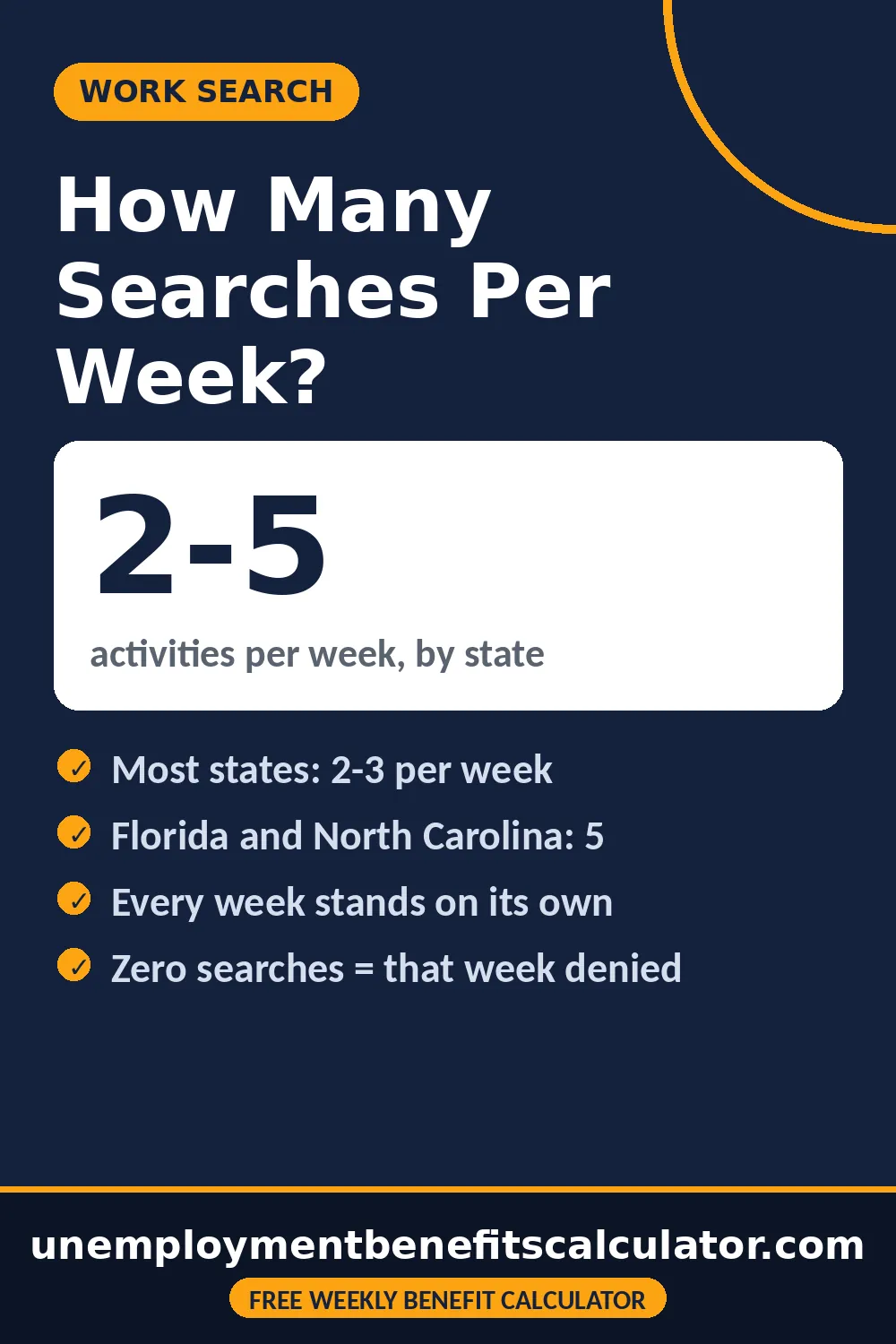
The number of required work search activities varies by state, but most fall somewhere between two and five per week. The most common requirement is two to three verifiable job search actions per week, though states like Florida and North Carolina require five, and a few states require four. Some states also distinguish between different types of activities — you might need at least one actual job application and can count other activities like attending a job fair or networking event toward the remaining requirement.
It is important to note that the requirement applies to every single week you certify, not just the weeks you feel like searching. If you certify for a week and report zero job search activities, that week's benefit will be denied, and you cannot make it up by doing extra searches the following week. Each week stands on its own. This is one of the most common reasons people lose benefits unexpectedly, especially during weeks when they are sick, traveling, or simply too discouraged to look. If you are unable to search for work in a given week because of a documented medical issue, contact your state agency immediately — some states allow a temporary exemption, but you must request it before the certification deadline. When you certify for benefits each week, you will be asked directly whether you met the search requirement, and your answer must be truthful.
What Counts as a Valid Job Search Activity
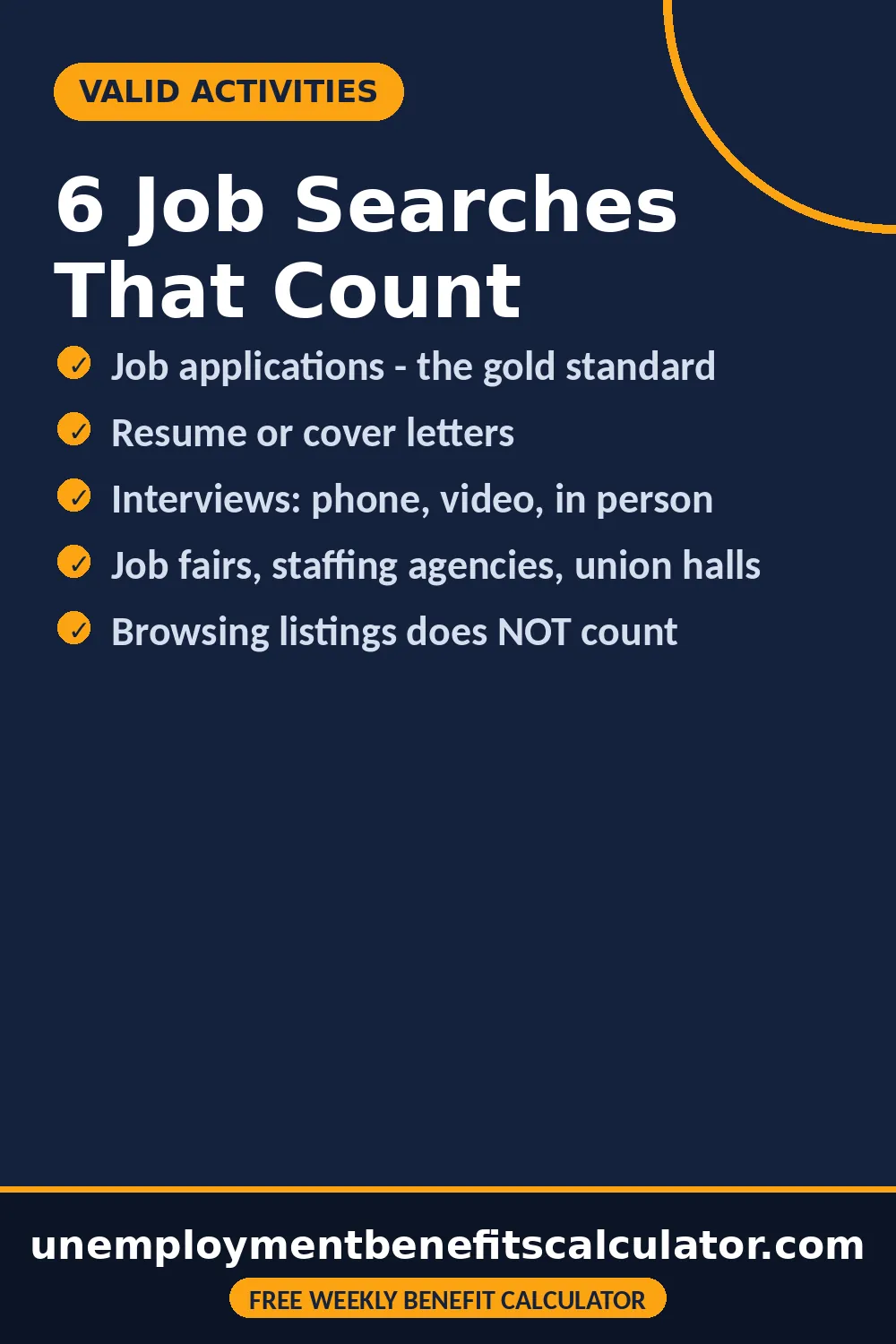
Not every job-related activity qualifies as a valid work search action under your state's rules. Understanding the distinction between qualifying and non-qualifying activities can prevent you from accidentally reporting insufficient searches and losing a week of benefits. Here are the activities that count in virtually every state.
Activities That Usually Do Not Count
Just as important as knowing what counts is knowing what does not. Many claimants are surprised when their search activities are rejected during an audit because they assumed something qualified when it did not. Here are the activities that generally will not satisfy your state's work search requirement.
| Activity | Counts in most states? | How to document it |
|---|---|---|
| Submitting a job application to an actual opening | Yes - the gold standard | Confirmation email or screenshot of the submission |
| Sending a resume or cover letter | Yes, even without a posted opening | Sent email or mailing receipt |
| Attending a job interview | Yes - phone, video, or in person | Appointment details and confirmation |
| Job fair or hiring event | Yes - one activity regardless of employers met | Event badge, sign-in sheet, or program |
| Registering with a staffing agency | Yes; follow-ups may count too | Registration confirmation |
| Browsing job boards without applying | No | Looking is not a search - you must apply or make contact |
| Updating LinkedIn or your resume file | No | Profile maintenance is not an active search step |
| Repeat applications to the same employer in one week | No in most states | Vary employers and positions across the week |
Counts/no-counts summarized from state agency guidance as of October 10, 2026. Applications through job boards like Indeed or LinkedIn count like any other application - save the confirmation email rather than trusting the platform's history, which disappears when listings expire.
The search requirement is one piece of weekly compliance - the biweekly certification walkthrough covers how to report your activities, and what disqualifies you explains what happens when an answer triggers a review.
How to Document Your Job Search
Proper documentation is your safety net. If your state audits your claim — and many states conduct random audits — you will need to prove that you performed every search activity you claimed on your certification. Without documentation, your word alone may not be enough, and you could be hit with an overpayment demand for weeks where you cannot verify your searches.
Most states provide a work search log form, either online through the unemployment portal or as a printable document. Whether you use the state's form or create your own spreadsheet, every entry should include the following details: the date of the activity, the employer or organization you contacted, the method of contact (online, email, phone, in person, job fair), the specific position or type of work you applied for or inquired about, and the result or outcome of the activity. Keeping this level of detail takes only a few minutes after each search, but it can save you thousands of dollars if your claim is audited.
Keep your documentation for at least a year after your claim ends, because audits can happen retroactively. Save confirmation emails from online applications, take screenshots of submission pages, keep copies of cover letters you send, and write down the name of anyone you speak with during a phone or in-person contact. If you apply online through a third-party site like Indeed or LinkedIn, save the confirmation email rather than relying on the platform to keep your application history, because those records can disappear when listings expire.
Refusing Suitable Work: When a Job Offer Becomes Mandatory
The job search requirement does not just mean you have to look for work — it also means you have to accept suitable work when it is offered. Refusing a suitable job offer is one of the fastest ways to lose your benefits, and the definition of what makes a job "suitable" changes the longer you are unemployed. During the first few weeks, suitable work generally means a job that pays close to your previous wage and uses your existing skills. As your unemployment stretches on, the standard gradually lowers — a job that pays significantly less than your previous position or requires different skills may eventually be considered suitable, especially if you have not found anything in your field after several months.
You can legitimately refuse a job offer if the work is unsafe, if the wages are substantially below the prevailing rate for that type of work in your area, or if the job requires you to violate your sincerely held religious or moral beliefs. You can also refuse if the commute is unreasonably long — though states differ on what they consider unreasonable, with most drawing the line somewhere between sixty and ninety minutes each way. If you refuse an offer and your employer reports the refusal to the unemployment agency, you will need to explain why the job was not suitable, and the agency will make a determination. This is one of the most common reasons people get disqualified from unemployment benefits, so think carefully before turning down any offer and document your reasons thoroughly.
State-by-State Differences in Search Rules
While the general principles are similar everywhere, the specific details of work search requirements differ significantly from one state to another. Some states are quite specific about what they require, while others give claimants more flexibility. Here are some key differences to be aware of.
Because these rules vary so much, always check what your specific state requires. Whether you are collecting California unemployment benefits, Texas unemployment benefits, or benefits in any other state, the work search requirements will be explained in your claimant handbook or on your state's unemployment website. When in doubt, do more than the minimum — extra searches never hurt, but falling short by even one activity can cost you a full week of benefits.
What Happens If You Do Not Meet the Requirements
The consequences of failing to meet your job search requirements depend on whether the failure was a one-time oversight or a pattern of non-compliance. For a first offense — certifying that you searched when you actually did not, or simply not searching enough in a given week — most states will deny benefits for that specific week only. You will not receive payment, but your claim remains open and you can continue certifying for future weeks as long as you meet the requirements going forward.
Repeated non-compliance triggers escalating penalties. After two or three weeks of insufficient search activity, many states will issue a formal warning and require you to attend a reemployment services session. Continued non-compliance after the warning can result in your entire claim being closed, meaning you lose all remaining weeks of benefits. If the agency determines that you intentionally misrepresented your search activities — for example, listing employers you never actually contacted — this crosses the line from simple non-compliance into fraud, which carries much more severe consequences including repayment of all benefits received, monetary penalties, and potential criminal prosecution.
If you lose benefits because of a search requirement violation that you believe was unjust, you have the right to appeal the determination through a formal hearing. At the hearing, you can present your job search records, explain any extenuating circumstances, and argue that you did in fact meet the requirements. Having thorough documentation dramatically improves your chances at an appeal, which is yet another reason to keep meticulous records of every single search activity.
Tips for Staying Compliant Without Stress
Meeting your job search requirements does not have to be overwhelming if you build a simple system and stick to it. Treat your search like a part-time job with set hours, and you will never fall short. Here are practical strategies that keep you compliant and actually improve your chances of finding work faster.
One more important consideration: if you are earning income from part-time work while collecting unemployment, you still need to meet the full job search requirement. Part-time work does not reduce or eliminate your obligation to search for full-time employment, unless you have a specific partial-claim arrangement with your state. You can learn more about how earnings affect your benefit in our guide on working part-time while collecting unemployment, but the search requirement applies regardless of whether you have part-time income.
Finally, if you want to estimate how much you stand to gain by staying compliant and keeping your benefits flowing, use the unemployment benefits calculator for your state to see your weekly payment amount. Losing even one week of benefits because of a missed search requirement is money you cannot recover, and over the course of a full claim period, the total you could lose from repeated non-compliance runs into thousands of dollars.
Frequently Asked Questions About Job Search Requirements
How many job searches are required per week for unemployment?
Most states require two to three verifiable work-search activities per week, a few require four, and Florida and North Carolina require five. The requirement applies to every week you certify - each week stands on its own.
Does applying for jobs on Indeed count for unemployment?
Yes. An application submitted through Indeed or any other job board counts exactly like a direct application, as long as it was for an actual opening. Save the confirmation email rather than relying on the platform's application history, which can disappear when listings expire.
Does browsing job boards count as a work search activity?
No. Looking at listings without applying does not satisfy the requirement in any state. You must take an active step - apply, send a resume, interview, or register with a staffing agency - for the activity to count.
What happens if I miss my weekly job search requirement?
That week's benefit is denied and you cannot make it up by doing extra searches later. Repeated failures can escalate to a full disqualification. If a documented medical issue stopped your search, contact your agency before the certification deadline - some states grant temporary exemptions.
Can I count the same employer multiple times in one week?
In most states, no - multiple applications to the same company in the same week count as one activity. Spread your applications across different employers and positions during the week.
Do I have to accept a job offer while on unemployment?
You must accept suitable work. Early in the claim, suitable generally means pay and skills close to your previous job; the standard lowers as unemployment stretches on. You can refuse unsafe work, below-prevailing wages, or an unreasonable commute (states draw the line around 60-90 minutes each way) - but document your reasons.
How long should I keep my job search records?
Keep every log entry and confirmation for at least one year after your claim ends. States conduct random audits - some audit 10% or more of claims - and without documentation, an audit can turn into an overpayment demand for weeks you cannot verify.
Can I get an exemption from work search requirements?
Possibly. Union members dispatching through a hiring hall, claimants in approved training programs (in some states), and people with documented medical issues can qualify for reduced or waived requirements - but the exemption must be requested and approved, not assumed.

Wasim Akram
Verified AuthorFounder & Lead Researcher, UnemploymentBenefitsCalculator.com
Wasim personally researches, writes, and reviews every article on this site. His expertise spans unemployment benefits policies across all 50 U.S. states, drawn from systematic research into state workforce agencies and Department of Labor guidelines.
Frequently Asked Questions
How many job searches are required per week for unemployment?
Most states require two to three verifiable work-search activities per week, a few require four, and Florida and North Carolina require five. The requirement applies to every week you certify - each week stands on its own.
Does applying for jobs on Indeed count for unemployment?
Yes. An application submitted through Indeed or any other job board counts exactly like a direct application, as long as it was for an actual opening. Save the confirmation email rather than relying on the platform's application history, which can disappear when listings expire.
Does browsing job boards count as a work search activity?
No. Looking at listings without applying does not satisfy the requirement in any state. You must take an active step - apply, send a resume, interview, or register with a staffing agency - for the activity to count.
What happens if I miss my weekly job search requirement?
That week's benefit is denied and you cannot make it up by doing extra searches later. Repeated failures can escalate to a full disqualification. If a documented medical issue stopped your search, contact your agency before the certification deadline - some states grant temporary exemptions.
Can I count the same employer multiple times in one week?
In most states, no - multiple applications to the same company in the same week count as one activity. Spread your applications across different employers and positions during the week.
Do I have to accept a job offer while on unemployment?
You must accept suitable work. Early in the claim, suitable generally means pay and skills close to your previous job; the standard lowers as unemployment stretches on. You can refuse unsafe work, below-prevailing wages, or an unreasonable commute (states draw the line around 60-90 minutes each way) - but document your reasons.
How long should I keep my job search records?
Keep every log entry and confirmation for at least one year after your claim ends. States conduct random audits - some audit 10% or more of claims - and without documentation, an audit can turn into an overpayment demand for weeks you cannot verify.
Can I get an exemption from work search requirements?
Possibly. Union members dispatching through a hiring hall, claimants in approved training programs (in some states), and people with documented medical issues can qualify for reduced or waived requirements - but the exemption must be requested and approved, not assumed.