Maryland Unemployment Calculator: the $24 Ladder, the 1.5× Test, and a 26-Week Clock
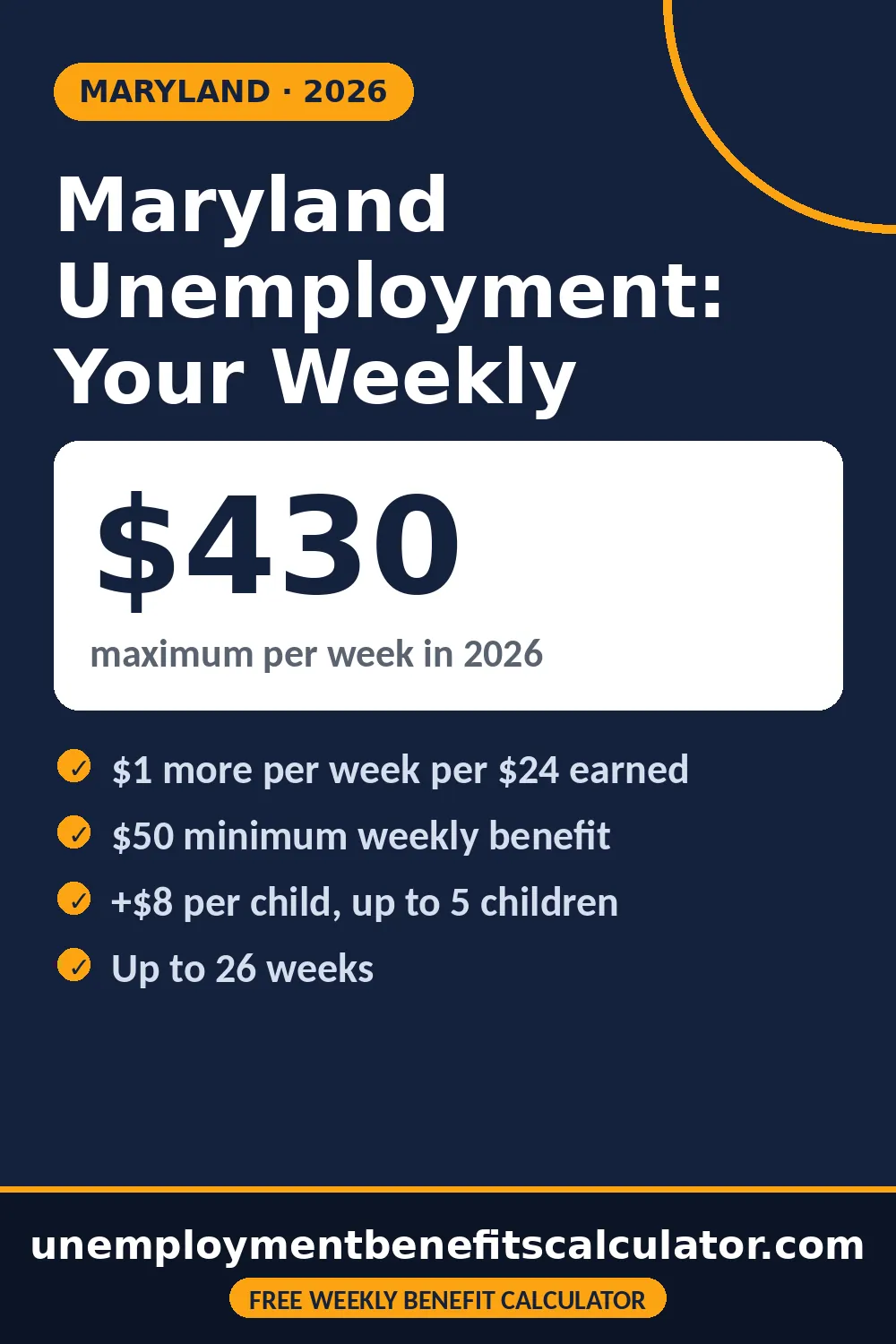
Maryland prices a weekly check like an old-line clerk rules a ledger: one dollar of benefit for every full $24 you earned in your best quarter, ruled line after line up to $430. The rest of the claim is where Maryland breaks from its neighbors — a 1.5-times wage test rejects lopsided years, dependent children add $8 apiece, the first $50 of weekly earnings never touches the check, and there is no waiting week.
Max weekly check
$430
high quarter above $10,296 hits the cap
Duration
26 weeks
the standard maximum, kept intact
Formula
HQ ÷ 24
each $24 of wages buys $1 a week
Waiting week
None
first eligible week is payable
Verified against Maryland sources · October 2026
Md. Code, Labor & Employment §8-803 · Schedule of Benefits
Three lines that tell the whole story
The legislature wrote Maryland’s benefit math as one long table — 381 lines, each covering $24 of high-quarter wages and paying one dollar more than the line before. The three lines below are the floor, a mid-rung, and the cap.
| Line | High quarter wages | Weekly amount |
|---|---|---|
| 1 | $1,176.01 – $1,200.00 | $50.00 |
| 222 | $6,480.01 – $6,504.00 | $271.00 |
| 381 | $10,296.01 and over | $430.00 |
Weekly rate
HQ ÷ 24, rounded up
Total payable
26 × rate
Waiting week
none
First tool
Maryland unemployment calculator: walk the schedule line by line
Maryland’s arithmetic needs exactly two figures: the quarter you earned the most, and everything you earned across the base period. Pull both from pay stubs, the BEACON wage records, or last year’s W2s. The ledger divides by 24, rules out your line on the statutory schedule, applies the 1.5× test with its six-line safety walk, adds $8 per dependent child, prices the 26-week pot, and previews a part-time week against the $50 disregard. Nothing is stored; the arithmetic happens in your browser.
The ledger · first tool
Rule out your line — $24 of wages per dollar
Maryland prices the week from one quarter and one total. Enter both from your wage records — the ledger walks the same statutory schedule the Division does.
Wages are gross. The children field feeds the $8-per-child allowance — $40 is the five-child maximum. Part-time wages run through the $50 disregard; leave it at zero for a full-check week.
High quarter ≥ $1,176.01
Your HQ $0 vs the $1,176.01 floor of line 1
Total ≥ 1.5× your schedule line
Enter a high quarter to price this test
The ledger is open — write two numbers in it
Maryland’s schedule needs your highest quarter and your base-period total. Everything else — the line, the walk, the children, the part-time week — follows from those two figures.
The direct answer
How much does unemployment pay in Maryland?
Maryland unemployment pays between $50 and $430 a week in 2026, depending on your highest base-period quarter. The Division’s own guidance prints the range: every full $24 of high-quarter wages moves you one line up the schedule, worth one more dollar a week, until the table tops out at $430. Most mid-range claims land between $200 and $350. Add $8 a week for each dependent child under 16 (up to five) — and there is no waiting week; the first certifiable week pays.
Three worked salaries show the shape of it — high quarter = weekly pay × 13, then ÷ 24, rounded up to the next dollar:
| You earned a week | Highest quarter | Estimated weekly check |
|---|---|---|
| $400 | $5,200 | $217 |
| $650 | $8,450 | $353 |
| $1,000 | $13,000 | $430 — the cap |
| $1,400 | $18,200 | $430 — still the cap |
Steady-pay assumption: high quarter = weekly pay × 13. Check = HQ ÷ 24, rounded up, clamped to $50–$430; dependents add $8 per child up to five.
The same schedule logic works in every state, with different floors and caps — see how much unemployment pays across the country, or price your own quarter with the Maryland calculator.
Worked example · the $1,000-a-week earner
A steady $1,000 a week looks like it should buy a fortune in benefits. Run it through the schedule and watch the cap bite. High quarter: $1,000 × 13 = $13,000. Now the ladder: $13,000 ÷ 24 = 541.67, which would rule out on a $542 line — but the table stops at line 381, so the check is $430, not $542.
The lesson: above a $10,296.01 high quarter, extra earnings add zero. The schedule rewards a steady year, not a towering quarter — and the 1.5× test still demands $15,480 in total wages even at the cap.
Register 01
Maryland unemployment amounts 2026: the $24 ladder from $50 to $430
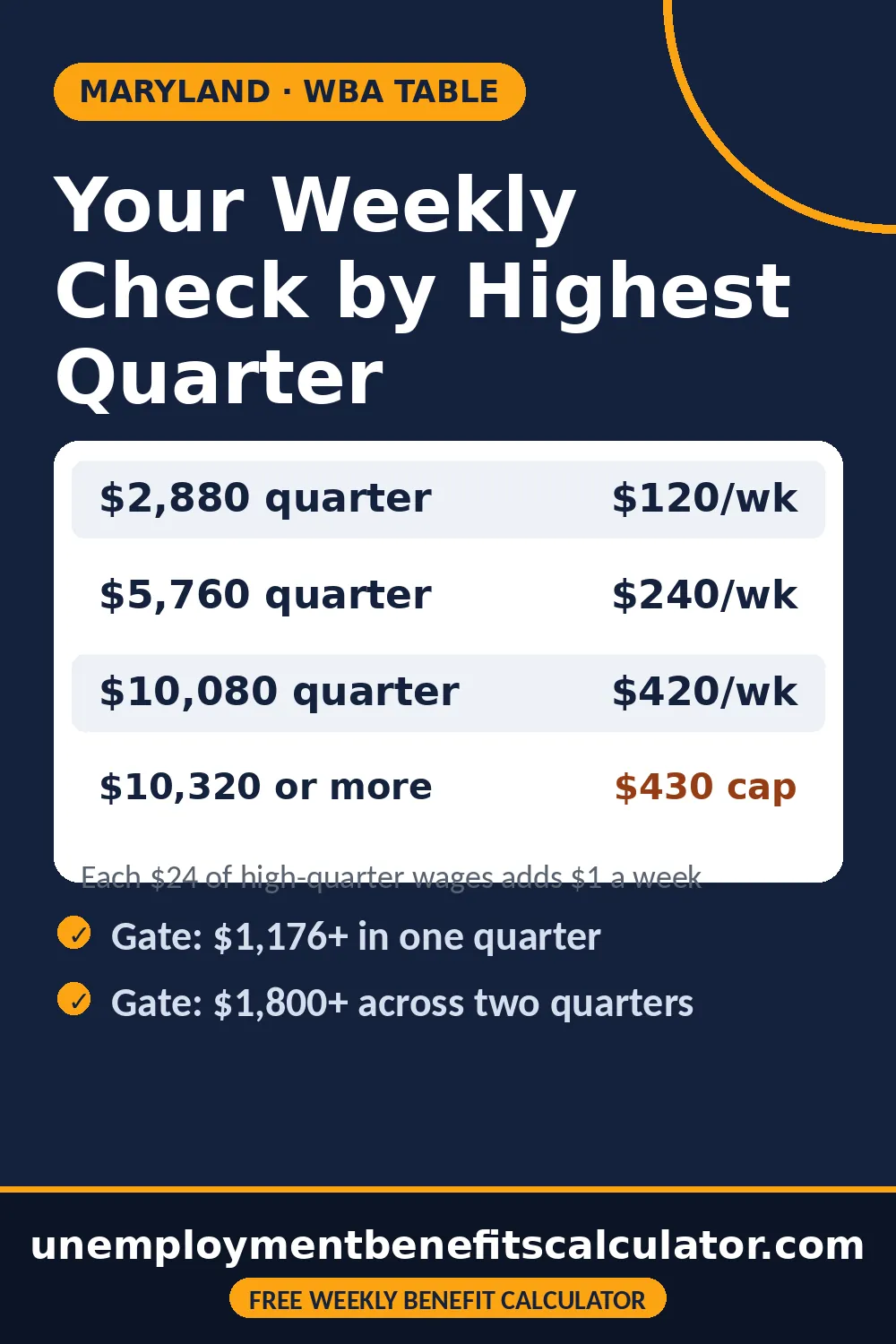
Most states hand you a formula and let you do the algebra. Maryland’s legislature instead wrote the whole benefit table into the law book — 381 lines running from $50 to $430, printed in Md. Code, Labor & Employment §8-803. Each line covers a $24 band of high-quarter wages and pays one dollar more than the line above. Read it top to bottom and the pattern holds: for every full $24 you earned in your best quarter, your weekly check grows by $1.
That makes the arithmetic quicker than it sounds. Take your highest-earning quarter from the base period, divide by 24, and round up to the next dollar. A high quarter of $6,500 lands on $271 a week; one of $9,600 lands on $400. Anything at or above $10,296.01 rules out on line 381, and the check stops climbing at $430 no matter how much more you earned.
Two boundary details matter as much as the formula. First, the schedule in force on the first day of your benefit year follows you for that entire year — your line is locked. Second, the ladder has no rung below line 1: a high quarter that clears the $1,176.01 entry bar pays $50, never less, while one that fails the bar pays nothing at all.
The rounding rule runs one way. §8-803(d)(2) rounds a fraction to the next lower dollar when the Division computes a payment — so a $6,505 quarter rules out on the $272 line, but the payroll clerk never rounds your pocket money up. The ladder rounds up to reach your line; every deduction after that rounds down.
The 2026 ladder, sampled
high quarter → weekly rate
| High-quarter wages | Weekly amount |
|---|---|
| $1,176.01 – $1,200 | $50 |
| $2,376.01 – $2,400 | $100 |
| $3,576.01 – $3,600 | $150 |
| $4,776.01 – $4,800 | $200 |
| $6,480.01 – $6,504 | $271 |
| $7,176.01 – $7,200 | $300 |
| $8,376.01 – $8,400 | $350 |
| $9,576.01 – $9,600 | $400 |
| $10,176.01 – $10,200 | $425 |
| $10,296.01 and over | $430 |
Weekly amount = high quarter ÷ 24, rounded up, clamped to $50–$430. “Total wages needed” is the 1.5× test — 1.5 × the top of that line’s band (§8-803 column C; line 1’s $1,800 is printed on the Division’s Do-I-Qualify page).
Register 02
Two money tests stand between you and the ladder
Finding your line on the schedule earns nothing by itself. Maryland guards the ladder with two wage tests, and a claim that fails either one never opens. Both read from the same base period, which is why the Division can issue a monetary determination before it ever asks what happened at your old job.
The high-quarter floor: $1,176.01
Your single best quarter must clear $1,176.01 in covered wages — the bottom edge of schedule line 1. Clear it, and your line is found by the $24 rule; miss it by a dollar and there is nothing to rule out on. The test catches short stints: about four weeks at minimum wage just misses; six or seven full-time weeks clear it.
The Division pairs the floor with a spread requirement: at least $1,800 in total wages across two or more quarters. One magnificent quarter alone cannot carry a claim, however large it was.
The 1.5× test: total wages vs. your line
Your base-period total must reach one and a half times the top of the schedule line your high quarter lands on. Line 1 requires $1,800 in total wages; the $271 line requires $9,756; the $430 cap line requires $15,480. This is Maryland’s defense against boom-and-bust work histories — the bounty year with nothing around it.
The statute prints the required total as column (C) of the table: your line names the exact dollar figure your whole year must beat.
The six-line walk — Maryland’s safety rope
Failing the 1.5× test at your high quarter’s line would strand a lot of honest workers, so §8-803(a)(2)(ii) builds in a graceful descent. If your total wages do not qualify you at your line, the Division walks down the schedule — one line at a time, up to six lines — looking for a rung where the required total finally fits your year. Each lower line costs one dollar a week.
Your line
$7,000 HQ → $292
needs $10,512 total
Walk one rung
$291 line → $10,476
total $10,480 fits — qualified
Miss by more
6 lines down, still short
claim fails — no benefits
Register 03
Base periods: the 18-month lookback and the alternate escape hatch
Every dollar on the ladder comes from one window: the base period, the first four of the last five completed calendar quarters before the week you file. Maryland skips the most recent quarter on purpose — employers need time to report wages — so the window can stretch back eighteen months. File in September 2026 and the skipped quarter is the one that just ended in June; the schedule reads your wages from July 2024 through March 2026.
Filing window → base period, mapped
claims filed in late 2026
| You file between | Base period (first 4 of last 5) |
|---|---|
| Oct 1 – Dec 31, 2026 | Jul 2025 – Jun 2026 |
| Jan 1 – Mar 31, 2027 | Oct 2025 – Sep 2026 |
| Apr 1 – Jun 30, 2027 | Jan 2026 – Dec 2026 |
| Jul 1 – Sep 30, 2027 | Apr 2026 – Mar 2027 |
Calendar quarters run January–March, April–June, July–September, and October–December, regardless of how your employer divides pay periods.
The lag cuts both ways
A strong spring pays a claim filed in autumn, because those wages have had time to land in the record. The reverse bites too: laid off in June with a fat spring quarter, a July filing skips the very quarter you just worked — it will not count until October.
Never delay filing to chase a better base period without weighing the weeks of benefits you would surrender first.
The alternate base period
Maryland runs an alternate base period alongside the standard one: the most recently completed four quarters, skipping the five-quarter lag. Claimants whose standard window misses their best earnings can qualify under it when the standard one falls short.
The Division applies the alternate automatically when it produces a better result, so a thin monetary letter deserves a second look before you accept it as final.
Register 04
Dependents: $8 a child, up to five, and the ceiling that erases the check bump
§8-804 pays a dependents’ allowance of $8 per week for each child you wholly or partly support — biological, adopted, or stepchild — as long as the child was under 16 on the first day of your benefit year. Five children is the cap, so the allowance tops out at $40 a week. The Division wants proof — a Social Security number or birth certificate for each child — and only one parent may claim the same child at a time.
Three quiet rules trim the allowance at the edges. It is payable only in weeks a regular benefit is payable, so a disqualified week pays no dependent money either. It stops when the 26-week clock runs out. And dependents are locked at the initial claim: a child born in May does not join a February filer’s claim until the next benefit year.
Then there is the ceiling nobody reads until it bites. §8-804(b)(2) caps the combined weekly total — schedule amount plus allowances — at $430. A claimant already drawing $410 with three children would reach $434 on paper, but the payment stays $430. Past a certain wage history, the children add nothing at all.
The $430 phase-out, priced
WBA + $8 × kids → actual check
| Schedule rate | 2 kids (+$16) | 5 kids (+$40) |
|---|---|---|
| $250 | $266 ✓ | $290 ✓ |
| $350 | $366 ✓ | $390 ✓ |
| $395 | $411 ✓ | $430 (capped) |
| $430 | $430 (capped) | $430 (capped) |
Once the schedule rate passes $390, five children’s $40 allowance starts clipping; at the $430 cap it is gone entirely. The calculator flags this phase-out.
Register 05
The first $50 you earn never touches the check
Maryland wants claimants to take whatever work they can find, and §8-803(d)(1)(iii) proves it with arithmetic. The statute subtracts any wages exceeding $50 from the weekly payment — the first $50 of gross earnings each week is ignored completely. Earn $49, collect your full check. Earn $150, lose only $100. Earn $50 over your benefit rate, and the week pays zero while staying certifiable.
One check, four earnings weeks
schedule rate $410 · no dependents
| Gross earnings that week | Disregarded | Deducted | Check paid |
|---|---|---|---|
| $0 (no work) | — | — | $410 |
| $49 | $49 | $0 | $410 |
| $150 | $50 | $100 | $310 |
| $460 | $50 | $410 | $0 — certifiable |
Report gross earnings in the week the work was performed, not the week the paycheck landed — a common and expensive mix-up.
Election judges keep it all
Buried in §8-803(d)(3) is a small civic gift: pay for serving as an election judge for a Maryland local board of elections is excluded from the wage deduction entirely. Poll workers can collect a day’s election pay and a full check in the same week.
Part-time claimants have their own lane
Workers who were part-time before the layoff stay eligible while looking only for part-time work, under three conditions: at least 20 hours a week for six months of the base period, a search for jobs with the same hours (or at least 20), and a local market with part-time demand.
The same $50 disregard applies to their weeks, so a 12-hour weekend shift rarely dents a part-timer’s check.
Register 06
No waiting week: Maryland pays from the first certifiable week
Most of the country takes a bite out of every new claim: one unpaid waiting week, served up front before the first check. Louisiana takes it. Texas takes it. Virginia takes it. Maryland never built one into its program — §8-803(d) computes a payment for an eligible week without ever carving out a week one exception.
The practical difference is real money. On a $300 weekly rate, a waiting week costs $300 — a full check surrendered to the calendar. Certify promptly from day one and Maryland’s first payment can land inside the window other states use just to clear their waiting week.
What Maryland does have is processing time. The Division aims to issue a determination about 21 days after you file, and a contested claim can stretch longer. Budget for the three quiet weeks after filing — the money is not surrendered, it simply has not started moving yet.
Regional reality check
Maryland is the outlier — the only one of the seven jurisdictions that pays week one.
Register 07
26 weeks on the regular program — the full-length clock
While a dozen states have trimmed their standard programs to 12–25 weeks, Maryland still runs the traditional maximum: 26 weeks of regular benefits. Every eligible week you certify draws one check; 26 in a row exhaust the pot. The clock runs on weeks claimed, not weeks unemployed, and partial weeks with earnings can stretch the window further.
The schedule is frozen at day one
§8-803(c) pins the schedule in effect on the first day of your benefit year to your claim for its whole life. A benefit year lasts 52 weeks, and within it your weekly rate cannot drift — even a statutory table change cannot move your check.
Extended Benefits wait in the wings
Maryland’s Extended Benefits program can add 13 weeks — half computed from regular benefits, half from 13 times the weekly rate — but only while state or national unemployment triggers fire. In normal years the program sits dormant.
Federal tiers are event-driven
Pandemic-era programs like PEUC are not on the books in 2026. Any federal extension would need new legislation, so treat 26 weeks as the working number and treat rumors of tier extensions as just that.
The pot arithmetic is simple enough to plan around: weekly schedule rate, plus any surviving dependent allowance, times up to 26 payable weeks. A $271 claim draws at most $7,046; a maxed $430 claim draws $11,180. The calculator at the top prices your own pot.
Register 08
Filing in BEACON: what to gather before you sit down
Maryland runs its unemployment system through BEACON, the claimant portal at beacon.labor.maryland.gov, open around the clock. Prefer a human voice? Claims agents take filings at 667-207-6520, Monday through Friday, 8 a.m. to 4 p.m., and Maryland Relay at 711 handles accessible calls. The claim starts the day it is filed — never backdated, so file in the same week you stop working. New to the process? The walkthrough in how to apply for unemployment online pairs with this checklist.
The pre-filing checklist
- Social Security number (and each dependent child’s SSN or birth certificate)
- Contact details and a working email — BEACON notices land there
- Employers from the last 18 months: legal name (from the W-2), address, phone
- First and last day worked at each job, plus the separation reason
- For federal workers: SF-8 or SF-50, and the 935 affidavit when assigned
- For military service: DD-214, Member 4 copy
- For non-citizens: Alien Registration Number
- For union members: union name and local number
Then, in order
File the claim
BEACON online or by phone; benefit year starts that day.
Register in MWE
Required — separate site, separate login.
Upload your résumé
Create or upload one, then select "Allow Employers to View My Résumé Online."
TrueID verification
BEACON routes identity checks through TrueID — upload documents or call an agent.
Watch the Action Items
Determinations, tasks, and affidavit requests appear in BEACON; missed items delay payments.
The Division aims to issue its determination within 21 days of filing — the monetary letter that names your schedule line, or the fact-finding that precedes it.
Day 0
File + MWE
claim effective that Sunday
Day 1–21
Determination
schedule line assigned
Every Sunday
Certify
BEACON, app, or phone line
~Week 3–4
First payment
direct deposit or debit card
Register 09
Your weekly rhythm: log three, certify Sunday, never skip
Once benefits start, every week runs the same two-step, and Maryland is strict about the order. Step one: document at least three reemployment activities in the Maryland Workforce Exchange before anything else. Step two: certify in BEACON between Sunday 12:01 a.m. and Saturday 11:59 p.m. for the week just ended. Certifying before logging is the most common self-inflicted delay.
The three activities — one must be a direct contact
Direct job contact — at least 1 each week
An application submitted (in person, online, by email or fax), an in-person approach to a potential employer, or a job interview — something aimed at a specific employer.
Supporting activities — the other 2
Résumé or profile work on MWE, job fairs, workshops, career-center appointments — documented in the weekly search log with dates and details.
- MWE résumé must stay public: "Allow Employers to View My Résumé Online."
- The MWE inbox carries assigned tasks — ignored tasks can delay or deny payments.
- MWE and BEACON logins are separate; saving both is a five-minute favor to yourself.
Certification: three channels, one Sunday rule
BEACON portal
Weekly Certification in the menu, any time.
MD Unemployment for Claimants app
iOS and Android — but it cannot file the first claim.
Automated phone line, 24/7
410-949-0022 from Baltimore or out of state; 800-827-4839 elsewhere in Maryland. Write down the confirmation number.
Answer the availability and work-search questions honestly, report every dollar of gross earnings, and request weeks with zero pay too — an uncashed week is a lost week.
Exemptions from work search exist — union hiring halls, temporary layoffs with a recall date, approved training — but they are granted, not assumed. Confirm yours in BEACON.
Register 10
Fired, laid off, or quit: how Maryland sorts the endings
The Division contacts every former employer you list, asks why you separated, and decides whether the ending was “through no fault of your own.” Maryland’s guidance draws the map plainly: layoffs for lack of work, employer-driven hour cuts, the end of a temp assignment, discharge short of misconduct, and quits with work-related good cause all qualify. Misconduct discharges and quits without good cause do not — at least not without a fight.
Clearly qualifying
- • Laid off because the work ran out
- • Hours cut by the employer
- • Temp contract reached its end date
- • Fired for poor performance, not willful misconduct
Reviewed case by case
- • Quit with work-related good cause — medical, safety, harassment the employer ignored
- • Quit to follow a relocating spouse
- • Constructive discharge — the job was made unbearable on purpose
- • Mutual separations and buyouts
Usually disqualifying
- • Quit for personal convenience
- • Fired for willful misconduct — theft, violence, no-shows
- • Refusing suitable work without good cause
- • Leave of absence — still attached to the employer
Evidence wins reviews. If you quit or disagree with the employer’s account, bring proof — emails, schedules, pay stubs, a doctor’s note. The Division decides on paper first; the claimant who arrives with documents rarely needs the hearing to prove what the file shows.
Register 11
Severance, vacation pay, and pensions: the offset rules
Money from your old employer does not always stack with unemployment. Maryland’s rule, restated on the Division’s qualification page: if you are still receiving severance, vacation, sick pay, or pension payments, your benefits may be canceled out or reduced until those payments stop. The Division’s own example makes it concrete — a $300 benefit against $200 a week of severance leaves a $100 check for those weeks.
What usually offsets
- Severance paid out weekly after the separation
- Payment in lieu of notice — wages by another name
- Accrued vacation and sick leave paid on a schedule
- Pension income from base-period employment
Lump-sum severance can be allocated across weeks, which is why the determination sometimes starts later than the filing date.
Report it, never hide it
The Division learns about severance two ways: you disclose it on the claim, or the employer mentions it during the separation review. Hidden payments surface later as overpayments — with the fraud toolkit attached — while disclosed payments simply pause or shrink the check.
Once the severance stream ends, the full check resumes; certifying every week during the offset keeps the claim alive.
Register 12
A worked claim: Maya in Baltimore
Maya worked five years for a Baltimore logistics firm before a September 2026 reduction in force. Her base period reads October 2024 through June 2026: a high quarter of $9,840, total wages of $15,240, two children aged 7 and 11, and a weekend bakery job grossing $150 a week. Here is her claim, line by line.
| 1 | Find the line | $9,840 ÷ 24 = 410.00 — she rules out at $410 |
| 2 | High-quarter floor | $9,840 ≥ $1,176.01 — pass |
| 3 | The 1.5× test | line 410 needs 1.5 × $9,840 = $14,760; Maya has $15,240 — pass |
| 4 | Dependents | 2 × $8 = $16 → $426, still under the $430 ceiling |
| 5 | Bakery week | $150 − $50 disregard = $100 deducted → $326 paid |
| 6 | The pot | 26 weeks × $426 = $11,076 maximum, no waiting week served |
Maya’s weekly check
$426
$410 schedule + $16 dependents
Bakery week
$326
26-week pot
$11,076
Her coworker Devon cleared $12,200 in his best quarter — cap territory — but only $15,300 in total wages against the $15,480 the cap line demands. The six-line walk rescues him at the $425 line, where $15,300 finally fits. His week: $425, not $430, and every rung of the walk cost him a dollar.
Register 13
Seven mistakes that cost Maryland claimants real money
Certifying before logging the week in MWE
Three documented activities first, certification second. Reversed weeks get flagged, and repeated flags freeze payments pending a review.
Letting the MWE résumé go stale
The requirement is an active, employer-viewable résumé. Upload once and never touch MWE again, and assigned tasks sit in the inbox — each one a potential payment delay.
Reporting net pay instead of gross
Earnings are reported gross, in the week the work happened. Net reporting undercounts, and the audit trail catches it — usually months later.
Hiding severance or vacation payouts
The employer discloses it anyway. Disclosed payments offset the check; concealed ones return as overpayments with penalties.
Missing the 15-day appeal window
The mailing date on the determination starts a 15-calendar-day clock. Three weeks spent calling around for advice is three weeks past the window — Maryland does not pause for reflection.
Skipping the $0 weeks
A week with no earnings still needs a certification request. Uncertified weeks never pay retroactively without a good-cause fight — free money left in the Division’s drawer.
Assuming the first determination is final
Wage records go stale, employers misreport dates, and the alternate base period exists for the miss. A thin monetary letter is a question — check it against your pay stubs.
Register 14
Appeals: 15 days, two levels, and the Board of Appeals
Every determination — monetary, eligibility, or separation — carries the same instruction: appeal within 15 calendar days of the mailing date. §8-806(g)(1) fixes the window, and Maryland counts from mailing, not receipt, so a letter that wanders eats your clock. Appeals go in through BEACON, in writing, or at a local office.
Lower Appeals Division
A hearing examiner takes evidence live — you, the employer, documents, witnesses. Most cases resolve here; the decision comes by mail with its own 15-day tag.
Board of Appeals
A written appeal — mail, fax, or email — within 15 days of the Lower Appeals decision. The Board reviews the record and can hear arguments before deciding.
Circuit court and beyond
Judicial review in circuit court is available after the Board — a different arena, and the point where lawyers stop being optional.
File first, perfect later. A one-line written appeal — “I disagree with the determination mailed [date] and want a hearing” — preserves every right you have. The hearing is where the evidence gets built, and benefits keep flowing for claimants who keep certifying each week.
Register 15
Overpayments, waivers, and the $807 million backdrop
An overpayment notice is not a moral judgment — it is an accounting event. Unreported wages, severance the employer disclosed late, availability questions answered wrong: any of these can leave you holding benefits the law says were not yours. What happens next depends entirely on one word: fraud.
Non-fraud overpayment
Honest mistakes get the repayment plan, not the prosecution. Maryland waives non-fraud overpayments for claimants in financial hardship — COMAR’s waiver process asks whether the overpayment was without fault and whether recovery would be against equity and good conscience. Future benefits can be intercepted to recoup the balance.
Fraud finding
A fraud determination carries the statute’s full weight: restitution of every dollar, penalties and interest on top — Maryland law reaches 15 percent of the overpayment and up to 90 days — plus a consequence the Division states plainly: you cannot collect again for a year, and repayment comes first. State tax refunds can be intercepted too. Identity-theft victims have their own track — report it immediately and the finding stays off your record.
The scale behind the enforcement
A January 2026 state audit reported $807 million in pandemic-era overpayments paid out between November 2020 and January 2025 — roughly $760 million of it effectively uncollectible, much from identity theft. The Division’s answer is the current regime: tighter TrueID checks, wage matching, aggressive collection. The takeaway for a 2026 claimant is simple — report everything, every week, and the machinery never has a reason to point at you.
Register 16
Taxes: Maryland wants its share too
The Division’s 1099-G page says it without hedging: unemployment benefits are subject to both federal and state income taxes and must be reported on your return. Some states wave their share; Maryland does not.
Withholding is optional
You can elect 10 percent federal withholding on the weekly certification. Maryland does not withhold state tax from checks — the bill arrives when you file, so setting aside a slice of each check is the honest version of a plan.
The 1099-G arrives by late January
BEACON issues the form electronically and the Division mails copies. An overpaid benefit still shows as paid on the 1099-G per federal law — reconcile it with the repayment paperwork at tax time.
Filing season discipline
Check the 1099-G against your own weekly cert records before filing — the Comptroller’s e-file system cross-matches the Division’s numbers automatically.
Register 17
Work Sharing, FAMLI, and the reform that didn’t pass
Work Sharing: the layoff alternative
Maryland invented its version in 1984 — one of the oldest Work Sharing programs in the country. Employers facing a downturn cut hours across an affected unit by 10 to 60 percent instead of laying people off, and workers collect prorated partial benefits to fill the gap. It is employer-filed, so ask HR before assuming a full claim is the only path.
FAMLI is a different door
Maryland’s Family and Medical Leave Insurance program — a separate system run by its own division — began paying benefits July 1, 2026. FAMLI covers serious illness, a new child, or family care; unemployment covers job loss. The two are administered apart, but a period can straddle both, and the concurrent-receipt rules are worth checking before you plan it.
The Modernization Act, 2026: failed
SB 3 and its House twin HB 188, the “Unemployment Insurance Modernization Act of 2026,” would have rewritten the schedule: a maximum at 40 percent of the state average weekly wage phased in by January 2027, a minimum tied to 15 percent, a heavier taxable wage base. It died on the final night of the session. The $24 ladder — and the $430 cap frozen since 2010 — survived intact, and the solvency concerns behind the debate are not going away.
Watch the next session, not the rumor mill. The failed bill signals the schedule will eventually move — the argument is over funding, not whether $430 since 2010 is low. Until a bill passes, every claim rules out on the 381 lines printed in §8-803, and this page’s calculator matches them.
Register 18
Maryland against the typical state: where the Old Line breaks ranks
| Rule | Maryland | The typical state |
|---|---|---|
| Weekly formula | Statutory schedule: HQ ÷ 24, rounded up | A fraction of HQ wages or AWW, with a printed cap |
| Weekly range | $50 – $430 | Roughly $235 (MS) – $1,033 (MA) |
| Waiting week | None — first eligible week pays | One unpaid week in most states |
| Dependent allowance | $8 per child under 16, max 5, capped inside $430 | About half the states pay none |
| Partial earnings rule | First $50 ignored, then dollar-for-dollar | Disregards vary wildly by state |
| Duration | 26 weeks standard | 12–26 weeks; some rate-triggered |
| Monetary gates | HQ ≥ $1,176.01 and total ≥ 1.5× your schedule line | HQ- and total-wage minimums, usually no 1.5× twist |
| Work search | 3 activities incl. 1 direct contact, logged in MWE | 1–5 contacts; many informal logs |
| State tax on benefits | Yes — Maryland taxes UI like ordinary income | A number of states exempt benefits entirely |
Typical-state comparisons reflect national program summaries published by CBPP and the U.S. Department of Labor; every state’s details vary.
Keep reading
Guides that pair with a Maryland claim
Register 19
Sources & verification
Every number on this page was re-checked against the sources below on October 8, 2026 — the Do-I-Qualify page, the official Claimant Handbook, the appeals page, and the weekly-certification guide were fetched and read directly. The 2026 legislative session ended with the schedule untouched, but statutes get amended; verify anything time-sensitive before relying on it.
- 1Md. Code, Labor & Employment §8-803 — Weekly Benefit Amount (381-line schedule, payment formula, $50 disregard, election-judge exclusion) law.justia.com/codes/maryland/2025/labor-and-employment/title-8/subtitle-8/section-8-803/
- 2Md. Code, Labor & Employment §8-804 — Allowance for Dependents ($8 per child, five-child cap, $430 combined ceiling) law.justia.com/codes/maryland/2025/labor-and-employment/title-8/subtitle-8/section-8-804/
- 3Md. Code, Labor & Employment §8-802 — Wages for Covered Employment (high-quarter floor, total-wage tests) law.justia.com/codes/maryland/2025/labor-and-employment/title-8/subtitle-8/section-8-802/
- 4Maryland Department of Labor — Do I Qualify for Unemployment Insurance Benefits? ($50–$430 range, $1,176.01 / $1,800 thresholds, 21-day aim, severance example, fraud ban) — fetched October 8, 2026 labor.maryland.gov/unemployment-insurance/claimants/do-i-qualify.shtml
- 5Maryland Department of Labor — UI Claimant Handbook, PDF (dependents’ allowance, $50 disregard, base periods, certification window) — fetched October 8, 2026 labor.maryland.gov/employment/clmtguide/uiclmtpamphlet.pdf
- 6Maryland Department of Labor — How to Apply for and Collect Benefits (BEACON filing, checklist, phone lines) labor.maryland.gov/unemployment-insurance/claimants/
- 7Maryland Department of Labor — Weekly Certification (Sunday–Saturday window, gross earnings, earnings ≥ WBA) — fetched October 8, 2026 labor.maryland.gov/unemployment-insurance/claimants/weekly-certification.shtml
- 8Maryland Department of Labor — Job Search Requirements (three activities, one direct contact, MWE résumé) labor.maryland.gov/unemployment-insurance/claimants/job-search.shtml
- 9Maryland Department of Labor — Work Sharing for Avoiding Layoffs (est. 1984, 10–60% hour reduction) labor.maryland.gov/unemployment-insurance/employer-agent/work-sharing-avoiding-layoffs.shtml
- 10Maryland Department of Labor — 1099-G Income Tax Form (federal and state taxation) labor.maryland.gov/unemployment-insurance/technical-support/1099G-tax-form.shtml
- 11Maryland Department of Labor — Audits and Overpayments (waiver process, collection) labor.maryland.gov/unemployment-insurance/claimants/audits-and-overpayments/
- 12Maryland Department of Labor — UI Appeals (15-day appeal window from mailing date) — fetched October 8, 2026 labor.maryland.gov/uiappeals/
- 13People’s Law Library of Maryland — UI Benefits: Eligibility (updated August 2026; base period, ABP, 26 weeks) www.peoples-law.org/unemployment-insurance-benefits-1-eligibility
- 14Maryland General Assembly — HB 188 / SB 3, Unemployment Insurance Modernization Act of 2026 (proposed 40% AWW maximum; failed) mgaleg.maryland.gov/
- 15U.S. Bureau of Labor Statistics — Local Area Unemployment, Maryland (4.2% preliminary, July 2026) www.bls.gov/lau/
- 16FRED — Maryland Unemployment Rate series fred.stlouisfed.org/series/MDUR
- 17IRS Topic 418 — Unemployment Compensation (federal taxation, optional 10% withholding) www.irs.gov/taxtopics/tc418
- 18Comptroller of Maryland — individual income tax (state taxation of UI) www.marylandtaxes.gov/
- 19CBPP — How Many Weeks of Unemployment Compensation Are Available? (national duration comparison) www.cbpp.org/research/economy/how-many-weeks-of-unemployment-compensation-are-available
- 20U.S. Department of Labor — Unemployment Insurance program overview www.dol.gov/unemployment
Not affiliated with, endorsed by, or operated by the Maryland Department of Labor or any government agency. This page is an independent calculator and guide; official answers come from the Division of Unemployment Insurance and its BEACON portal. Full-time research by Wasim Akram; last verified October 2026.
Straight answers
Maryland unemployment questions, answered
How much unemployment will I get in Maryland?
Maryland runs a 381-line schedule: every full $24 you earned in your highest base-period quarter adds $1 to the weekly check, starting at $50 and stopping at $430. A high quarter of $6,500 lands on the $271 line, while anything above $10,296 hits the $430 cap. Add $8 a week for each dependent child under 16, up to five, and the calculator at the top of this page runs the same schedule plus the two wage tests.
How long do Maryland unemployment benefits last?
The regular program pays up to 26 weeks, the longest standard duration most states offer. Maryland can layer Extended Benefits on top during recessions and Congress sometimes funds extra weeks nationally, but a routine 2026 claim should budget for 26 weeks at most. The schedule amount is frozen on day one of your benefit year, so a rate change mid-year does not move your check.
Why did my Maryland claim get denied even though I worked all year?
Maryland applies two monetary tests, and the second one quietly rejects lopsided years: your total base-period wages must reach 1.5 times the top of the schedule line your high quarter lands on. A $10,000 quarter needs at least $15,000 in total wages, so one booming season surrounded by thin months can fail even though the year looked healthy. You also need the high quarter itself to clear $1,176.01 and wages spread across at least two quarters.
Is there a waiting week in Maryland?
No — Maryland never built one into the program, a small club of states. Once your claim is processed and you certify an otherwise eligible week, that first week is payable rather than surrendered the way it is in Louisiana, Texas, and most of the country. The gap that does exist is timing: the Division aims to decide within 21 days, so plan on roughly three weeks before money moves.
Can I work part-time and still collect Maryland unemployment?
Yes, and the rule is generous at the margin. Maryland ignores the first $50 you earn in a week; every dollar above that comes off the check one for one. A worker drawing $410 with two $8 dependent allowances can gross $150 at a weekend job and still receive $326. Report gross earnings every week, and certify weeks that pay nothing to keep the claim alive.
How many job searches does Maryland require each week?
Three documented reemployment activities every week, at least one a direct job contact — an application, an interview, an in-person visit, or a written outreach to a specific employer. Log everything in the Maryland Workforce Exchange, keep a public résumé there, then complete the weekly certification in BEACON. Watch the MWE inbox: skipped tasks can freeze payments until they are done.
What happens if I was fired or I quit in Maryland?
A misconduct discharge and a quit without work-related good cause both trigger a disqualification review, and the Division contacts your former employer for its side of the story. Maryland distinguishes ordinary poor performance from misconduct, and a quit for personal convenience is not automatically good legal cause. Either side can appeal within 15 days of the mailing date.
How do I file a claim in Maryland?
File online through the BEACON claimant portal, open around the clock, or by phone with a claims agent at 667-207-6520, Monday through Friday 8 a.m. to 4 p.m. Have your Social Security number, 18 months of employer details with separation reasons, and each dependent child’s information ready. Identity checks run through TrueID inside BEACON, and the claim is never backdated.
Does Maryland tax unemployment benefits?
Yes, twice. The IRS taxes every dollar of unemployment income, and Maryland includes benefits in state taxable income — the Division says so on its 1099-G page. You can elect federal withholding on the weekly certification, but Maryland collects its share when you file the state return. A 1099-G covering the year arrives by late January.
How do I appeal a Maryland unemployment decision?
You have 15 calendar days from the mailing date on the determination to appeal to the Lower Appeals Division — through BEACON, in writing, or at a local office. A hearing examiner takes evidence, and either side can carry the case to the Board of Appeals within another 15 days of that decision. Missing the first window generally closes the appeal, so calendar it the day the letter arrives.
Around the Chesapeake