The Harbor Beacon Ledger
Verified against michigan.gov/leo/uia · September 2026
Michigan Unemployment Calculator: 4.1% of Your Best Quarter, Up to $530 a Week
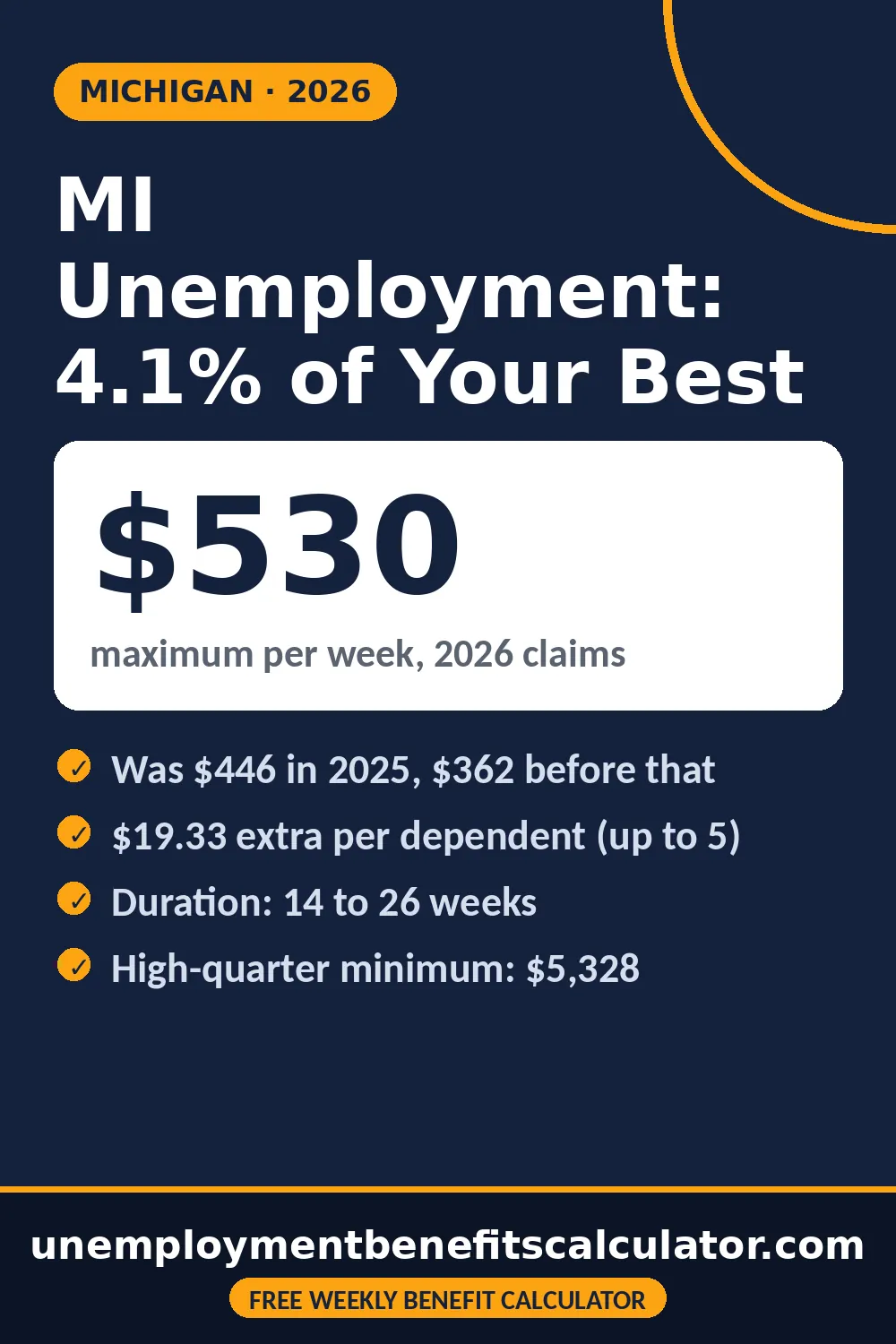
Michigan pays up to $530 a week on claims filed in 2026. That is the new HB 4406 cap.
Your own number starts at 4.1 percent of your highest quarter. Five dependents add $19.33 each.
The tool below runs the full formula, the 14-to-26-week span, and a part-time check in one pass.
$530
max weekly rate
$96.65
max dependent add-on
26
weeks at the cap
$5,328
high-quarter minimum
Last updated: October 10, 2026. Figures follow current Michigan UIA rules - confirm details with the agency before you file.
Run Your Michigan Numbers
The 4.1% engine behind every figure on this page.
Harbor Beacon Estimator
4.1% engine · $530 cap · $19.33 per dependent · 14-to-26-week span
Weekly rate
$394
4.1% of $9,600
With dependents
$394
no dependents selected
Weeks of benefits
16
43% rule: 15.7 raw
Part-time verdict
Full week available
1.5× ceiling: $591
Withholding preview (illustrative)
$39.40
10% federal
$16.75
4.25% Michigan
$337.86
rough net per week
Estimates follow MCL 421.27 and the UIA's 2026 rate notice. The UIA rounds its own figures, and border cases can differ.
Nothing here is legal or tax advice.
The Quick Answer for 2026
Michigan unemployment runs on one simple rate. The UIA pays 4.1 percent of your highest quarter.
That raw figure then meets the $530 cap. Dependents stack $19.33 each on top, up to five.
Duration works separately. The UIA takes 43 percent of your total base wages and divides by your weekly rate.
That division lands between 14 and 26 weeks. Most minimum-qualifying claims settle near 16 weeks. The tool above already runs it.
Chart Note
Claims filed in 2026 use $530, $19.33, and the 26-week limit. Those are the live HB 4406 numbers.
On January 1, 2027, the cap moves to $614 and the dependent rate to $26.
The 4.1% Formula, Worked
One multiplication, one cap, and the answer is your week.
Take your single best quarter from the base period. Multiply it by 0.041, nothing more.
A $9,600 quarter works out to $393.60, so the check rounds near $394. The math stays flat above the cap.
Once a quarter clears $12,927, the 4.1 percent product passes $530. The cap then holds the check down.
Here is the ladder the UIA formula produces. The week column assumes the bare-minimum wage test of 1.5 times your best quarter.
| Highest quarter | Weekly rate | With 5 dependents | Weeks at minimum wages |
|---|---|---|---|
| $5,328 | $218 | $314.65 | 16 weeks |
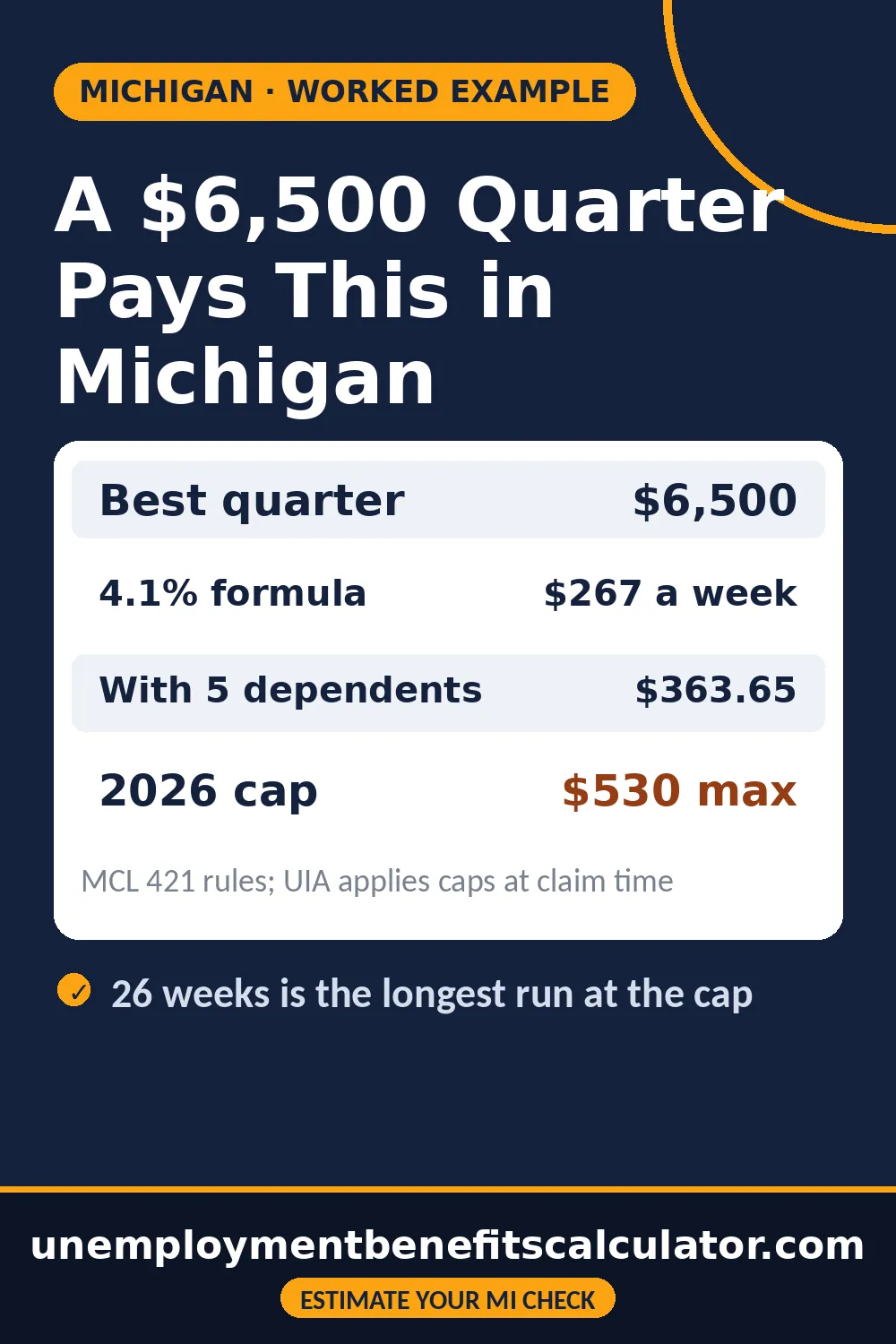
| $6,500 | $267 | $363.65 | 16 weeks |
| $8,000 | $328 | $424.65 | 16 weeks |
| $9,600 | $394 | $490.65 | 16 weeks |
| $11,400 | $467 | $563.65 | 16 weeks |
| $12,927 | $530 | $626.65 | 16 weeks |
| $15,000 | $530 | $626.65 | 16 weeks |
Notice the last column never moves. At minimum qualifying wages, the 43 percent rule always lands near sixteen weeks.
Reaching 26 weeks takes a wage record with more than the minimum. Steady work across several quarters does it.
What Changed on January 1, 2026
HB 4406 rebuilt Michigan's benefit math in three annual steps.
Michigan froze its maximum at $362 for over a decade. Lawmakers finally reversed the 2011 cut in 2025.
Claims filed in 2025 saw the cap lift to $446. Claims in 2026 see $530. One law wrote both steps.
On January 1, 2027, the same law lifts it again to $614. The dependent rate follows the same arc.
| Claim year | Max weekly rate | Per dependent | Max weeks |
|---|---|---|---|
| Through 2024 | $362 | $6.00 | 20 weeks |
| 2025 claims | $446 | $12.66 | 26 weeks |
| 2026 claims | $530 | $19.33 | 26 weeks |
| 2027 claims | $614 | $26.00 | 26 weeks |
Shoal Warning
Old guides still quote $362 and 20 weeks. Michigan Legal Help and even some 2026 blogs carry those figures.
The UIA's own pages confirm $530, $19.33, and 26 weeks for 2026 claims. Trust the agency, not the archive.
Base Period and the Three Money Gates
The UIA checks three wage tests before any formula runs.
Your base period is the first four of the last five completed calendar quarters. It skips the most recent quarter.
Fail that test and the UIA tries the alternate base period. That one uses the four most recent completed quarters instead.
Three gates follow. Miss any one and the claim fails for lack of wages.
The three gates for a 2026 claim
- Wages in at least two quarters of the base period.
- At least $5,328 earned in your single highest quarter.
- Total base-period wages of at least 1.5 times that quarter.
The 1.5-times rule is the one that surprises people. A great quarter alone is not enough.
A $9,000 best quarter demands $13,500 in total base wages. Roughly $4,500 more must show up elsewhere.
Chart Note
Recently self-employed workers often clear the high-quarter gate yet fail the 1.5-times test. Check both before you file.
Your Week Count: the 43% Rule
Michigan's statute writes the duration math right into MCL 421.27.
Multiply your total base-period wages by 43 percent. Divide the result by your weekly benefit rate.
The quotient is your week count. The statute floors it at 14 and caps it at 26.
Bare-minimum claims do this division for you. Minimum wages mean base pay of 1.5 times your quarter.
And 0.43 times 1.5, divided by 0.041, always lands near sixteen weeks. The statute's floor never binds on minimum records.
Longer work histories stretch the span. Two and a half quarters of steady wages above your best quarter reach the 26-week cap.
Chart Note
Marco's claim in the worked examples below shows the cap in action. His base wages carried him to the full 26.
Dana and Riley, with minimum-qualifying records, both land on 16 weeks.
Extended Benefits add 13 more weeks nationally, but only when triggers fire. No state had them on as of May 2026.
Michigan's own trigger has stayed cold, so plan around the regular 14-to-26-week span.
Dependents: $19.33 Each, Up to Five
Michigan pays a dependent allowance on top of the wage-based rate. The 2026 rate is $19.33.
You may claim up to five dependents. Five pushes the add-on to $96.65 a week.
A capped check with five dependents totals $626.65. That is the richest weekly payment a 2026 claim can draw.
Your dependents must meet the UIA's support tests. A spouse or child who earns their own living does not count.
Chart Note
The dependent rate climbs to $26 on January 1, 2027. Families filing next year should expect the larger figure.
Part-Time Work and the 1.5× Ceiling
MCL 421.27 draws one bright line above which the week pays nothing.
Part-time hours do not kill a claim. Michigan lets you earn wages and still draw a reduced check.
The statute sets the ceiling. Gross earnings for the week may not exceed 1.5 times your weekly benefit rate.
Cross that line and the week is simply not eligible. Stay under it and the UIA trims the check as earnings rise.
The statute describes the trim itself. Benefits fall by one dollar for each dollar above the 1.5-times line.
Total benefits plus earnings are what count. The UIA measures the week, not the paycheck date.
Example: Dana's part-time week
Dana's weekly rate is $467. Her 1.5-times ceiling sits at $700.50.
At $300 in part-time wages, she still collects a reduced check that week.
At $710 in wages, the week pays nothing and burns no benefit week.
Shoal Warning
Report gross earnings for every week, even before the paycheck arrives. The UIA matches wage records later.
Severance also reduces a week. Michigan offsets benefits dollar for dollar against severance pay.
Filing: MiWAM Now, MiUI Next
Michigan is swapping its claim system mid-stream in 2026.
File online through MiWAM at michigan.gov/uia. The portal runs around the clock.
Prefer a human? The UIA line takes calls at 1-866-500-0017 on weekdays. Mondays and Tuesdays are the busiest.
A second number matters later. The MARVIN certification line is 1-866-638-3993.
MiUI is the incoming replacement. Its tax functions went live in June 2026, and benefit functions follow later this year.
During the switch, watch for UIA notices about blackout windows. A missed certification during a cutover can stall a payment.
Chart Note
File the claim in the first week you are unemployed. Backdating past that week needs proof, and the UIA rarely grants it.
The Bi-Weekly Certification Rhythm
Michigan certifies every two weeks, not weekly. Miss the window and benefits can delay or stop.
Certify in MiWAM, or call MARVIN at 1-866-638-3993. Have your gross earnings from both weeks ready.
Approved money moves two to three business days after certification. Direct deposit is the default path. The card is the backup.
No bank account? The UIA loads a U.S. Bank prepaid debit card instead. One card, reloaded each cycle.
The payment clock, start to finish
- Certify two weeks at once, online or by phone.
- The UIA processes the certification within a day or two.
- Funds post to your bank or card two to three business days later.
Work Search: Three Activities a Week
Michigan's newest law change landed July 19, 2026.
For years, one logged activity a week was enough. As of July 19, 2026, the UIA requires three.
Report them with each certification. Keep your own backup record too. The UIA audits claims after the fact.
The agency's accepted list is broad. Any of these count as one activity.
- Applying for a job, in person or online
- Attending a job fair or hiring event
- Building a profile or résumé on a job or networking site
- Registering with a staffing agency
- Working with a Michigan Works! service center
Some claimants also get picked for RESEA. That federal reemployment program adds an orientation and an assessment appointment.
Shoal Warning
Skip the three reports and the UIA can stop benefits. Restore them fast and respond to any integrity notice the same week.
The 2026 law also added protections for domestic violence survivors and more scheduling flexibility for claimants.
Why Michigan Claims Get Denied
MCL 421.29 lists the disqualifications, and the courts set the tone.
Quitting without good cause disqualifies you under the statute. So does discharge for misconduct.
Michigan's Supreme Court defines misconduct narrowly. It takes willful and wanton disregard of the employer's interest, not mere mistakes.
Attendance cases carry a specific rule. Three straight missed days without notice reads as a quit, unless you prove otherwise.
Good cause still saves real emergencies. Documented illness, unsafe conditions, or a family crisis belong in your protest letter.
Fraud findings are a different animal. Intent separates a disqualification you can outlive from penalties that follow you.
Chart Note
The burden shifts at each step. In a quit case you must show good cause.
In a firing, the employer must prove the willful disregard. Keep that asymmetry in mind when you write your protest.
Overpayments, Waivers, and Fraud
Collections restarted in September 2025 after a long pause.
The UIA resumed restitution in September 2025. Notices went out with Form 1088 payment vouchers.
The agency can reach back three years on any benefit payment. Keep your MiWAM inbox and mail current.
Not every overpayment is fraud. Agency errors and mid-claim wage reports both create honest debts.
A hardship waiver exists for those cases. Request it through MiWAM and show that repayment is extraordinary or unjust.
True fraud carries criminal exposure. A first offense can mean jail time plus a fine equal to the overpayment.
A second finding lifts the surcharge to 150 percent. The restitution address on every notice is the agency's own.
Shoal Warning
Never pay a third party to "release" benefits. The UIA itself warns of fee scams targeting Michigan claimants.
Everything the agency needs runs through MiWAM, 1-866-500-0017, and official mail. Free of charge.
The 30-Day Appeal Ladder
Every step in Michigan's appeal chain gives you thirty days.
A denial arrives as a determination with a mail date. Your clock starts there, not at delivery.
Step one is a written protest within 30 days. Say what the determination got wrong and attach your proof.
Step two is the redetermination. If it goes against you, appeal again within 30 days.
Step three is the Michigan Insurance Appeals Commission. The Commission needs your appeal within 30 days of the mailed redetermination.
Keep certifying throughout. If you later win, the weeks you logged become payable.
Taxes: the 1099-G Lands in January
Unemployment counts as income for the IRS. Expect a 1099-G by the end of January.
Michigan taxes benefits too. The amount flows onto your state return as ordinary income.
You can volunteer withholding. Ten percent federal is the common election; Michigan has no automatic withholding.
No withholding chosen? Set money aside yourself. A year of full benefits at the cap is $13,780 before dependents.
Chart Note
Download your 1099-G directly from MiWAM each January. Mailed copies arrive through the same window.
For Michigan Employers: 2026 Rates
The 2026 taxable wage base is $9,500 per employee. Employers in good standing pay on $9,000.
New employers start at 2.7 percent. Construction employers carry a flat 5.0 percent.
Experience-rated accounts run from 0.06 percent to 12.2 percent. Layoff history, not goodwill, moves the rate.
MiUI's tax portal is already live for employer filings. Benefit-side tools for claimants arrive later in 2026.
Three Michigan Claims, Charted
The formula, the week count, and the ceiling, run three different ways.
Dana — nurse in Grand Rapids, two kids
Her best quarter paid $11,400. The 4.1 percent product is $467.40, so her rate rounds to $467.
Two dependents add $38.66, bringing her weekly total to about $505.66.
Minimum-qualifying wages put her at 16 weeks. A part-time shift stays payable under her $700.50 ceiling.
Marco — warehouse worker in Detroit, no dependents
Marco's best quarter paid $7,850, so his rate is $322. His base-period wages total $24,000.
The 43 percent rule gives him $10,320 ÷ $322, which is 32 weeks of raw math.
The statute caps it at 26. Marco draws a half year of checks and nothing for part-time weeks above $483.
Riley — seasonal tourism work in Traverse City, one child
Riley's quarter earned $6,200, so the rate is $254. One dependent lifts the week to $273.33.
Minimum-qualifying wages land Riley on 16 weeks of eligibility.
Seasonal-employer rules can pin those weeks to the normal season. Riley files early and reads every UIA notice.
Michigan Against Its Neighbors
The Great Lakes basin, priced four different ways.
Michigan's $530 cap sits mid-pack among its neighbors. Wisconsin's new $497 cap is close; Minnesota's $890 is far above.
Duration favors Michigan too. Fourteen to twenty-six weeks with a statutory formula beats Indiana's flat record.
| State | Max weekly | Max weeks | How the rate is built |
|---|---|---|---|
| Michigan | $530 + deps | 14 to 26 | 4.1% of the best quarter, $19.33 per dependent |
| Wisconsin | $497 | up to 26 | half your two best quarters, averaged |
| Ohio | $842 | 20 to 26 | half the average weekly wage, dependents lift the cap |
| Indiana | $390 | up to 26 | about half your high-quarter weekly wage |
| Minnesota | $890 | up to 26 | high-quarter wage ÷ a state-set divisor |
Neighbor figures were verified in September 2026 against each state's own agency or legislature. Caps drift every January.
Michigan Unemployment FAQ
Twelve answers, each pulled from the agencies and statutes above.
How is unemployment calculated in Michigan?
The UIA takes 4.1 percent of your highest base-period quarter, then applies the $530 cap and dependents.
How much does unemployment pay in Michigan in 2026?
Up to $530 a week, plus $19.33 for each dependent, to a maximum of five dependents.
How many weeks of unemployment do I get in Michigan?
Fourteen to twenty-six weeks. The UIA divides 43 percent of your base wages by your weekly rate.
What wages do I need to qualify?
Wages in two quarters, at least $5,328 in your best quarter, and total base wages of 1.5 times that.
Does Michigan unemployment pay weekly or biweekly?
You certify every two weeks, and approved money reaches your account two to three business days later.
Can I work part-time and still collect?
Yes, while gross earnings stay under 1.5 times your weekly rate. Above that line, the week earns nothing.
How many dependents can I claim?
Five is the ceiling. Each adds $19.33 a week on 2026 claims, so five adds $96.65.
What changed in the July 2026 law?
You must report three work-search activities a week as of July 19, 2026, instead of one.
Where do I file my Michigan claim?
Online through MiWAM at michigan.gov/uia, or by phone at 1-866-500-0017 on weekdays.
What if the UIA denies my claim?
Protest within 30 days of the mail date, then appeal onward to the Appeals Commission within 30 more.
Does Michigan tax unemployment benefits?
Yes. The IRS taxes them, and Michigan counts them as income. Your 1099-G arrives by end of January.
What is MiUI, and does it change anything?
MiUI replaces MiWAM in stages during 2026. Tax tools are live; benefit tools arrive later this year.
Chart Terms: a Michigan UI Glossary
Base period
The first four of the last five completed calendar quarters. The UIA reads your wages here first.
Alternate base period
The four most recent completed quarters. It rescues claims that fail the standard test.
Weekly benefit rate
Your per-week payment before dependents: 4.1 percent of the best quarter, capped at $530 in 2026.
Dependent allowance
An add-on of $19.33 per dependent, up to five, on 2026 claims.
Benefit year
Fifty-two weeks from the day you filed. New claims after it ends use fresh wages.
Certification
The bi-weekly report of wages and availability. Miss it and payments stall.
MARC
The UIA-certified work-search log claimants keep. Three activities a week are required as of July 19, 2026.
Determination
A written UIA decision with a mail date. Appeal clocks run from that date.
Redetermination
The second ruling after a protest. The next appeal goes to the Commission.
MiUI
The system replacing MiWAM in 2026. Tax tools are live; benefit tools come later this year.
Reach the UIA
| Channel | Detail |
|---|---|
| Customer service | 1-866-500-0017, weekdays; Mondays and Tuesdays are heaviest |
| Certification line | MARVIN at 1-866-638-3993 |
| Online | MiWAM at michigan.gov/uia, any hour, through a MiLogin account |
| In person | Appointments available by phone at Michigan Works! offices statewide |
| Unemployment Insurance Agency, PO Box 169, Grand Rapids, MI 49501 |
Sources and Verification
Every number on this page traces to one of these documents.
- UIA — Unemployment weekly benefit rate increases Jan. 1, 2026 (Dec 18, 2025)
- UIA — Increased unemployment benefits and added weeks (Mar 27, 2025)
- UIA — Eligibility Requirements publication
- UIA — New Unemployment Law Changes (3 work searches, Jul 19, 2026)
- UIA — Unemployed Michigan workers must now complete three activities (Jul 20, 2026)
- Michigan Legislature — MCL 421.27, payment of benefits
- Michigan Legislature — MCL 421.29, disqualifications
- Michigan Legislature — House Bill 4406 of 2025
- UIA — Fact Sheet: Claiming Unemployment Benefits in Michigan
- UIA — Payment methods and the U.S. Bank debit card
- UIA — Appeals and the Michigan Insurance Appeals Commission
- UIA — 1099-G tax statements (Jan 14, 2026)
- UIA — Unemployment Insurance Taxes, 2026 rate summary
- UIA — Misconduct Cases (Michigan Supreme Court standard)
- GovDelivery — MiUI to Replace MiWAM in 2026 (Jun 23, 2026)
- CBPP — How Many Weeks of Unemployment Compensation Are Available (May 2026)
- IRS — Topic 418, Unemployment Compensation