Kentucky Unemployment Calculator: the 1.1923% Ledger, Four Money Gates, and the 16-Week Clock
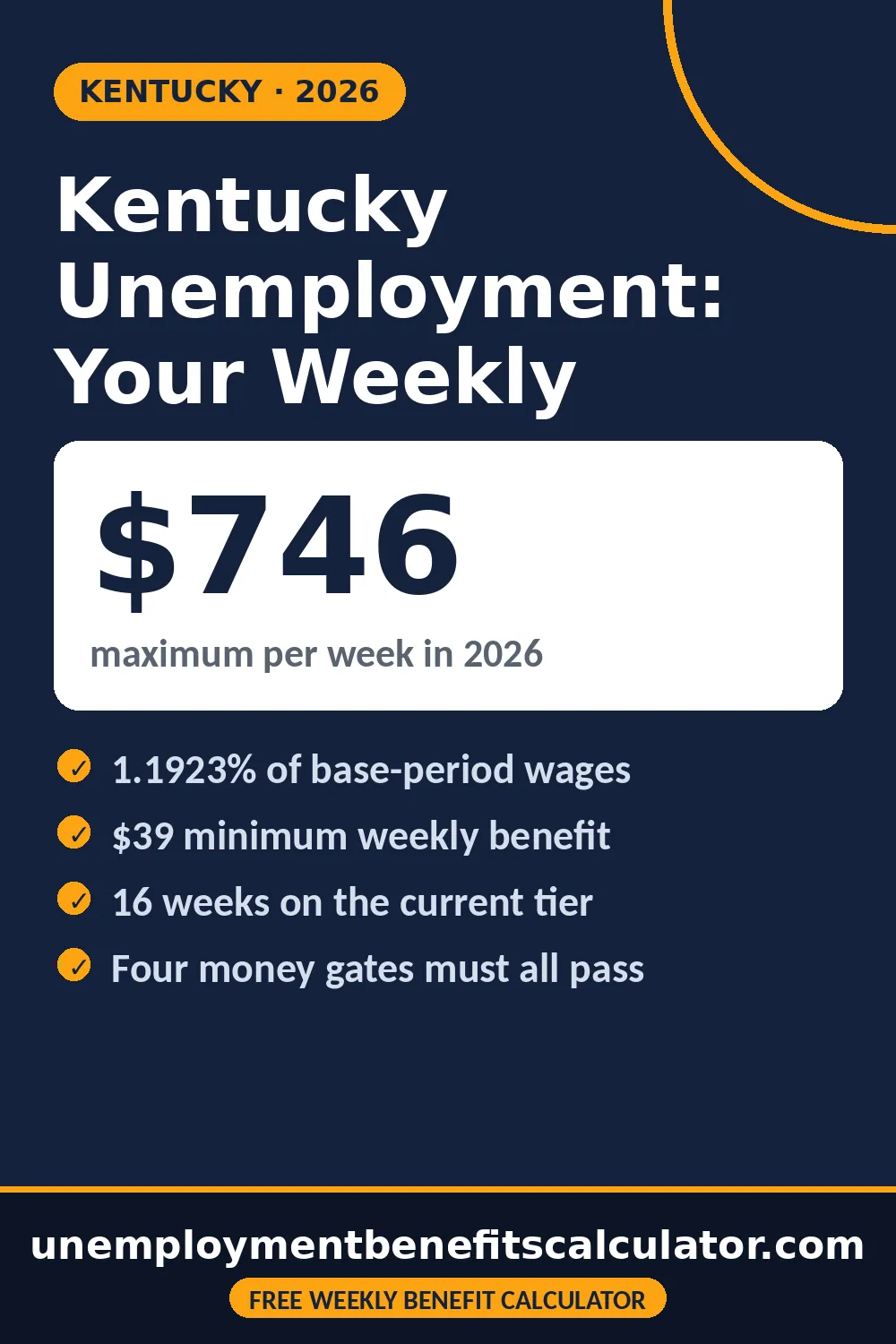
Kentucky computes your weekly check like a ledger keeper posts a column: every base-period quarter enters the book, the total is multiplied by 1.1923 percent, and the answer is held between $39 and $746. That is only the first page — four money gates decide whether the claim opens, a sliding duration scale sets your weeks, and one waiting week comes off the front. This page runs every rule with you, including a full worked answer to Kentucky’s most-asked question: what a $1,000-a-week paycheck actually collects.
Max weekly check
$746
claims filed on/after July 5, 2026
Current duration
16 weeks
4.7% rate → floor tier
Formula
1.1923%
of all four quarters, combined
Waiting week
1 unpaid
served before checks begin
Verified against Kentucky sources · October 2026
Commonwealth of Kentucky · OUI
Sample Monetary Determination
Three to ten days after you file, the Office of Unemployment Insurance mails this letter — the state’s own ledger sheet. It lists your four quarters, rules on monetary validity, and states your weekly rate. This page teaches you to predict every number before the envelope lands.
Q1 wages
best ≥ $1,500
Q2 wages
posted
Q3 wages
posted
Q4 wages
posted
Weekly rate
1.1923% of total
Total payable
16 × rate
Waiting week
unpaid
First tool
Kentucky unemployment calculator: post your four quarters
Enter what you earned in each of the four base-period quarters — pay stubs or the state’s own wage records will tell you. The ledger multiplies the total by 1.1923 percent, applies the $39 floor and $746 cap, runs all four money gates, and prices the whole claim: pot, waiting week, and part-time deductions included. The arithmetic happens in your browser; nothing is stored or sent.
Section 1 · The estimator
Run your four quarters through the ledger
Kentucky reads all four base-period quarters. Enter each one from your wage records — the same four boxes the state’s own calculator asks for.
Kentucky deducts 80% of gross weekly earnings from your check — the rule from the state’s Claimant Guide.
Your Monetary Determination preview
Enter the four quarters and the ledger computes the weekly rate, runs every money gate, and prices the benefit-year pot — the same arithmetic the Office of Unemployment Insurance applies to a real claim.
The question everyone asks
$1,000 a week in Kentucky: here is the estimated check
The direct answer
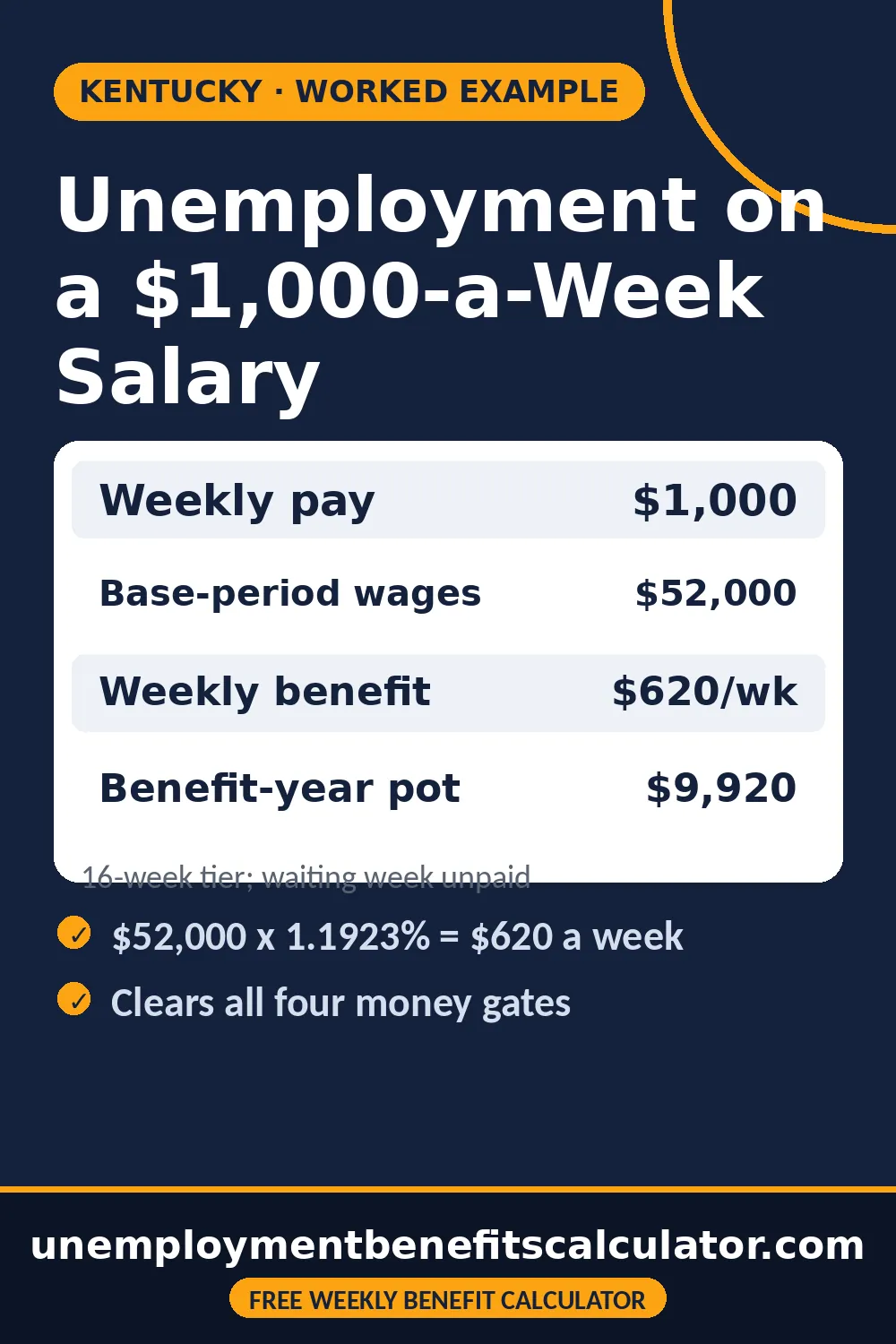
If you made $1,000 a week for a full year before filing, Kentucky pays an estimated $620 a week in unemployment — $52,000 of base-period wages × 1.1923%, rounded to the nearest dollar. That claim carries a pot of $9,920 (16 × $620), the waiting week takes one check off the front, and about $9,300 is actually payable on the current 16-week tier.
Here is the ledger behind that number. A steady $1,000 a week posts $13,000 into each 13-week quarter — $52,000 across all four. Multiply by 1.1923 percent and the raw figure lands at $619.996, which rounds to $620. Every gate clears with room to spare: the best quarter holds $13,000 against the $1,500 minimum, the other three quarters total $39,000, the full ledger quadruples the best quarter against a 1.5× requirement, and the last two quarters ($26,000) cover 8× the weekly rate several times over. The $746 cap sits far above the reading, so nothing is trimmed.
The number moves with how much of the year you worked, because the formula reads total wages, not the wage rate. The table prices the same $1,000 paycheck across four common work histories — and note the last row: once base wages pass roughly $62,568, the cap takes over and extra wages stop raising the check.
| Weeks worked at $1,000/wk | Base-period wages | Estimated weekly check | Benefit-year pot |
|---|---|---|---|
| 52 weeks — full year | $52,000 | $620 | $9,920 |
| 39 weeks — three quarters | $39,000 | $465 | $7,440 |
| 26 weeks — two quarters | $26,000 | $310 | $4,960 |
| 13 weeks — one quarter only | $13,000 | $155 raw | no claim opens |
| 52 weeks with overtime ≈ $65,300 | $65,300 | $746 cap | $11,936 |
Estimates follow the state’s published 1.1923% formula with the $39–$746 rails effective July 5, 2026; the mailed Monetary Determination letter is the controlling figure. On the full-year claim, part-time work starts shrinking the $620 check once 80 percent of gross earnings crosses it — around $775 a week of wages zeroes the payment. For the national picture, the guide to how much unemployment you will get compares every state’s formula family.
The arithmetic
How Kentucky turns wages into a weekly check
Most states price unemployment from one quarter of work. Kentucky refuses the shortcut: take all four base-period quarters, add them, and multiply by 1.1923 percent — the rate the Career Center publishes on its Benefits Calculator page. Round to the nearest dollar, then apply the clamp rails: no check below $39, none above $746 for claims filed on or after July 5, 2026. Claims filed between January and early July 2026 ran under the prior $720 cap, which shows how quickly the ceiling ratchets each summer.
The formula is younger than it looks. For decades Kentucky paid 1.5 percent of total base wages; House Bill 4 in 2022 rewrote the multiplier down to 1.1923 percent at the same time it cut duration. Because the multiplier touches your whole year rather than one hot quarter, a waitress with steady tips and a pipefitter with one booming season can land surprisingly close together — the gates below are what separate their claims.
| Total base-period wages | Raw 1.1923% figure | Weekly check |
|---|---|---|
| $3,000 | $36 | $39 — the floor lifts it |
| $5,000 | $60 | $60 |
| $10,000 | $119 | $119 |
| $20,000 | $238 | $238 |
| $33,000 | $393 | $393 |
| $50,000 | $596 | $596 |
| $62,568 | $746 | $746 — the cap lands here |
| $90,000 | $1,073 | $746 — the cap holds the line |
Read the last two rows together: $62,568 of base-period wages is the exact threshold where the $746 cap starts binding. Every dollar above that line adds nothing to the weekly check — but it does grow the one-third-of-wages pot comparison you will meet below, so high earners still care about the fine print.
The bouncer at the door
Four money gates decide whether the claim opens
The multiplier only prices a claim that already exists. Before issuing a Monetary Determination letter, the Office of Unemployment Insurance runs four tests over your wage ledger — fail any of the first three and there is no claim at all: $1,500 in at least one quarter, $1,500 outside the best quarter, total wages at least 1.5× the best quarter, then, after the rate is computed, last-two-quarter wages at least 8× the weekly rate.
$1,500 inside a single quarter
One quarter of your base period must carry at least $1,500 on its own — Kentucky’s proof of real attachment. A brief holiday retail season alone will not carry it; two months of a factory schedule will. The gate reads your best quarter automatically, so no strategy is needed.
Best quarter $9,600 — passes with room to spare.
$1,500 outside the best quarter
Kentucky also demands $1,500 in wages beyond your strongest quarter — the gate that punishes one-season careers. A construction worker with $14,000 in one record quarter and little else opens the first gate and fails the second. Spread wages across a second and third quarter and this test clears itself.
Best quarter $9,600, other quarters total $18,400 — passes.
Total wages ≥ 1.5× the best quarter
The full ledger must be at least 1.5 times your best quarter — in practice, the other three quarters combined must equal at least half the best one. Lopsided years fail here: one $12,000 quarter plus three $1,500 quarters totals $16,500 against a required $18,000, and the claim dies at intake.
Total $28,000 vs best quarter $9,600 × 1.5 = $14,400 — passes.
Last two quarters ≥ 8× the weekly rate
This gate runs after the formula: Kentucky adds your third and fourth base-period quarters and requires the sum to cover at least eight of your weekly checks. It confirms recent attachment — the state wants your latest work to fund a meaningful slice of the claim it opens.
Last two quarters $19,600 vs 8 × $393 = $3,144 — passes easily.
From the Frankfort ledger
Kentucky’s eligibility page adds one soft warning the gates do not capture: when the third and fourth quarters look very thin next to the first two, the claim “may also be invalid” even if the arithmetic squeaks through. The office reads recency, not just ratios — expect extra scrutiny after a long dry spell, and appeal within 30 days if the letter goes the wrong way.
Which quarters count
The base period: the first four of the last five quarters
Kentucky prices your claim from the first four of the last five completed calendar quarters, deliberately skipping the most recent one. A claim filed in October 2026 therefore reads the window from July 2025 through June 2026 — every dollar in that twelve-month ledger feeds the formula, and wages after June 2026 sit ready for a future claim instead.
A quirk hides in the calendar: Kentucky’s UI quarters begin the first Sunday of January, April, July, and October, so the boundaries do not land on the month edges most workers expect. For a layoff straddling the quarter line, that shift can decide which quarter holds a critical paycheck — and it is one of the first places to look when the mailed letter disagrees with your arithmetic.
| Quarter | Roughly | In the ledger? |
|---|---|---|
| July – September 2026 | just ended | no — skipped by design |
| April – June 2026 | 4th base quarter | yes — most recent |
| January – March 2026 | 3rd base quarter | yes |
| October – December 2025 | 2nd base quarter | yes |
| July – September 2025 | 1st base quarter | yes — oldest |
| April – June 2025 | beyond the window | no |
The lag cuts both ways when you choose a filing week: waiting a few weeks can pull a just-ended strong quarter into the ledger, while filing sooner captures an older, stronger window. Run both scenarios in the calculator — it accepts any four quarters you feed it.
How long the money lasts
The 16-to-24-week scale — and why 26 weeks is gone
For more than eighty years a Kentucky claim meant 26 weeks. House Bill 4 of 2022 ended that era, tying duration to the unemployment rate and briefly dropping the maximum to 12 to 14 weeks; the 2023 follow-up, House Bill 146, rebuilt the scale at 16 to 24 weeks. The tier in force when you file — measured on a six-month average rate that resets every January 1 and July 1 — locks your weeks for the life of the claim.
Today the machine sits on its lowest rung: Kentucky’s seasonally adjusted rate was 4.7 percent in July 2026, well under the 6.5 percent threshold, so new claims open on the 16-week floor tier. The rate would have to average above 10 percent before anyone touched 24 weeks again. The one lever left is training — an approved program can add up to five weeks.
| Six-month average unemployment rate | Weeks available |
|---|---|
| 6.5% or less | 16 |
| over 6.5% up to 7% | 17 |
| over 7% up to 7.5% | 18 |
| over 7.5% up to 8% | 19 |
| over 8% up to 8.5% | 20 |
| over 8.5% up to 9% | 21 |
| over 9% up to 9.5% | 22 |
| over 9.5% up to 10% | 23 |
| over 10% | 24 |
Source: Kentucky Career Center “Eligible Weeks” flyer and Maximum Number of Unemployment Eligibility Weeks page, both updated under HB 146.
46%
of claimants exhaust
running out of weeks before landing work — near the 2013 high (KyPolicy, May 2026)
3.1%
hiring rate, Dec 2025
the lowest since January 2010, so searches take longer than the weeks allow
8%+
four counties above
Lewis, Magoffin, Martin, and Wolfe averaged over 8% unemployment in 2025
The whole envelope
Your benefit-year pot: 16 checks, or a third of your wages
Duration is only half the ceiling. The Career Center’s FAQ states the total rule directly: the maximum you can draw is 16 times your weekly rate or one-third of your base-period wages, whichever is less. The pot matters most for part-year workers, who can empty the envelope before the calendar runs out.
Run the sides against each other and the arithmetic settles it: sixteen checks total 19.08 percent of base wages while one-third is 33.3 percent, so whenever the cap is not binding, the 16 × rate side binds. The one-third language is a leftover from the 26-week era, though at extreme wage levels the cap can flip the comparison. Your planning number is simply the weekly check times sixteen — at the cap, 16 × $746, an $11,936 ceiling per benefit year.
| Weekly check | Pot: 16 × rate | Pot if ⅓ of $33,000 wages |
|---|---|---|
| $39 | $624 | $11,000 |
| $150 | $2,400 | $11,000 |
| $250 | $4,000 | $11,000 |
| $393 | $6,288 | $11,000 |
| $746 | $11,936 | $11,000 |
The last row shows the flip: even a capped $746 check carries a pot of $11,936, but against $33,000 of wages the one-third rule pays $11,000 — and the state pays the lesser.
The front of the claim
One waiting week, then an 80% rule for part-time work
The unpaid week that starts every claim
Every initial claim serves one unpaid waiting week, and the FAQ is blunt about the mechanics: the first eligible week pays nothing, you must request it with your work-search reporting, and it never converts to a check on a regular claim. Treat it as a fixed cost of filing — $620 gone for the full-year $1,000-a-week claimant above, $746 at the cap — and budget a week deeper than feels necessary.
Part-time work and the 80% deduction
Reduced hours do not close the claim, but Kentucky prices the mix unusually: the Claimant Guide deducts 80 percent of your gross weekly earnings from the check — its own example takes a $400 weekly amount minus 80 percent of $100 in wages, leaving $320. Pensions and retirement pay deduct at 100 percent instead. Report every dollar the week it is earned — the state-by-state rules in the part-time work guide show why Kentucky’s 80% formula is among the stingiest in the country.
| Gross weekly earnings | 80% deduction | Check | Total week |
|---|---|---|---|
| $80 | $64 | $329 | $409 |
| $140 | $112 | $281 | $421 |
| $200 | $160 | $233 | $433 |
| $300 | $240 | $153 | $453 |
| $400 | $320 | $73 | $473 |
| $492 | $394 | $0 | $492 |
Total weekly income keeps climbing even as the check shrinks, because 80 percent of earnings never quite equals the earnings themselves — the break-even sits around $492 for this $393 claim. Request every week anyway, including zero weeks, or the claim goes dormant.
A worked claim sheet
Whitney — distillery line lead, Bardstown
Whitney earned $7,900, $8,400, $8,100, and $8,600 across her four base-period quarters — $33,000 posted, no lopsided season. The formula rounds $33,000 × 1.1923% to a $393 weekly check, all four gates clear, and her pot holds 16 checks worth $6,288.
The waiting week prices out first, leaving $5,895 payable. Two bottling-hall shifts a week at $140 gross deduct $112 under the 80% rule — $281 checks while she works part-time, a $421 total weekly income, every shift reported the week it is worked.
Whitney’s ledger, line by line
Reduced checks spend the same pot slower — how many of those 22 weeks actually pay depends on the weeks tier and the benefit-year clock, so read the mailed letter’s week count closely.
Where the money comes from
Employers: the 2026 taxable wage base is $12,000
Every check on this page is funded by employer payroll taxes, and the lever keeps climbing: Kentucky raised its UI taxable wage base to $12,000 per employee for 2026 — up from $11,700 in 2025 and $11,400 in 2024, a $300 annual step written into the 2022 financing law. The Office of Unemployment Insurance’s taxable-wage-base schedule lists the 2026 surcharge at 0.00 percent, and experience-rated contribution rates run from 0.30 to 9.00 percent, which is why two identical payrolls can owe very different SUI bills.
| Calendar year | Taxable wage base | Surcharge |
|---|---|---|
| 2024 | $11,400 | 0.00% |
| 2025 | $11,700 | 0.00% |
| 2026 | $12,000 — current | 0.00% |
Claimants have a stake in the $12,000 figure even though it never touches the WBA formula: employers report quarterly wages up to the wage base, and those same records feed the Monetary Determination letter. If a 2026 paycheck is missing from your ledger, a wage-record correction — not an appeal — is what fixes it.
The weekly toll
Five verifiable work searches — the strictest count in America
Since January 1, 2023, Kentucky has demanded five unique, verifiable work-search activities every week you request benefits — more than any other state. The count is audited, not trusted: randomized weekly audits check your records, which must survive a full year after the claim ends. Fail the count for any requested week and that week’s benefits are lost.
The five are not interchangeable: at least three must be formal applications or interviews, and the other two come from the supporting list below. One application plus four workshops fails; three applications, one interview, and a job fair passes. If you are unsure what survives an audit months later, the guide to documenting your work-search activities shows the evidence format that holds up.
The core three — choose from these
at least 3 of 5- Formal job application — confirmation email, submission screenshot, fax confirmation, or a paper application signed and dated by the employer or Career Center staff.
- Job interview — scheduling documentation or a form letter signed by the employer.
One strong application can generate an interview, but the state counts activities, not outcomes — keep both paper trails. Not sure a virtual event qualifies? Whether networking and job fairs count toward work search comes down to the documentation you keep.
The supporting two — six categories
the other 2 of 5- Job shadowing — employer-completed form with dates and hours.
- Job fair or networking event — a business card or signed letter.
- Search-skills workshop or seminar — certificate or presenter’s letter.
- Career Center employment program — registration or referral documentation.
- Kentucky Career Center partner activities — staff-certified participation.
- Online participation — screenshots for virtual workshops and events.
Who skips the search
Three groups are fully exempt: union members whose hiring hall does the finding, workers with a definite return-to-work date inside 16 weeks of filing, and people in a labor dispute with their employer. Claimants in approved training, work-share, or employer E-claims file through different tracks. Everyone else searches — including part-timers and the self-employed, who must be available for full-time work.
Day one to first dollar
The filing clock, exactly as the state lays it out
Kentucky publishes its own day-by-day expectations, so this calendar mirrors the agency rather than guessing. The claims portal at uiclaimsportal.ky.gov takes applications around the clock; the phone line at (502) 564-2900 answers weekdays 9 to 5 Eastern, with a relay at 800-648-6057. One hard warning comes attached: only ky.gov addresses and that number are legitimate — look-alike filing sites harvest Kentuckians’ identities every year.
File the application
Submit online or by phone with your Social Security number, employer details for the last 18 months, and a separation reason for each. List other states, temporary agencies, and any military DD-214. Kentucky never backdates — a delay costs real weeks.
The state reads the ledger
The office runs the four money gates against your base-period wages and rules on monetary validity — where the $1,500, 1.5×, and 8× rules either clear or trip.
The Monetary Determination letter
The letter arrives by mail — a statement of your potential rate and pot, not a guarantee of payment. Verify ID.me in this window if you filed by phone; unverified claimants cannot request benefits.
Request your first payment
Request the week in the portal — this is where the waiting week gets served. Only claimants exempt from work search may keep requesting by phone; from here you request every two weeks.
Payment lands in 2–5 business days
With no disqualifying issues, payment goes to your method on file — direct deposit, debit card, or paper check. A pending fact-finding interview or employer protest pauses this step until the determination lands.
ID.me, before you need it
Every claimant verifies identity through ID.me before requesting any payment — phone filers before their first request, online filers inside the portal. The Career Center keeps video tutorials and a help form for document snags; start on Day 1, not Day 13, because verification delays are the most self-inflicted kind. The national breakdown in how long the first check takes shows where Kentucky’s two-to-five-day window sits.
Fraud runs both ways
Knowingly false information is fraud under KRS 341.990 — fines, imprisonment, restitution, plus an overpayment bill. The state’s fraud form on kentucky.gov covers reporting others; identity fraud, a claim opened in your name, goes to the same office. Guard your PIN, challenge unknown determinations immediately, and keep weekly answers truthful.
The letter, decoded
Reading your Monetary Determination line by line
The letter that lands between Day 3 and Day 12 is the state’s ledger applied to your life, and every line is checkable. The FAQ is careful to say it is not a guarantee of benefits — the “how much” before the “whether.” Read it beside the calculator: the two should agree within a dollar of rounding, and when they do not, the letter is telling you something your wage notes missed.
The four posted quarters
The letter lists each base-period quarter and the wages each employer reported. A missing employer — a staffing agency, a restaurant group under one tax ID — drags the whole formula down. Disputed wages start with a wage-record correction, not an appeal.
The weekly rate
Your WBA should equal 1.1923 percent of the posted total, rounded, held between $39 and $746. A single misplaced quarter changes the rate for the life of the claim — this line is worth sixty seconds of arithmetic.
The maximum benefit amount
The pot line shows 16 × the weekly rate, or one-third of base wages if smaller. Compare it against the duration tier in force when you filed to see whether weeks or dollars run out first.
The benefit year ending
The BYE date is the claim’s expiry — 52 weeks after filing, no extensions. Every skipped week burns that year; if wages since the base period are strong, a new claim after the BYE may price better.
Two details deserve a highlighter: the waiting week is already baked into the letter’s math, and the wage figures come from employer reports — the same data the ID.me-verified portal reproduces. If an employer under-reported, the portal wage listings are where the discrepancy shows before it costs you a thousand dollars of pot.
How the story ended
Fired, quit, or laid off: the separation review
Money gates open claims; the separation review keeps them open. A discharge qualifies when it happened for reasons other than misconduct connected with the work; a quit qualifies when it came with good cause attributable to the employment. Both routes begin with a fact-finding interview, and employers are invited to participate — silence is not agreement, but the state must investigate lack-of-work separations regardless.
The line between disappointing and misconduct decides most cases. Good cause for missing work is generally not misconduct, and lost-day counts alone cannot establish it: attendance problems, personality conflicts, and skill shortfalls usually land on the payable side; deliberate violations, theft, and violence land on the disqualified side. A worker whose disqualification stands can requalify by returning to work and earning the statute’s wage threshold — the disqualification is not forever, but the claim it rode in on usually is.
Cleanest path
Laid off / lack of work
No disqualifying issue to investigate. The claim rides on the money gates alone.
Fact-finding first
Fired for cause claimed
The employer must substantiate misconduct connected with work; vague charges rarely carry the day.
Good cause required
Quit for work reasons
The reason must attach to the job — unsafe conditions, a material change, documented harassment — not to circumstances outside it.
Severance deserves its own sentence before you file — the answer changes weekly amounts, and our guide to severance and unemployment breaks down how states count it. File in your first week regardless; the clock never runs backward. And if your case begins from a firing rather than a layoff, the walkthrough of when you can get unemployment if you are fired maps how the misconduct question gets decided.
When the letter is wrong
Thirty days to appeal, and the overpayment wake-up
Every determination letter carries a clock: thirty days from the mail date to appeal in writing. Send it to the UI Appeals Branch — the FAQ lists UIappeals@ky.gov and the Frankfort address — with your name, the last four digits of your SSN, and contact information. It is the most generous window of any state we track, and it is still missed constantly by claimants waiting for the office to reconsider on its own. It will not.
Hearings run by telephone most of the time, with in-person sessions when witnesses or complexity justify one. A referee hears both sides and issues a decision either party can carry further. Build the evidence file before the hearing date — separation notices, schedules, messages, pay records, and the work-search log you have been keeping anyway; the record you make early follows the whole case.
The bill that arrives later
An overpayment happens when benefits were paid the law did not allow — a reversed appeal, unreported earnings, a misread question. Kentucky offsets future benefits and pursues the balance through collections; fraud findings add penalties under KRS 341.990. The defense is boring and effective: report everything weekly, answer every request, and appeal any notice on the same thirty-day clock.
The tax column
Taxes: the IRS takes, and Kentucky takes too
Unemployment income is taxable twice for Kentuckians. The IRS taxes every dollar as ordinary income, and the Department of Revenue is equally direct — benefits are fully taxable on the state return at the flat 3.5 percent rate for 2026, a step down from 4 percent. On a $6,288 pot like Whitney’s the state column costs a little over $200; the full-year $1,000-a-week example from earlier — a $9,920 pot — owes roughly $347 to Frankfort before the IRS sees its share.
Withholding is opt-in: the portal’s “Withholding Status” menu elects 10 percent federal withholding, and Kentucky does not automatically withhold either tax. Many claimants skip it, then meet a spring bill they did not price. The 1099-G arrives in the portal and by mail by the end of January, and every dollar on it must appear on both returns.
10%
federal, optional
Elect it in the portal or owe at filing — your call, priced by your bracket.
3.5%
Kentucky flat tax, 2026
Fully applied to benefits; no special exemption for unemployment income.
1099-G
arrives late January
In the portal and by mail; reconcile it against your own request history.
The side doors
Work share, training weeks, combined wages, and disaster aid
Work share instead of layoffs
Work Share lets employers cut a unit’s hours 10 to 40 percent rather than cut people, and the office tops up the lost wages with partial benefits. The employer files the plan; employees keep their jobs and a bridged paycheck. Approval runs twelve months, and approved-plan workers are exempt from the five-search toll. Work share is Kentucky’s version of short-time compensation — the alternative-to-layoffs guide compares plans across states.
Five extra weeks in training
The one lever that stretches the 16-week tier: enroll in an approved training or certification program with an eligible provider, and benefits can continue up to five weeks beyond exhaustion — never past the 24-week ceiling. Approval must come before the weeks are claimed, so coordinate with the Career Center while checks still flow.
Combined wage claims
Worked across state lines? A Combined Wage Claim folds other states’ wages into Kentucky’s ledger, or lets you file where the wages tell the better story — the difference between a thin claim and a full one for truckers, traveling nurses, and Ohio Valley commuters.
Disaster aid and extended benefits
Two federal ripples: Disaster Unemployment Assistance opens after federally declared disasters for workers regular UI does not cover, and Extended Benefits can add weeks when unemployment surges — Kentucky sits nowhere near that trigger in 2026. That guide explains the trigger mechanics every state shares.
The top of the ladder
When the cap catches you: Marcus’s $65,300 year
High earners discover the cap the hard way. Marcus, a Louisville healthcare administrator, posted $16,900, $16,400, $15,800, and $16,200 across his base period — $65,300 total. The raw arithmetic reaches $779 a week, comfortably past every gate including the 8× test, but the clamp rail is absolute: Kentucky holds the check at $746 and the $33 of weekly overage evaporates. His pot runs 16 × $746 — $11,936 — before the waiting week takes its slice.
| Base-period wages | $65,300 | all four gates clear |
| Raw 1.1923% figure | $779 | the formula’s first answer |
| Check after the $746 cap | $746 | $33/week absorbed by the ceiling |
| Benefit-year pot | $11,936 | 16 × $746 |
| After the waiting week | $11,190 | one check served unpaid |
The economics land hardest at this end: a capped $746 check replaces a thinner slice of the ledger than the formula intended, and the July 2026 jump — $720 to $746 in one summer — is the mechanism narrowing that gap. The same July review is the only raise Kentucky checks ever get.
Before you file
Seven Kentucky mistakes that cost real money
Assuming 26 weeks
Kentucky has not paid 26 weeks since 2022. Planning around 26 weeks of runway when the tier pays 16 is how 46 percent of claimants end up exhausting the claim.
Treating one good quarter as enough
The $1,500-outside-the-best-quarter gate and the 1.5× test both read the other three quarters. A single strong season with thin paychecks around it opens nothing — even a $155 raw reading on $13,000 of wages goes nowhere without them.
Ignoring the base-period lag
The quarter you are filing in does not count. Filing a week later can capture a just-ended strong quarter — or a week earlier can dodge a weak one. Check the window before you file, not after.
Skipping the waiting-week request
The first eligible week is unpaid only if you claim it and search for it. Skip the request and you may serve the waiting week again later, or strand the week entirely.
Forgetting the 80% math
Kentucky is not a $50-disregard state. Eighty percent of gross part-time earnings comes off the check, and pensions come off at 100 percent. Model the mix before accepting shifts.
Padding the search with workshops
Three of the five weekly activities must be applications or interviews. Four workshops and one application is a failed week in an audit, even though it felt diligent at the time.
Letting the 30-day clock die
The appeal window from the mail date is thirty days — the longest in the country and still the most commonly missed. Calendar it the day the letter arrives.
Placement on the map
Kentucky against the typical state
Every state shares a federal frame, but the details diverge sharply. The table sets Kentucky’s verified 2026 rules against what most of the country does — pricing the whole year instead of a quarter, tying duration to the unemployment rate, and auditing a five-search week no other state asks.
| Rule | Kentucky, 2026 |
|---|---|
| Weekly check formula | 1.1923% of all four quarters, $39–$746 |
| Duration | 16–24 weeks, tied to the unemployment rate |
| Waiting week | One unpaid week on every initial claim |
| Work search | 5 verifiable activities weekly, audited |
| Part-time rule | 80% of gross earnings deducted |
| Dependent allowance | None |
| Appeal window | 30 days from the mail date |
| State tax on benefits | Fully taxed at the 3.5% flat rate |
If you are comparing offers or planning a move, the neighboring ledgers are worth a look: the Tennessee, Ohio, Indiana, Illinois, Virginia, and West Virginia calculators all run their own formulas, and the same wages can price very differently across a state line. The states grid covers all fifty.
Straight answers
Kentucky unemployment questions, answered
How much unemployment will I get in Kentucky?
Kentucky multiplies your total base-period wages by 1.1923% and rounds to the nearest dollar, then holds the result between $39 and $746 a week. Base-period wages of $33,000 compute to $393 a week — 33,000 × 0.011923 — while anything above roughly $62,568 in base wages lands on the $746 cap. The calculator at the top of this page runs the same arithmetic across all four quarters, then checks every money gate the state applies.
How much unemployment will I get if I make $1,000 a week in Kentucky?
If you earned $1,000 a week for a full year before filing, your four base-period quarters hold $13,000 each — $52,000 total. Kentucky multiplies that by 1.1923% and rounds to a $620 weekly check, which clears all four money gates comfortably. The benefit-year pot runs 16 × $620, or $9,920, minus the unpaid waiting week — $9,300 payable on the current 16-week tier. Work fewer weeks at the same wage and the check shrinks: 39 weeks earns $465 a week, 26 weeks earns $310, and a single quarter cannot open a claim at all.
How long do Kentucky unemployment benefits last?
The duration is a sliding scale, not a fixed 26 weeks. Since House Bill 146 took effect July 1, 2023, weeks are keyed to Kentucky’s seasonally adjusted unemployment rate over a six-month lookback — 16 weeks at rates up to 6.5 percent, one extra week per half-point rise, up to 24 above 10 percent. With the rate at 4.7 percent in July 2026, most new claims open on the 16-week floor tier.
Why did my Kentucky claim get denied even though I worked all year?
Kentucky applies four money gates on top of the formula, and one quiet gate trips a lot of claims: wages outside your best quarter must total at least $1,500, and total base wages must reach 1.5 times the best quarter. A single strong quarter with thin paychecks around it fails the 1.5× test even though the year looked fine. After the rate is computed, the last two base-period quarters must also total at least eight times the weekly rate.
What is the waiting week in Kentucky?
Every initial claim serves one unpaid waiting week. Request it and complete your work-search reporting for it to count; it never converts to a payment on a regular claim. Plan a week of rent and groceries on savings — the first check arrives after the waiting week plus the state’s two-to-five-business-day payment window.
Can I work part-time and still collect Kentucky unemployment?
Yes, and the math is unusual: Kentucky deducts 80 percent of your gross weekly earnings from your check, a rule straight from the state’s Claimant Guide. With a $400 weekly amount and $100 of part-time wages, 80 percent of the earnings — $80 — comes off the check, paying $320. Report every dollar, including odd jobs; once 80 percent of your earnings equals or passes your weekly amount, the week pays nothing but should still be requested to keep the claim alive.
How many job searches does Kentucky require each week?
Five unique, verifiable work-search activities every week you request benefits — the strictest weekly count of any state. At least three must be formal job applications or interviews; the other two can be job shadowing, a job fair or networking event, a search-skills workshop, or a Career Center program. Keep every confirmation for a full year, because the state runs random weekly audits.
What happens if I was fired or I quit in Kentucky?
Being fired for misconduct or quitting without good cause attributable to the work both trigger a disqualification review. Kentucky distinguishes ordinary poor performance from misconduct connected with the work, and a quit for good personal reasons is not automatically good legal cause. You get a fact-finding interview before a determination, and either side can appeal — but an upheld misconduct finding can cost you the rest of the claim, so gather evidence early.
How do I file a claim in Kentucky?
File online at the uiclaimsportal.ky.gov claims portal, which is open around the clock, or by phone at (502) 564-2900 between 9 a.m. and 5 p.m. Eastern on weekdays. Every claimant verifies identity through ID.me before requesting payments. Gather your Social Security number, employer details for the last 18 months, and each employer’s separation reason. The claim starts the day you file and is never backdated, so file in your first week out of work.
Can I extend Kentucky benefits with job training?
There is a narrow training extension: if your benefits run out before the 24-week ceiling, an approved job-training or certification program through an eligible provider can add up to five weeks, never past 24. Because claims today open at 16 weeks, a committed training plan can meaningfully stretch support — ask the Career Center before your final weeks, not after benefits end.
Does Kentucky tax unemployment benefits?
Yes, twice. The IRS taxes every dollar of unemployment income, and Kentucky taxes benefits fully on the state return as well — the Department of Revenue states this plainly. The flat income tax sits at 3.5 percent for 2026. You can elect 10 percent federal withholding in the portal, but expect the state bill at filing time unless you set money aside. A 1099-G arrives by late January.
Where every number comes from
Sources & verification
Every figure on this page was checked against Kentucky government sources — the core rules in September 2026 and re-verified October 2026, when the Office of Unemployment Insurance’s own Benefits Calculator and taxable-wage-base pages confirmed the $39–$746 range and the $12,000 wage base. Where a number changed mid-year — the $720-to-$746 cap on July 5, 2026 — both dates are shown. This site is not affiliated with, endorsed by, or operated on behalf of the Kentucky Office of Unemployment Insurance or any government agency.
- 1.Kentucky Career Center — Unemployment Insurance Benefits Calculator — formula 1.1923%, $39–$746 effective July 5, 2026, $1,500 / 1.5× / 8× gates, SAUR definition. Accessed September 2026; core figures re-verified October 8, 2026.
- 2.Kentucky OUI — Benefits Calculator (ui.ky.gov) — confirmed October 2026: minimum $39 and maximum $746 per week effective July 5, 2026. Accessed September 2026; core figures re-verified October 8, 2026.
- 3.Kentucky OUI — Taxable Wage Base and Surcharge Information (ui.ky.gov) — 2026 wage base $12,000 (surcharge 0.00%); 2025 $11,700; 2024 $11,400. Accessed September 2026; core figures re-verified October 8, 2026.
- 4.Kentucky Career Center — UI FAQ Guide — rate ranges $39–$720 and $39–$746, waiting week, pot = 16× rate or ⅓ of wages, appeals to UIappeals@ky.gov, no dependent allowance. Accessed September 2026; core figures re-verified October 8, 2026.
- 5.Kentucky Career Center — Claimant FAQs — five weekly work-search activities, categories, exemptions, bi-weekly requests, 1099-G, training extension, BYE. Accessed September 2026; core figures re-verified October 8, 2026.
- 6.Kentucky Career Center — If You Are Unemployed — Day 1–16 filing timeline, portal and phone lines, ID.me, payment methods, fraud warning, work documents. Accessed September 2026; core figures re-verified October 8, 2026.
- 7.Kentucky Career Center — Maximum Number of Unemployment Eligibility Weeks + Eligible Weeks Flyer (PDF) — HB 146 tier table, 16–24 weeks, six-month SAUR lookback. Accessed September 2026; core figures re-verified October 8, 2026.
- 8.Kentucky General Assembly — House Bill 4 (2022) — the 2022 rewrite of duration, work search, waiting-week, and wage-base financing provisions. Accessed September 2026; core figures re-verified October 8, 2026.
- 9.Kentucky General Assembly — House Bill 146 (2023) — the rebuilt 16–24-week duration scale. Accessed September 2026; core figures re-verified October 8, 2026.
- 10.Kentucky Center for Economic Policy — May 19, 2026 analysis — 46% exhaustion rate, 3.1% hiring rate, county unemployment detail. Accessed September 2026; core figures re-verified October 8, 2026.
- 11.Kentucky Center for Statistics — July 2026 statewide release — 4.7% seasonally adjusted July 2026 unemployment rate. Accessed September 2026; core figures re-verified October 8, 2026.
- 12.Kentucky Career Center — Claimant Guide (PAM400, PDF) — 80% partial-earnings deduction with worked example, Work Share 10–40%, deductible-income definitions. Accessed September 2026; core figures re-verified October 8, 2026.
- 13.Kentucky Department of Revenue — unemployment benefits fully taxable on the Kentucky return. Accessed September 2026; core figures re-verified October 8, 2026.
- 14.Kiplinger — state taxation of unemployment, 2026 — Kentucky flat income tax 3.5% for 2026, down from 4%. Accessed September 2026; core figures re-verified October 8, 2026.
- 15.U.S. Department of Labor — unemployment insurance — federal program frame and state administration. Accessed September 2026; core figures re-verified October 8, 2026.
- 16.IRS — Topic 418, Unemployment Compensation — federal taxation of every benefit dollar. Accessed September 2026; core figures re-verified October 8, 2026.
- 17.CBPP — How Many Weeks of Unemployment Compensation Are Available? — independent confirmation of Kentucky’s 16-week current tier. Accessed September 2026; core figures re-verified October 8, 2026.
- 18.CareerOneStop — American Job Center network — general job-search and training resources cited for work-search planning. Accessed September 2026; core figures re-verified October 8, 2026.
Editorial note: this calculator and guide are independent tools for Kentucky workers. The Office of Unemployment Insurance’s own estimator and the mailed Monetary Determination letter are the controlling sources for any real claim, and rounding differences of a dollar or two can occur between this page’s arithmetic and the state’s systems.
Around the Bluegrass
Neighboring state calculators
TN · South
Tennessee calculator
up to $325/wk
OH · Midwest
Ohio calculator
up to $842/wk
IN · Midwest
Indiana calculator
up to $390/wk
IL · Midwest
Illinois calculator
up to $628/wk
VA · South
Virginia calculator
up to $478/wk
WV · South
West Virginia calculator
up to $662/wk
MO · Midwest
Missouri calculator
up to $320/wk