Maine Unemployment Benefits Calculator
Maine plots the check from two quarters and a family count: one twenty-second of the average of your best two base-year quarters, plus $25 a week per dependent — held between $113 and $649 for the benefit year that opened June 1, 2026. Enter your top two quarters below, count your dependents, and let the chart price the draw.
Buoy Nº 1 · The calculator
Maine Unemployment Calculator: plot the rate
Two inputs do the work — your two highest base-period quarters and your dependent count. The 1/22 division sets the base rate, the $25-per-dependent allowance rides on top under its 75% cap, and the $113–$649 window holds for every claim filed June 1, 2026 through May 31, 2027. Part-time wages preview the $128 disregard.
Estimates mirror the statute and the MDOL Claims FAQ, not the department’s own computation. The monetary determination MDOL issues after you file is the number that pays.
Average of the two best quarters ÷ 22, rounded down — the statute’s own division.
Lesser of 26× the weekly rate or one-third of base wages, plus the dependent supplement.
MDOL issues the official amount from employer wage reports after you file.
Buoy Nº 2 · The plain answer
How much unemployment will I get in Maine?
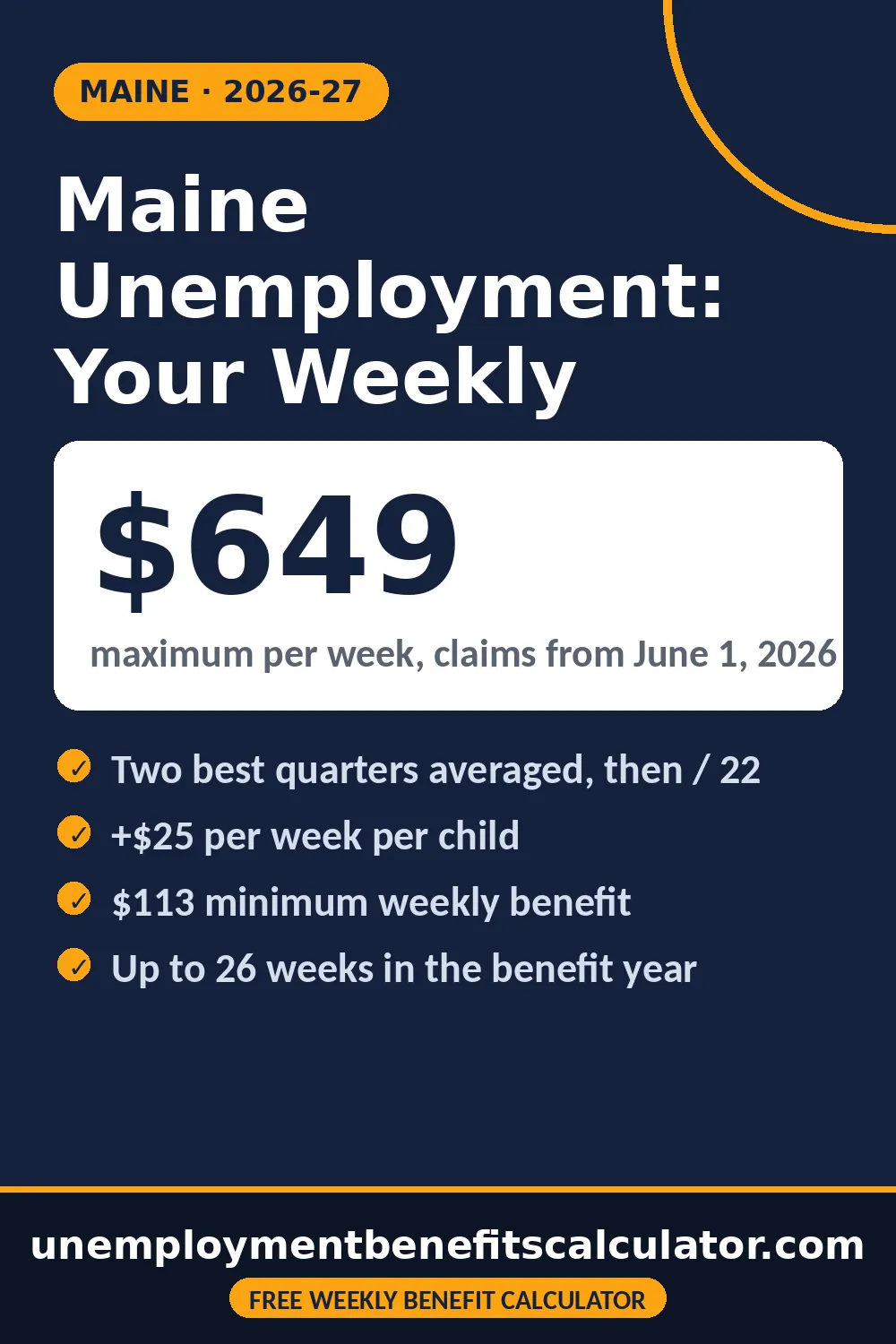
Take the two highest-earning quarters in your base period, add them, divide by two, then divide that average by 22 and round down. Check the result against the floor and ceiling — nothing pays below $113 or above $649 on the 2026–27 schedule — then add $25 per dependent under the 75% cap. That is the whole calculation; the calculator above runs it in one pass.
Duration and totals travel separately: up to 26 weeks, but the statute caps the pot at the lesser of 26 times the weekly rate or one-third of total base wages, plus the dependent supplement. The first week is a certified, unpaid waiting week.
(best quarter + second quarter) ÷ 2 ÷ 22 = your week, between $113 and $649, plus $25 a dependent — for up to 26 weeks after one unpaid, certified waiting week.
Buoy Nº 3 · The formula
Calculate unemployment benefits in Maine: the statute’s own division
Title 26, §1191 writes the rule precisely: each eligible individual establishing a benefit year is paid 1/22 of the average of the wages paid in the two highest quarters of the base period, rounded to the nearest lower full dollar. Maine pays $50 a week for every $1,100 of two-quarter average — a 1-in-22 exchange rate that makes the math easy to run in your head before the determination arrives.
The two-quarter average rewards sustained earning and softens spikes. Whatever your history, only the top two of the four base-period quarters matter — the other two ride along for eligibility and the pot, not the rate.
Maine resets its benefit figures each June 1 for the following twelve months of claims — the maximum is pegged by statute to 52% of the state’s average annual weekly wage. The 2026–27 schedule runs $113 to $649; a claim filed in May rode the prior year’s numbers for its whole benefit year. Near the reset, a week of timing re-prices the claim.
| Two highest quarters | Average ÷ 22 | Base rate |
|---|---|---|
| $11,900 / $10,800 | $11,350 | $515 |
| $9,000 / $8,400 | $8,700 | $395 |
| $8,900 / $8,700 | $8,800 | $400.00 — a common determination figure |
| $6,000 / $5,600 | $5,800 | $263 |
| $3,000 / $2,400 | $2,700 | $122 — near the floor |
| $16,000 / $14,000 | $15,000 | $681 → $649 (cap holds) |
| $14,300 / $14,256 | $14,278 | $649 — the exact 2026–27 maximum |
If your own determination letter shows a figure like $400.00, the table is how it got there: a two-quarter average of $8,800, divided by 22. Every row above is the published formula run straight — no adjustments, no state add-ons hiding in the arithmetic.
Buoy Nº 4 · The ladder
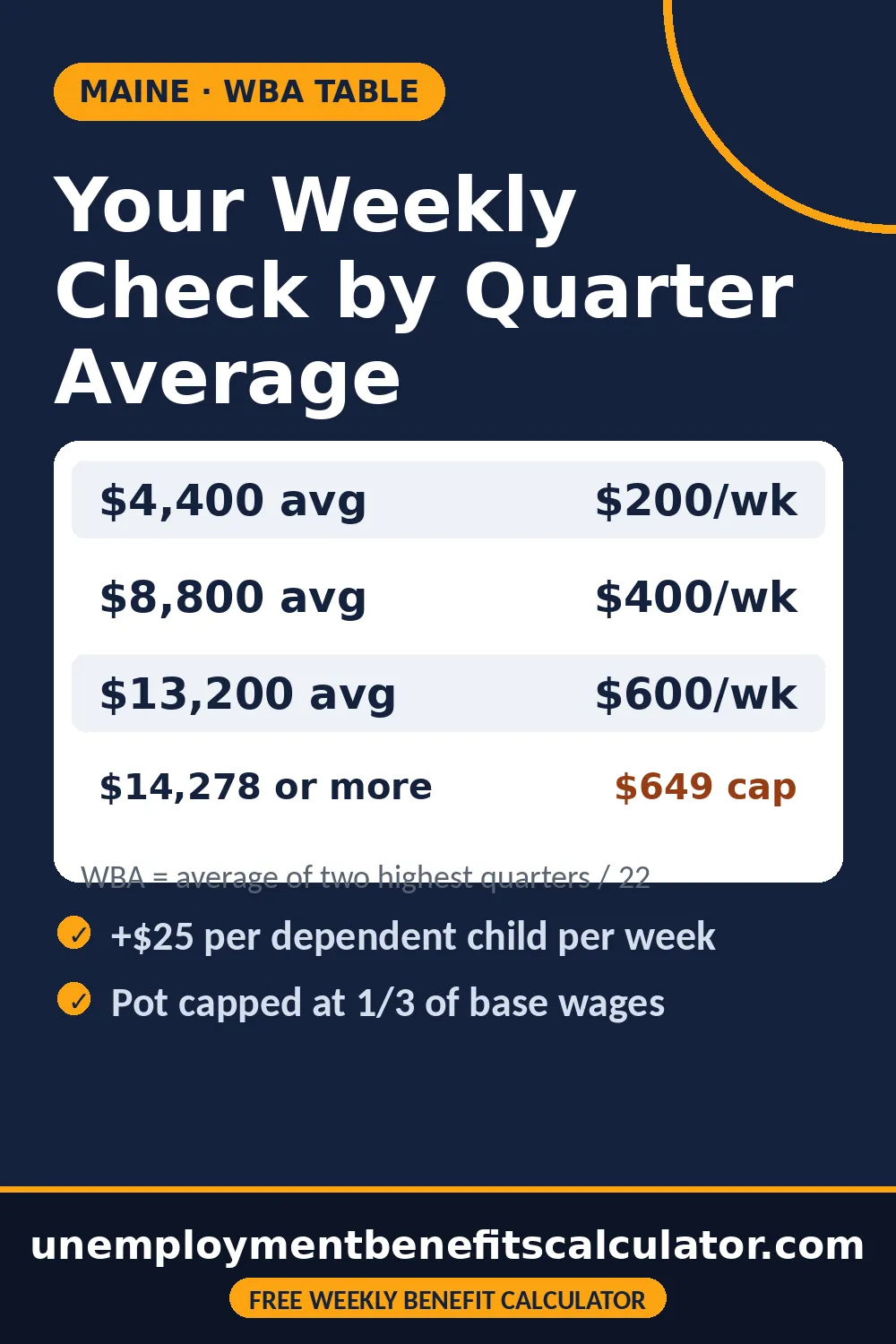
Maine weekly benefit amounts by weekly wage
The ladder below converts steady weekly pay into the reading Maine actually makes — 13 weeks per quarter, two equal top quarters, the ÷22 division, no dependents. Every dependent steps your row up by $25 until the 75% cap; the calculator prices your exact case.
| Steady weekly wage | Best quarter (× 13 wks) | Estimated weekly benefit | Where it lands |
|---|---|---|---|
| $350 | $4,550 | $206 | Within the band |
| $550 | $7,150 | $325 | Within the band |
| $750 | $9,750 | $443 | Within the band |
| $950 | $12,350 | $561 | Within the band |
| $1,000 | $13,000 | $590 | Within the band |
| $1,150 | $14,950 | $649 | At the $649 maximum |
| $1,525 | $19,825 | $649 | At the $649 maximum |
Two readings worth naming: a $400.00 weekly benefit — a figure that shows up in many Maine determinations — corresponds to about $8,800 average across your two best quarters, roughly $677 a week of steady pay. And no weekly wage buys a $1,525 check: at $1,525 of steady pay the $649 maximum has long since bound, and the max itself is reachable only from a two-quarter average of $14,278 or more.
Buoy Nº 5 · Worked example
How much unemployment will I get if I make $1,000 a week?
Here is the full claim as MDOL will compute it. Assume steady pay of $1,000 a week — a $13,000 quarter — and a filing in October 2026, inside the June 1, 2026 – May 31, 2027 schedule.
Steady $1,000 weeks fill every quarter to $13,000 (13 weeks). The base period — the first four of the last five completed quarters — holds four $13,000 quarters, so the two highest are $13,000 and $13,000. Uneven history? A $14,000 quarter and a $12,000 quarter average the same $13,000, so the rate below is sturdier than it looks.
The two-quarter average is $13,000, and one twenty-second of it is $590.90 — rounded down to a $590 weekly benefit. That sits comfortably inside the $113–$649 window; the maximum would need a $14,278 average.
No dependents: the check stays $590. Two dependents add $50, and the 75% cap on a $590 rate allows $442, so nothing trims — the benefit lands at $640. Five dependents would add $125, still under the cap.
The pot is the lesser of 26 × $590 = $15,340 or one-third of total base wages ($52,000 ÷ 3 = $17,333) — the 26-week figure governs for a steady earner. With two dependents the supplement rides on top: 26 weeks at $640 totals $16,640. Payments span up to 27 calendar weeks, waiting week included.
The first $128 of weekly earnings is ignored. A week at $400 pays $590 − ($400 − $128) = $318; a week at $128 or less pays the full $590; and a week at $718 or more ($590 + $128) pays nothing — though you keep certifying through it.
$590 a week — $640 with two dependents — for up to 26 weeks after the waiting week. Elect the 10% federal withholding and $59 a week pre-funds the IRS bill ($1,534 over the draw), and plan the Maine state layer separately, because Maine taxes benefits too.
One ceiling worth remembering: on thin base-period totals the pot, not the rate, is where the money moves — one-third of a $30,000 total is $10,000, which prices even a high-rate claim down to roughly 17 paid weeks.
Buoy Nº 6 · The allowance
$25 a week per dependent — with a 75% rudder
Maine adds $25 per week for each dependent child to the base rate — and carries a rudder no other state on this site has: the total allowance cannot exceed three-quarters of the weekly benefit. The statute defines the dependent narrowly: under 18, or 18 or over and incapable of earning because of incapacity, a full-time student, in your custody pending adoption, or supported under a court order.
Two guardrails ride with it: only one individual may claim the same dependent in a week — the provision that stops separated parents from both collecting on one child — and dependents are declared at filing with each child’s Social Security number, then priced into the determination. The allowance does not re-compute from later paperwork.
Mid-scale claimants gain the most in percentage terms: $50 on a $515 rate is nearly 10%; $125 on a $250 rate is half again. The allowance is why Maine’s small claims stay livable for families.
At the $113 floor the cap allows $84 — so a large-family claimant collects $197, not $238. At the $649 maximum the cap allows $486, which is why the richest possible Maine check is $649 + $486 = $1,135 a week.
Buoy Nº 7 · The gates
Eligibility: the base-period arithmetic behind the rate
Maine prices the claim from the base period — the first four of the last five completed calendar quarters before your benefit year opens. Covered wages feed the two-quarter average; self-employment sits outside the system. Maine also runs a safety lane: if you do not qualify on the regular base period, the department uses the last four completed quarters instead.
The non-monetary requirements travel together: unemployed through no fault of your own, able and available for work, registered with Maine JobLink, and certifying weekly with work-search information attached. Pension, severance, and bonus pay must all be reported — each can offset weeks — and every adverse determination carries the appeal clocks below.
| If you file in | Your standard base period covers |
|---|---|
| October – December 2026 | July 2025 through June 2026 |
| January – March 2027 | October 2025 through September 2026 |
| April – June 2027 | January 2026 through December 2026 |
| July – September 2027 | April 2026 through March 2027 |
The newest finished quarter always sits out while employer wage reports settle — a strong quarter landing just after the window closes cannot help the claim. Wages from other states, federal service, and the military fold into the Maine record when they fall in the window, often the margin that turns a denial into a determination. Missing employers are the most common reason a determination comes back small: check the letter against your own records the day it arrives.
| Situation | How the claim treats it |
|---|---|
| W-2 wages in the base period | feed the 1/22 average and the eligibility arithmetic |
| Self-employment income | excluded from the benefit computation |
| Dependent children you support | add $25 a week each, capped at 75% of the base rate |
| Pension, severance, or bonus pay | must be reported — all can offset weekly benefits |
| Wages from another state | combined into the Maine claim where the work was covered |
Buoy Nº 8 · The hold and the pot
The waiting week — and the lesser-of pot limit
Maine law requires one week’s waiting period before benefits pay — and the department’s phrasing is the operative part: you must file the weekly certification for that week, work-search information included, even though no payment follows. The week is served once per benefit year and is not repaid at the back end. With the first payment typically landing two to three weeks after filing, the fourth week of unemployment is the realistic first-deposit window even in a clean claim.
Title 26 caps the benefit-year total at the lesser of 26 times the weekly benefit or one-third of total base-period wages, and then adds the dependent supplement on top. Steady earners run out the 26-week calendar first; spiky histories — one hot quarter, thin shoulders — can exhaust the one-third pot early. The determination letter states your number; check it against your own totals the day it arrives.
Maine has no extended-benefits layer behind the 26-week calendar at current rates, and weeks need not be used consecutively — they just have to fall inside the 52-week benefit year. Return to work, lose the job again within the year, and the remaining pot picks the claim back up.
Buoy Nº 9 · A second claim, worked
Ellie in Bangor — where the pot bites
Ellie scheduled patient services for a Bangor healthcare system until the September consolidation cut her team. Her base-period quarters: $11,900, $10,800, $9,300, $7,800 — a $39,800 total. Here is the claim as MDOL will compute it.
The two highest quarters average ($11,900 + $10,800) ÷ 2 = $11,350. One twenty-second prices the week at $515.90, rounded down to $515 — comfortably inside the $113–$649 window.
Ellie supports two dependents: 2 × $25 adds $50. The 75% cap sits at $386, so nothing trims — the weekly benefit lands at $565.
26 weeks × $515 = $13,390, but one-third of her $39,800 base-period wages is $13,267 — the lesser figure governs, pricing the base-rate pot at about 23½ full weeks. The dependent supplement rides on top: 26 × $50 = $1,300.
One documented work-search activity a week plus the active Maine JobLink account. A week at $128 or less pays in full; a $200 week pays $565 − $72 = $493; anything at $693 or more ($565 + $128) pays nothing.
A $13,267 base pot + $1,300 of dependent supplement = a $14,567 ceiling — not the $14,690 the 26-week reading alone suggests. The one-third limit is the quiet brake on spiky Maine careers, and it is exactly why the pot belongs in every claim plan.
Buoy Nº 10 · Working while claimed
Part-time work and the $128 disregard
Maine’s partial rule starts with a cushion that just grew: as of June 7, 2026, the first $128 of weekly gross earnings is ignored — the department’s current CPI-indexed step of the statute’s disregard, repriced each first Sunday of June. Earnings above $128 reduce the check dollar for dollar, and earnings of $128 or more over the weekly benefit amount make the week ineligible.
The reporting rule carries it: gross wages for the week the work happened, holiday and vacation pay included, reported with the certification even if the paycheck has not landed. On Ellie’s $565 benefit, a week at $100 pays the full $565, a week at $400 pays $293, and a week at $693 or more pays nothing — but the certification still goes in, because the record stays alive even when the deposit does not.
| Week’s gross wages ($565 benefit, $128 free) | Reduction | Check for the week |
|---|---|---|
| $128 or less | none — inside the disregard | $565 |
| $200 | $72 | $493 |
| $400 | $272 | $293 |
| $600 | $472 | $93 |
| $693 or more | week not payable | $0 — keep certifying if part-time |
On the $590 benefit from the $1,000-a-week example, the table shifts one line: $128 or less pays $590, a $400 week pays $318, and the zero line sits at $718. Termination pay, bonus pay, and pensions follow their own offset rules — report all three when asked.
Buoy Nº 11 · Staying qualified
Work search: one documented activity, a 14-day filing window
Maine’s weekly work-search standard is the gentlest on this site: at least one approved work-search activity each week you claim, recorded with the certification, plus an active Maine JobLink account (Maine Equal Justice catalogs the qualifying activities — interviews, applications, job fairs, reemployment-services sessions). MDOL’s own FAQ frames the duty plainly: actively seeking work, actively registered with JobLink, and the activity reported on each weekly certification.
Two timing rules do the quiet enforcement. Certifications must be filed within 14 days of the week-ending Saturday or the week may not pay, and every certification — waiting week included — asks for the work-search record. A week filed without one is a week an audit can convert into an overpayment. The defensible habit costs five minutes: one dated entry — employer, role, channel, outcome — every claimed week.
Wed — applied to a posted patient-access role at a Bangor health system (date, employer, channel, outcome). JobLink profile current. Certification filed Saturday, inside the 14-day window. One entry, honestly logged — the whole standard, met for the week.
Buoy Nº 12 · Opening the claim
Filing: ReEmployME online, or the phone that still answers
Maine’s claim system is ReEmployME — the initial claim, weekly certifications, correspondence, and the 1099-G all live in one account. The distinctive part is the door Maine never closed: claimants without computer access can file by phone at 1-800-593-7660, weekdays 8:00 a.m. to 3:00 p.m., which makes Maine one of the few states where the initial claim itself still has a voice path.
Whatever the channel, the intake wants the last 18 months of employers with dates and wages, the dependent declaration with children’s Social Security numbers, and the separation facts. Expect two to three weeks from filing to the first payment in a clean claim — the waiting week plus processing — and treat the mailbox seriously: determinations, fact-finding notices, and appeal schedules all run on deadlines that start at the mail date.
reemployme.maine.gov — initial claim, weekly certifications, correspondence. One account, all weeks.
1-800-593-7660, weekdays 8:00–3:00 — questions, and claims filed by phone for offline claimants.
Division of Administrative Hearings — written appeal within 30 days of the Deputy’s Decision mail date.
Buoy Nº 13 · How claims are lost
Quits, discharges, and the suitable-work line
Every Maine separation runs a fact-finding pass between the claimant’s account and the employer’s. A quit needs good cause connected to the work — circumstances a reasonable worker would have treated as compelled, raised through channels before leaving. A discharge turns on misconduct connected with the work: deliberate, willful disregard of the employer’s interests, not ordinary mismatches of pace, fit, or ability.
The suitable-work line runs alongside: refusing an offer of suitable work can disqualify the claim, with suitability weighed against training, experience, local pay, and how long the claim has run. Seasonal workers should note the pattern explicitly — end-of-season separations with a recall expectation are handled differently from open-ended layoffs. Adverse determinations carry the appeal windows below, and weeks at issue stay preserved by certifying weekly while the dispute runs.
Layoff for lack of work · end of a season with no recall promise broken · discharge for fit or ability without willful misconduct · quit with documented good cause tied to the job · leaving documented unsafe conditions reported first through channels.
Willful safety or policy violations after warnings · attendance collapse without mitigation · quitting over an unaddressed-but-fixable grievance · falsified records · refusing suitable rehire offers without good cause.
Buoy Nº 14 · Disputing a decision
Thirty days to appeal — and 15 more at the Commission
The first clock: an appeal of the Deputy’s Decision must be filed within 30 calendar days of its mailing date, and MDOL may allow an additional 30 days for good cause. Appeals go to MDOL’s Division of Administrative Hearings — file online in ReEmployME, by email at Admin.Hearings@Maine.gov, by phone at 1-207-621-5001, by fax, or by mail — where a Hearing Officer takes sworn testimony and issues the written decision that opens the second clock.
The mailing date starts the window, not the day you open the envelope. The hearing is the claim’s first real courtroom moment: sworn testimony, documents, credibility weighed live. Complete wage records and logged work searches fare measurably better on this rung.
A Hearing Officer’s decision can be appealed to the Unemployment Insurance Commission within 15 days of the decision date, in writing to 57 State House Station, Augusta. The Commission may or may not grant another hearing.
Judicial review of the Commission runs through Maine’s courts on the record — lawyer territory, deadline-governed, and rare. Most Maine claims end at the second rung.
Keep certifying weekly while the appeal runs — a reversal pays the preserved weeks, and a lapsed claim cannot be back-filled.
Buoy Nº 15 · Money that must go back
Overpayments, fraud, and the waiver lane
An overpayment is any benefit the rules did not allow — the unreported shift, the pension offset missed, the dependent count that changed undeclared. MDOL pursues repayment administratively for honest error, and Maine keeps a door open beside the debt: overpayment waiver requests for claimants who received benefits without fault and cannot repay without hardship.
Fraud — benefits obtained by misrepresentation or willful nondisclosure — takes the waiver lane off the table and adds penalties, disqualification, and potential prosecution on top of repayment. The department’s channels run both directions: claimants can report suspected fraud on their own accounts, and identity verification clears stolen-identity claims. Ten seconds of accurate gross-wage reporting remains the cheapest insurance the system sells.
Buoy Nº 16 · April comes for both
Taxes: the 1099-G — and Maine’s own bite
Benefits are taxable at both layers. The IRS counts every dollar on Form 1099-G — ordinary income, with an optional 10% federal withholding election — and Maine taxes benefits as ordinary income on the state return, with no UI exemption. The full claim is visible to both tax authorities.
Run the $1,000-a-week claim as the example: 26 weeks at $590 is a $15,340 base draw. The 10% federal election moves $59 a week — $1,534 across the pot — toward the IRS bill; the Maine share funds from the same April cash flow. Decline the federal box and April arrives entirely unfunded on a reduced income.
1099-G for the full year · 10% withholding election · taxed as ordinary income alongside any wages earned during the claim year.
Maine taxes UI as income — no exemption · no separate UI withholding election · plan the April cash flow for both layers at once.
Buoy Nº 17 · The backdrop
Maine’s labor market and employer side
Maine’s seasonally adjusted unemployment rate held at 3.1% through July 2026 — well under the national read — with roughly 400 payroll jobs added in July. The claimant base reflects the state’s engines: healthcare systems spanning Bangor to Portland, specialty paper and wood-products mills, lobster and groundfishing along the coast, tourism economies that swell Acadia every summer, and the logistics spine that connects a very rural state.
The employer side funds the system on one of the smallest wage bases in the country: covered employers pay UI tax on the first $12,000 of each worker’s wages, and the department held Schedule A — the lowest-cost rate schedule — for 2026, averaging about $267.60 per employee. A healthy trust fund passes the savings back. For claimants, the June 1 reset is the date to watch, because it re-prices the $113–$649 window this page runs on.
One extension note: Maine has no extended-benefits layer behind the 26-week calendar at current rates — the draw is genuinely the whole envelope.
Buoy Nº 18 · Avoid these
Seven mistakes that cost Maine claimants real money
The window runs from the mailing date of the Deputy’s Decision, not the day you open it. An extra 30 days exists for good cause — a rescue, not a plan. File first, assemble second.
The unpaid first week must be certified with work-search information or you never earn credit for it. Skipping it jeopardizes every week behind it.
Registration is a standing requirement. A lapsed profile surfaces at review time as an eligibility issue that freezes weeks mid-claim.
Gross wages ride the week the work happened — holiday and vacation pay included. Net-pay reporting is the overpayment factory, and the $128 disregard computes on gross.
The reset re-prices the whole window. A claim filed May 30 rides the old year’s figures; one filed June 2 draws the new range for its whole benefit year.
All three can offset weeks under Maine’s rules. Undisclosed offsets surface at review and turn paid weeks into overpayments the waiver lane may not cover.
The lesser-of pot can exhaust early on spiky histories — one-third of thin base wages is the ceiling, not 26 × the rate. Read the determination’s total, not just the weekly figure.
Buoy Nº 19 · Context
Maine against the typical state
| Feature | Maine, 2026–27 | The typical state |
|---|---|---|
| Weekly formula | 1/22 of the two-highest-quarter average | high-quarter fractions from 1/25 to 1/26 |
| 2026–27 weekly range | $113 to $649 (claims from June 1) | about $235 to $1,033 across all states |
| Dependent allowance | $25 per dependent, capped at 75% of the check | roughly a dozen states pay add-ons |
| Waiting week | yes — certified, searched, unpaid, once per year | roughly half the states hold one |
| Duration | up to 26 weeks — pot limited to the lesser of 26× the rate or ⅓ of base wages | a flat 12–30 weeks, or pot rules that bind |
| Partial rule | first $128 ignored (June 2026 figure); dollar-for-dollar above | disregards vary from flat dollars to percentages |
| Work search | 1 documented activity weekly + JobLink registration | 2–5 contacts weekly depending on the state |
| Appeal deadline | 30 days from the Deputy’s Decision mail date; 15 days at the Commission | 10, 21 or 30 days depending on the state |
| State tax on benefits | taxed — no UI exemption | some states exempt UI entirely |
| Rate schedule | Schedule A held — the lowest-cost tier | rate schedules move with trust-fund health |
In one sentence: Maine runs a generous division on a modest window — a two-quarter average at 1/22, a family allowance with its own rudder, the lightest weekly search on this site, and a two-rung appeal ladder, all on a schedule that resets every June 1.
Buoy Nº 20 · Questions
Maine unemployment FAQ
How much unemployment will I get in Maine?+
Maine divides the average of your two highest quarters by 22 — one twenty-second of the wages paid in the two best quarters of the base period, rounded down to the dollar. Quarters of $11,900 and $10,800 average $11,350, which prices the week at $515. The 2026-27 range runs $113 to $649 for new claims filed on or after June 1, 2026.
How much unemployment will I get if I make $1,000 a week in Maine?+
Steady pay of $1,000 a week builds a $13,000 calendar quarter (13 weeks). With your two best quarters both at $13,000, the average is $13,000, and $13,000 ÷ 22 = $590.90, rounded down to $590 a week — before dependents. Two dependents add $50 (the 75% cap allows $442), so the check reads $640. The full worked example is on this page.
What is the maximum weekly benefit in Maine for 2026-27?+
$649 for claims filed June 1, 2026 through May 31, 2027 — reached when the average of your two highest quarters is $14,278 or more ($649 × 22). The $25-per-dependent allowance rides on top and is capped at 75% of the weekly benefit, so at the maximum rate the allowance tops out at $486 and the total check can reach $1,135 a week.
How does the $25 dependent allowance work?+
Maine adds $25 per week for each dependent child — a child under 18, a child 18 or over incapable of earning because of mental or physical incapacity, a full-time student, a child in your custody pending adoption, or a child you support under a court order. The statute caps the total allowance at three-quarters of your weekly benefit, and only one claimant can claim the same dependent in a week,
Does Maine have a waiting week?+
Yes. Maine law requires a one-week waiting period before benefits pay — and the department’s phrasing is the operative part: the first eligible week claimed is a Waiting Period week, no payment is made for it, and you must file the weekly certification for that week, work-search information included, to receive credit. It is served once per benefit year and is not repaid at the back end.
How long do Maine unemployment benefits last?+
Up to 26 weeks of regular benefits in the 52-week benefit year — not everyone qualifies for all 26, and weeks need not be used consecutively. There is also a total pot: the statute caps the amount payable at the lesser of 26 times your weekly benefit or one-third of your total base-period wages, plus the dependent supplement.
How does Maine handle part-time earnings?+
As of June 7, 2026, the first $128 of your weekly gross earnings does not affect the check; earnings above $128 reduce it dollar for dollar, and earnings of $128 or more over your weekly benefit amount make the week ineligible. The disregard is cost-of-living indexed each June. Report gross wages for the week the work happened, and keep certifying every week you remain part-time.
Does Maine tax unemployment benefits?+
Yes at both layers. The IRS counts every dollar on Form 1099-G with an optional 10% federal withholding election, and Maine taxes benefits as ordinary income on the state return — Maine has no UI exemption. The 1099-G posts each January for the return.
How do I file for unemployment in Maine?+
Through ReEmployME, the state’s online claim system — initial claim, weekly certifications, and correspondence in one account. Prefer a phone: 1-800-593-7660 reaches MDOL customer service weekdays 8:00 a.m. to 3:00 p.m. and can open a claim for claimants without computer access. Expect roughly two to three weeks from filing to the first payment.
How many work searches does Maine require each week?+
Maine’s bar is the lightest on this site: at least one approved work-search activity each week you claim, recorded with your weekly certification, plus an active Maine JobLink registration (Maine Equal Justice catalogs the qualifying activities). Certifications must be filed within 14 days of the week-ending Saturday or the week may not pay. Light does not mean optional — a week without a documented activity is a week at risk.
What is Maine’s appeal deadline?+
Two clocks. The first: 30 calendar days from the MAILING date of the Deputy’s Decision to file with the Division of Administrative Hearings (online in ReEmployME, by email, phone, fax, or mail) — and MDOL may allow an additional 30 days for good cause. The second: a Hearing Officer’s decision can be appealed to the Unemployment Insurance Commission within 15 days of the decision date. Keep certifying weekly while the appeal runs.
Why does Maine’s benefit year start June 1?+
Maine resets its minimum and maximum each June 1 for claims filed through the following May 31 — a schedule tied to the state’s wage data. The June 1, 2026 reset put the range at $113 to $649; claims filed before it rode the prior year’s figures.
Buoy Nº 21 · Paper trail
Sources & verification
Every rule on this page was checked against primary sources on October 8, 2026. This site is not affiliated with the Maine Department of Labor; the calculator mirrors the published statute rather than replacing MDOL’s own determination.
- 1.Maine Title 26, §1191 — Payment and amounts: the 1/22 formula, rounding, dependents, lesser-of pot, CPI-indexed disregard — legislature.maine.gov/statutes/26/title26sec1191.html
- 2.MDOL — Claims FAQ: $113 min / $649 max + $25 per dependent, 2026–27; base period; waiting week; $128 disregard; 26 weeks — maine.gov/unemployment/claimsfaq/
- 3.MDOL — filing, appeals, overpayment and waiver information — maine.gov/unemployment/
- 4.MDOL — Appeals: 30 calendar days from the mailing date, good-cause extension, filing channels — maine.gov/unemployment/appeals/index.shtml
- 5.MDOL — Appeals FAQ: 15-day window to the Unemployment Insurance Commission — maine.gov/unemployment/appealsfaq/
- 6.ReEmployME — claimant portal (initial claim, weekly certifications, 1099-G) — reemployme.maine.gov/
- 7.MDOL — Employer FAQ: $12,000 taxable wage base (fetched October 8, 2026) — maine.gov/unemployment/employersfaq/
- 8.Maine Equal Justice — Basics of Unemployment Insurance (work-search activities; $128 disregard walkthrough) — maineequaljustice.org/
- 9.Nolo — Collecting Unemployment Benefits in Maine appeals structure — nolo.com/legal-encyclopedia/collecting-unemployment-benefi
- 10.IRS — Topic 418: Unemployment compensation (federal taxation, 1099-G, 10% withholding) — irs.gov/taxtopics/tc418
- 11.BLS / MDOL — Maine employment situation 3.1% July 2026 — bls.gov/regions/northeast/maine.htm
- 12.CBPP — How Many Weeks of Unemployment Compensation Are Available — cbpp.org/research/economy/how-many-weeks-of-unemployment-c
- 13.CareerOneStop — Maine unemployment benefits directory — careeronestop.org/
Keep reading while the claim runs
These guides from our own desk cover the steps Maine shares with every state — estimating the check, applying online, base periods, and the appeal playbook.
New England calculators
New Hampshire is Maine’s only border state, and Seacoast workers often qualify from combined wages — but New England claimants compare offers across the whole region, so Vermont and Massachusetts sit one click away too. Every other state lives in the all-states index.
The homepage calculator prices every state’s weekly range side by side, and each state’s dedicated page carries its own verified rules.
Open the national calculator