Louisiana Unemployment Calculator: the Divide-by-25 Rule, Two Wage Gates, and the 12-Week Floor
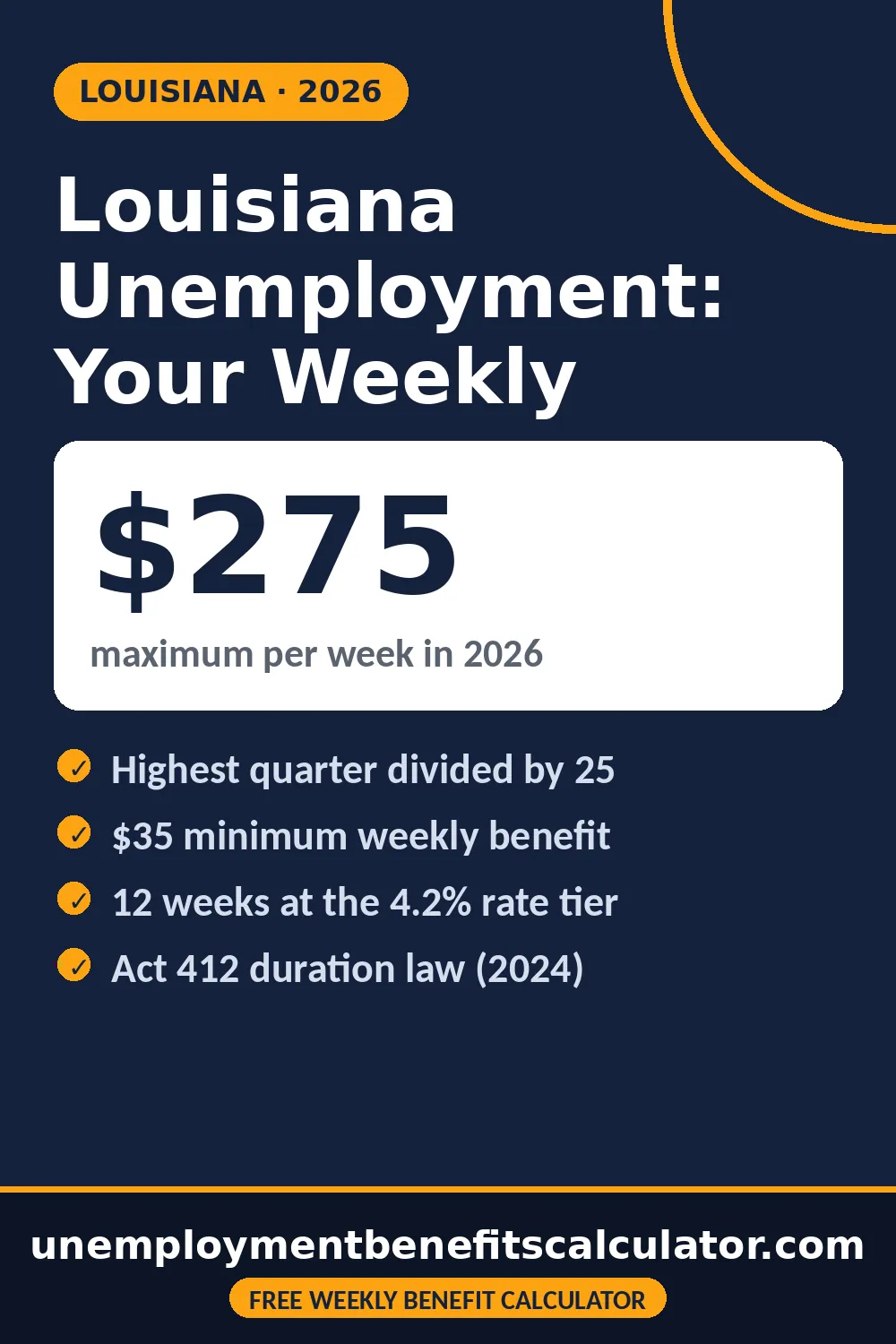
Louisiana prices a weekly check with one clean cut, straight through your highest-earning quarter. Divide that quarter by 25, hold the answer between $35 and $275, and the register shows your weekly rate. The rest of the claim is where Louisiana differs from its neighbors — two wage gates decide whether the claim opens, a 2024 law ties the duration to the state’s unemployment rate, and one unpaid waiting week comes off the front. This page runs every one of those rules with you.
Updated October 2026 — every figure re-checked against laworks.net and BLS on October 8, 2026. The minimum weekly benefit is now $35.
Max weekly check
$275
a quarter of $6,875 hits the cap
Min weekly check
$35
the 2025 law lifted the old $10
Current duration
12 weeks
4.2% rate → floor tier
Waiting week
1 unpaid
served before checks begin
Verified against Louisiana sources · Updated October 2026
S.S. Pelican State · Manifest
Your benefit year, port by port
A Louisiana claim moves on a schedule the LWC has run for years, and knowing the ports ahead keeps the boat from stalling. File on day zero, watch the determination arrive inside two weeks, surrender the first week to the waiting rule, then certify every Sunday until the pot empties. Each stop below gets its own section on this page.
Day 0
File in HiRE
claim starts, never backdated
Day 3–10
Determination
rate + wages posted
Week 1
Waiting week
filed, unpaid
Weekly
Certify Sunday
5 searches logged
~Week 3
First payment
direct deposit
Weekly rate
high quarter ÷ 25
Total payable
12–20 × rate
Waiting week
unpaid
First tool
Louisiana unemployment calculator: two numbers, one division
Louisiana’s formula needs exactly two figures from your wage history: the quarter you earned the most, and everything you earned across the base period. Pull both from pay stubs, the HiRE wage records, or last year’s W2s, and enter them below. The register divides by 25, applies the $35 floor and the $275 cap, checks both gates, and prices the 12-week pot with the waiting week and any part-time earnings included. Nothing is stored or sent anywhere; the arithmetic happens in your browser.
The register · first tool
Divide your high quarter by 25
Louisiana prices the week from one quarter and one total. Enter both from your wage records — the register runs the same division the LWC does.
Louisiana ignores half your weekly amount — earnings above that half come off dollar for dollar.
The register is ready when you are
Enter your highest base-period quarter and your four-quarter total. The division, both gates, the 12-week pot, and the waiting week all price out on this side.
Estimates mirror the LWC’s published method. The monetary determination the state mails after you file is the binding figure — if a quarter is missing from its wage sheet, dispute the wages before spending the estimate.
Slice 1 · The division
The weekly benefit amount, from one quarter to the next
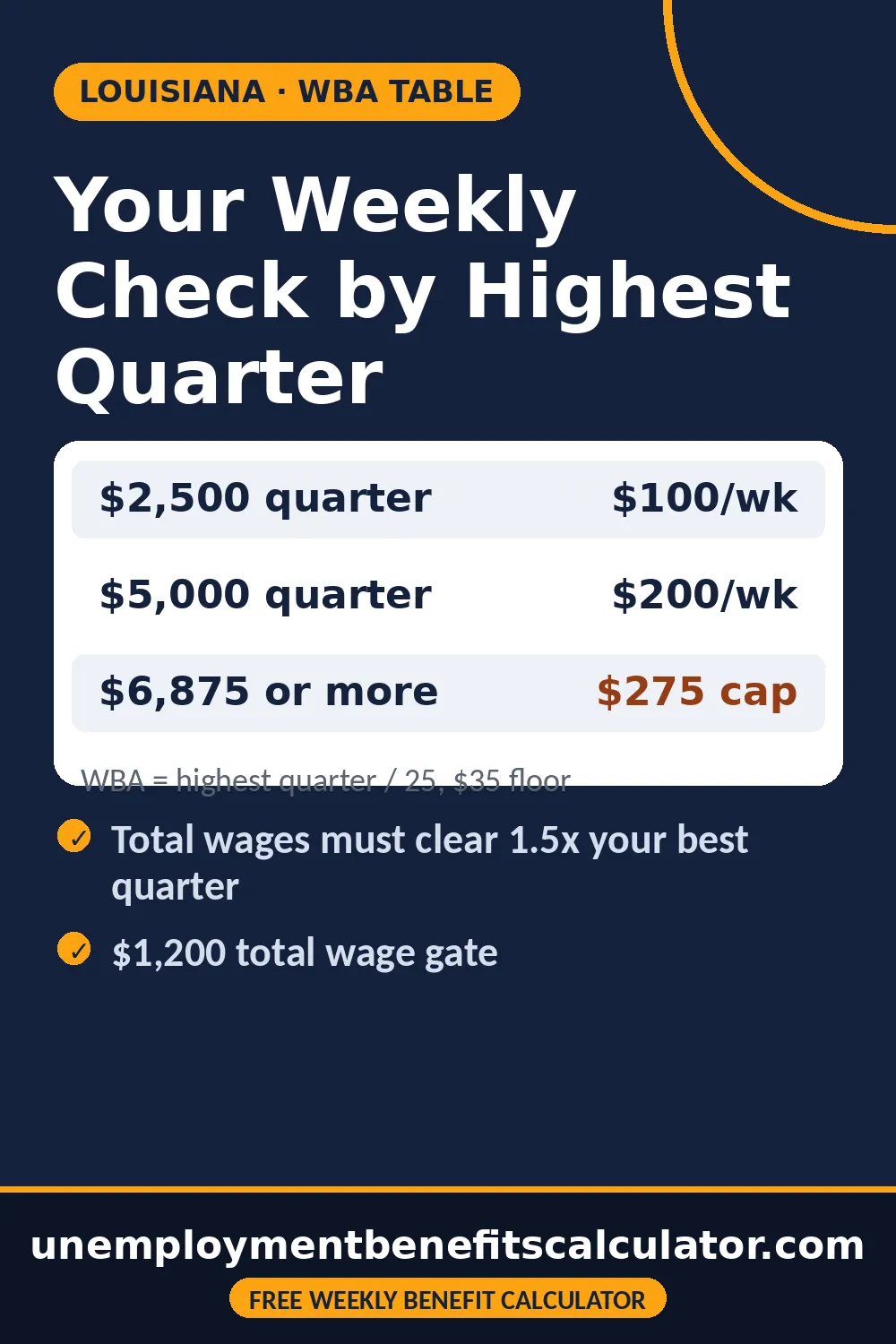
Most states average a full year of wages or pull from a formula table. Louisiana makes one cut: find the base-period quarter where you earned the most, and divide it by 25. A $4,500 quarter pays $180. A $6,200 quarter pays $248. The same division runs inside the state’s own system, so if you can multiply by 25, you can predict your check to the dollar before you file.
Two rails keep the figure inside state law, and both moved with the January 2025 law changes. No check falls below $35 — the LWC’s claimant FAQ now states the minimum at $35.00, up from the $10 floor this state carried for years — and none rises above $275, a ceiling Louisiana has kept since 2024 and one of the lowest maximums in the country. The cap starts binding at a high quarter of exactly $6,875, because 6,875 divided by 25 is 275; the floor stops mattering at a quarter of $875. Every dollar earned above the cap line adds nothing to the weekly rate, though it still counts toward the 1.5× gate you will meet in Slice 3.
| Highest quarter (HQW) | Raw ÷ 25 figure | Weekly check |
|---|---|---|
| $250 | $10 | $35 — the new floor lifts it |
| $500 | $20 | $35 — the floor still holds |
| $875 | $35 | $35 — the floor’s exact edge |
| $1,000 | $40 | $40 |
| $3,000 | $120 | $120 |
| $4,500 | $180 | $180 |
| $6,200 | $248 | $248 |
| $6,875 | $275 | $275 — the cap lands here |
| $9,000 | $360 | $275 — the cap holds the line |
Read the top and bottom rows together: a $250 quarter and a $9,000 quarter are seven weeks of wages apart, yet their checks sit $240 apart at most — the floor raises the smallest claims, the cap flattens the biggest. A restaurant worker whose best quarter hit $7,400 and a project manager whose hit $11,000 both receive the same $275, which is why the duration rules in Slice 5 matter so much in Louisiana.
Slice 2 · The question everyone asks
How much unemployment will I get if I make $1,000 a week?
If you earn $1,000 a week, steadily, every Louisiana rule lands on the same answer: the maximum, $275 a week. A thousand a week builds a $13,000 quarter over thirteen weeks. Divide by 25 and the raw reading is $520 — nearly twice the state cap — so Louisiana holds the check at $275. No amount of additional wages raises it; $275 is the ceiling for every claimant in the state, from a $6,875 quarter to a $60,000 one.
Direct answer
$275 a week — the Louisiana maximum — for a steady $1,000-a-week worker.
Twelve weeks on the current floor tier, a $3,300 pot, and $3,025 actually paid once the unpaid waiting week is served.
| Step | Result |
|---|---|
| Weekly wage | $13,000 high quarter |
| Raw division | $520 raw |
| Weekly check | $275 — capped |
| Gate 1 — total wages | passes |
| Gate 2 — spread | passes |
| Duration tier | 12 weeks |
| Benefit pot | $3,300 |
| Waiting week | $3,025 payable |
| Part-time shield | $137.50 ignored |
Two conditions hide inside that table. The $13,000 quarter is the highest quarter, not the total: if the $1,000 weeks cluster into one season and the rest of the year is thin, the second gate demands $19,500 in total base wages — one hot quarter plus quiet months can fail it, and no weekly rate at all is the result. And the $275 cap means a claim built on $1,000-a-week wages replaces about 27.5 percent of earnings, one of the lowest replacement rates in the country; the state makes up for size with speed, not generosity. For the national picture and how other states price the same wage sheet, see the guide to how much unemployment you will get.
Slice 3 · The two gates
Two money tests decide whether the claim opens
The division only prices a claim that already exists. Before the LWC computes a rate, the Benefit Rights handbook lists two wage tests your base period must pass, and failing either one means no claim at all — no determination letter, no rate, no weeks. The handbook words them simply: at least $1,200 in total wages, and total wages at least one and a half times what you earned in your highest quarter. Here is what each gate actually asks.
$1,200 in total base wages
Everything you earned across the four base-period quarters must add up to at least $1,200. The bar is low on purpose — it exists to filter out claims built on a week or two of casual work rather than real attachment. Anyone who worked a sustained job at minimum wage clears it without noticing.
Four quiet quarters totaling $6,400 — passes with room to spare.
Total wages ≥ 1.5× the high quarter
This is Louisiana’s gate that bites. The whole year must be at least one and a half times your best quarter, which in practice means the other three quarters combined must equal at least half the best one. One booming season with thin work around it fails here — the handbook gives the shape of it, and the $1,000-a-week example in Slice 2 shows the arithmetic.
High quarter $6,200, total $13,800 vs required $9,300 — passes.
From the pilot house
Notice what the two gates reward: spread-out work, not big seasons. A deckhand who earned $5,000, $5,200, $4,900, and $5,100 across the year passes both gates easily and draws about $204 a week. A festival contractor who earned $11,000 in one quarter and almost nothing in the other three can fail outright — the total would need to reach $16,500, nearly a second full season packed into eleven months. If your year looked like that, gather every wage record before filing, because a missing employer wipes quarters out of the base period entirely. The full state-by-state comparison lives in our monetary eligibility guide.
Slice 4 · The window
The base period: the first four of the last five quarters
Louisiana reads your claim from the first four of the last five completed calendar quarters, and it deliberately skips the quarter you are filing in. A claim filed in October 2026 sits inside a quarter that has not finished, so the state reaches back one quarter further: the base period opens in April 2025 and closes in March 2026. Everything you earned in that twelve-month window is the wage sheet the division reads. Wages after March 2026 do not help this claim — but they sit ready for a future one.
| You file in | Base period closes |
|---|---|
| October–December 2026 | March 31, 2026 |
| January–March 2027 | June 30, 2026 |
| April–June 2027 | September 30, 2026 |
| July–September 2027 | December 31, 2026 |
The lag matters most for workers whose pay climbed recently. A nurse who spent early 2025 in a lower-paying clinic and moved to a hospital in June 2026 would find the raise entirely outside the window for a late-2026 claim — the higher hospital wages price the next claim instead, filed after June 2027. Timing a claim around a quarter boundary can genuinely change the rate, so check where your best wages actually fall before filing the week you lose a job.
Slice 5 · The clock
How long Louisiana benefits last: the 12-to-20-week scale
For decades Louisiana paid up to 26 weeks, the traditional American duration. Act 412 of 2024 rewrote that, effective for claims filed on or after January 5, 2025: the maximum number of weeks now tracks Louisiana’s unemployment rate — 12 weeks when the average rate is 5 percent or less, one additional week for each half-point rise, and a hard ceiling of 20 weeks once the rate reaches 8.5 percent. The LWC’s FAQ states the mechanics the way the law does: your Maximum Benefit Amount equals 12 to 20 times your weekly benefit, keyed to the average of the three most recently published seasonally adjusted rates at the time you file. Claims filed before January 5, 2025 keep the old 26-week clock.
Where does Louisiana sit today? The statewide seasonally adjusted rate was 4.2 percent in August 2026, down from 4.4 percent in July — among the lowest stretches in the state’s modern record — which pins every new claim on the 12-week floor tier. The Center on Budget and Policy Priorities, which tracks duration state by state, currently lists Louisiana at up to 12 weeks. The scale only moves when unemployment climbs, and it can climb fast here: hurricanes have pushed the rate past 10 percent before, which would swing new claims toward the top of the table.
| Average unemployment rate | Maximum weeks |
|---|---|
| 5.0% or less | 12 wks — current |
| Over 5.0% but under 5.5% | 13 |
| 5.5% to under 6.0% | 14 |
| 6.0% to under 6.5% | 15 |
| 6.5% to under 7.0% | 16 |
| 7.0% to under 7.5% | 17 |
| 7.5% to under 8.0% | 18 |
| 8.0% to under 8.5% | 19 |
| 8.5% or more | 20 |
Two practical notes on the clock. First, the rate the law reads is a trailing average of three published months, not this week’s print — so the tier moves slowly and predictably, and a single storm month does not rewrite it. Second, the weeks are a ceiling, not an entitlement: your claim pays until the pot of weeks is drawn or the benefit year expires, whichever comes first. A claimant who finds work in six weeks simply leaves the rest on the table; a claimant who searches hard for twelve hits the wall and needs a plan.
Slice 6 · The weather map
Louisiana’s job market right now
The federal state employment and unemployment release put Louisiana’s seasonally adjusted rate at 4.2 percent in August 2026, a tenth of a point better than July’s 4.4 and among the lowest readings the state has recorded in its modern data. For a claimant, that number is not trivia: it is the input the Act 412 scale reads. With the average rate sitting comfortably below the 5 percent threshold, every new claim opens on the 12-week floor tier, and a $275-a-week maximum claim draws $3,300 before the waiting week.
The direction matters as much as the level. A rate this low means employers are holding workers in most parishes, which cuts both ways for a job seeker — fewer layoffs push people into the system, but the five-work-search weekly requirement assumes openings exist to apply for. The tier-to-tier ladder in Slice 5 is the part to watch: if the rate climbs back through 5 percent, the duration scale stretches one week at a time, and the same wage sheet buys a longer claim. The BLS release and the FRED series in Sources update monthly.
Slice 7 · The unpaid opening
The waiting week: the first slice nobody eats
Louisiana bakes its own surprise into the front of every claim. The first week after your claim’s effective date is a waiting week: you file for it, you meet every rule for it, and no check is issued. The Benefit Rights handbook is blunt about it — you must file, but you will not be paid. Only the second week out of work starts drawing down the pot, which means a 12-week claim is really an 11-check claim spread across 13 weeks.
The handbook adds one wrinkle worth knowing before you file. If your first week is not payable — a missed certification, an eligibility question still open — the waiting week shifts to the next week you do qualify, rather than burning a payable week in its place. Either way the waiting week never converts into cash on a regular Louisiana claim. Budget for it the way you budget for a deposit: one week of rent and groceries that savings has to cover while the paperwork catches up. Skipping the request is the common version of this mistake — the waiting week must be filed like any other week, or the shift rule cannot protect you.
Slice 8 · Half the check
Part-time work and the 50% disregard
Louisiana runs one of the friendlier partial-benefit rules in the country, and almost nobody knows it. The Benefit Rights handbook says you can earn up to half of your weekly benefit amount before any deduction touches your check. On a $248 weekly rate, the first $124 of part-time wages is simply ignored — the check arrives whole. Only the wages above that half come off, dollar for dollar, so $180 earned leaves $192 payable and $124 earned leaves the full $248.
The rule rewards shifted and reduced hours precisely because the disregard scales with the check. A server whose restaurant cut her to two shifts keeps most of her benefits; a warehouse worker picking up weekend gig work can stack wages onto the disregard and sometimes lose nothing. The cliff is real, though: once your gross earnings reach the full weekly amount, the week pays zero, and earnings above the weekly amount take the week off the claim entirely.
| Gross wages earned | Check that week |
|---|---|
| $0 | $248 — full check |
| $$80 | $248 — inside the disregard |
| $$124 | $248 — the disregard edge |
| $$180 | $192 |
| $$230 | $142 |
| $$248 | $0 — report, request, keep alive |
Report gross earnings for the week you worked them, not the week the paycheck lands — Louisiana matches wage reports against your certifications, and mismatched timing is the most common overpayment trigger in the state. A $0 week should still be requested so the claim stays open behind it.
Slice 9 · Five actions
The work-search rule is stricter now: five a week
Louisiana tightened its work-search requirement for claims filed on or after January 4, 2026. Under the old rule, three work-search activities a week were enough; the new standard is five valid actions every week you request benefits. The LWC claimant FAQ draws the line by claim date — anyone who first applied before January 4, 2026 stays on the three-activity rule for the life of that claim, while new claims live under five. Workers on a temporary layoff with a definite return-to-work date can have the requirement waived, but everyone else plans for five.
What counts as a valid action? Job applications submitted to real openings, interviews — phone or in person — and comparable activities such as job fairs, reemployment workshops, and appointments at an American Job Center all qualify when they are logged with employer names and dates in HiRE. The state’s own events calendar is full of eligible opportunities, from regional hiring fairs to practice-interview sessions at local centers. Employers can report claimants who fail to appear for scheduled interviews, and every action you log should survive a call to the employer listed.
Keep a search log
Date, employer, role, contact, and result for all five actions. Audits ask for last year’s weeks, not this week’s memory.
Build the log →Count events deliberately
Job fairs and networking count as actions when documented. Two applications plus an interview plus a fair plus a workshop is a complete week.
What counts →From the pilot house
Five real actions a week is a job search that fills a calendar, and the claimants who treat it that way tend to exit benefits before the pot empties. Louisiana’s reemployment services can help get there sooner: if the LWC schedules you for a reemployment appointment, attending is mandatory, and skipped sessions stop checks just as surely as a missed certification.
Slice 10 · The claim
Filing in Louisiana: HiRE, ID.me, and the first sixteen days
The front door is HiRE — Louisiana Works’ self-service system at louisianaworks.net/hire — where you can file the initial claim, file weekly certifications, and read every determination the state issues. The same account searches job listings, so the work-search log and the benefits system live in one place. Anyone who cannot file online can use the UI Call Center at 1-866-783-5567, where lines run long on Mondays; Tuesdays through Thursdays are quieter. The full walkthrough lives in our guide to applying for unemployment online.
Identity verification comes first. New claimants filing on HiRE are routed through ID.me, the federally certified verification partner Louisiana Works uses — a passport or driver’s license plus a short video selfie usually clears it in minutes on a phone. Have these ready before you sit down to file: your Social Security number, employer names, addresses, and dates for the last 18 months, each employer’s separation reason, and your banking details for direct deposit, which is the fastest way to be paid.
File the claim
The effective date is the day you file — never backdated. File the week you lose work, even if severance or a final check is still coming.
Verify with ID.me
Clear identity verification before the LWC can process anything. A stuck ID.me step is the most common day-one stall.
Monetary determination
HiRE posts your wage sheet: the quarters, the high quarter, the weekly rate, and whether the two gates passed. Check every line against your own records.
Certify the prior week
Answer the eligibility questions and log five work-search actions. Certification is weekly, and skipped weeks usually cannot be fixed later.
First payment lands
The waiting week plus processing put money in the bank roughly two to three weeks after filing for a clean claim.
The determination letter is worth reading with a calculator beside you: it lists the four quarters the employers reported, and a missing employer — a staffing agency that filed under one tax ID, a restaurant group that lagged its reports — shrinks the high quarter and drags the whole rate down. Disputed wages start with a wage-record correction, not an appeal.
Slice 11 · Every Sunday
Weekly certifications: the rhythm that keeps the claim alive
Louisiana pays week by week, and each week has to be requested. Certifications open in HiRE every Sunday for the week just ended, and the questions are the same each time: able and available for work, physically in Louisiana, no full-time job taken, gross earnings reported, work-search actions logged. The IVR phone line at 1-866-783-5567 handles the same questions for claimants who prefer the phone. Miss a week and that week generally cannot be paid retroactively, so the Sunday habit is the whole ballgame.
Accuracy matters more than speed on those questions. Louisiana cross-matches your reported earnings against employer wage reports each quarter, and the mismatch letters arrive months later, when an honest $20 rounding error has quietly become an overpayment case. Report gross wages — before taxes — for the week worked, keep your own dated log beside the HiRE screen, and the certifications take five minutes a week with no surprises behind them.
Sunday
Certify
HiRE or the IVR line opens for the prior week.
Gross
Report earnings
Before-tax wages for the week worked, not the week paid.
Five
Search actions
Logged with employer names, dates, and contacts.
Slice 12 · Fired or quit
Layoffs, discharges, and quits: how Louisiana judges the ending
Louisiana pays benefits after a layoff for lack of work without a second thought — the separation reason the employer reports drives everything else. A discharge raises the question of misconduct connected with the work: repeated no-call absences, theft, violence, or a final violation of a rule the worker knew about. Ordinary poor performance, the kind that shows up in reviews but not in willful acts, is not misconduct under Louisiana law, and the employer carries the burden of proving the difference with records, not adjectives.
A quit raises the mirror question of good cause attributable to the work — a medical condition the job caused or worsened, a documented hazard the employer refused to fix, or a material change in the job the worker never agreed to. Quitting for personal convenience, however understandable, does not carry a claim by itself. The LWC gathers statements from both sides before issuing a nonmonetary determination, and the claimant’s paper trail — texts, schedules, doctor notes, complaint emails — is what those hearings turn on.
If you were fired
Ask the employer for the exact reason given to the state. Pull together schedules, reviews, and any write-ups. Misconduct must be proven by the employer; your job is to show the record contradicts the label.
Fired — the full guide →If you quit
Write down the why with dates before memories blur. Good cause in Louisiana points back at the work — health, safety, or a changed deal — and documents beat testimony every time.
Non-monetary eligibility →A disqualification for misconduct or a bad quit is serious but rarely forever. The LWC’s own standard is the cleanest sentence in the handbook: return to work and earn at least ten times your weekly benefit amount, then become unemployed again through no fault of your own, and the ledger resets. The original claim does not recover, but a fresh claim after re-employment prices cleanly.
Slice 13 · Fifteen days
The appeal clock: fifteen days, then a hearing, then a board
Every determination — monetary, nonmonetary, or overpayment — carries a fifteen-day appeal window counted from its mailing date. The LWC appeals FAQ is explicit: file online through HiRE, by mail to the Appeals Unit in Baton Rouge, or by fax within fifteen days, and state plainly which determination you dispute and why. Each determination is appealed separately, so a bad week stacked on a bad quarter takes two filings. Missing the window generally closes the case, which makes this the most expensive fortnight in the whole claim. Calendar the deadline the day the letter arrives, not the day you finish reading it.
Appeals land with an administrative law judge, and most Louisiana hearings run by telephone. The employer appears too, witnesses testify under oath, and exhibits — schedules, messages, pay records — carry more weight than either side’s summary. A decision follows by mail; either party can take it further to the Board of Review within another fifteen days, and from there to state district court on the same clock. Claimants who appeal a denial should keep certifying every week during the appeal, because weeks won on appeal are only payable if they were requested on time.
Overpayments, briefly
When the LWC decides it paid weeks it should not have — a reversed appeal, mismatched earnings, an eligibility mistake — the claim becomes a debt the state pursues aggressively: offsets against tax refunds and lottery winnings, referral to collection, and recovery from future claims. The overpayment portal at la.egov.com lets you review balances, dispute, or request a repayment schedule. Fraud-flagged overpayments carry penalties and prosecution risk; repayment-only overpayments are recoverable with patience.
Slice 14 · Two returns
Taxes: Washington takes its share, Baton Rouge takes three percent
Unemployment income is taxed twice for Louisiana workers. The IRS taxes every benefit dollar as ordinary income — a fact that surprises people who never elected withholding — and Louisiana includes benefits in gross income on the state return too, at a flat 3 percent individual rate that took effect with tax year 2025. The Louisiana Department of Revenue states the flat rate on its own rate page, and benefits ride inside it like any other income.
Withholding is optional and separate. HiRE lets you elect 10 percent federal withholding on weekly certifications; Louisiana does not withhold state tax from checks at all. A claimant drawing $248 a week with no election receives $248 and meets both bills in April. The math that catches people: a full 12-week floor-tier claim at the $275 cap produces $3,300 of income, enough to move a modest refund into a balance-due. The state’s 1099-G arrives by late January and also lives in HiRE.
Elect 10% federal withholding
One checkbox in HiRE sends a tenth of each check to the IRS and softens the April bill on the biggest claims.
Set aside the 3% yourself
No state withholding exists. Move three cents of every benefit dollar to savings and the Louisiana bill funds itself.
Slice 15 · The side doors
Work Share, training weeks, and disaster claims: the programs beside regular UI
Regular claims are not the only door. Louisiana’s Work Share program lets employers cut every employee’s hours instead of laying anyone off — the affected workers file, and the LWC pays the pro-rated difference between the reduced check and the old one, funded from the same account as regular benefits. For employers it preserves trained crews through slow seasons; for workers it keeps full health coverage and a paycheck of some size every week. The employer files the plan, not the worker, so ask HR whether a Work Share agreement already exists before assuming a reduced schedule pays nothing.
Training has its own door now. The LWC’s Additional Benefits program pays up to eight extra weeks to claimants who are enrolled in and attending school or an approved training program before their regular benefits run out — the weekly amount stays the same, the enrollment has to start before exhaustion, and dropping out ends the extra weeks. It is the closest thing Louisiana has to a dependent-style add-on, and it rewards finishing the certification rather than starting it late. Note what Louisiana does not pay: no dependency allowance of any kind — a claimant with four children and a claimant with none draw the same $275 cap.
Hurricanes change the math in other ways. When a president declares a major disaster, Disaster Unemployment Assistance opens for people regular UI cannot cover — the self-employed, farmers, and workers whose jobs washed away with the business itself — and the LWC extends filing deadlines for regular claims in affected parishes, so a missed certification during an evacuation can usually be repaired. None of these side doors changes the divide-by-25 register for regular claims; they sit beside it.
One claim, end to end
Renée in Lafayette: a wage sheet through the whole machine
Concrete numbers make the rules stick, so meet Renée, a line supervisor at a marine-supply plant outside Lafayette whose position disappears in an October 2026 reorganization. Her four base-period quarters run $4,100, $6,200, $2,100, and $1,400 — a total of $13,800, with the summer quarter of $6,200 standing as the high quarter. Here is every rule on this page applied to her wage sheet, in the order the LWC applies them.
| Step | Result |
|---|---|
| Gate 1 — total wages | passes |
| Gate 2 — spread | passes |
| Weekly rate | $248 |
| Duration tier | 12 weeks |
| Benefit-year pot | $2,976 |
| Waiting week | $2,728 payable |
| Part-time check | $192 that week |
The story behind the table: Renée files the Monday after her last shift, clears ID.me that evening, and posts a monetary determination showing $248 within a week. She serves the unpaid waiting week, certifies every Sunday with five logged actions, and takes a part-time inventory job in month two that pays $180 a week — inside the half-disregard math shown above, so her checks dip only slightly. Eleven paychecks and a part-time wage later, she lands full-time work with two weeks of the pot still unspent. Every number on this page met her once, in order.
Seven ways claims stall
The mistakes Louisiana claimants keep making
Louisiana’s program is simple at the top — one division, two gates — and unforgiving in the details. These are the seven stalls the LWC sees every week, and every one of them is avoidable with a calendar and a folder.
Filing late in the quarter
A claim filed days before a quarter closes can catch an extra quarter of recent wages. A claim filed days after can drop the best quarter out of the window entirely. Check the lag table before you file.
Skipping the waiting-week filing
Assuming the first week is automatic leaves a hole. The waiting week must be requested like every other week, or the shift-the-week rule cannot protect you.
Reporting net pay instead of gross
The certification asks for gross wages. Net figures understate earnings, and the quarterly wage match turns every one of them into an overpayment letter.
Logging only three searches
Three was the old rule. Claims filed on or after January 4, 2026 need five valid actions a week, and a week with four is a failed week in an audit.
Missing the ID.me step
The claim sits untouched while identity verification pends. Clear it the same day you file, on a phone, with a license or passport ready.
Ignoring the determination letter
A missing employer or a wrong quarter in the wage sheet drags the rate down for the whole benefit year. Dispute wage errors immediately — corrections compound.
Letting the 15-day clock die
Louisiana’s appeal window is short. A denial you meant to contest becomes final because fifteen days passed quietly.
Placement on the map
Louisiana against the typical state
Every state shares a federal frame, but the details diverge sharply. The table below sets Louisiana’s rules against what most of the country does, using the same verified numbers this page carries. Louisiana’s fingerprint is unmistakable: it prices the week from a single quarter, ties duration to the unemployment rate, and holds one of the lowest maximum checks in the nation.
| Rule | Louisiana, 2026 |
|---|---|
| Weekly check formula | High quarter ÷ 25, $35–$275 |
| Duration | 12–20 weeks, tied to the unemployment rate |
| Waiting week | One unpaid week on every initial claim |
| Work search | 5 valid actions weekly for new claims |
| Part-time rule | Half the check disregarded |
| Dependent allowance | None |
| Appeal window | 15 days from the mailing date |
| State tax on benefits | Taxed at the 3% flat rate |
If you are comparing offers or planning a move, the neighboring claims are worth a look: the same wage sheet prices very differently across a state line — see the Texas, Arkansas, and Mississippi calculators, or the states grid for all fifty.
Straight answers
Louisiana unemployment questions, answered
How much unemployment will I get in Louisiana?
Louisiana divides your highest base-period quarter by 25 and holds the answer between $35 and $275 a week. A high quarter of $6,200 pays $248, while any quarter above $6,875 lands on the $275 cap and any quarter below $875 rests on the $35 floor. The calculator at the top of this page runs the same division, checks both wage gates, and prices the whole claim including the waiting week.
How much unemployment will I get if I make $1,000 a week?
At $1,000 a week of steady work, your high quarter is about $13,000 — and $13,000 divided by 25 is $520, well past the cap. Louisiana holds the check at $275, the state maximum. Steady earnings of $52,000 across the base period clear both gates ($1,200 minimum and the 1.5× spread test), so the claim prices at 12 weeks of $275 — a $3,300 pot, reduced to $3,025 once the unpaid waiting week is served. A thinner year around that $13,000 quarter needs at least $19,500 in total wages to pass the second gate.
How long do Louisiana unemployment benefits last?
The ceiling is no longer a fixed 26 weeks. Act 412 of 2024 ties the maximum to Louisiana’s unemployment rate: 12 weeks when the average rate sits at 5 percent or less, one extra week for each half-point rise, and 20 weeks once the rate reaches 8.5 percent. Louisiana’s seasonally adjusted rate was 4.2 percent in August 2026, so new claims open on the 12-week floor tier.
Why did my Louisiana claim get denied even though I worked all year?
Louisiana applies two monetary tests, and the second one quietly rejects lopsided years: your total base-period wages must reach at least 1.5 times your highest quarter. A worker with a $9,000 quarter and thin wages around it would need $13,500 in total — a single booming season without steady work around it fails even though the year looked fine on paper. Total base wages must also clear $1,200.
What is the waiting week in Louisiana?
The first week on every new claim is an unpaid waiting week. You must file for it and meet every eligibility rule, but no check is issued. If that first week is not payable for some reason, the waiting week shifts to the next week you do qualify. Plan one week of expenses on savings, because the waiting week never converts to payment on a regular claim.
Can I work part-time and still collect Louisiana unemployment?
Yes. Louisiana lets you earn up to half of your weekly benefit amount with no reduction at all — a $248 check ignores the first $124 of part-time wages. Earnings above that half come off dollar for dollar, so $180 of wages leaves $192 of the check. Report gross earnings for every week worked; a week that pays zero should still be requested to keep the claim open.
How many job searches does Louisiana require each week?
Five valid work-search activities every week for claims filed on or after January 4, 2026 — up from three under the old rule. Job applications, interviews, and comparable actions such as job fairs or American Job Center appointments all count when they are logged in HiRE with employer details. Claimants on a temporary layoff with a definite recall date can ask for a waiver; everyone else plans for five.
What happens if I was fired or I quit in Louisiana?
A discharge for misconduct connected with the work or a quit without good cause attributable to the work both trigger a disqualification review. Louisiana distinguishes ordinary poor performance from misconduct, and a quit for personal convenience is not automatically good legal cause. LWC gathers statements from you and the employer before issuing a determination, and either side can appeal within 15 days of the mailing date. After a disqualification, returning to work and earning at least ten times your weekly benefit amount resets the ledger.
Does Louisiana tax unemployment benefits?
Yes, twice. The IRS taxes every dollar of unemployment income, and Louisiana includes benefits in gross income on the state return as well. Louisiana’s individual income tax is a flat 3 percent for taxable periods beginning on or after January 1, 2025. You can elect 10 percent federal withholding on your weekly claims, but the state bill comes at filing time unless you set money aside. A 1099-G covering the year arrives by late January.
How do I appeal a Louisiana unemployment decision?
You have 15 days from the mailing date printed on the determination to appeal — online through HiRE, by mail, or by fax to the Appeals Unit. Most cases then go to a telephone hearing before an administrative law judge, and either side can take the decision further to the Board of Review within another 15 days. Missing the first 15-day window generally closes the appeal, so calendar it the day the letter arrives — and keep certifying every week while the appeal is pending, because weeks won on appeal are only payable if they were requested on time.
Where every number comes from
Sources & verification
Every figure on this page was re-checked against Louisiana government sources on October 8, 2026 — the LWC FAQ, appeals FAQ, and ID-verification pages were fetched live that day; the Benefit Rights PDF is cited from the official document (its text verified through a search-index excerpt where the site’s bot protection blocked a direct download). Where a rule changed by claim date — the five-activity work search of January 2026, the 12-week duration floor and $35 minimum of January 2025 — both sides of the line are shown. This site is not affiliated with, endorsed by, or operated on behalf of the Louisiana Workforce Commission or any government agency.
- 1.Louisiana Workforce Commission — Claimant Benefits FAQ — minimum WBA $35.00, maximum $275, MBA equal to 12–20 × WBA by the three-month average rate, five work-search activities for claims on or after January 4, 2026 (three before), ten-times-earnings disqualification reset, Additional Benefits training weeks — fetched live October 8, 2026.
- 2.Louisiana Workforce Commission — Unemployment Benefits Rights and Information (PDF) — $1,200 total-wage test, 1.5× high-quarter test, unpaid waiting week and its shift rule, 50% partial-earnings disregard — official handbook, cited from the September 2026 verified check with text corroborated October 8, 2026.
- 3.Louisiana State Legislature — Act No. 412 of 2024 — duration rewritten from 26 weeks to the 12–20-week scale keyed to the average unemployment rate — carried from the September 2026 verified check.
- 4.Louisiana Workforce Commission — Maximum Duration instruction memo (PDF) — LWC implementation of Act 412: 26 weeks reduced to a variable 12–20 weeks effective for claims on or after January 5, 2025 — carried from the September 2026 verified check.
- 5.Louisiana Workforce Commission — Claimant Appeals FAQ — 15-day appeal window from the mailing date, filing methods, telephone ALJ hearings, Board of Review within 15 days — fetched live October 8, 2026.
- 6.Louisiana Workforce Commission — Identity Verification for Unemployment Claims — ID.me as the identity partner for new HiRE claims — fetched live October 8, 2026 (replaces the retired FAQ page previously cited).
- 7.Louisiana Law Help — Unemployment Benefits — one-week waiting period before payments start, HiRE filing practice — corroborated October 8, 2026.
- 8.Louisiana Department of Revenue — Individual income tax rates — flat 3% individual income tax for taxable periods beginning on or after January 1, 2025 — carried from the September 2026 verified check, corroborated October 8, 2026.
- 9.U.S. Bureau of Labor Statistics — State Employment and Unemployment (LAUS) news release — Louisiana 4.2% seasonally adjusted, August 2026 (4.4% July) — fetched live October 8, 2026.
- 10.FRED — Louisiana unemployment rate (LAUR) — the monthly series behind the duration-tier reading — October 2026.
- 11.U.S. Department of Labor — unemployment insurance — federal program frame and state administration.
- 12.IRS — Topic 418, Unemployment Compensation — federal taxation of every benefit dollar and 10% elective withholding.
- 13.CBPP — How Many Weeks of Unemployment Compensation Are Available? — independent confirmation that Louisiana currently tops out at 12 weeks.
- 14.CareerOneStop — American Job Center network — job-search and training resources cited for work-search planning.
Editorial note: this calculator and guide are independent tools for Louisiana workers. The LWC’s own HiRE system and the mailed monetary determination are the controlling sources for any real claim, and rounding differences of a dollar or two can occur between this page’s arithmetic and the state’s systems.
Around the bayou