
Losing your job over performance problems feels very different from losing one to a layoff. There is no position-eliminated letter to soften the blow and no tidy paperwork to explain it.
The unemployment office now has to decide whether your employer's stated reason actually blocks your benefits. The answer in most states surprises people: poor performance alone almost never blocks an unemployment claim.
The legal line runs between inability and misconduct, and it decides your case. If you tried but could not meet the standard, state agencies treat it as a no-fault separation. If you willfully ignored rules, stole time, or deliberately tanked your output, that is misconduct instead.
A misconduct finding can bar you from benefits for weeks or even months. Knowing which side your termination falls on separates an approved claim from a denied one.
This guide explains how every major state draws that line in 2026 and what evidence agencies weigh. It also covers how to file after a performance-based firing and what to do if employers reclassify it as misconduct. While your claim processes, the unemployment benefits calculator can estimate your weekly amount so you can plan.
Table of Contents
- Poor Performance vs. Misconduct: The Legal Difference
- What States Actually Consider Poor Performance
- When Poor Performance Crosses Into Misconduct
- How to File Your Claim Correctly
- The PIP Question
- State-by-State Rules
- What to Do If Your Claim Is Denied
- Why You Should Always File
Poor Performance vs. Misconduct: The Legal Difference
Every state unemployment law sorts job loss into two distinct buckets with opposite outcomes. No-fault separations usually qualify for benefits, while misconduct separations usually do not.
Poor performance still falls into the first bucket in nearly every state. The law defines misconduct as a willful act, not an inability to perform.
The U.S. Department of Labor's standard definition describes misconduct as a willful or deliberate disregard of the employer's interests. It also covers violations of standards of behavior that the employer has the right to expect.
Notice the three key words used in that definition: willful, deliberate, and disregard. Simply being bad at your job, even consistently bad, does not meet that threshold.
The Vermont Department of Labor puts it most directly in its own guidance. Its case law exempts inefficiency, unsatisfactory conduct, and good-faith errors in judgment from the misconduct definition.
Ordinary negligence in isolated instances and performance failures from inability or incapacity stay outside misconduct too. In other words, poor performance caused by a lack of skill, training, or capacity is not misconduct.
| Factor | Poor Performance (Usually Eligible) | Misconduct (Usually Denied) |
|---|---|---|
| Intent | Unintentional — you tried but fell short | Willful — you chose to break rules or ignore duties |
| Employer's proof | Production numbers, quality scores, customer complaints | Written warnings, policy violations, documented incidents |
| Pattern | Consistent underperformance despite effort | Escalating defiance, repeated rule-breaking after warnings |
| Typical state ruling | Eligible — no-fault separation | Denied — discharge for misconduct |

What States Actually Consider Poor Performance
State agencies look at the reason behind the performance gap, not just the numbers. A cashier who is slow because she is new sits in a different legal category than a phone-using one. The first situation is a training issue, while the second crosses into willful neglect.
Most states recognize these scenarios as poor performance rather than misconduct:
- Failure to meet quotas or sales targets — Missing a sales goal, even repeatedly, is not misconduct unless you deliberately stopped trying. The Texas Workforce Commission notes that inability to meet production standards does not, by itself, constitute misconduct.
- Mistakes or errors in judgment — A bookkeeper who keeps making math errors falls here, and so does a driver who gets lost. In every case these are skill gaps, not willful violations.
- Unable to learn new systems or processes — A company may upgrade software, restructure teams, or change job duties. When the employee cannot keep up, the failure is one of adaptation, not defiance.
- Customer complaints about quality — A server with complaints about slow service, a mechanic whose repairs come back, a teacher whose students underperform. Quality shortfalls like these are performance issues rather than misconduct.
- Physical inability to perform — A warehouse worker who cannot lift the required weight, or a construction worker who cannot meet physical demands. The Washington Employment Security Department confirms that lacking the physical ability for a job does not disqualify a claim.
When Poor Performance Crosses Into Misconduct
The line blurs when the employer can show the performance problem was within your control. State agencies and appeals boards have drawn clear boundaries over decades of case law. Here is where poor performance stops being a defense:
- Refusal to follow instructions — If your supervisor told you to do something a specific way and you refused, that is insubordination. Insubordination is misconduct in every state, and the damage to your output does not change that.
- Violation of known policies — Breaking safety rules, ignoring attendance policies, or using company equipment for personal business after warnings are willful acts. They count as willful regardless of whether they also dragged down your numbers.
- Substance use on the job — Showing up intoxicated or using drugs at work is misconduct in every state. The underlying cause matters even when the termination letter says poor performance.
- Deliberate slowdown or sabotage — The employer may prove you intentionally reduced your output, perhaps working slowly to protest a policy change. A proven intentional slowdown counts as willful misconduct rather than poor performance.
- Repeated violation after warnings — This is the most common gray area in performance terminations. If you were warned about a specific behavior, corrected it, then relapsed, the agency may find misconduct. But if you were warned about performance numbers and still could not hit them despite trying, most states see inability.

How to File Your Claim Correctly
The way you describe your separation on the claim form shapes the entire process. State agencies use your statement, the employer's response, and supporting documents to make a preliminary ruling. Here is how to handle each step:
Step 1: File Immediately
Do not wait, because most states set claims effective the Sunday of the week you file. Every day of delay costs you real money in lost weekly benefits. File online through your state's unemployment portal the same day or the next business day.
You will need your Social Security number, a driver's license or state ID, and 18 months of employment history. Gather employer names, addresses, dates, and earnings for every job you held.
Step 2: Describe the Separation Honestly
When the form asks why you lost your job, use plain factual language. Write something like terminated for not meeting performance expectations, or discharged for failure to meet production standards.
Do not write fired for misconduct even if your termination letter uses that phrase. That wording is the employer's characterization, not the agency's legal finding. The New York Department of Labor advises claimants to state the facts and let the agency classify the separation.
Step 3: Respond to the Employer's Statement
Your employer will receive a notice and has a deadline to respond. If they check misconduct on their separation report, you will get a chance to rebut it.
Prepare your response in advance instead of scrambling after the notice arrives. Gather performance reviews, emails praising your work, written warnings with your responses, and evidence that you tried to improve.
A pattern of positive reviews before a sudden performance termination suggests the real reason was something else.
Step 4: Attend the Fact-Finding Interview
Many states conduct a phone interview with both parties before making a preliminary ruling. Be honest, specific, and calm from the first question to the last. Explain what you were told about your performance and what steps you took to improve.
Describe whether the employer provided training or accommodations that should have helped. If you were placed on a Performance Improvement Plan, say whether the goals were realistic and whether you met them.
The PIP Question: Does a Performance Improvement Plan Hurt Your Claim?
A Performance Improvement Plan, commonly called a PIP, sits between performance and discipline. Employers use PIPs to document a timeline for improvement before any termination decision.
State agencies read the same documents differently depending on what happened during and after the plan.
If you were placed on a PIP, met the stated goals, and were still fired, you have a strong claim. The employer's own documentation shows you improved, which undercuts any misconduct argument.
If you missed the goals but were genuinely trying, most states still classify the separation as poor performance. The plan itself is evidence of a performance gap, not of willful behavior. It shows the employer recognized a gap and gave you a chance to close it.
The scenario that hurts you is ignoring the PIP entirely. Skipping meetings, refusing feedback, or continuing the same behavior shifts the pattern from inability toward willful disregard. Anyone weighing resignation instead should first read how constructive discharge rules apply to pressure-based departures.
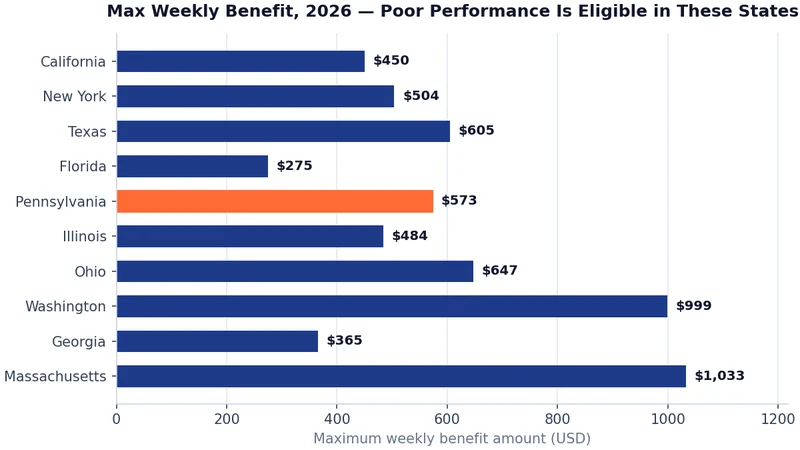
State-by-State Rules for Performance-Based Terminations
The general rule is that poor performance does not disqualify you, but states define misconduct differently. Here is how the ten largest states handle it in 2026:
| State | Max Weekly Benefit (2026) | Poor Performance Rule | Source |
|---|---|---|---|
| California | $450 | Inefficiency or inability is not misconduct (CDT precedent) | edd.ca.gov |
| New York | $504 | Fired for inability to do the job — eligible unless willful misconduct proven | dol.ny.gov |
| Texas | $564 | Inability to meet standards is not misconduct connected with the work | twc.texas.gov |
| Florida | $275 | Poor performance alone is not misconduct; willful violation of known rules is | flsenate.gov |
| Pennsylvania | $573 | Inability to perform is not willful misconduct under UC law | pa.gov |
| Illinois | $484 | Fault must be deliberate; poor performance is not discharge for misconduct | ides.illinois.gov |
| Ohio | $647 | Just not being able to do the job is not willful misconduct | jfs.ohio.gov |
| Washington | $999 | Fired for lacking ability — eligible; fired for violating known rules — not eligible | esd.wa.gov |
| Georgia | $365 | Inefficiency or unsatisfactory performance is not misconduct | dol.georgia.gov |
| Massachusetts | $1,033 | Incapacity or inability is not deliberate misconduct | mass.gov |
What to Do If Your Claim Is Denied
Denials happen more often than people expect, and they are not final. If the agency rules your termination was misconduct, you have the right to file an unemployment appeal.
The appeals process is where most performance-based claims get reversed. The burden shifts to the employer to prove willful behavior at that stage.
The Appeals Timeline
Most states give you 10 to 30 days from the denial notice to file an appeal. Missing that window ends the right permanently, so treat the deadline as sacred.
File the appeal immediately; you can refine the argument later, but you cannot extend the deadline. The California EDD and Illinois IDES both allow online appeal filing.
What to Bring to the Hearing
Appeal hearings are usually conducted by phone or video with an administrative law judge. Prepare these documents:
- Performance reviews showing your work history and ratings
- Emails or messages praising your work or acknowledging effort
- The Performance Improvement Plan (if one was issued) and evidence you met the goals
- Your written rebuttal to any misconduct allegations
- Witness statements from coworkers who can speak to your work ethic
- The termination letter or separation notice
The Key Argument
At the hearing, the legal question becomes very simple. Did you lose your job because you could not do the work, or because you chose not to?
Judges usually rule for claimants whose employer records show discipline for numbers, not policy violations. That outcome is far more likely when you can show you were genuinely trying. The employer must prove by a preponderance of evidence that your actions were willful, and willful is a high bar.
Why You Should Always File — Even If You Think You Will Be Denied
Many people fired for performance never file because they assume they do not qualify. That assumption costs claimants real money every single year. Filing is free, and the agency makes the determination, not your employer.
Your employer may not even bother to contest the claim at all. Even if they do, the facts often still support your eligibility.
Even if the initial claim is denied, appeals reverse a significant number of performance-related denials. The U.S. Department of Labor encourages all separated workers to file and let the agency determine eligibility. There is no penalty for filing in any state.
Your weekly benefit amount could land between $300 and $600 per week depending on your state and earnings. You can estimate yours right now with the unemployment benefits calculator.
Frequently Asked Questions
Can you get unemployment if you were fired for poor performance?
Yes, in most states. Poor performance is generally classified as a no-fault separation, not misconduct. State agencies distinguish between inability (eligible) and willful misconduct (denied).
What is the difference between poor performance and misconduct for unemployment?
Poor performance means you tried but could not meet the standard. Misconduct means you willfully violated rules or deliberately disregarded duties. Only misconduct disqualifies you.
Does a Performance Improvement Plan affect unemployment eligibility?
A PIP itself does not disqualify you. If you tried to improve and were still fired, most states classify it as poor performance. Ignoring the PIP entirely could shift it toward misconduct.
What if my employer says I was fired for misconduct when it was poor performance?
Challenge this during the claims process and at appeal. Gather performance reviews and emails. The employer must prove your actions were willful.
How do I file for unemployment after being fired for performance?
File immediately through your state portal. Describe the separation as terminated for not meeting performance standards. Do not use the word misconduct.
What states allow unemployment after being fired for poor performance?
Nearly all states allow benefits for poor performance. CA, NY, TX, FL, PA, IL, OH, WA, GA, and MA all treat inability as a no-fault separation eligible for benefits.