
Short Answer: Yes, Minimum Wage Workers Can Qualify, and the Math Is Tighter Than Most People Expect
Minimum wage workers often skip unemployment entirely, convinced that their wages are too small for the system to care about. That instinct costs real money. Hourly workers at minimum wage qualify for benefits the same as salaried professionals, and in several situations the weekly check, while modest, covers a meaningful share of what the job was paying.

The catch is that the margin for error shrinks as wages shrink. Higher earners worry about caps trimming their checks; minimum wage workers worry about whether they earned enough in the base period to qualify at all. Both worries come from the same formula, and understanding it turns an intimidating claim into predictable arithmetic.
This guide runs the numbers for different wage levels, shows when a minimum wage claim fails the monetary test, and explains why the state you worked in matters as much as the hours you worked.
How the Formula Treats a Minimum Wage Paycheck
Unemployment benefits start from the same place for everyone: the wages in your base period, generally the first four of the last five completed calendar quarters. For a minimum wage worker, the fastest estimate multiplies hourly pay by hours worked to find weekly earnings, then applies the divide-by-26 rule of thumb to the best quarter.
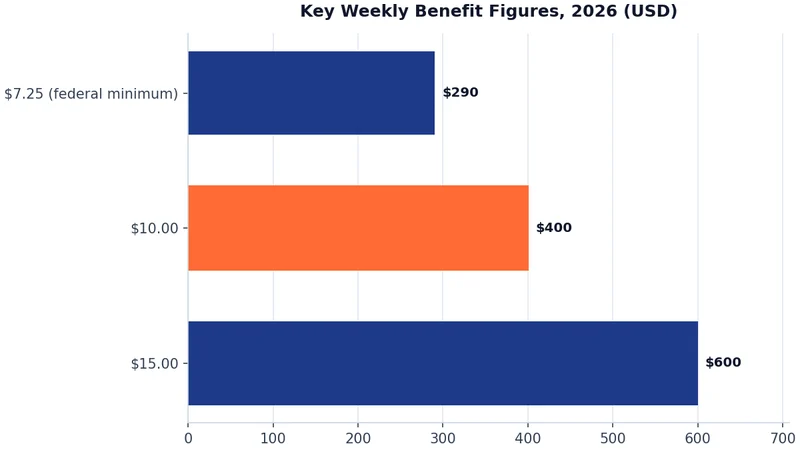
The federal minimum wage has stood at $7.25 an hour since 2009, which produces $290 a week at forty hours. A best quarter at those hours totals roughly $3,770 before taxes, and the standard formula lands near $145 per week. That number sits above the minimum weekly benefit in most states, which means a full-time federal-minimum worker generally qualifies for something rather than nothing.
Everything depends on the hours, though. The formula cannot tell the difference between low pay and short schedules, it only sees quarterly totals, and that is where minimum wage claims live or die.
Worked Examples at Three Wage Levels
The table below estimates weekly benefits for a full-time worker with steady hours, using the common highest-quarter-divided-by-26 approach and ignoring state caps, which rarely matter at these wage levels.
| Hourly wage | Weekly pay at 40 hours | Best quarter wages | Estimated weekly benefit |
|---|---|---|---|
| $7.25 (federal minimum) | $290 | $3,770 | About $145 |
| $10.00 | $400 | $5,200 | About $200 |
| $15.00 | $600 | $7,800 | About $300 |
Notice the pattern: benefits rise in a straight line with wages, and no state cap interferes at these levels in high-cap states. A $15-an-hour worker in a state with a $450 ceiling gets a check worth half their paycheck, while the same worker in a state capped at $275 sees the ceiling bite directly into their replacement rate.
Minimum weekly benefits act as a floor at the other end. They range from $5 in Hawaii to $135 in Ohio in 2026, per the Department of Labor's benefit comparison tables, and a thin wage history that computes below the floor still collects the floor amount once eligibility passes.
When a Minimum Wage Claim Fails the Monetary Test
Qualifying requires more than any wages at all. Every state sets monetary thresholds, typically a minimum total of base-period earnings plus a requirement that wages appear in at least two quarters. Workers with short employment spells can fail these tests even with a real work history.
Part-time schedules are the usual culprit. A fifteen-hour week at $7.25 produces about $109 weekly, a best quarter near $1,420, and a total base period that may fall short of a state's minimum earnings requirement. The same worker at forty hours clears most thresholds comfortably, which is why the full-time versus part-time line matters more than the wage line for minimum wage claims.
If a standard claim fails, two rescue paths exist. The alternate base period, available in some states, swaps in your most recent quarters, which helps workers whose hours picked up late in the year. And wages from a second or prior job all count toward the same base period, so total the whole year before concluding that the claim fails.
State Minimum Wages Quietly Raise the Check
The federal floor applies in relatively few states, because most states set their own minimums well above $7.25. Every dollar of state minimum wage flows straight through the formula into the benefit, which makes geography a real factor for low-wage workers.
A full-time worker earning a $15 state minimum builds quarters around $7,800, double the federal-minimum quarter. At the divide-by-26 estimate, that is roughly $300 a week of benefits instead of $145, from the same forty hours of work. High-minimum states effectively subsidize their own unemployment insurance through the wage floor itself.
This is one of the quiet reasons low-wage workers in high-minimum states recover faster after a layoff. Our California unemployment calculator shows the effect for that state's wage floor, and the state-by-state comparison guide extends the picture for anyone weighing a move.
What Counts as Wages Beyond the Hourly Rate
Minimum wage claims should sweep in every covered dollar, because small amounts matter more when the base is thin. Workers sometimes leave eligible wages out of their mental math and underestimate a claim that would have qualified.
- Overtime hours at the required time-and-a-half rate, which inflate a quarter quickly.
- Reported tips for tipped jobs, which count as covered wages when the employer runs them through payroll.
- Shift differentials, holiday pay, and bonuses, all of which belong in the quarter where they were paid.
- Wages from a second part-time job, which combine with the main job in the same base period.
Gather your pay stubs rather than estimating from memory, because quarterly totals built from actual records frequently clear thresholds that mental math says are out of reach. Include every covered employer from the base period, even short stints and seasonal gigs, since small quarters often supply exactly the second-quarter wages the monetary test demands. The base period guide shows exactly which quarters to total.
Working Part Time While the Claim Runs
Many minimum wage claimants find partial work during a job search, and the earnings rules determine whether the check survives. The state subtracts your gross part-time wages, sometimes ignoring a small disregard first, from your weekly benefit, and a week that earns more than the benefit plus disregard pays nothing.
For low weekly benefits, that boundary arrives quickly. A $150 benefit disappears once a part-time shift pays much beyond it, so part-time work at minimum wage can fully replace a small check, which is fine but worth understanding in advance. Our guide on working part time while claiming covers the reporting mechanics, and the earnings disregard guide covers the deduction math.
One more rule protects the check itself: remain able and available for full-time work. A part-time schedule during a claim is allowed, but the agency still expects you to be hunting for full-time hours, and the work search documentation requirement does not pause because the benefit is small.
What If Some Wages Never Made It Into the System
Not every minimum wage job reports wages the way the law requires. Off-the-books arrangements leave no tax record, which means no covered wages and no benefit credits, no matter how many hours you worked. A worker paid entirely in cash generally has nothing for the formula to use, which is one of the quiet costs of unofficial work.
Partial under-reporting is more common and more fixable. Some employers pay the hourly wage on payroll but skip overtime, or pay a flat weekly amount that never matches actual hours. If your pay stubs disagree with what the employer reported to the state, the wage correction process can add the missing amounts, and corrected records raise both your eligibility and your weekly benefit.
Bring evidence when you file a correction: pay stubs, bank deposit records, schedules, and any written communication about hours. States recompute claims when wage reports change, and the deadline for challenging a benefit determination runs short, usually 10 to 30 days, so raise discrepancies immediately rather than after the determination letter arrives.
If the Employer Contests Your Claim
Minimum wage claims get contested more often than workers expect, sometimes because high turnover makes employers blanket-challenge every separation. A contest does not mean a denial, and it does not shift the burden onto you. The employer must prove misconduct or the specific disqualification it is asserting, with documents rather than assertions.
Expect a notice, a written statement of the employer's position, and a chance to respond before any hearing. Answer with facts and dates, attach your records, and attend the hearing if one is scheduled. Attendance rates are low, and claimants who show up with documentation win a large share of these cases for the simple reason that a no-show forfeits by default.
Keep collecting certifications every week while the dispute runs, because weeks you fail to certify cannot be paid retroactively even if you win the argument.
Estimate Your Own Claim in Five Minutes
Start with your last five completed quarters and find the best one, using pay stubs for accuracy. Divide that quarter by 26 for a ballpark weekly benefit, then compare the result against your state's minimum and maximum to see whether either boundary applies.
Check the two monetary thresholds next: total base-period earnings and wages in at least two quarters. If the totals look close to the line, file anyway and let the agency run the official numbers, because employer wage reports occasionally contain quarters your memory missed. The unemployment benefits calculator automates the arithmetic once you enter your quarters, and it applies your state's exact rules rather than the general estimate.
If the claim fails the monetary test, ask about the alternate base period before giving up, and total every job's wages for the year. A surprising number of failed claims succeed on the second look.
What To Do This Week
Collect your pay records and build the quarter-by-quarter table, because every decision downstream depends on those totals. Then run the numbers through the calculator and see where your estimate sits relative to your state's floor and ceiling.
If the estimate lands near the state minimum, plan your budget around that floor rather than around your old paycheck, and read the part-time earnings guides linked above before picking up side shifts. A small check managed well beats a slightly larger check that turns into an overpayment letter.
Check whether your state adds a dependency allowance too, because several states tack on a fixed amount per dependent for claimants with children, and that addition applies at every wage level. For a household living close to the line, a $25-per-child weekly addition is not a rounding error, it is groceries, and leaving it unclaimed is the most avoidable loss in the entire system.
Related Guides
- base period wage requirements explained
- part-time work while claiming
- earnings disregard rules explained
- state-by-state benefit comparison
- tipped worker benefit rules
Frequently Asked Questions
Can minimum wage workers get unemployment benefits?
Yes, if the base-period wages meet your state's monetary thresholds, which usually means enough total earnings across at least two quarters. A full-time minimum wage worker at $7.25 an hour typically qualifies for a weekly benefit around $145.
How much unemployment will I get at $15 an hour?
A full-time $15-an-hour worker with steady hours builds a best quarter near $7,800, which estimates to about $300 a week under the common divide-by-26 formula, subject to your state's minimum and maximum.
Why was my unemployment claim denied for insufficient wages?
Claims fail the monetary test when total base-period earnings fall short or wages do not appear in at least two quarters. Part-time schedules are the usual cause. Total every job's wages and ask about the alternate base period before giving up.
Do part-time minimum wage hours qualify for unemployment?
Sometimes. Fifteen hours a week at $7.25 produces thin quarters that often fail the thresholds, while twenty-five or more hours usually pass. The totals matter more than the wage rate itself.
What if I was paid in cash and have no wage record?
Unreported cash wages built no unemployment tax credits, so they cannot support a claim. If your employer reported less than you actually earned on payroll, a wage correction request with pay stubs and bank records can add the missing amounts.
Can my employer contest a minimum wage unemployment claim?
Yes, and the contest alone is not a denial. The employer must prove the disqualification it asserts with documents. Respond by the deadline, attend any hearing, and keep certifying every week during the dispute.