
Short Answer: The Same Career Pays Very Different Unemployment Checks Depending on the State, so Compare Before the Truck Is Loaded
Workers plan moves around housing costs, schools, and job markets, and almost nobody factors in the unemployment system. They should. Maximum weekly benefits run from $235 in Mississippi to $1,033 in Massachusetts in 2026, and the formula differences mean a laid-off worker with identical wages can face a check that is three or four times larger depending on which side of a state line they call home.
If a move is anywhere in your plans, the unemployment math belongs in the decision, not in a surprise afterward. This guide shows which numbers actually differ between states, runs one salary through three states, and explains the timing rules that decide which state even processes your claim.
The Three Numbers That Separate States
Strip away the paperwork and every state differs from its neighbors in three measurable ways. Comparing these three numbers answers most of the relocation question before you look at anything else.
- The maximum weekly benefit, which caps what any claimant in the state can receive.
- The benefit formula, which decides how much of your wages the state replaces below that cap.
- The duration limit, which sets how long the money can last, from 12 weeks in Florida and North Carolina to 30 in Massachusetts.
Two workers with the same salary, one in a high-maximum state with a generous formula and 26 weeks of duration, the other in a low-maximum state with 12 weeks, are living under completely different safety nets. The difference compounds every week of a job search.
Where the States Land in 2026
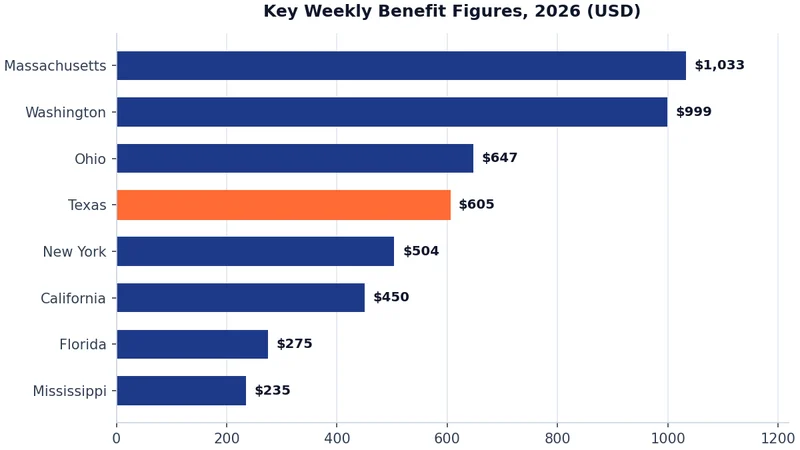
The verified 2026 range tells the story quickly. On the high end, Massachusetts pays up to $1,033 per week and Washington reaches $999, with New Jersey replacing 60 percent of wages for many claimants and Pennsylvania capping at $573. On the low end, Florida tops out at $275 and Mississippi at $235, and both states also sit near the bottom of the duration table.
The middle of the pack carries most of the country. Ohio caps at $647, Texas at $605, Pennsylvania at $573, New York at $504, and California at $450. The Department of Labor's comparison tables publish every state's figures, and the spread between neighboring states is rarely small.
| State | 2026 maximum weekly benefit | What that means in practice |
|---|---|---|
| Massachusetts | $1,033 | Highest cap in the country, plus 30 weeks of duration |
| Washington | $999 | High cap and a formula that rewards strong quarters |
| Ohio | $647 | Middle-of-the-road cap and standard duration |
| Texas | $605 | Moderate cap, strict work search enforcement |
| New York | $504 | Moderate cap with wide eligibility rules |
| California | $450 | Lower cap, high wages, no waiting week |
| Florida | $275 | Low cap and only 12 weeks of duration |
| Mississippi | $235 | Lowest cap in the nation |
Treat the table as a starting point rather than a verdict, because formula details and eligibility rules shift the effective numbers for any individual wage history.
One Salary, Three States
Meet Sam, a $60,000-a-year operations coordinator with evenly spread quarters, laid off in May. In Massachusetts, the formula pays about half the average weekly wage from his top quarters, which lands near $577, comfortably under the $1,033 cap. His claim is worth up to 30 weeks of coverage at that rate.
In Texas, Sam's highest quarter of $15,000 divides by 25 to suggest $600, which lands just under the $605 cap, and the claim runs a standard 26 weeks. In Florida, the divide-by-26 formula suggests $577, but the $275 cap flattens everything, and duration stops at 12 weeks.
Sam's total possible benefits run roughly $17,300 in Massachusetts, $15,600 in Texas, and $3,300 in Florida. Same worker, same salary, same week of layoff. The state line did all of that.
Cost of Living Flips Part of the Ranking
A raw benefit comparison overstates some states and understates others, because the check buys different amounts of life. A $275 weekly check in a low-cost region covers a different slice of survival than the same check in an expensive metro, and a $1,033 check in Massachusetts competes with rents that eat half of it.
The honest comparison weighs the benefit against the destination's housing costs, not against the benefit alone. A move that raises your benefit by $100 a week while raising your rent by $300 is a worse safety net, not a better one, and the reverse trade sometimes works in a worker's favor.
Job markets belong in the same equation. States with stronger hiring in your field shorten the benefit period you actually need, which can make a modest check in a fast market outperform a rich check where hiring is slow.
Duration deserves its own line in the comparison rather than a footnote. Twelve weeks of benefits in a low-cap state can end before a realistic job search finishes, and a claim that stops paying mid-search forces desperate decisions. A state that pays two extra weeks of meaningful money often delivers more security than a state with a slightly higher headline maximum, so weigh the weeks and the dollars together before you commit to a ZIP code.
Which State Actually Runs Your Claim
Here is the rule most movers get wrong: you generally file for unemployment in the state where you worked, not the state where you live. Wages were taxed where the employer sits, and that state's agency processes the claim even if you have already moved across the country.
If you move after losing your job, your existing claim usually follows the rules of the state where you earned the wages, and the moving mid-claim guide covers the transfer and reporting details. If you move and then file for the first time, you typically file an interstate claim against the old state's wages, which means the old state's formula and cap apply even from your new address.
Interstate claims work through a federal coordination system, but the practical experience lags behind a local claim. The paying state still runs eligibility reviews, still enforces its own work search rules, and occasionally routes questions through the state where you now live. Payment timing and adjudication both tend to run slower, which is one more reason to file before relocating whenever the calendar allows.
Planning to work in the new state for a while before any layoff changes everything, because fresh wages start building credits under the new state's system. After enough quarters of in-state work, the new state's rules take over, which is the legitimate way a relocation resets your unemployment math.
Remote and Seasonal Workers Carry Special Angles
Remote work scrambles the where-you-worked rule, because your chair and your employer sit in different states. Most agencies treat the claim as belonging to the state where the employer reports wages, though some remote workers discover their wages were reported to a third state entirely. Before a remote-work move, check which state your employer lists on your pay stub, because that is the system that will eventually run your claim.
Seasonal workers face the mirror-image problem, following the seasons across state lines and building split wage records in each. A ski season in Colorado and a summer in Michigan leaves two partial bases, and the claim often lands under whichever state holds enough qualifying wages. The seasonal workers guide explains how those split histories get combined.
Both groups should keep pay records from every state employer, because interstate wage verification is where these claims typically stall. A folder of pay stubs from each state shortens weeks of adjudication into days.
Company Transfers Are a Different Question
Relocation discussions that start with your employer follow a separate rulebook from moves you choose yourself. If your company offers a transfer to another office and you decline, the refusal gets judged under suitable work rules, which weigh pay, duties, distance, and your personal circumstances.
A transfer with equal pay inside a reasonable commute is usually suitable, and refusing it can act like a quit. A transfer across the country with no moving support is different, and many states treat declining it as good cause rather than a disqualification. The job offer refusal guide maps those factors.
Get the transfer offer in writing either way. Whether you accept or decline, the letter is the evidence that decides how the agency reads the separation if the relationship ends later.
Eligibility Differences the Money Math Misses
Weekly amounts are the headline, but state systems differ in ways that reach your experience directly.
- Work search requirements range from one job contact a week to documented daily activity, with Texas and Florida among the strictest enforcers.
- Waiting weeks add a gap before the first payment in some states, while California and several others eliminated theirs. The waiting week guide lists where each rule stands.
- Earnings disregards decide how much part-time income you keep, and the range between states is wide enough to change part-time strategy entirely.
- Base period rules vary slightly, including alternate base periods in some states that rescue claims with thin recent wages.
None of these flip a decision on their own, but two or three of them stacked on a low-cap state can make the practical gap much larger than the headline maximum suggests.
Run the Comparison Yourself
The fastest comparison is a spreadsheet with one column per candidate state and three rows: estimated weekly benefit from your wage history, the state maximum, and the duration limit. Enter your quarters in the unemployment benefits calculator once per state, and the tool applies each state's formula automatically. State versions like the California unemployment calculator, Texas unemployment calculator, and New York unemployment calculator make the per-state numbers a two-minute job.
If you are relocating for a specific job offer, run the numbers with your new salary too, because the benefit that matters is the one your future claim would pay if the new job ends. Relocating for work has its own set of unemployment consequences, which the relocating for work guide explains.
What To Do This Week
Write down the states on your list and look up three figures for each: the 2026 maximum weekly benefit, the duration limit, and the work search rule. Then run your own wage history through the calculator for the strongest candidate, and compare the estimated weekly check against your current rent in that market.
If the comparison changes your move timing, act on it. Filing your claim before a move, when you are eligible, locks in the originating state's system, and a few weeks of timing can be worth thousands of dollars in total benefits. Line up your job search documents before the boxes come out, because the claim will thank you for it later.
Related Guides
- moving to a different state mid-claim
- relocating for work rules
- waiting week rules by state
- estimating your weekly benefit amount
- seasonal worker certification rules
Frequently Asked Questions
Which state pays the highest unemployment benefits in 2026?
Massachusetts pays the highest maximum at $1,033 per week, followed by Washington at $999. At the low end, Florida caps at $275 and Mississippi at $235, so identical salaries can produce very different checks.
Which state pays my unemployment claim if I move?
Generally the state where you worked and paid wages, not where you now live. Claims filed after a move typically run as interstate claims against the old state's wage records and under its formula and cap.
Do I lose unemployment benefits if I move to another state?
No. Moving does not cancel an existing claim, though the originating state keeps running it and you must meet its weekly requirements. Payments continue while you remain eligible and keep certifying.
How long can you collect unemployment in each state?
Most states pay up to 26 weeks. Florida and North Carolina stop at 12 weeks, and Massachusetts extends to 30. Duration differences matter as much as the weekly amount when comparing states.
Does cost of living matter when comparing state benefits?
Yes. A larger check in an expensive metro can cover less real life than a smaller check in a cheap region, so compare the benefit against destination housing costs rather than against other states' maximums alone.
Can I choose which state to file in?
No. The claim generally belongs to the state where the wages were earned and taxed. Working in a new state long enough builds credits there, which is how a relocation eventually resets your unemployment system.