
Short Answer: Your Weekly Benefit Is a Percentage of Your Highest-Earning Quarter, Capped by Your State
Every unemployment estimate starts with the same ingredients, no matter which state you live in. The agency looks at your recent wages, finds the quarter where you earned the most, applies a state formula, and checks the result against a maximum. Your weekly benefit amount, the number that shows up on every certification, comes out of those four steps.

You can estimate the whole thing yourself in about ten minutes with nothing but a pay stub and a calendar. The math is not hidden, and states publish their formulas openly. Knowing your estimate before you file helps you budget the job search, spot agency errors, and decide whether part-time work makes sense during your claim.
This guide walks through the formula step by step, shows how the biggest states differ, and runs a complete worked example with real numbers from beginning to end.
The Four Numbers Every Estimate Needs
Before any formula runs, you need four facts lined up. Get these first and the rest is arithmetic.
- Your base period, which is generally the first four of the last five completed calendar quarters before you file. Our base period guide explains how to find yours.
- Your highest quarter wages, the largest quarterly total inside that base period.
- Your state's formula, which converts those wages into a weekly amount.
- Your state's maximum weekly benefit, the cap that trims high earners down to a fixed ceiling.
The base period matters more than people expect, because it decides which wages count at all. A raise in your final month of work usually does nothing for your claim if it lands outside the base period, while a strong quarter early in the window can carry the entire calculation.
The Formula Most States Use
Roughly half the states use the same basic shape: your weekly benefit equals about half of what you made per week in your highest quarter. Since a calendar quarter runs 13 weeks, that works out to dividing your highest quarter wages by 26.
Take a worker whose best quarter paid $9,100. Dividing by 26 gives $350 per week, which is exactly the ballpark a full half of a $700 gross weekly wage should produce. States then trim that number at the cap, and some states round it down to the nearest dollar or use a lookup table instead of a straight division.
The result is a rough rule of thumb that works across most of the country: take your best quarter, divide by 26, and expect the final number to land close to that figure unless your state marches to a different drum.
How the Big States Differ
Five states illustrate the range of formulas in play for 2026, and the differences are big enough to matter even before the caps appear.
| State | How the weekly benefit is figured | 2026 maximum |
|---|---|---|
| California | Benefits chart keyed to highest quarter earnings, roughly highest quarter divided by 26 | $450 |
| Texas | Highest base-period quarter divided by 25, rounded to the nearest dollar | $605 |
| New York | Half of your highest quarter wages, capped | $504 |
| Florida | Highest quarter divided by 26, with a low cap | $275 |
| Massachusetts | About half your average weekly wage from your two highest quarters | $1,033 |
Texas confirms its method on the TWC eligibility and benefit amounts page, and Massachusetts describes its formula as roughly 50 percent of average weekly wages on the state's UI benefits guide. California publishes its chart through the EDD benefit calculator page, with weekly amounts running from $40 to $450.
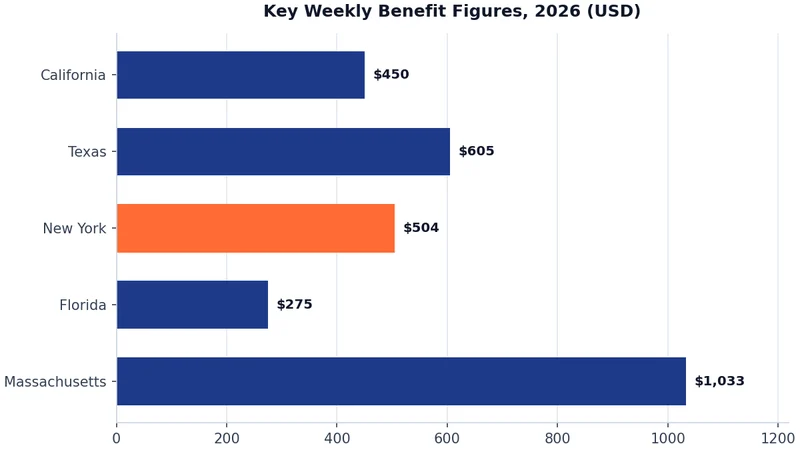
The caps are where identical salaries produce wildly different checks. Massachusetts pays more than three times what Florida does at the top, and the formulas push workers toward those caps at different income levels.
A Complete Worked Example From Wages to Check
Meet Dana, a project coordinator in Texas who earned a $52,000 salary and was laid off in July. Her quarterly paychecks totaled roughly $13,000, but a bonus pushed her second quarter to $14,250. Filing in July means her base period ended in March, and her highest quarter is that $14,250 quarter.
Step one applies the Texas formula: $14,250 divided by 25 equals $570. Step two checks the cap: Texas tops out at $605 in 2026, so Dana's $570 lands under the ceiling and becomes her weekly benefit amount. Her maximum entitlement runs $570 times 26 weeks, which is $14,820 for the claim if she certifies all 26 weeks.
Now move Dana to California with the same wages. The chart approximation divides $14,250 by 26, which suggests about $548, but California's $450 cap trims the check to that ceiling. Same salary, same quarter, and the state line moves her weekly income by as much as $120 a week.
Finally, put her in Massachusetts, where the formula averages her two best quarters. Her $14,250 and $13,000 quarters average to $13,625 per quarter, which is about $1,048 per week, and half of that lands near $524, well under the $1,033 cap. The lesson is that high earners need to know their state's cap before celebrating an estimate.
Three Estimating Mistakes That Throw the Number Off
The formula is simple, but three recurring mistakes send estimates far from reality, and all of them are easy to avoid once named.
The first is using your take-home pay instead of gross wages. Unemployment formulas run on gross earnings before taxes and deductions, and a $52,000 salary with heavy benefits withholdings estimates very differently from its net paycheck. Always rebuild gross quarterly totals from pay stubs or your last W-2.
The second is reaching for your most recent months instead of the base period. Workers who just had a strong final quarter expect that quarter to drive the claim, but if the base period ended before it, those wages sit outside the window entirely. Check the calendar before the calculator.
The third is forgetting the cap entirely. High earners apply the divide-by-26 rule, see a satisfying number, and never compare it against the state maximum, then act shocked when the benefit letter arrives $200 lower. The cap check takes ten seconds and belongs in every estimate.
How Taxes Change the Number You Actually Receive
The weekly benefit amount is a gross figure, and taxes shrink what lands in your account. Unemployment income is federally taxable, most states tax it too, and the 2026 voluntary federal withholding rate remains 10 percent, deducted only if you elect it on your claim.
Choosing withholding is a budgeting decision, not a requirement. Many claimants skip withholding to maximize weekly cash flow and set aside money for the April bill instead. Others elect the flat 10 percent to avoid a spring surprise. Neither choice changes your eligibility or your weekly amount, only the gap between gross benefit and usable cash.
When you budget the job search, plan around the net figure. A $450 benefit with no withholding delivers the full $450 weekly but leaves the tax bill untouched, while the same benefit with withholding delivers $405 and a smaller April obligation.
What To Do If the Agency's Number Comes Back Wrong
Sometimes the official benefit letter disagrees with a careful estimate by a wide margin, and the discrepancy almost always traces back to wage records rather than formula differences. Employers file wage reports quarterly, and errors, late filings, and payroll transitions all leave gaps that shrink your base period.
Start by requesting the wage breakdown the agency used, which every state must provide on request. Compare it line by line against your pay stubs, W-2 forms, and final pay records. Look for a missing employer, a quarter reported with zeros, or a salary captured under the wrong quarter.
If a quarter is missing, file a wage correction request with proof attached, typically pay stubs or bank records showing the deposits. States reopen and recompute claims when wage reports change, and the recomputation raises both your weekly amount and your total entitlement retroactively. Appeals deadlines are short, generally 10 to 30 days from the determination, so move quickly once you spot the gap.
Why Your Real Check Might Differ From the Estimate
Manual estimates land within a few dollars most of the time, but several legitimate adjustments can move the official number.
- Dependency allowances in some states add a fixed amount per dependent, which no simple formula captures.
- Seasonal or uneven earnings can shift which quarter counts as highest once the agency pulls exact employer wage reports.
- Pay in lieu of notice, bonuses, and vacation payouts can shift your effective last day or add wages to a quarter.
- A waiting week in many states delays the first payment without changing its size.
- Part-time earnings during the claim reduce each weekly check under your state's earnings disregard rules.
None of these are errors. They are adjustments layered on top of the base formula, and most show up as small moves rather than surprises.
Estimating How Long the Money Lasts
Duration follows the benefit amount out of the same paperwork. Most states pay up to 26 weeks, though Florida and North Carolina stop at 12 and Massachusetts extends to 30. The Center on Budget and Policy Priorities tracks how state durations compare, and the spread is wider than most workers assume.
Total claim value adds one more check: many states cap the whole claim at 26 times your weekly benefit or a fraction of your base-period wages, whichever is smaller. A worker with a high weekly benefit but thin total wages can exhaust the dollar cap before the week cap, which shortens the runway. If your estimate sits near the state maximum, look up both numbers rather than assuming a full 26 weeks.
Recurring federal programs can extend duration during recessions, as the extended benefits guide on this site explains, but those trigger rules live outside the regular estimate entirely.
Run the Numbers With the Calculator
Manual math is for understanding, but the fastest route to a number is the tool built for it. The unemployment benefits calculator applies your state's formula and cap automatically once you enter your wages, and state-specific versions like the California unemployment calculator and Texas unemployment calculator use each state's exact rules.
Use the calculator for the number and this guide for the logic behind it. When your official benefit letter arrives, compare it against the estimate, and question anything more than a few dollars off. Agency wage records occasionally miss a quarter, and a corrected wage report can raise your weekly check for the rest of your claim.
What To Do This Week
Pull your pay records and mark your last five completed quarters on a calendar, then total each quarter to find your highest. Apply the divide-by-26 rule for a ballpark, then check your state's cap in the table above to see whether the ceiling trims it. That two-minute exercise puts you ahead of most claimants before the application is even open.
When the estimate is in hand, read the guide on how part-time work reduces your payment next, because the earnings disregard decides how much you keep if a freelance gig or part-time job lands during the claim.
Related Guides
- base period wage requirements explained
- earnings disregard rules
- work sharing and partial benefits
- California unemployment calculator
- Texas unemployment calculator
Frequently Asked Questions
How do I calculate my weekly unemployment benefit?
Find your highest-earning quarter in your base period and divide it by 26 for a quick estimate, since most states pay about half your best-quarter weekly wage. Then check your state's maximum weekly benefit, because the cap trims anything above it.
What is the highest quarter in unemployment calculations?
It is the calendar quarter inside your base period where you earned the most wages. Most states build the weekly benefit around that quarter, either dividing it directly or averaging it with the second-highest quarter.
Why is my unemployment benefit lower than half my salary?
Two reasons: the formula works on your best quarter rather than your annual salary, and every state caps the weekly amount. High earners hit the cap first, so a six-figure salary in a low-cap state produces a modest weekly check.
Is unemployment income taxed?
Yes, unemployment is federally taxable and most states tax it too. You can elect a flat 10 percent federal withholding on your claim, or set money aside yourself and settle at tax time.
How accurate are manual unemployment estimates?
Most careful estimates land within a few dollars of the official number. Larger gaps usually mean a wage record error, such as a missing employer or quarter, which you can fix with a wage correction request and pay stubs.
Can I estimate benefits if my quarters were uneven?
Yes. List each of the five most recent completed calendar quarters, total them, and find the largest. Uneven quarters make no difference to the method, only to which quarter turns out to be the highest.