Losing a job is one of the most stressful experiences anyone can go through. But what if your employer could keep you on the payroll at reduced hours, and the government would step in to cover part of your lost wages? That is exactly what Short-Time Compensation does. Also called Shared Work in many states, this program lets businesses reduce everyone's hours instead of laying off a portion of their workforce, while affected employees collect partial unemployment benefits to make up the difference. It is a win for workers who keep their jobs, a win for employers who retain trained staff, and a win for the unemployment insurance system that pays out less in total benefits. If you are facing a reduction in hours at work, this program might be exactly what you need.
What Is Short-Time Compensation (STC)?
Short-Time Compensation, often called STC or Shared Work, is a program within the federal-state unemployment insurance system that provides partial benefits to workers whose hours have been reduced by their employer. Instead of terminating employees, the employer places an entire group or unit on a reduced schedule — say, four days a week instead of five, or 32 hours instead of 40. The workers then receive prorated unemployment benefits for the hours they are no longer working. The key difference from regular unemployment is that you remain employed. You keep your health insurance, your retirement contributions, your seniority, and your place on the team. You just work fewer hours and collect a partial UI check to bridge the gap.
The program was significantly expanded by the Coronavirus Aid, Relief, and Economic Security (CARES) Act in 2020, which provided federal funding to encourage states to adopt or expand their STC programs. While that federal incentive has expired, most states that adopted STC during the pandemic have kept their programs in place. Today, over half of U.S. states offer some form of Short-Time Compensation, and the list continues to grow as policymakers recognize the economic advantages of keeping workers attached to their employers during downturns.
For employees who are wondering if they qualify for benefits, STC has much more lenient eligibility requirements than regular unemployment because you do not need to be fully unemployed. You simply need to be an employee of a participating employer whose hours have been reduced under an approved plan. There is no job search requirement in most states because you already have a job — the program assumes your employer will restore your full hours when business conditions improve.
How STC Differs from Regular Unemployment Insurance
The differences between Short-Time Compensation and regular unemployment insurance go well beyond the obvious fact that you remain employed under STC. The entire structure of the program — from eligibility to benefit calculation to employer involvement — operates differently. Understanding these distinctions matters because choosing the wrong path could cost you money or leave you without coverage you are entitled to.
The most important practical difference is that under STC, your employer drives the process. You do not file an individual claim the way you would for regular unemployment benefits. Instead, your employer submits a Shared Work plan to the state agency for approval. Once approved, all affected employees are automatically enrolled. You still need to certify each week that you worked the reduced schedule, but the process is much simpler than a traditional UI claim. The state already knows who you are, who your employer is, and what your benefit amount should be.

Which States Offer STC / Shared Work Programs
As of 2026, more than half of U.S. states operate a Short-Time Compensation or Shared Work program. The specific names, rules, and benefit formulas vary by state, but the core concept is the same everywhere: employers reduce hours across a group instead of laying off individuals, and workers receive prorated UI benefits for the lost hours. If your state is not on this list, talk to your employer about whether legislation is pending — several states have bills in progress.
Note that even within states that have STC programs, not all employers participate. The program is voluntary for employers in most states — they must actively choose to submit a Shared Work plan. If your employer is not enrolled, you cannot collect STC benefits on your own. You would instead need to understand how part-time work reduces your regular UI payment and file a traditional claim if your hours drop enough to qualify.
Employer Requirements to Participate in STC
For an employer to set up a Short-Time Compensation plan, they must meet several requirements that vary by state but generally include the following core conditions. These rules exist to prevent abuse — without them, employers could theoretically game the system by reducing hours by a trivial amount just to shift wage costs onto the UI system.
Employers should also know that participating in STC typically has a smaller impact on their experience rating — the factor that determines their unemployment insurance tax rate — compared to laying off employees. When you lay off five people who then collect full UI benefits for 26 weeks, your experience rating takes a significant hit that raises your payroll taxes for the next three years. With STC, the benefit payments are smaller and spread across more employees, resulting in a much lower charge to your account. For businesses thinking about the long-term cost, this alone can make STC worth the administrative effort.
Employee Eligibility for STC Benefits
From the employee side, eligibility for Short-Time Compensation is refreshingly simple compared to regular unemployment. You do not need to be totally unemployed, you do not need to be actively searching for work (in most states), and you do not need to prove you were separated from employment through no fault of your own. The fact that your employer has an approved STC plan is essentially your proof of eligibility.
The basic requirements are straightforward. You must be an employee of a participating employer with an approved Shared Work plan. Your hours must be reduced under that plan — you cannot volunteer for a smaller schedule and then claim STC benefits on your own. You must be available to work your reduced schedule and any additional hours your employer offers under the plan. And you must have earned enough in the base period to establish a weekly benefit amount under your state's formula — which most regularly employed workers will easily meet.
One thing that catches people off guard is that you must certify for benefits each week, just like with regular UI. The certification process is usually simpler — you confirm that you worked the number of hours specified in your employer's plan and that you did not refuse any additional work offered by your employer. But skipping certification will stop your payments just as surely as it would with a regular claim. Knowing how to certify correctly prevents unnecessary payment delays.
How STC Benefit Amounts Are Calculated
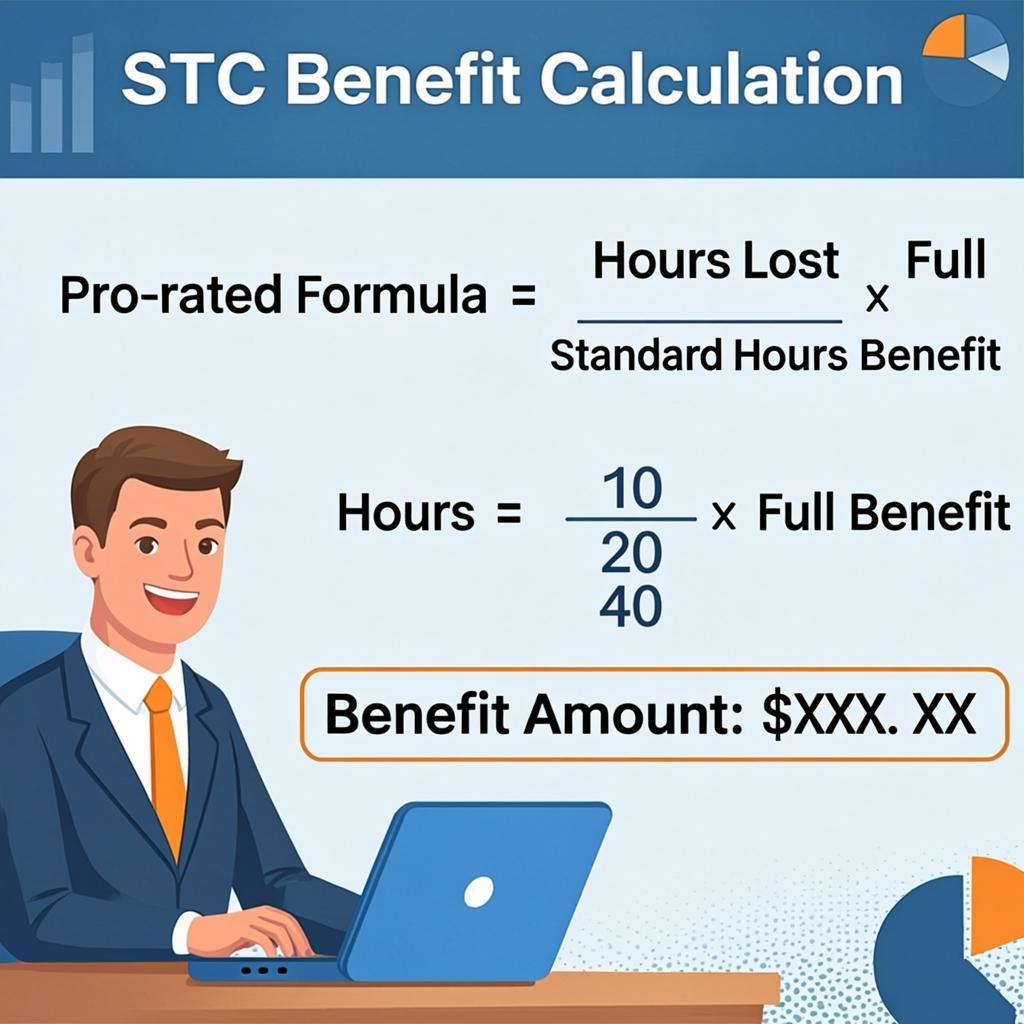
The math behind Short-Time Compensation is where it gets really interesting. Your STC benefit is essentially a prorated fraction of what you would receive on regular unemployment, based on the percentage your hours were reduced. This is the core formula that every state follows, though the details vary slightly.
Here is the standard calculation. First, the state determines your regular Weekly Benefit Amount (WBA) using the same formula it would use if you were fully unemployed — typically based on your earnings in the base period. Then, the state calculates the percentage by which your hours were reduced. Your STC benefit equals your WBA multiplied by that reduction percentage.
Let me walk through a more detailed example so you can see how the numbers compare across different scenarios. Say you normally earn $1,000 per week for 40 hours of work. Your state calculates a WBA of $400 based on your earnings history. Your employer enrolls in a Shared Work plan that reduces your schedule by 40%, dropping you to 24 hours per week at $600 in wages. Your STC benefit would be $400 × 0.40 = $160 per week. Your total weekly income becomes $760 — significantly more than the $400 you would get on regular unemployment, and you still have your job, health insurance, and career trajectory intact.
Some states add a small adjustment or rounding factor, and a few states calculate the reduction percentage differently — for instance, using the ratio of actual hours worked to normal hours rather than a simple percentage reduction. The amount of unemployment you receive under STC will always be less than full UI but combined with your reduced wages, your total income will be higher than either option alone.
STC vs Regular UI vs Part-Time Work: Side-by-Side Comparison
Workers facing reduced hours often have three paths: stay on the job under a Shared Work plan and collect STC benefits, get laid off and collect regular UI while looking for new work, or find part-time work on their own while collecting partial UI. Each option has different financial outcomes and trade-offs. Let's break them down using a concrete example so you can see the real numbers.
The table shows why STC is often the best option for workers who have the choice. You keep more total income than regular UI, you keep your job and benefits, and you do not have to spend 20 hours a week applying for positions you may not want. The part-time plus partial UI column looks attractive at $805, but remember — finding a part-time job that pays $560 per week on your own is not guaranteed, and you still have to meet job search requirements for full-time work. With STC, your employer has already arranged the reduced schedule for you.
There is one important caveat. Not all workers get to choose between these options. If your employer does not participate in STC and is not willing to enroll, you cannot force them. In that case, if your hours are reduced significantly enough to qualify for partial UI under your state's part-time work rules, that becomes your best available path. And if you are laid off entirely, regular UI is your only option until you find new work.
Advantages for Employers: Why Smart Companies Choose STC
The business case for Short-Time Compensation is strong, especially for companies in industries with cyclical demand — manufacturing, construction, hospitality, retail, and professional services all experience periods where workload drops temporarily. Laying off experienced workers during a slowdown and then recruiting and training replacements when demand returns is enormously expensive. The Center for American Progress estimates that replacing a worker costs roughly 20% of their annual salary for mid-range positions and can exceed 200% for senior or specialized roles.
There is also a strategic advantage that does not show up on any spreadsheet: reputation. In a tight labor market, companies known for protecting their workforce during downturns attract better candidates when hiring picks back up. Word gets around. An employer who laid off 30% of their staff last recession and is now scrambling to recruit will lose out to the competitor who used STC and kept their team intact. In an era where Glassdoor reviews and social media posts can define your employer brand overnight, the reputational cost of layoffs extends well beyond the immediate financial impact.
Advantages for Employees: More Than Just Money
For workers, the benefits of Short-Time Compensation go well beyond the partial UI check. The financial advantage is clear — your total weekly income under STC is always higher than what you would collect on regular unemployment alone. But the non-financial advantages are arguably more important, especially over a period of weeks or months.
Keeping your job means keeping your health insurance. In the United States, employer-sponsored health coverage is the foundation of most families' medical care. Losing it means either paying full price for COBRA continuation coverage — which can easily exceed $1,500 per month for a family plan — or navigating the individual market with its limited networks and high deductibles. Under STC, you typically remain on your employer's group plan at the same contribution level, just as if you were working full hours. For anyone with ongoing medical needs, this alone makes STC worth far more than the dollar amount of the benefit.
You also keep your retirement contributions flowing. Your 401(k) contributions continue at the reduced wage level, and more importantly, your employer match continues too. Contrast that with being laid off, where both your contributions and the match stop entirely. Over a six-month period, the lost retirement savings from a layoff can amount to thousands of dollars in missed contributions and forfeited employer matching — money you never get back, since most employers do not make retroactive match contributions when you are rehired.
Career continuity matters more than most people realize. A gap on your resume, even a short one, signals to future employers that you were separated from your workforce — fair or not, it affects how recruiters and hiring managers evaluate your application. Under STC, you were never unemployed. You were employed with reduced hours. That is a very different signal in the job market, and it maintains your professional momentum. The length of time you spend on benefits under STC tends to be shorter because your employer restores hours as business conditions improve, whereas a laid-off worker is at the mercy of the broader job market.

How to Apply for STC: Employer and Employee Process
The application process depends on whether you are an employer setting up a plan or an employee who wants to know if your company participates. Let me walk through both paths.
For Employers
For Employees
As an employee, you do not apply for STC on your own — your employer must have an approved plan. But you can take proactive steps. Talk to your HR department or manager and ask whether the company has a Shared Work or STC program. Many employers do not even know the program exists, and a simple conversation can start the process. Point them to your state's unemployment agency website where they can find the employer application. If your employer is considering layoffs, mentioning STC as an alternative could save your job and your coworkers' jobs too.
Once your employer has an approved plan and you are enrolled, your responsibility is to certify each week. Most states allow online or phone certification. You confirm the hours you worked under the reduced schedule and that you did not refuse additional work offered by your employer. Missing a certification week means missing a payment — there are no retroactive certifications for STC in most states, just like with regular UI where certain actions disqualify you. Stay on top of your weekly certifications and you will receive your partial benefit without interruption.
Important Limitations and Things to Watch Out For
No program is perfect, and Short-Time Compensation has some limitations you should understand before banking on it. First, STC benefits are typically limited to the same maximum duration as regular UI in your state — usually 26 weeks. If your employer's reduced schedule lasts longer than that, your STC benefits will exhaust just like regular UI would. Some states allow extensions under certain conditions, but do not assume your STC benefits will last indefinitely.
Second, if your employer restores your hours to full-time and then reduces them again, they may need to submit a new STC plan. States differ on whether a single plan can cover intermittent reductions or whether each reduction requires a new application. This matters in industries like manufacturing where production schedules can fluctuate week to week.
Third, STC does not protect you from eventual layoffs. If business conditions continue to deteriorate and your employer decides that even the reduced schedule is not sustainable, they can still lay you off. At that point, you would transition from STC to regular UI benefits. The good news is that your STC period does not count against your regular UI entitlement — you would still have access to your full regular UI benefits (minus any STC weeks already collected, depending on your state's rules). Understanding how reduced work affects your overall benefit calculation helps you plan for this transition.
Real-World Example: Manufacturing Company in Ohio
To make all of this concrete, consider a real-world scenario. A mid-size manufacturing company in Ohio with 50 production workers faces a 30% drop in orders. Without STC, the company would lay off 15 workers (30% of the workforce) and keep the remaining 35 at full hours. The 15 laid-off workers would each collect Ohio's maximum WBA of $532 per week for up to 26 weeks — a total UI payout of roughly $207,480. The company's experience rating would take a major hit, raising their UI tax rate for the next three years.
With STC, the company reduces all 50 workers' hours by 30% instead. Each worker drops from 40 hours to 28 hours per week. A worker earning $800 per week now earns $560 in wages. Their STC benefit is $350 (the WBA for someone earning $800/week) multiplied by 30% = $105 per week. Total weekly income per worker: $665. The company's total UI payout is about $137,000 over 26 weeks — significantly less than the layoff scenario. And every single worker keeps their job, their health insurance, and their seniority. When orders pick back up, the company simply restores full hours with zero rehiring costs.
The math speaks for itself. STC saved the company money, saved the UI trust fund money, and most importantly, saved 15 people from losing their livelihoods. That is the kind of outcome policymakers had in mind when they designed these programs.
Key Takeaways
- Short-Time Compensation (STC) lets employers reduce hours instead of laying off workers, with employees receiving prorated UI benefits for lost hours.
- Over 35 states offer STC/Shared Work programs as of 2026, and more are adding legislation each year.
- STC benefits equal your Weekly Benefit Amount multiplied by the percentage your hours were reduced.
- Your total weekly income under STC is always higher than regular UI alone, and you keep your job and health insurance.
- Employers benefit from lower UI tax impacts, reduced rehiring costs, and preserved workforce morale and expertise.
- STC is employer-initiated — you cannot apply on your own, but you can ask your employer to enroll.
- You must certify weekly just like regular UI, but there is typically no job search requirement since you already have a job.
- STC benefits are taxable and count against your maximum benefit duration, just like regular UI.
- If your state or employer does not offer STC, reduced hours may still qualify you for partial UI under your state's standard rules.