Taking a part-time job while collecting unemployment can be a smart financial move. It keeps some money coming in, maintains your work history, and can even lead to a full-time offer. But that part-time paycheck creates a reporting obligation that many claimants underestimate or get wrong. Every week when you certify for benefits, you are required to report any income you earned during that claim period. The rules around what to report, how to calculate it, and how your state applies the earnings disregard are more nuanced than most people realize. A single reporting error can snowball into an overpayment notice months later, forcing you to repay benefits you already spent on rent and groceries.
This guide walks through the entire process of reporting part-time income on your weekly unemployment certification. You will learn what types of income count, the difference between gross and net reporting, how your state's earnings disregard protects a portion of your wages, the formula for calculating partial benefits, and the specific rules that apply to gig economy workers. If you are new to the certification process altogether, our guide to certifying for unemployment benefits covers the basics of each weekly claim.
Why Reporting Part-Time Income Correctly Matters
The unemployment insurance system operates on trust. When you certify each week, you are making a sworn declaration that the information you provide is accurate. States do not have the resources to verify every single claimant's income in real time, so they rely on your honesty during certification and catch discrepancies later through employer wage reports, cross-matches with other government databases, and periodic audits. This means you might receive full benefits for weeks even though you should have received a reduced amount — and months down the road, you will get a letter demanding repayment.
Overpayment is not just a financial headache. In many states, an overpayment caused by failing to report income can be classified as fraud, which carries additional penalties. These can include a disqualification period where you cannot collect benefits at all, a monetary penalty that multiplies the amount you owe, and even criminal prosecution in extreme cases. The stakes are real, and they are high. Even honest mistakes — like reporting net pay instead of gross, or forgetting to include tips — can trigger an overpayment determination. Our article on common certification mistakes that trigger overpayment goes into detail on the most frequent errors and how to avoid them.
On the flip side, some claimants are so afraid of making a mistake that they over-report their income or simply stop certifying when they pick up part-time work. That is unnecessary and costly. You are allowed to earn money while on unemployment — the system is designed to encourage partial employment. Understanding the rules lets you report with confidence and keep every dollar you are legitimately entitled to.
What Counts as Income During Certification
This is where many people get tripped up. The question on your weekly certification form typically asks something like "Did you work and earn wages during the week?" But "wages" is a broader term than most people assume. It is not just the hourly paycheck from your part-time retail shift. Here is what states generally expect you to include as income when you certify:
Some types of income do notcount against your unemployment benefits. These include Social Security retirement benefits, VA disability payments, workers' compensation, pension payments from a previous employer, and child support payments. The key distinction is whether the money comes from work you performed during the claim week. If you earned it by working, it counts. If it is a passive payment from a prior entitlement, it generally does not. When in doubt, report it and let the agency determine how to treat it — under-reporting is always worse than over-reporting.
Gross vs. Net Earnings — Which to Report
This is one of the most common points of confusion, and getting it wrong can cost you. When your certification form asks for earnings, it wants your gross earnings — the total amount you earned before any deductions for taxes, health insurance, retirement contributions, or anything else. Your take-home pay is your net earnings, and that is not what the unemployment agency uses to calculate your benefit reduction.
Here is why this matters with real numbers. Say you worked 15 hours at $18 per hour during a claim week. Your gross earnings are $270. After federal tax, state tax, and Social Security withholdings, your net take-home is roughly $220. If you report $220 instead of $270, you have under-reported by $50. Your benefit reduction will be too small, and the state will eventually catch the discrepancy through your employer's quarterly wage report. You will then receive an overpayment notice for the difference, plus potentially a fraud penalty. The lesson is simple: always report the number on your pay stub before deductions, not the amount deposited in your bank account.
One wrinkle worth knowing: some states ask you to report earnings in the week you earned them, while others ask for earnings in the week you were paid. Most states use the earned-week method, but a few — including New York — use the paid-week method. This distinction can matter if you worked a shift at the end of one week but did not receive the paycheck until the following week. Check your state's certification instructions carefully. If you want to understand how your weekly benefit amount is set in the first place, our guide to how your benefit amount is calculated explains the formula.

The Earnings Disregard / Exemption by State
Here is the good news that many claimants do not know about: most states let you keep some of your part-time earnings without reducing your unemployment check at all. This is called the earnings disregard, earnings exemption, or partial benefit allowance, depending on your state. It is a specific dollar amount or percentage of your weekly benefit amount that the state ignores when calculating your benefit reduction. The purpose is to encourage people to take part-time work rather than sit at home waiting for a full-time offer.
The disregard varies significantly by state. The most common approach is to disregard either a flat fraction of your weekly benefit amount or a specific dollar amount, whichever is higher. Here are the main patterns you will see across the country:
You need to look up the specific disregard for your state because the difference can be meaningful. A claimant with a $400 WBA in a state with a 25% disregard can earn $100 per week with zero benefit reduction, while the same claimant in a no-disregard state would see their benefit cut by the full $100. Over the course of a 26-week claim, that adds up to a substantial difference in total benefits received. If you are trying to figure out whether part-time work makes financial sense in your situation, our article on how part-time work reduces your payment walks through the math in detail.
How Partial Benefits Are Calculated Step by Step
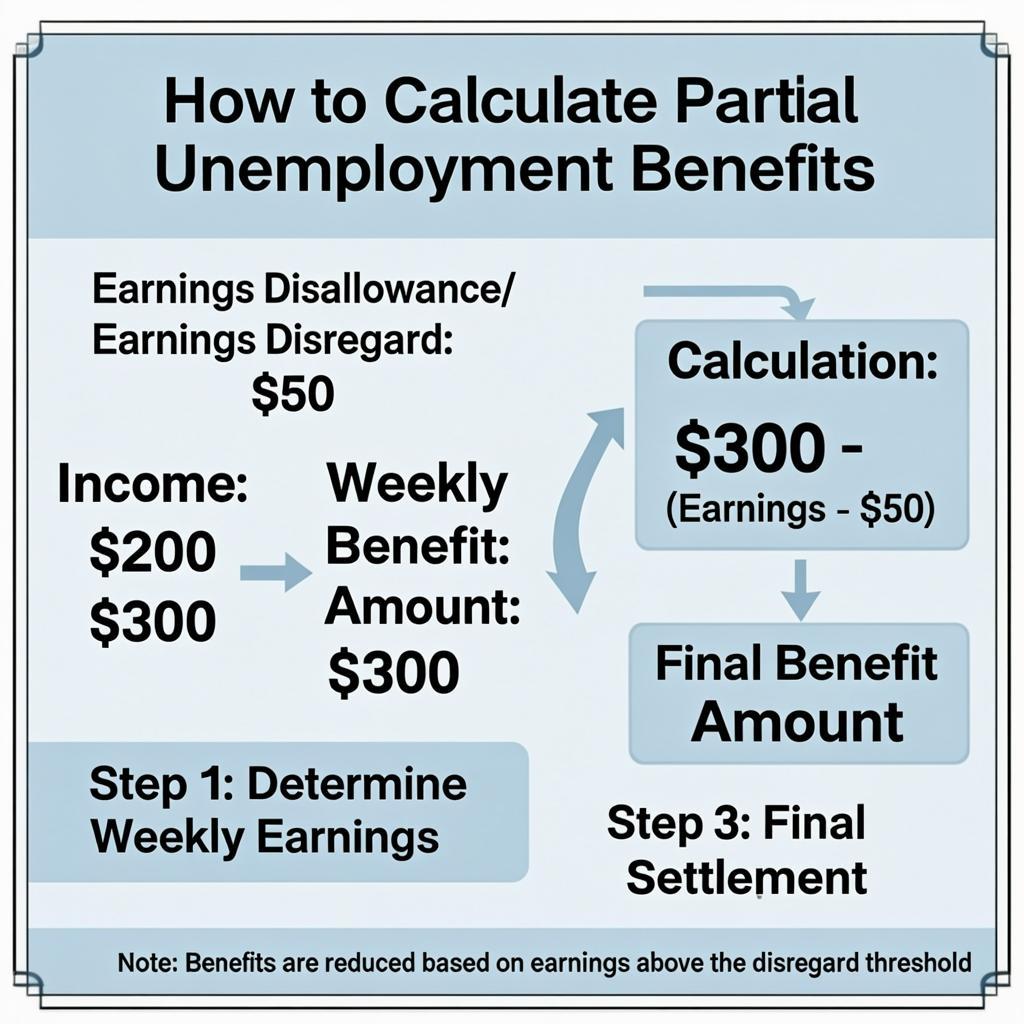
Once your earnings exceed the disregard amount, your weekly benefit is reduced according to a specific formula. While the exact formula varies by state, the most common approach works like this: subtract the earnings disregard from your gross earnings, then subtract the remaining amount from your weekly benefit amount. The result is your partial benefit for that week. If the partial benefit is zero or negative, you receive no payment for that week — but your claim stays open and your remaining balance is preserved.
Notice something important in that example: even with the benefit reduction, your total weekly income is higher with part-time work than it would be on full benefits alone. You receive $500 instead of $400. That is the incentive the system is designed to create. Working part-time leaves you better off financially, and the disregard makes the first chunk of your earnings essentially free money on top of your benefit. It is worth understanding whether you can work part-time and still collect before turning down any opportunity.
Some states use a different reduction rate. Instead of reducing your benefit dollar-for-dollar after the disregard, they might reduce it by 50 cents for every dollar earned, or by two-thirds of your earnings. These more generous formulas can make part-time work even more financially attractive. Your state's unemployment handbook will specify the exact reduction rate. If the math feels overwhelming, you can always use a partial benefit calculator to estimate your payment before certifying.
Reporting Requirements for Gig Economy Workers
The rise of gig economy work — Uber, Lyft, DoorDash, Instacart, TaskRabbit, freelance writing, and similar platform-based income — has created a gray area in unemployment reporting that catches many people off guard. When you drive for Uber or deliver for DoorDash, you are technically self-employed as an independent contractor. This creates a tension with unemployment benefits, because most states require you to be available for full-time work and actively seeking employment. Building a gig business can look like self-employment, which might disqualify you entirely.
The practical reality is more nuanced. Most states treat gig income as reportable earnings during the week you perform the work, similar to how they treat wages from a W-2 employer. If you drove for Uber on Tuesday and earned $85, you report $85 in gross earnings for that certification week. The tricky part is that gig platforms do not withhold taxes or provide traditional pay stubs, so calculating your gross earnings takes more effort. You need to track your total fares and tips for the week, not just the amount that hit your bank account after platform fees.
Here is where it gets complicated. For gig workers, gross earnings generally means your total fares before the platform takes its cut. If you collected $120 in Uber fares and Uber kept $30 as their commission, your gross earnings are $120 — not the $90 deposited in your account. Some states take the position that the platform fee is a business expense you can deduct, while others say you must report the full fare. This inconsistency means you should call your state agency and ask specifically how to calculate gig earnings for certification purposes. Document the answer in case you are ever audited.
There is also the self-employment question. If your gig work becomes substantial — say you are driving 30 hours a week and earning $600 — some states will determine that you are no longer unemployed and are instead self-employed, which disqualifies you from benefits. A few hours of gig work per week is usually fine, but ramping up to near-full-time hours on a gig platform can jeopardize your claim. When you answer the certification questions each week, be honest about the extent of your self-employment activity.
Common Mistakes in Income Reporting
After reviewing thousands of claimant communications and overpayment notices, the same errors come up again and again. These are the mistakes that land people in trouble — and they are all avoidable once you know what to watch for.
The pattern across all of these mistakes is a lack of precision. People round numbers, forget to check their pay stubs, or assume that small amounts do not matter. The unemployment system is a bureaucracy that deals in exact figures, and even a $10 discrepancy can trigger a flag when your employer's quarterly report does not match what you certified. Develop a routine: before you sit down to certify, pull up your pay information for the week and write down the exact gross amount. Then enter that number on your certification. It takes two extra minutes and can save you months of headaches.
What Happens If You Under-Report or Over-Report
The consequences of reporting errors are not symmetrical. Under-reporting — whether intentional or accidental — is treated far more harshly than over-reporting. Here is how each scenario typically plays out.
Under-reporting (you earned more than you reported): The state eventually discovers the discrepancy through employer wage reports, which are filed quarterly. When the match shows that you earned more than you certified, the agency issues an overpayment notice. You must repay the excess benefits you received, and depending on the severity and whether the agency determines it was intentional, additional penalties can apply. These may include a fraud determination that adds a 15–30% penalty on top of the overpayment amount, a disqualification period of 5–15 weeks where you cannot collect benefits even if you are eligible, and a permanent flag on your record that subjects future claims to extra scrutiny. If you receive an overpayment notice, our guide on what to do about overpayment explains your options for appealing, requesting a waiver, or setting up a repayment plan.
Over-reporting (you reported more than you actually earned): This is much less common, but it happens when someone estimates high, reports gross earnings when their state allows business expense deductions, or accidentally double-counts a paycheck. The result is that your benefit is reduced more than it should be, and you receive less money than you are entitled to. The state will not proactively correct this — they have no incentive to give you money back. You would need to contact the agency, provide documentation of the correct earnings, and request an adjustment. Most claimants never bother, which means over-reporting silently costs them money every week.

State-by-State Differences in Earnings Treatment
No two states treat part-time earnings exactly the same way, and the differences can have a real impact on your weekly payment. The three main variables are the earnings disregard amount, the reduction rate applied to earnings above the disregard, and the threshold at which your benefit drops to zero. Let me give you a sense of the range.
California disregards the greater of $25 or 25 percent of your WBA, then reduces your benefit dollar-for-dollar for the remaining earnings. Illinois disregards 50 percent of your WBA — one of the most generous disregards in the country — making part-time work very attractive for Illinois claimants. Texas disregards 25 percent of your WBA but uses a slightly different calculation for the reduction. Florida, which as of 2026 no longer has state unemployment benefits, is obviously off the table entirely. New Jersey disregards 20 percent of your WBA. Pennsylvania uses a flat 30 percent disregard. The variation is significant enough that a claimant earning $200 per week part-time could see dramatically different benefit reductions depending on their state.
Some states also differ in how they handle the situation where your earnings exceed your WBA plus the disregard. In most states, if your gross earnings equal or exceed your WBA, you receive zero benefits for that week — but the week does not count against your total benefit balance. A few states are stricter and will end your claim entirely if you earn above a certain threshold for multiple consecutive weeks. Before you start part-time work, check your state's specific rules so you know exactly where the lines are. If you have already filed and want to confirm your claim is still active, you can check your claim status onlinethrough your state's portal.
Step-by-Step Guide to Reporting Correctly Each Week
Let me bring everything together into a practical weekly routine you can follow every time you certify. This process takes about five minutes and will virtually eliminate the risk of reporting errors.
This routine becomes second nature after a few weeks. The key is doing it the same way every time so you do not skip a step. Set a reminder on your phone for your certification day, and make "check pay stubs" the first thing you do before opening the certification portal. If you have not yet started the certification process and are still in the application phase, our guide to applying for unemployment benefits covers everything from filing your initial claim to receiving your first payment.
One final point: if you realize after submitting your certification that you made an error, do not just hope nobody notices. Contact your state agency immediately to correct the information. Most states allow you to amend a recent certification, and proactively correcting a mistake is viewed very differently than having the agency discover it on their own. A self-corrected error almost never results in a fraud determination, while an agency-discovered discrepancy often does. The phone call might be frustrating — hold times can be long — but it is infinitely better than receiving an overpayment letter six months from now.
Disclaimer:This article provides general information about reporting part-time income on weekly unemployment certifications. Earnings disregard amounts, partial benefit formulas, gig economy reporting rules, and overpayment procedures vary significantly by state and are subject to change. Always follow your state agency's specific instructions when certifying for benefits. If you need personalized advice about your claim, contact your state's unemployment office or consult a qualified legal professional.