
When you file for unemployment, the single number that matters most to your daily life is your weekly benefit amount — the dollar figure that determines how much money lands in your bank account every week. Most people assume this number is based on their most recent salary, but the reality is more nuanced. Your weekly benefit amount is calculated using a specific formula that looks at your earnings history across a defined time period called the base period, identifies the quarter where you earned the most, and then applies a state-specific percentage to that high-quarter total. The result is your weekly benefit amount, and it can vary significantly from state to state even if your earnings history is identical.
Understanding this formula before you file gives you a major advantage. You can estimate your benefit amount, plan your budget, and avoid the surprise of receiving less than you expected. If you have not yet started the application process, our step-by-step guide to applying for unemployment walks you through every stage from gathering documents to submitting your claim.
What Is the Base Period and Why Does It Matter
The base period is the foundation of your entire benefit calculation. It is the specific timeframe that your state uses to review your earnings history and determine whether you qualify for benefits and how much you will receive. Most states use what is called the standard base period, which consists of the first four of the last five completed calendar quarters before the date you file your claim. This means the base period shifts depending on when you file — filing in January versus filing in March can change which quarters fall within your base period, and that shift can change your benefit amount by hundreds of dollars per week.
A calendar quarter is a three-month block: January through March is the first quarter, April through June is the second, July through September is the third, and October through December is the fourth. When you file your claim, the state looks back at the five most recently completed quarters, then excludes the most recent one (because earnings in that quarter may not yet be fully reported by employers) and uses the remaining four quarters as your base period. This system ensures that the earnings data used in your calculation is complete and verified through employer wage reports, which are submitted to state agencies on a quarterly basis.
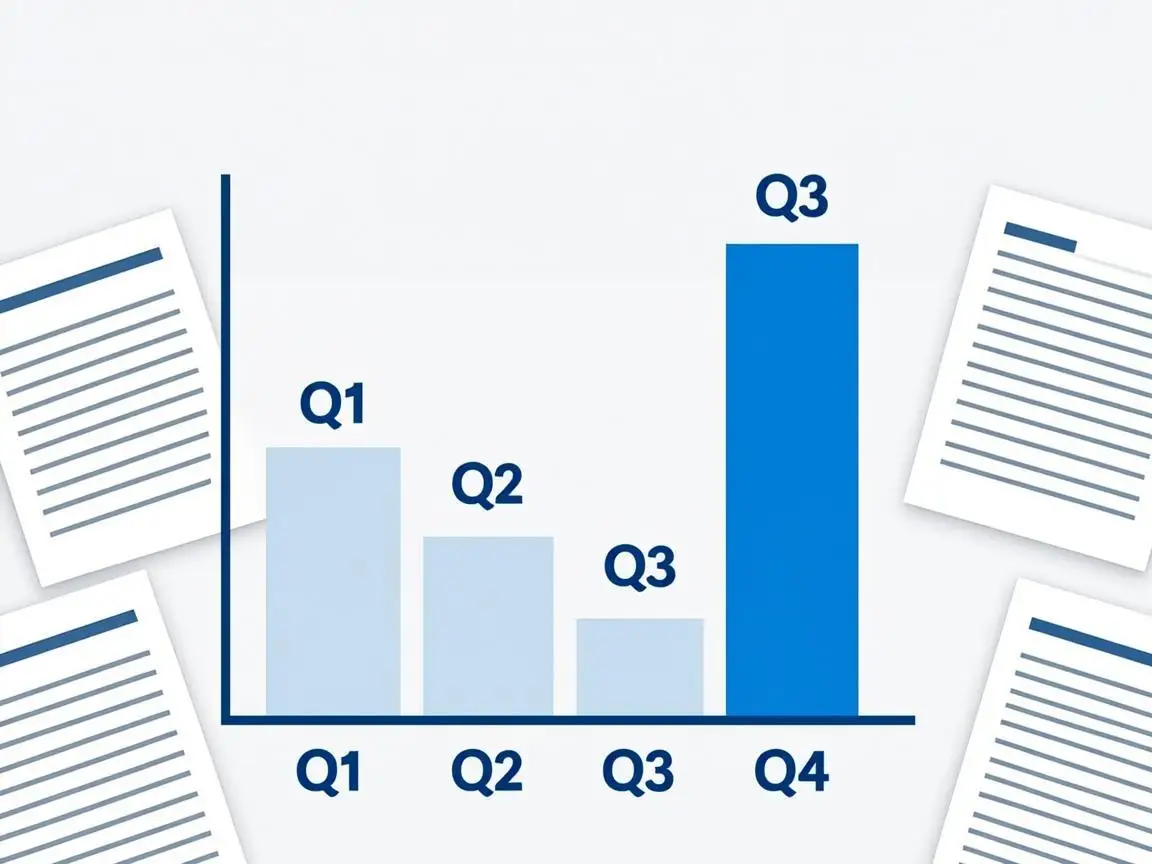
📋 How the Base Period Shifts Based on Your Filing Date
The timing of your claim filing directly determines which quarters fall into your base period, and this can have a significant impact on your benefit amount. Consider a worker who earned $15,000 in Q3 (July-September) and only $3,000 in Q2 (April-June). If they file in January, their base period might include Q2 but exclude Q3, resulting in a much lower benefit calculation. If they wait until April to file, Q3 enters the base period and Q2 shifts out — and the high-quarter calculation jumps from $3,000 to $15,000, potentially doubling or tripling the weekly benefit.
This timing strategy is legal and commonly used by informed claimants. It is not fraud or manipulation — it is simply understanding how the system works and filing when your earnings history produces the best calculation. If you want to explore the timing of your initial claim more deeply, our guide on filing timing explains the optimal strategies for when to submit your application.
The High-Quarter Formula: How Your WBA Is Determined
Once the state identifies your base period, it examines your earnings in each of the four quarters. The quarter where you earned the most — your high quarter — becomes the primary input for calculating your weekly benefit amount. Most states use a straightforward formula: they take your total earnings in the high quarter, divide it by a fixed number (typically 26, representing the number of weeks in a half-year), and then apply a state-specific percentage multiplier. The result is your weekly benefit amount.
For example, in a state that uses a 4% multiplier on your high-quarter wages, if you earned $12,000 in your best quarter, the calculation would be: $12,000 × 4% = $480 per week. Other states might use a different percentage — Massachusetts uses approximately 3.85%, while Minnesota uses roughly 4.62%. The percentage difference might seem small, but it compounds over 26 weeks of collection. A 0.5% difference on a $15,000 high quarter translates to $75 per week, which adds up to $1,950 over the full benefit period. Understanding your state’s specific multiplier helps you plan realistically rather than guessing.

🔢 Step-by-Step WBA Calculation Example
Let us walk through a complete calculation using real numbers. Suppose you worked in California and earned the following amounts across your four base-period quarters: Q1 = $8,500, Q2 = $11,200, Q3 = $14,600, Q4 = $9,800. Your high quarter is Q3 at $14,600. California’s formula takes the high-quarter earnings and applies roughly 3.85% to determine your WBA. The calculation: $14,600 × 0.0385 = $562.10 per week. California then rounds this to the nearest dollar and applies a minimum threshold ($40) and maximum cap ($450). Since $562 exceeds the cap, your actual WBA would be $450 per week.
This example illustrates a critical point: even if your earnings produce a higher calculation, most states cap your weekly benefit at a fixed maximum. The cap varies dramatically between states — Massachusetts caps at $1,033, while Arizona caps at $320. To see the exact caps for every state, our complete benefit calculation guide includes a state-by-state comparison table with maximums, minimums, and calculation percentages.
Alternative Calculation Methods Some States Use
While the high-quarter method is the most common, several states use alternative formulas that can produce different results. Understanding which method your state uses is essential because the same earnings history can yield very different benefit amounts depending on the formula applied. Some states average your earnings across two or more quarters rather than relying solely on the highest quarter, and this averaging approach tends to benefit workers with steady, moderate earnings while penalizing those with highly variable income patterns.
📊 The Average-Quarter Method
States like Minnesota and Wisconsin use a variation that considers your average earnings across multiple quarters rather than just the highest one. Minnesota, for example, takes the average of your two highest quarters and applies its multiplier to that average. This means a worker who earned $14,000 in one quarter and $3,000 in the other three would get a different calculation than they would under a pure high-quarter formula. The averaging method smooths out income spikes and provides a more stable — though often lower — benefit amount for workers with inconsistent earnings.
If your income fluctuates significantly from quarter to quarter — which is common for seasonal workers, gig economy participants, and commissioned salespeople — the averaging method may reduce your WBA compared to a pure high-quarter calculation. Seasonal workers in particular should understand this distinction, as our guide for seasonal workers explains how irregular earnings patterns affect both eligibility and benefit amounts across different state formulas.
Earnings Thresholds and Minimum Qualification Requirements
Your weekly benefit amount is not just about how much you can receive — it also determines whether you qualify at all. Every state sets minimum earnings thresholds that you must meet during your base period to be eligible for any benefits. These thresholds ensure that only workers with a meaningful attachment to the labor force — those who earned enough and worked enough — can collect unemployment. If your earnings fall below the threshold, your claim will be denied regardless of why you lost your job.
1️⃣ The High-Quarter Earnings Minimum
Most states require that you earned a minimum amount in your high quarter to qualify. This minimum ranges from roughly $1,000 to $3,000 depending on the state. In Texas, for example, you must have earned at least $1,250 in your high quarter. In New York, the minimum is approximately $2,600. If your highest quarter falls below this threshold, the state will deny your claim entirely. This is why understanding your earnings across the base period is crucial before filing — if your high quarter does not meet the minimum, there is no benefit to collect, and you may need to adjust your filing timing to shift a stronger quarter into the base period.
2️⃣ The Total Base Period Earnings Minimum
In addition to the high-quarter minimum, many states also require that your total earnings across the entire base period meet a minimum threshold. This prevents someone who earned a large amount in just one quarter from qualifying if their other quarters show negligible earnings — a pattern that suggests a very brief or intermittent attachment to the workforce. For instance, California requires that your total base period earnings equal at least 1.25 times your high-quarter earnings. If your high quarter was $5,000, your total base period earnings must be at least $6,250. If your other three quarters brought in only $500 each ($1,500 total), your total base period earnings would be $6,500, which barely meets the requirement. Workers who do not meet these thresholds should review our eligibility guide to understand all the qualification criteria that affect their claim.
State Multiplier Percentages: How Each State Calculates Differently
The multiplier percentage is the single most important variable in your benefit calculation after your high-quarter earnings. Each state sets its own percentage, and the range across all 50 states is surprisingly wide. Understanding your state’s multiplier allows you to estimate your benefit amount with reasonable accuracy before you even file your claim.
The most common multiplier range falls between 3.85% and 4.62% of high-quarter wages. States at the lower end of this range — such as California at approximately 3.85% — produce lower weekly benefits from the same earnings history. States at the higher end — such as Minnesota at roughly 4.62% — produce higher benefits from identical earnings. The practical difference is substantial: on a $12,000 high quarter, the California formula produces about $462 per week (before the $450 cap applies), while Minnesota would produce approximately $554. Over 26 weeks of collection, that difference totals roughly $2,400.
Minimum and Maximum Weekly Benefit Amounts
Even after the formula produces your calculated WBA, every state applies two adjustments: a minimum floor and a maximum ceiling. The minimum ensures that even low-earning workers receive a meaningful amount — typically between $40 and $100 per week depending on the state. The maximum caps the benefit at a fixed dollar amount regardless of how high your earnings were, and this cap varies dramatically between states. The practical effect is that high-earning workers in low-cap states receive a disproportionately small percentage of their previous income, while workers in high-cap states receive a more proportional replacement.
The maximum cap ranges from around $275 per week in low-benefit states like Arizona and Mississippi to over $1,000 per week in high-benefit states like Massachusetts and Washington. This means a worker who earned $100,000 per year in Arizona would receive at most $275 per week — a replacement rate of roughly 14% — while the same worker in Massachusetts could receive up to $1,033 per week, representing a replacement rate closer to 53%. The disparity between state caps is one of the most significant factors affecting your financial stability during unemployment, and it is entirely determined by where you worked, not where you live.
How Part-Time Earnings and Deductions Reduce Your WBA
Your calculated WBA represents the maximum you can receive in a week where you have no other income. If you earn money from part-time work, gig jobs, or any other source during a certification period, your state will reduce your benefit payment based on its earnings disregard policy. The earnings disregard is a small amount you can earn without affecting your benefits — typically between $25 and $50 per week in most states — and anything above that disregard reduces your benefit proportionally.
The reduction formula varies by state, but the most common approach reduces your benefit by 50% to 75% of the earnings above the disregard. For example, if your WBA is $400 and you earn $200 in a week, with a $50 disregard: your earnings above the disregard are $150, and at a 50% reduction rate, your benefit would be reduced by $75, resulting in a payment of $325 plus your $200 earnings, giving you a total weekly income of $525. This partial benefit system is designed to encourage part-time work during unemployment. For a complete understanding of how part-time earnings interact with your benefits, our guide on working part-time while collecting explains the calculation in detail for every state.
Receiving Your Determination Letter and Verifying the Amount
After you file your claim and the state processes your application, you will receive a benefit determination letter that states your weekly benefit amount, your maximum benefit amount (the total you can collect over your entire benefit year), and the earnings history the state used to calculate these figures. This letter is one of the most important documents in your unemployment case, and you should review it carefully for errors.

Common errors include missing quarters of earnings (if an employer failed to report your wages), incorrect high-quarter identification, and wrong multiplier application. If the WBA on your determination letter seems too low, compare it against your own earnings records. Request your wage reports from the state if necessary, and file an appeal if the calculation used incorrect data. The appeal process for benefit amount disputes is different from eligibility appeals, but the general framework is similar. Our appeal guide covers both types of disputes and the evidence you need to present.
The Alternate Base Period: When Standard Earnings Do Not Qualify
Some workers — particularly those who lost their job very recently and have minimal earnings in the standard base period — may not qualify under the regular formula. For these situations, many states offer an alternate base period that includes the most recently completed quarter (the one excluded from the standard base period). Using the alternate base period allows the state to count your most recent earnings, which can be the difference between qualifying and being denied.
The alternate base period is not automatically applied in all states — some require you to request it, while others apply it automatically when your standard base period does not meet the minimum thresholds. The key difference is that the alternate period includes fresher earnings data that employers may not have fully reported yet, which means the initial calculation might be lower than your actual entitlement. As employer wage reports are updated, your benefit amount may be adjusted upward retroactively. If you are concerned about qualification thresholds, check whether your disqualification risks include insufficient earnings, and ask your state agency about alternate base period options.
The Bottom Line
Your weekly benefit amount is not a random number assigned by a state agency — it is a formula-driven calculation based on your documented earnings history. Understanding the base period, the high-quarter method, your state’s multiplier percentage, and the minimum and maximum adjustments gives you the power to estimate your benefit before filing, identify errors in your determination letter, and potentially increase your amount by timing your claim strategically. The formula is the same across most states, but the variables — multiplier percentages, caps, thresholds — create significant differences in what you actually receive.
If your calculated amount seems too low, check for missing wage reports, verify your base period quarters, and consider whether an alternate base period might produce a better result. And if you disagree with the determination, you have the right to appeal with supporting evidence. The more you understand the calculation before you file, the fewer surprises you will face after your claim is processed.
For a complete picture of the unemployment system from start to finish, our eligibility guide and application walkthrough provide the foundation, while our benefit amount overview gives you the numbers for every state.

Wasim Akram
Verified AuthorFounder & Lead Researcher, UnemploymentBenefitsCalculator.com
Wasim personally researches, writes, and reviews every article on this site. His expertise spans unemployment benefits policies across all 50 U.S. states, drawn from systematic research into state workforce agencies and Department of Labor guidelines.