
One of the most common questions people ask when they lose their job is: how much unemployment will I actually get? The uncertainty can be stressful, especially when you are trying to figure out how to pay rent, cover groceries, and keep up with bills on a reduced income. The good news is that you can estimate your unemployment benefits before you file — and with reasonable accuracy. You do not need to wait for a determination letter to arrive in the mail to know roughly what your weekly benefit will be. With a few pieces of information about your earnings history and your state's formula, you can calculate an estimate that will be within a few dollars of your actual benefit.
This guide walks you through the exact process of estimating your Weekly Benefit Amount (WBA) before you file. We will cover the information you need to gather, the formula your state uses, and free tools that can do the math for you. Whether you are trying to decide if unemployment will cover your basic expenses or comparing your options between filing now and waiting a few weeks, having a reliable estimate is the first step in making informed financial decisions. If you are ready to file, our application guide covers the complete filing process.
What You Need Before You Start
Before you can estimate your benefits, you need to gather a few key pieces of information. The most important is your earnings history for the past 18 months. This includes your gross wages from all employers during that period, broken down by calendar quarter. Calendar quarters are January through March, April through June, July through September, and October through December. You can find this information on your pay stubs, W-2 forms, or your employer's payroll portal. If you worked for multiple employers during the past 18 months, you will need the earnings from each one.
You also need to know the date you plan to file your claim, because the filing date determines which quarters fall within your base period. The base period is the timeframe from which your earnings are considered, and it is typically the first four of the last five completed calendar quarters before your filing date. If you file in August 2026, for example, your base period would be April 2025 through March 2026. Shifting your filing date by even a few weeks can change your base period by an entire quarter, which could significantly affect your benefit. For more on the base period, see our WBA calculation guide.
Step-by-Step Estimation Process
Estimating your benefit is a straightforward process that involves four steps. Follow these steps in order, and you will have a reliable estimate of your Weekly Benefit Amount within minutes.
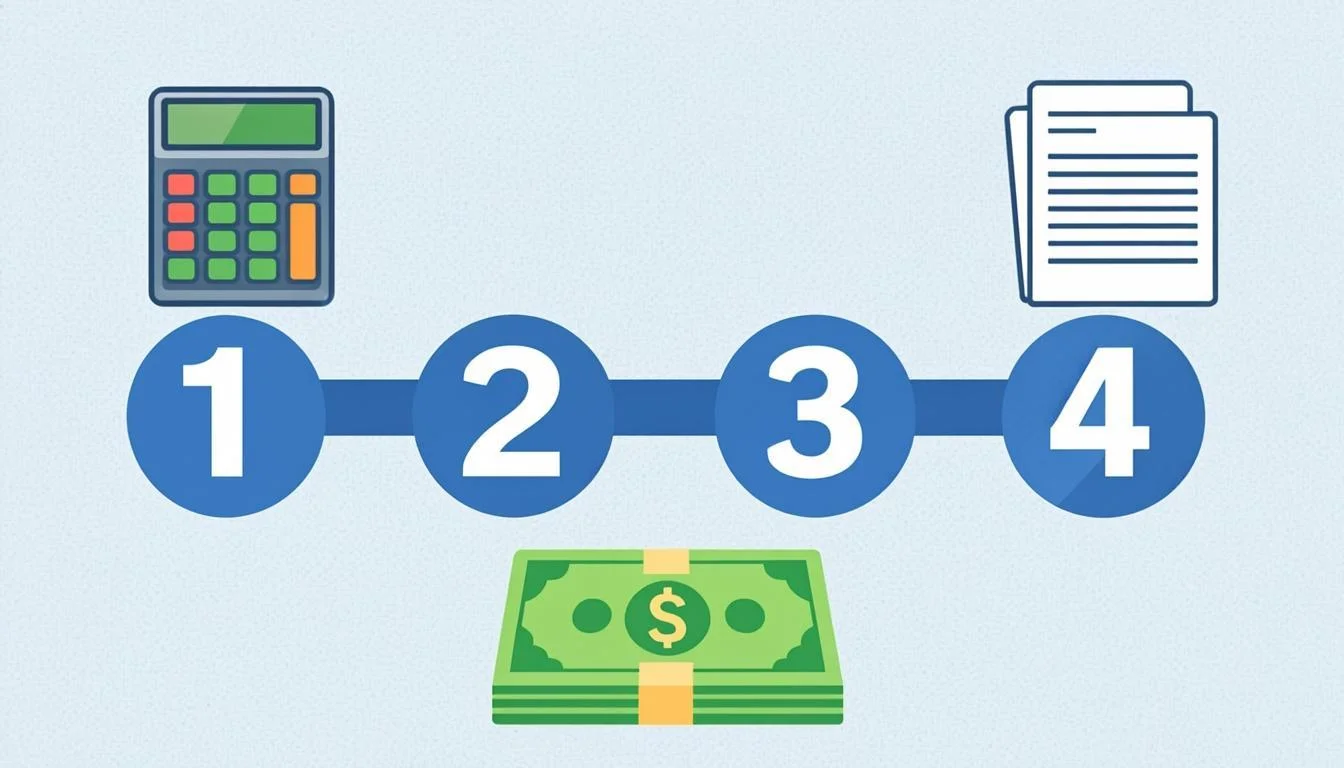
Step 1: Identify Your Base Period
The first step is to determine which quarters fall within your base period. This depends on when you file your claim. If you file in July, August, or September 2026, your base period is Q2 2025 through Q1 2026. If you file in October, November, or December 2026, your base period shifts to Q3 2025 through Q2 2026. Write down your total earnings for each quarter in the base period. If you do not have exact numbers, use your pay stubs or W-2 forms to estimate as closely as possible. If you worked for multiple employers, combine the earnings from all employers for each quarter.
Step 2: Find Your High Quarter
Once you have your earnings for each quarter in the base period, identify the quarter with the highest total earnings. This is your high quarter, and it is the foundation of your benefit calculation in most states. For example, if your quarterly earnings were $7,500, $9,200, $8,800, and $6,400, your high quarter would be $9,200. Some states use the average of the two highest quarters instead of the single high quarter, so check your state's specific formula. For a complete reference of state formulas, see our benefit formula guide.
Step 3: Apply Your State's Formula
The most common formula is to divide your high quarter earnings by 26. This produces a weekly figure that is approximately 50% of your average weekly earnings during the high quarter. Some states divide by 25 instead of 26, which produces a slightly higher benefit. Other states use a two-quarter average divided by 26. Apply the formula for your state from the reference table below. For example, if your high quarter is $9,200 and your state divides by 26, your estimated WBA would be $9,200 / 26 = $353.85, rounded to $354 per week.
Step 4: Check Against Minimum and Maximum
Your calculated WBA must fall within your state's minimum and maximum thresholds. If your calculated amount is below the minimum, you will receive the minimum. If it is above the maximum, your benefit will be capped at the maximum. For example, if your calculated WBA is $354 and your state's maximum is $500, your benefit will be $354. If your calculated WBA is $600 but your state's maximum is $500, your benefit will be capped at $500. Check the maximum benefits by state guide for current thresholds.

Free Online Estimation Tools
If you do not want to do the math yourself, there are several free online tools that can estimate your unemployment benefit in seconds. Your state's unemployment website may offer an official benefit calculator that uses the exact formula and current thresholds. These calculators are the most accurate because they are maintained by the agency that processes your claim. Simply enter your earnings for each quarter in the base period, and the calculator will produce your estimated WBA.
Third-party websites also offer benefit calculators, though their accuracy varies. Some of these calculators are updated regularly and use the correct formulas, while others may be outdated or use simplified calculations that do not account for state-specific rules like dependents allowances or alternate base periods. If you use a third-party calculator, verify the result against the official formula for your state. The best approach is to use the state calculator as your primary tool and a third-party calculator as a cross-check. For a comprehensive guide to using calculators, see our complete calculator guide.
State-by-State Estimation Quick Reference
The following table provides the key formula components for each state so you can quickly estimate your benefit. Use the formula that applies to your state along with your earnings data to calculate your estimated WBA.
| State | Formula | Max WBA | Min WBA |
|---|---|---|---|
| Alabama | HQ / 26 | $275 | $45 |
| California | HQ / 25 | $580 | $40 |
| Florida | HQ / 26 | $275 | $32 |
| Illinois | HQ / 26 | $534 | $51 |
| Massachusetts | 2QA / 26 | $1,028 | $25 |
| Michigan | 2QA / 26 | $362 | $81 |
| New York | HQ / 26 | $527 | $40 |
| Ohio | 2QA / 26 | $680 | $134 |
| Pennsylvania | HQ / 26 | $615 | $35 |
| Texas | HQ / 25 | $580 | $69 |
| Washington | 2QA / 26 | $1,019 | $295 |
HQ = High Quarter | 2QA = Two-Quarter Average | Full 50-state table available in our benefit formula guide
Factors That Can Change Your Actual Benefit
Your estimate may not match your actual benefit exactly, and there are several reasons why. The most common factor is that your employer's wage report may differ from your own records. Employers sometimes report wages for the wrong quarter, fail to report bonuses or commissions, or report incorrect amounts. If there is a discrepancy, your actual benefit will be based on the employer's report unless you can provide documentation to correct it. This is why it is important to keep your pay stubs and W-2 forms — they are your evidence if a dispute arises.
Other factors that can change your actual benefit include dependents allowances, which add extra money to your weekly benefit in some states, and deductions for part-time earnings or severance pay. If you have dependent children, your benefit could be $25 to $50 higher per dependent than your estimate. If you are working part-time, your benefit will be reduced based on your state's earnings disregard rules. Finally, if you are receiving a pension from a previous employer, some states will reduce your benefit by a portion of the pension amount. For more on these factors, see our dependents allowance guide and severance pay guide.

How to Use Your Estimate for Financial Planning
Once you have a reliable estimate of your weekly benefit, you can use it to create a realistic budget for your unemployment period. Start by comparing your estimated benefit to your essential monthly expenses: rent or mortgage, utilities, food, transportation, and insurance. If your benefit covers these expenses, you may be able to manage without additional income. If it does not, you will need to identify other sources of income, such as part-time work, savings, or assistance programs.
Remember that unemployment benefits are taxable, so you should set aside roughly 10% of each payment for federal taxes if you choose not to have taxes withheld. You can also choose to have 10% of your benefit withheld for federal taxes, which simplifies the process at tax time. Some states also tax unemployment benefits, so check your state's rules. For more on the tax implications, see our unemployment tax guide.
Key Takeaways
Disclaimer:This article provides general information about estimating unemployment benefits. Rules and regulations vary by state and are subject to change. Always verify current rules with your state's unemployment agency. If you need personalized advice, consult a qualified legal or financial professional.