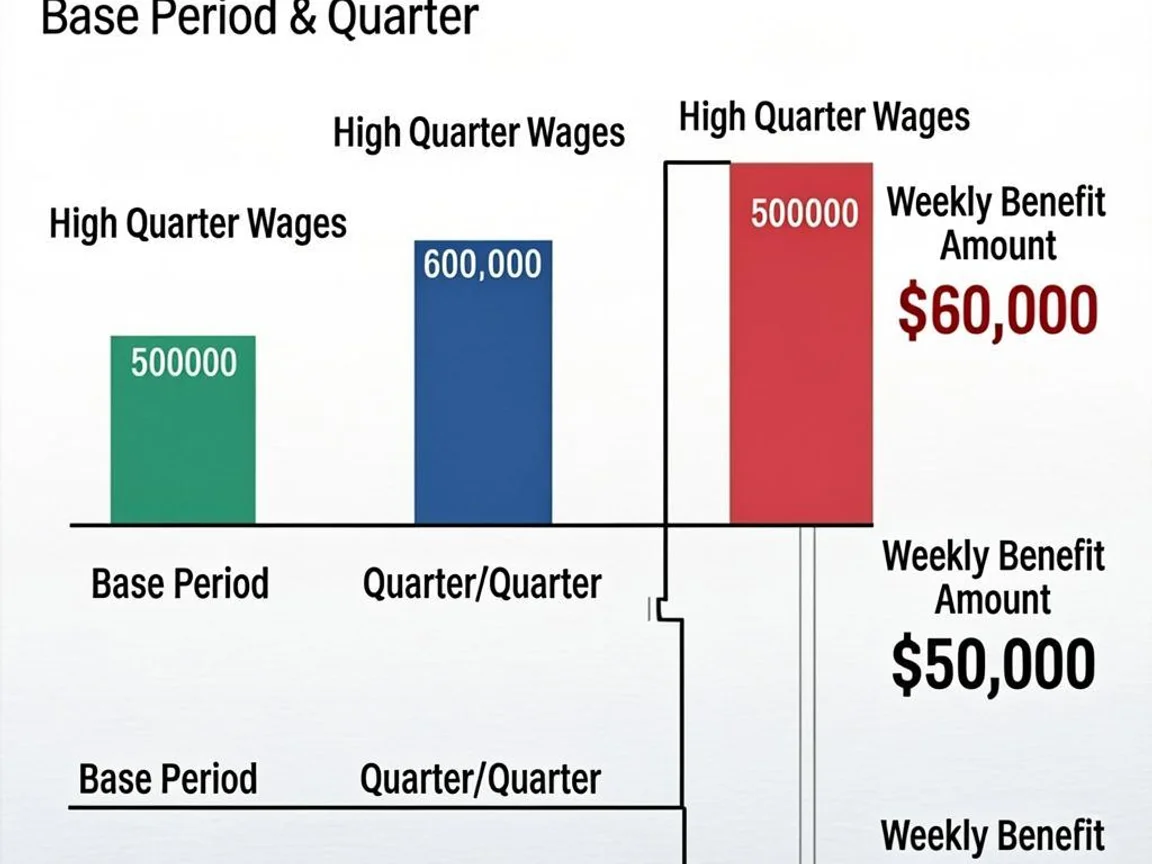
When you file for unemployment benefits, your state does not pick a number out of thin air. Every state uses a specific mathematical formula to determine your Weekly Benefit Amount (WBA) — the amount you receive each week while unemployed. Although the exact formula varies from state to state, nearly all of them follow the same basic framework: they look at your earnings history during a defined period called the base period, identify the highest-earning quarter, apply a percentage multiplier, and then enforce minimum and maximum thresholds. Understanding this formula is not just an academic exercise — it allows you to estimate your benefit before you file, verify that your state has calculated it correctly, and plan your finances accordingly. If your benefit seems too low, knowing the formula can help you determine whether an error was made and whether you should appeal the decision.
The formula may seem complex at first glance, but it is fundamentally simple arithmetic. The complexity comes from the variations between states — different base period definitions, different percentage multipliers, different ways of rounding, and different minimum and maximum thresholds. This guide breaks down every component of the unemployment benefit formula, explains how each state differs, and provides a complete reference table so you can calculate your own WBA with confidence. If you are new to the unemployment process, our application guide covers the initial filing steps, and this guide explains the math behind the benefit you receive.
The Four Components of Every State's WBA Formula
Although the specifics vary, every state's unemployment benefit formula is built from four core components. Understanding these components is the key to understanding how your benefit is calculated and why it differs from what your coworker or neighbor receives. The four components are the base period, the high quarter, the percentage multiplier, and the minimum/maximum thresholds. Let us walk through each one in detail.
1. The Base Period — Which Earnings Count
The base period is the timeframe from which your earnings are considered when calculating your WBA. In most states, the base period is the first four of the last five completed calendar quarters before you filed your claim. Calendar quarters are January through March (Q1), April through June (Q2), July through September (Q3), and October through December (Q4). For example, if you file your claim in July 2026, your base period would be April 2025 through March 2026 — that is, Q2 2025, Q3 2025, Q4 2025, and Q1 2026. The most recent quarter (Q2 2026) is excluded, which is why it is called the "first four of the last five."
Some states also use an alternate base period, which includes the most recent completed quarter. This is important for workers who did not earn enough during the standard base period to qualify for benefits. For example, if you started a new job in January 2026 and were laid off in June 2026, your standard base period would not include any earnings from that job, but the alternate base period would. Roughly 40 states use an alternate base period, and you are automatically evaluated under both — if you qualify under the standard base period, that is used; if not, the alternate base period is checked. Understanding which quarters are included in your base period is the first step in calculating your benefit, because only earnings within the base period are considered. For more details on the base period, see our weekly benefit amount calculation guide.
2. The High Quarter — Your Best-Earning Quarter
Once the base period is established, the state looks at your total earnings in each of the four quarters and identifies the one with the highest total — this is your high quarter. The high quarter is the foundation of the WBA calculation in most states. The logic is straightforward: your benefit should be based on your best earning period, because that represents the wage level you were earning before you became unemployed. If your earnings were $8,000 in Q1, $9,500 in Q2, $7,200 in Q3, and $6,800 in Q4, your high quarter would be Q2 at $9,500. Most states use the high quarter alone, but some states use an average of the two highest quarters, or even an average of all four quarters, to smooth out fluctuations and provide a more representative benefit amount.
The high quarter also determines whether you meet the minimum earnings threshold to qualify for benefits at all. Most states require that your high quarter earnings exceed a certain dollar amount — typically between $1,000 and $3,000 — and that your total base period earnings equal at least 1.5 times your high quarter earnings. If you do not meet these thresholds, you will not qualify for benefits regardless of the formula. This is why it is important to understand your earnings history before filing; if you are close to the threshold, waiting a few weeks to file could shift your base period to include more earnings and potentially qualify you for a higher benefit.
3. The Percentage Multiplier
The percentage multiplier is the factor that converts your high quarter earnings into your Weekly Benefit Amount. The most common multiplier is 50%, meaning your WBA is approximately half of your average weekly earnings during the high quarter. However, the calculation is not as simple as dividing the high quarter by 13 (the number of weeks in a quarter) and multiplying by 50%. Many states use a fixed table or formula that applies different percentages at different earning levels, effectively creating a progressive system where higher earners receive a larger dollar benefit but a smaller percentage of their previous wages.
The multiplier ranges from roughly 40% to 60% across states, with 50% being the most common. Some states use a flat percentage — for example, 50% of your high quarter weekly average — while others use a graduated table where the percentage changes at specific earning thresholds. For instance, a state might pay 50% on the first $4,000 of high quarter earnings, 45% on the next $4,000, and 40% on anything above $8,000. This graduated approach means that the actual percentage of your previous wages that you receive decreases as your income increases, which is why higher earners often receive a smaller replacement rate even though their dollar benefit is larger.
4. Minimum and Maximum Thresholds
Every state sets a minimum and maximum WBA. The minimum ensures that even very low-wage workers receive a meaningful benefit, while the maximum caps the benefit at a level the state can afford. The maximum WBA is one of the most significant variables in the unemployment system, ranging from as low as $235 per week in Mississippi to as high as $1,028 per week in Massachusetts. These maximums are typically adjusted annually based on the state's average weekly wage, so they tend to increase slightly each year. The minimum WBA is usually between $25 and $75 per week, though some states have a minimum as low as $5 or $10.
The maximum WBA is particularly important because it creates a cap on the benefit regardless of how much you earned. If you earned $3,000 per week and your state's maximum WBA is $500, you will receive $500 — not $1,500. This means that high earners face a significant replacement rate gap, receiving only a small fraction of their previous income. For a detailed breakdown of maximums by state, see our maximum benefits comparison guide.
State-by-State WBA Formula Reference
The following table provides a comprehensive reference for the WBA formula used by each state. This includes the primary formula type, the percentage multiplier, the base period definition, and the current maximum WBA. Use this table to understand how your state calculates benefits and to estimate your own WBA. Remember that these figures are subject to change and you should always verify with your state's unemployment agency.
| State | Formula Type | Multiplier | Max WBA (2026) |
|---|---|---|---|
| Alabama | High Quarter / 26 | ~3.85% | $275 |
| Alaska | High Quarter / 25 | 4% | $442 |
| Arizona | High Quarter / 26 | ~3.85% | $320 |
| Arkansas | High Quarter / 26 | ~3.85% | $451 |
| California | High Quarter / 25 | 4% | $580 |
| Colorado | High Quarter / 26 | ~3.85% | $719 |
| Connecticut | 2-qtr avg / 26 | ~3.85% | $724 |
| Delaware | High Quarter / 26 | ~3.85% | $442 |
| Florida | High Quarter / 26 | ~3.85% | $275 |
| Georgia | 2-qtr avg / 26 | ~3.85% | $410 |
| Hawaii | High Quarter / 26 | ~3.85% | $696 |
| Idaho | High Quarter / 25 | 4% | $490 |
| Illinois | High Quarter / 26 | ~3.85% | $534 |
| Indiana | 2-qtr avg / 26 | ~3.85% | $390 |
| Iowa | High Quarter / 26 | ~3.85% | $571 |
| Kansas | High Quarter / 26 | ~3.85% | $494 |
| Kentucky | High Quarter / 26 | ~3.85% | $596 |
| Louisiana | High Quarter / 26 | ~3.85% | $284 |
| Maine | 2-qtr avg / 26 | ~3.85% | $534 |
| Maryland | High Quarter / 26 | ~3.85% | $430 |
| Massachusetts | 2-qtr avg / 26 | ~3.85% | $1,028 |
| Michigan | 2-qtr avg / 26 | ~3.85% | $362 |
| Minnesota | 2-qtr avg / 26 | ~3.85% | $846 |
| Mississippi | High Quarter / 26 | ~3.85% | $235 |
| Missouri | High Quarter / 26 | ~3.85% | $320 |
| Montana | 2-qtr avg / 26 | ~3.85% | $546 |
| Nebraska | High Quarter / 26 | ~3.85% | $466 |
| Nevada | High Quarter / 26 | ~3.85% | $516 |
| New Hampshire | 2-qtr avg / 26 | ~3.85% | $546 |
| New Jersey | High Quarter / 26 | ~3.85% | $804 |
| New Mexico | High Quarter / 26 | ~3.85% | $314 |
| New York | High Quarter / 26 | ~3.85% | $527 |
| North Carolina | High Quarter / 26 | ~3.85% | $350 |
| North Dakota | High Quarter / 26 | ~3.85% | $534 |
| Ohio | 2-qtr avg / 26 | ~3.85% | $680 |
| Oklahoma | High Quarter / 26 | ~3.85% | $362 |
| Oregon | High Quarter / 26 | ~3.85% | $765 |
| Pennsylvania | High Quarter / 26 | ~3.85% | $615 |
| Rhode Island | 2-qtr avg / 26 | ~3.85% | $756 |
| South Carolina | High Quarter / 26 | ~3.85% | $326 |
| South Dakota | High Quarter / 26 | ~3.85% | $428 |
| Tennessee | N/A | N/A | N/A (no state UI) |
| Texas | High Quarter / 25 | 4% | $580 |
| Utah | High Quarter / 26 | ~3.85% | $580 |
| Vermont | 2-qtr avg / 26 | ~3.85% | $598 |
| Virginia | 2-qtr avg / 26 | ~3.85% | $510 |
| Washington | 2-qtr avg / 26 | ~3.85% | $1,019 |
| West Virginia | High Quarter / 26 | ~3.85% | $424 |
| Wisconsin | High Quarter / 26 | ~3.85% | $470 |
| Wyoming | 2-qtr avg / 26 | ~3.85% | $530 |
Three Common Formula Types Explained
While the table above shows the basic formula for each state, it is helpful to understand the three main formula types in more detail. Each type has different implications for workers at different income levels, and knowing which one your state uses can help you predict how changes in your earnings will affect your benefit.
Type 1: Single High Quarter Formula (Most Common)
The single high quarter formula is used by the majority of states. Under this method, your WBA is calculated by dividing your high quarter earnings by 26 (the approximate number of weeks in two quarters, which produces a weekly figure equivalent to roughly 50% of your weekly earnings during the high quarter). Some states divide by 25 instead of 26, which produces a slightly higher benefit. The advantage of the single high quarter formula is simplicity — you can easily calculate your own benefit by looking at your pay stubs from your best-earning quarter. The disadvantage is that it can produce irregular results for workers whose earnings fluctuate significantly from quarter to quarter. If you had one unusually good quarter followed by three mediocre ones, your benefit will be based on that single high quarter, which may overstate your typical earnings level.
Type 2: Two-Quarter Average Formula
About 15 states use a two-quarter average formula, which takes the average of your two highest-earning quarters and divides that by 26 to produce your WBA. This method smooths out quarterly fluctuations and provides a more stable benefit for workers with variable income. For example, if your two highest quarters are $9,500 and $8,000, the average is $8,750, and your WBA would be approximately $336 ($8,750 / 26). This is slightly lower than the single high quarter formula would produce ($9,500 / 26 = $365), but it is more representative of your actual earnings pattern. States that use this formula include Connecticut, Georgia, Indiana, Maine, Massachusetts, Michigan, Minnesota, Montana, New Hampshire, Ohio, Rhode Island, Vermont, Virginia, Washington, and Wyoming.
Type 3: Total Base Period / Weeks Formula
A small number of states use a formula based on your total base period earnings rather than a single quarter or two-quarter average. Under this method, your total earnings across all four quarters of the base period are divided by the number of weeks in the base period (typically 52) and then a percentage is applied. This method produces the most stable and predictable benefit, but it tends to result in a lower WBA for workers whose earnings were concentrated in one or two quarters. The total base period formula is less common but is used in a few states that prioritize consistency over responsiveness to peak earnings.
Common Mistakes in WBA Calculations
Errors in WBA calculations are more common than most people realize, and they can cost you hundreds of dollars over the course of your benefit year. The most frequent errors occur when the unemployment agency uses incorrect wage data, misidentifies the base period, or applies the wrong formula. These errors can result in a benefit that is either too low (costing you money) or too high (leading to an overpayment notice that you must repay). Understanding the common mistakes can help you verify your benefit and catch errors early.
How Timing Your Claim Affects Your Benefit
The timing of your unemployment claim can have a significant impact on your WBA because it determines which quarters fall within your base period. Filing a few weeks earlier or later can shift your base period by an entire quarter, potentially including or excluding thousands of dollars in earnings. This is especially important for workers who had a significant change in income during the year — for example, a promotion, a pay cut, or a period of reduced hours — because the quarters included in the base period will determine whether your benefit is based on your higher or lower earnings.
Consider a worker who earned $5,000 per quarter in Q1 and Q2 of 2025, then received a promotion and earned $8,000 per quarter in Q3 and Q4 of 2025. If they file in January 2026, their base period would be Q1-Q4 2025, and their high quarter would be $8,000. If they file in April 2026 instead, their base period would shift to Q2 2025 through Q1 2026, and if Q1 2026 has no earnings (because they are unemployed), their high quarter might still be $8,000 but their total base period earnings would be lower, potentially affecting their eligibility. The lesson is clear: before you file, take the time to understand which quarters will be in your base period and how your earnings in those quarters will affect your benefit. If you are unsure, contact your state's unemployment office for guidance on the optimal filing date. Our early filing guide provides additional tips on timing your application.
What to Do If Your WBA Seems Wrong
If you receive a determination letter showing a WBA that seems too low — or too high — you have the right to appeal. The appeals process varies by state, but generally you must file a written appeal within 10 to 30 days of the date on your determination letter. The most common reason for a low WBA is missing or incorrect wage data. Employers sometimes fail to report wages, report them for the wrong quarter, or report the wrong amount. If you suspect that your WBA is based on incorrect data, request a copy of your wage transcript from the unemployment agency and compare it with your own pay stubs and W-2 forms. If there is a discrepancy, provide the agency with documentation of your correct earnings and request a redetermination.
If your WBA is too high, you should still report the discrepancy. Accepting a benefit that is higher than you are entitled to will result in an overpayment notice, and you will be required to repay the excess amount. In some cases, the agency may also impose penalties or interest. It is always better to catch and correct errors early, before they compound over multiple weeks. For a detailed guide on the appeals process, see our appeal guide.
How to Estimate Your WBA Before Filing
You do not need to wait until you file for unemployment to estimate your benefit. With a basic understanding of your state's formula and your earnings history, you can calculate a reasonably accurate estimate of your WBA before you even begin the application process. Start by gathering your pay stubs or W-2 forms for the past 18 months. Identify the four quarters that will be in your base period based on the date you plan to file. Calculate your total earnings for each quarter, identify the highest-earning quarter (or two highest quarters, depending on your state), and apply the formula from the reference table above. Compare the result with your state's maximum WBA — if your calculated amount exceeds the maximum, your benefit will be capped at the maximum.
Keep in mind that this is only an estimate. The actual WBA may differ slightly due to rounding rules, the specific method your state uses to calculate weekly averages, and any dependents allowance that may apply. For a more precise estimate, many state unemployment websites offer online benefit calculators that use the official formula. You can also use our complete calculator guide to walk through the estimation process step by step.
Key Takeaways
Disclaimer:This article provides general information about how unemployment benefit formulas work. Rules and regulations vary by state and are subject to change. Always verify current rules with your state's unemployment agency. If you need personalized advice, consult a qualified legal or financial professional.