
Last updated: October 11, 2026. State week limits and EB triggers move with unemployment rates - confirm your weeks with your state labor department before you plan around them.
| Your duration question | The rule |
|---|---|
| Standard maximum | Up to 26 weeks in most states |
| Benefit year window | 52 weeks from the day you file |
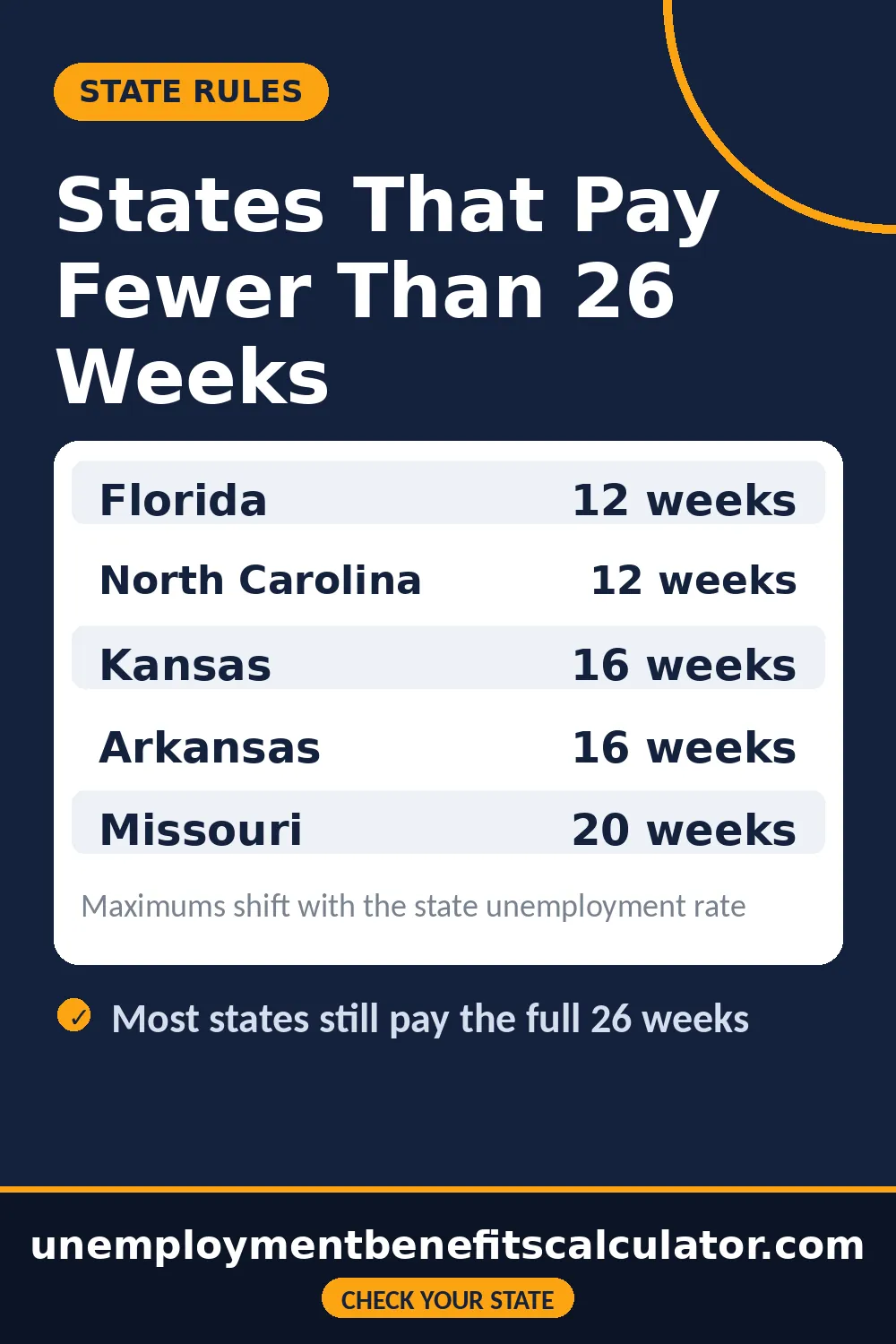
| Lowest state maximums | 12-20 weeks (FL, NC, KS, AR, MO) |
| Extended Benefits (EB) | Adds 13-20 weeks, only when triggered |
| EB status in mid-2026 | No states have EB triggered on |
One of the first questions people ask after losing a job is simple: how long will these benefits last? The answer is not as straightforward as you might think. While the national standard sits at 26 weeks, your actual benefit duration depends on a handful of factors — your past earnings, your state's specific formula, whether you work part-time, and whether any extension programs are active. Some claimants receive far fewer weeks than the maximum. Others qualify for additional weeks through federal or state extension programs during periods of high unemployment. This guide walks you through every layer of benefit duration so you know exactly where you stand and what to expect.
The Standard Benefit Duration in Most States
The majority of U.S. states offer up to 26 weeks of regular unemployment benefits during a single benefit year. This has been the historical standard since the unemployment insurance program was created, and it remains the baseline in 2026. However, "up to 26 weeks" does not mean everyone automatically receives 26 weeks. Your actual duration depends on your total benefit amount, which is calculated from your earnings during a specific period called the base period.
Each state uses a formula to determine your weekly benefit amount and your maximum total benefit. In most states, your maximum total benefit equals roughly half of your base period wages, capped at 26 times your weekly benefit amount. So if your weekly benefit is $400, your maximum total benefit would be $10,400, which at $400 per week lasts exactly 26 weeks. But if you earned less during your base period, your maximum total benefit might run out before you reach 26 weeks. This is why some claimants only receive 20 or 22 weeks of payments even in a 26-week state.
Understanding how your weekly benefit amount is calculated is essential because it directly determines how many weeks of payments you will receive. The higher your past earnings, the higher your weekly benefit, and the closer you get to the full 26 weeks.
States With Fewer Than 26 Weeks
Not every state offers 26 weeks. Several states have reduced their maximum benefit duration based on local economic conditions or legislative decisions. As of 2026, a handful of states cap benefits at fewer than 26 weeks. These reductions often happen when state unemployment trust funds run low, and legislatures respond by trimming the number of payable weeks rather than cutting weekly amounts.
For example, states like Florida and North Carolina have historically offered fewer weeks — sometimes as few as 12 weeks during periods of low unemployment. Kansas, Arkansas, and Missouri have also reduced their maximum weeks below 26 at various points. The exact number of weeks in these states can fluctuate based on the state's unemployment rate, meaning the maximum might increase during recessions and decrease during strong economic periods.
Wondering how much each week is worth? Our free weekly benefit calculator estimates your check from your state's formula in under a minute.
If you live in one of these states, it is especially important to plan your finances carefully. You may want to explore working part-time while collecting unemployment benefits to stretch your benefit period further. Part-time earnings can supplement your reduced weekly benefit without necessarily disqualifying you, as long as you report them accurately.
What Is the Benefit Year and Why It Matters
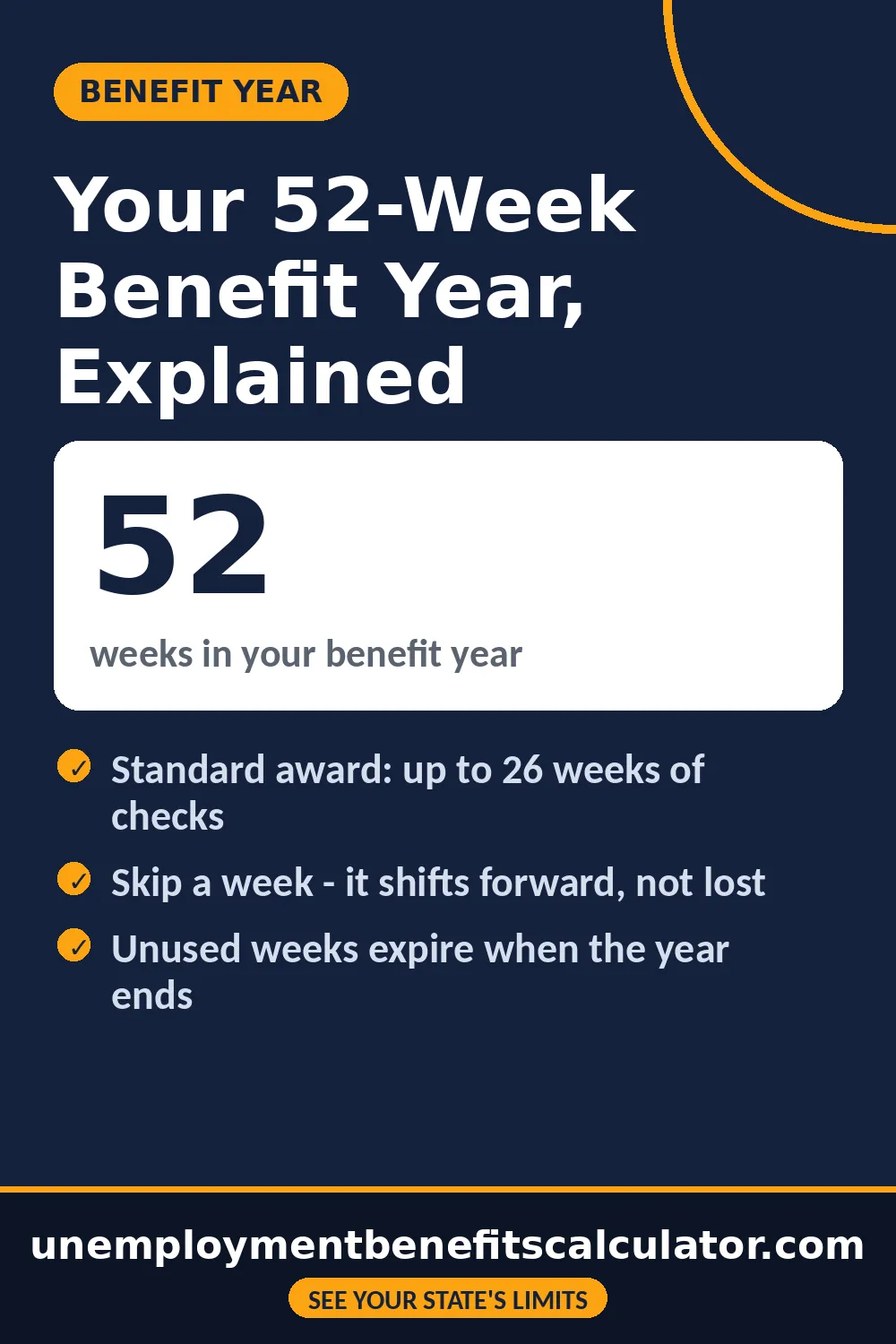
Your benefit year is the 52-week period that begins on the date you file your initial unemployment claim. During this benefit year, you can collect up to your maximum total benefit amount. Think of it as a window of opportunity — once that 52-week window closes, any unused benefits vanish, and you must file a brand-new claim to start over.
Here is where many people get confused. Your benefit year and your benefit duration are not the same thing. Your benefit duration is the number of weeks you actually receive payments, which might be 26 weeks or fewer. Your benefit year is the entire 12-month period during which you are eligible to collect those weeks. So if you receive 26 weeks of benefits, those weeks are spread out over the 52-week benefit year. If you skip a week because you earned too much from part-time work, that week simply shifts forward — you do not lose it, as long as you are still within your benefit year.
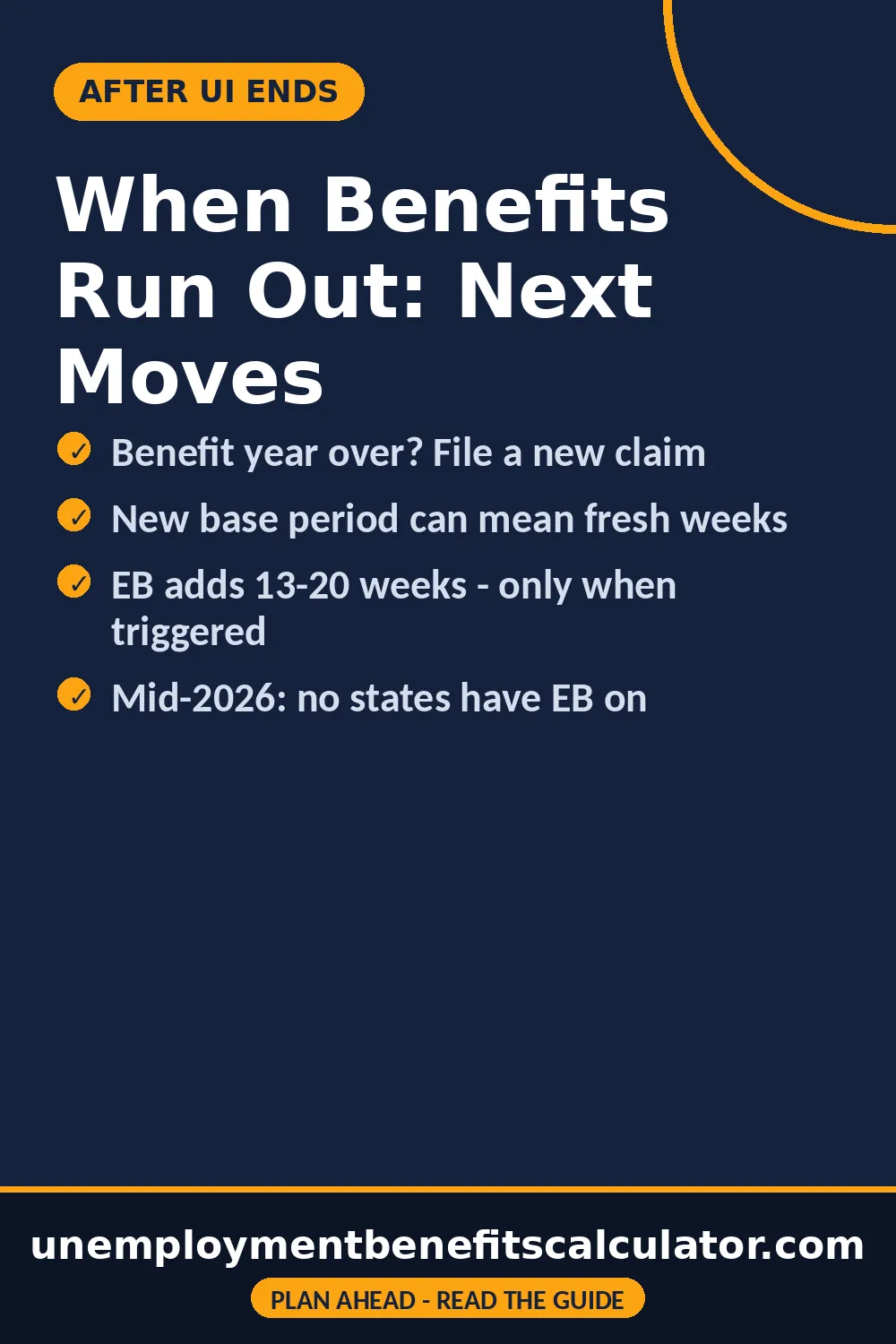
The problem arises when your benefit year expires before you have collected all your entitled weeks. This can happen if you had breaks in certification, worked part-time for extended periods, or had your claim temporarily stopped for other reasons. When your benefit year ends, you need to file a new claim. If you have sufficient wages in a new base period, you may qualify for a new benefit year with a fresh set of weeks. If not, you may be left without coverage until you earn enough to establish a new claim.
Extended Benefits (EB): When Regular Benefits Run Out
When regular unemployment benefits are exhausted, Extended Benefits may become available — but only under specific economic conditions. The Extended Benefits program is a federal-state partnership that provides additional weeks of unemployment compensation during periods of high unemployment within a state. It is not a permanent program that is always active. Instead, it triggers on when a state's insured unemployment rate meets certain thresholds set by federal law.
When triggered, EB typically provides up to 13 additional weeks of benefits beyond the regular state program. In states with exceptionally high unemployment, the extension can reach up to 20 weeks. The weekly benefit amount during EB is usually the same as your regular benefit. However, EB comes with stricter job search requirements, and you may need to document more work search activities per week than you did during regular benefits.
As of mid-2026, no states have Extended Benefits triggered on. This means that once you exhaust your regular state benefits, there is currently no federal extension available. This situation can change quickly if unemployment rises, so it is worth checking your state's labor department website regularly. During the pandemic, for instance, federal programs like PEUC provided up to 53 additional weeks, but those programs have long since expired.
How Part-Time Work Affects Your Benefit Duration
Working part-time while collecting unemployment does not shorten your benefit year, but it does change how quickly you use up your total benefit amount. When you report part-time earnings, most states apply an earnings disregard — a small amount you can earn without any reduction — and then reduce your weekly benefit by a percentage of your remaining earnings. The key point is that you are still certified for that week, which means the week counts against your total duration in some states but not in others.
In most states, if your part-time earnings reduce your weekly benefit to zero, you generally do not use up a week of benefits. This means you could theoretically extend your benefit period well beyond 26 weeks by working part-time and only receiving partial benefits for some weeks. However, the rules vary. Some states count any week in which you receive even one dollar of benefits as a full week used. Others prorate the usage. Understanding your state's specific rule on this can help you strategize about how to certify for benefits each week in a way that maximizes your total coverage period.
The important thing is never to underreport or hide your earnings. Doing so can lead to disqualification from unemployment benefits entirely, along with potential fraud penalties and repayment demands that far exceed whatever you might have gained. Always report your part-time income accurately and let the state calculate the appropriate reduction.
What Happens If Your Claim Is Denied Midway
Sometimes a claimant receives several weeks of benefits and then suddenly finds their payments stopped because the employer has filed an appeal or the state has discovered an eligibility issue. When this happens, it does not necessarily mean your benefit duration resets or that you lose your remaining weeks. If you win the appeal, you typically receive back pay for the weeks you missed, and your claim continues as before.
However, the appeal process itself takes time — often several weeks or even months. During that period, you are not receiving payments, which can create serious financial strain. Knowing how to appeal an unemployment denial effectively is crucial for protecting both your current and future benefits. The sooner you file your appeal and prepare your evidence, the sooner you can get your payments restored.
In some cases, a denial might be based on something that happened before you even filed — such as being fired for misconduct versus a no-fault termination. The distinction between these two categories makes a significant difference in whether you receive benefits at all, let alone for how long.
Waiting Weeks and Their Impact on Duration
Most states impose a one-week waiting period before your first payment is issued. During this waiting week, you must certify for benefits just like any other week, but you do not receive a payment. Some states have eliminated the waiting week, while others still enforce it. The waiting week does not count against your total benefit duration — it is essentially an unpaid week at the start of your claim.
Understanding this distinction matters for your financial planning. If your state has a waiting week, your first actual payment will arrive one week later than you might expect. This is separate from the processing time that determines how long it takes to get your first unemployment check, which can add another one to three weeks depending on your state and any verification requirements.
How to Maximize Your Benefit Period
Getting the most out of your unemployment benefits requires strategy and careful attention to the rules. Here are the key approaches that experienced claimants use to extend their benefit coverage as long as possible while staying fully compliant with state requirements.
First, always certify on time. This sounds obvious, but it is the single most common reason people lose weeks of benefits. Set a reminder for your certification day and complete it the same day every week or every two weeks, depending on your state's schedule. Second, report all earnings accurately. Even small amounts matter, and honest reporting protects you from overpayment demands later. Third, maintain thorough documentation of your job search activities. If your state audits your work search — and many do random audits — you need proof that you met the requirements for every single week.
Fourth, consider whether part-time work makes sense for your situation. In some states, earning partial income while receiving reduced benefits can actually extend the total number of weeks you receive payments, because a week in which you receive a partial benefit may not count as a full week used in all states. Fifth, if you are considering leaving your job and wondering if you qualify for benefits, understand that quitting without good cause will eliminate your eligibility entirely — and even with good cause, the burden of proof is on you.
State-by-State Maximum Benefit Duration for 2026
Benefit durations change as states adjust their unemployment insurance programs. Below is a general overview of where things stand in 2026. Because some states tie their maximum weeks to the unemployment rate, the actual number of weeks available in those states may be higher or lower than what is listed here depending on current economic conditions. Always verify with your state's labor department for the most up-to-date information.
What to Do as Benefits Approach Their End
When you are within a few weeks of exhausting your benefits, you need to shift into a different gear. The safety net is about to disappear, and your focus should move from maintaining your claim to securing your next source of income — whether that is a new job, part-time work, or other forms of assistance.
Start by visiting your local American Job Center. These federally funded centers offer free job search assistance, resume workshops, interview coaching, and sometimes training programs that can help you transition into a new field. Many also have connections to employers who are actively hiring. If you have been meeting your job search requirements for unemployment, you are probably already applying for positions regularly — but now is the time to expand your approach beyond your usual methods.
Consider whether additional education or training could improve your prospects. Some states offer training extensions that allow you to continue receiving benefits while enrolled in an approved training program. These extensions do not add weeks beyond your maximum, but they may allow you to receive benefits during weeks when you would otherwise be ineligible because you are in school rather than available for work. Check with your state's unemployment office to see if this option is available.
Finally, do not ignore other assistance programs. SNAP benefits, housing assistance, utility payment programs, and charitable organizations can provide critical support during the gap between when your unemployment ends and when you find your next job. There is no shame in using these programs — they exist precisely for situations like this.
Frequently Asked Questions
How many weeks of unemployment can I get?
Most states pay up to 26 weeks of regular benefits during a single benefit year. A handful of states pay fewer - Florida and North Carolina can be as low as 12 weeks, Kansas and Arkansas 16, and Missouri 20, depending on unemployment rates.
What is a benefit year?
Your benefit year is the 52-week period that starts the day you file your initial claim. Your weeks of benefits are used inside that window - they are not the same thing as the year itself.
What happens to weeks I do not use?
Any unused benefits expire when the benefit year ends. If you still have wages in a new base period, you can file a new claim for a fresh benefit year.
Does part-time work shorten my duration?
No - your benefit year does not get shorter. But every part-time dollar reduces that week's payment, so your total award lasts fewer calendar weeks. A week you skip shifts forward while you remain inside the benefit year.
What are Extended Benefits (EB)?
EB is a federal-state program that adds weeks when a state's unemployment is high - typically up to 13 extra weeks, up to 20 in states with exceptionally high unemployment. The weekly amount matches your regular benefit.
Is EB available right now?
As of mid-2026, no states have Extended Benefits triggered on. Once your regular weeks run out, there is currently no federal extension - but this can change quickly if unemployment rises.
Do I get a waiting week before benefits start?
Rules differ by state - some states hold your first week, others pay it. See our waiting week rules guide for the state-by-state detail before you file.
What should I do when my benefits run out?
If your benefit year has ended, file a new claim - with enough wages in a new base period you may qualify for a fresh set of weeks. If your year is still running, your remaining weeks have simply been used up.