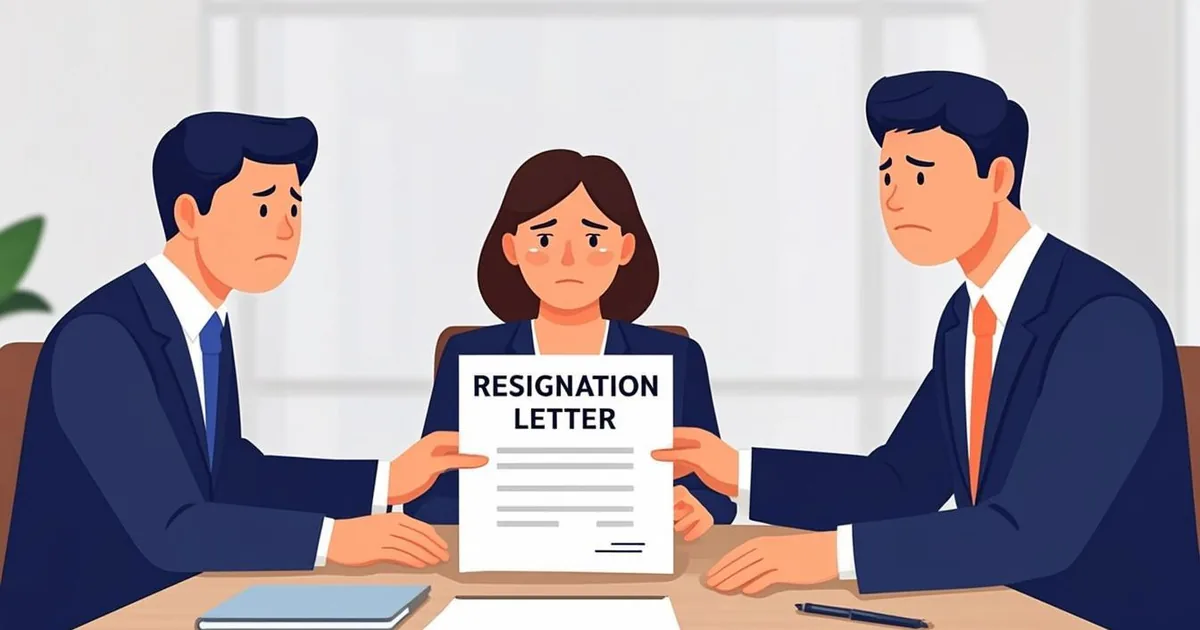
Can You Get Unemployment After Resigning Under Pressure?
Yes — resigning under pressure does not automatically disqualify you from unemployment benefits. If your employer pressured you to resign, and the pressure would make a reasonable person feel that leaving was the only real option, most states treat the separation as a quit with good cause or even as a discharge.
The keyword here is voluntary. Unemployment rules were written for people who walk away by choice, not for people who are marched out the door with a pre-written resignation letter and a warning that firing looks worse on a résumé.
I have read a lot of state agency guidance on voluntary quits while researching this site, and pressured resignations are one of the most misunderstood separations in the whole system. This guide explains when a pressured resignation still pays, what evidence wins, and how each state looks at it. For the broader rules, see what counts as good cause for quitting.
When a Pressured Resignation Still Counts as a Voluntary Quit
Every state asks one core question: who was the moving party in the separation? If you left because you genuinely wanted to leave, the quit is voluntary. If the employer created conditions or issued instructions that made leaving the only realistic path, the employer was the real mover.
State agencies weigh a few factors to decide this:
- Explicit instructions. A manager saying "I need your resignation letter by Friday or HR will process a termination" points strongly at the employer as the moving party.
- The realistic choice you faced. If refusing to resign meant immediate termination, refusing changed nothing about your unemployment except the label.
- Who drafted the paperwork. A resignation letter prepared by HR, handed to you for signature, is strong evidence the exit was engineered.
- The timing. Pressure applied days or hours before the resignation carries far more weight than a general feeling of dissatisfaction over months.
The U.S. Department of Labor's unemployment insurance program guidance leaves the good cause definition to each state, but the fact-finding pattern is consistent nationwide. An adjudicator interviews you, interviews the employer, and then decides whether the quit was truly voluntary.
In states like Texas, the claimant carries the burden of showing good cause connected with the work, while an employer alleging misconduct must prove it. The Texas Workforce Commission publishes this burden-of-proof split directly in its guide to work separations. That split matters: when you claim you were pushed out, the paperwork and testimony you bring carry the case.
Resignation in Lieu of Termination: The Most Common Confusion
"Resign in lieu of termination" means your employer offered you a choice: resign and keep a cleaner departure, or be fired. It sounds voluntary because you signed a resignation letter. Legally, it often is not.
Many state agencies treat this arrangement as a discharge rather than a voluntary quit, because the employer started the clock. California's EDD, for example, evaluates who caused the separation and whether you had good cause and made reasonable efforts to keep the job before deciding a quit case. When the employer's own records show a termination was already on the table, the "resignation" label loses its power.
Here is the trap, though. The employer reports the separation to the agency on its own paperwork. If that form says "voluntary resignation - personal reasons," and your claim says "forced out," you get a phone interview or fact-finding hearing. The label on the employer's form is not the final word, but it sets the fight you have to win.
If you are ever handed a resignation letter to sign in this situation, write on the letter itself, before signing, one line like: "Signing under direction of management on [date]; resigning under pressure to avoid termination." That single sentence transforms the document from their evidence into yours. The National Employment Law Project's good cause quit analysis shows how much these state-by-state definitions decide outcomes for pressured leavers.
What Counts as Pressure: Ultimatums and Impossible Choices
Pressure comes in different strengths, and agencies know it. Some situations are straightforward. Others require you to explain why staying was not realistic.
Situations agencies usually accept
- A direct resign-or-be-fired ultimatum with a deadline
- A demand to resign immediately, signed letter pre-drafted by the employer
- "Retire now or we terminate you for cause" framing, especially with a disciplinary write-up pending
- Resignation demanded as the price of withdrawing a misconduct accusation
- A demotion-and-pay-cut package presented as "the only alternative is resignation"
Situations that need more explanation
- A hostile manager making daily life miserable without a specific demand
- Schedule changes, reduced hours, or pressure to hit impossible targets
- Vague comments like "maybe this job is not for you anymore"
In the second group, the pressure is real but invisible on paper. Agencies handling these claims look for what you did before quitting: did you complain to HR, ask for a transfer, or object in writing? New York's standard is a useful example — a voluntary separation is disqualified only when it is without good cause, and good cause must be compelling, not merely preferential. If your situation fits the second list, read the complaints-and-paperwork section below twice, because your claim lives or dies there.
Reduced schedules deserve their own mention, because a cut in hours sometimes justifies a partial claim instead of a full quit. Our guide to unemployment when your hours are reduced covers that path.
How Each State Treats a Pressured Resignation
Good cause definitions vary more between states than almost any other unemployment rule. The table below shows how the biggest states handle a pressured resignation, plus the 2026 maximum weekly benefit so you know what is at stake. Nationally, maximum weekly benefits run from $235 in Mississippi to $1,033 in Massachusetts, and most states pay between $300 and $600 at the top of their formula.
| State | How a pressured resignation is judged | Max weekly benefit (2026) | Standard duration |
|---|---|---|---|
| California | Good cause required; claimant must show reasonable efforts to preserve the job; resign-in-lieu-of-termination often treated as a discharge | $450 | Up to 26 weeks |
| New York | Disqualified only if separation is without good cause; compelling, work-connected pressure can qualify | $504 | Up to 26 weeks |
| Texas | Claimant must show good cause connected with the work; employer-initiated ultimatums shift the case toward a discharge | $564 | Up to 26 weeks |
| Florida | Voluntary quits are disqualified unless the cause was attributable to the employer; 12-week benefit year makes proof urgent | $275 | Up to 12 weeks |
| Washington | Good cause plus reasonable steps to keep the job, unless trying would have been futile or unsafe | $999 | Up to 26 weeks |
| Pennsylvania | Quit must be for "necessitous and compelling" reasons; employer pressure aimed at forcing an exit qualifies | $573 | Up to 26 weeks |
| Massachusetts | Good cause with no reasonable alternative; pressure that removes real choice supports eligibility | $1,033 | Up to 30 weeks |
| Ohio | Just-cause standard; a quit forced by employer instructions or intolerable choices can meet it | $647 | Up to 26 weeks |
Maryland takes the same work-connected approach — good cause must arise from the conditions of the work, which its Department of Labor applies through a long line of appeal decisions. Washington spells out the preserve-your-job requirement in its voluntary quit rules: quitting for good cause pays only if you tried to keep working, unless trying would have been pointless.
Whatever the state, eligibility also depends on your earnings in the base period — the first four of the last five completed calendar quarters. Pressure does not waive the wage test, so a successful good-cause argument still needs enough earnings to fund a weekly benefit amount.
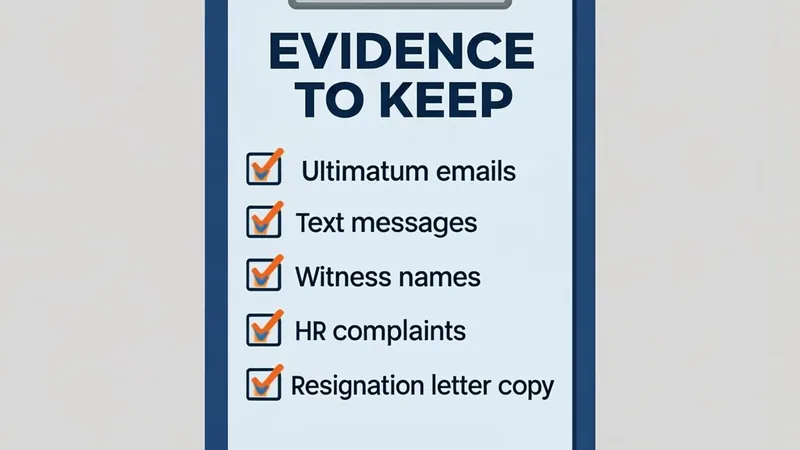
Proof Wins These Cases: Evidence to Gather Before You Walk Out
Good-cause claims are evidence contests. The person who resigned almost never has HR's file, so your documentation has to be built before the last day. If you see pressure coming, start collecting now.
- Written ultimatums. Save emails, chat messages, and texts that contain demands, deadlines, or threats. Screenshot chat tools before your account is closed.
- The resignation letter itself. Keep a copy of exactly what you signed, including any handwritten note about pressure. Photograph it if you have to.
- Witnesses. Note which coworkers heard the ultimatum. A coworker who hears "resign or be fired" can testify at a hearing even if nothing was written.
- Your complaint history. Every email to HR, every report to a manager, every written objection shows you tried to fix things before leaving. This matters enormously in states that require reasonable steps to preserve the job.
- Performance reviews. Positive reviews dated before the pressure campaign undercut any employer story that you were being fired for poor work anyway.
- The separation paperwork. Ask for copies of whatever the employer files with the state. You are entitled to a determination notice that states the reported reason.
One habit separates winning claims from losing ones: contemporaneous notes. Write a short, dated summary of each pressure event the day it happens — who said what, who else was present, what deadline was set. Determination offices and hearing officers treat a dated note written in the moment far more seriously than a story reconstructed three weeks later.
What If You Already Signed a Resignation Letter Under Pressure?
This is the fact pattern that panics people, and it is less fatal than it feels. Signing under pressure does not erase the pressure. Agencies decide whether the signature reflected a real choice, and duress is a recognized reason a "voluntary" signature does not count.
Three things strengthen a signed-under-protest case:
- Same-day retraction. If you regretted the resignation immediately, send a short email or letter that day retracting it and stating the pressure. Some employers accept it; even when they do not, the retraction timestamp is powerful evidence.
- Words on the document. If you wrote anything about pressure, direction from management, or avoiding termination on the letter, quote it in your claim.
- The employer's conduct around the signature. A letter drafted by HR, presented with a termination form already filled out, tells its own story.
If you have not signed yet and can avoid it, do not sign a "voluntary resignation" form silently. Sign it with the pressure annotation described above, or hand over a one-line letter of your own that states the real situation. A truthful one-line letter you wrote beats a polished two-page letter their lawyer wrote.

How to File So the Pressure Shows Up Early
The reason you give on the initial claim follows the whole case. Filing carefully is free; fixing a careless answer costs you weeks.
- File in the state where you worked, within days of the separation. Every week of delay risks wages falling out of your base period.
- Describe the quit precisely. Write "resigned under pressure — employer directed me to resign or face termination on [date]" rather than "personal reasons" or "mutual agreement."
- Answer the quit questionnaire honestly. Most states send one after you file. Attach or reference your evidence: the ultimatum email, the retraction, the complaint history.
- Prepare for the fact-finding call. Agencies usually phone you, then the employer. Have your documents in front of you and stick to dates and quotes.
- Keep certifying. File your weekly certifications while the investigation runs. Benefits stop only if you fail to certify, not because the case is pending.
Register for work search in parallel unless your state has waived it, because a separate work-search disqualification can stack on top of a quit dispute. Our walkthrough of documenting your work search activities shows what a clean log looks like.
If You Are Denied: Appeal Deadlines and the Hearing
Initial denials in pressured-resignation cases are common, because the employer's paperwork usually says "voluntary quit." A denial is a prompt to appeal, not a verdict. Every state gives you between 10 and 30 days from the date on the determination notice, and the appeal deadline is enforced almost without exception.
The appeal hearing is your real chance. Bring the documents, bring witnesses if the ultimatum was spoken, and expect the employer to repeat whatever the separation form says. In quit cases the burden sits on you to show good cause; in misconduct-framed cases the employer must prove the misconduct, which is why the exact framing of the separation decides who carries the file.
A realistic example shows the mechanics. Take Dana, a hospital scheduling coordinator whose new director decided the team needed "a clean slate." On a Tuesday afternoon, Dana was handed a typed resignation letter, told that a termination for "performance issues" was being drafted, and given until 5 p.m. to decide.
Dana added a handwritten line — "signing under direction of management; resigning under pressure to avoid termination" — then signed, photographed the letter, and emailed a retraction that evening after collecting statements from two coworkers who had heard the ultimatum. The claim itself described the ultimatum with dates.
The state agency scheduled a fact-finding call; the employer repeated "voluntary resignation." Dana's dated evidence — the letter annotation, the 5 p.m. deadline, two witnesses — outweighed the label, and the good-cause finding held.
Notice what actually won: not the emotional story, but the paper trail built inside seventy-two hours. Deadlines, documents, and witnesses beat adjectives every time. If your claim is already denied, the step-by-step in how to appeal an unemployment denial covers forms, deadlines, and hearing preparation.
Common Mistakes That Sink Pressured-Resignation Claims
Most lost claims I have studied fail on avoidable details rather than the underlying facts. Avoid these five:
- Writing "personal reasons" on the separation form because it felt easier in the moment. Those two words follow you into adjudication.
- Waiting weeks to file. Base period math plus appeal deadlines mean delay shrinks both your benefits and your options.
- Quitting with no paper trail. If no ultimatum email exists and no witness heard it, the agency sees a resignation with a story attached.
- Skipping the fact-finding call. The interview proceeds without you, and unexplained absences get read as agreement with the employer's version.
- Missing the appeal window. A winning case filed on day 31 is a closed case. Calendar the deadline the hour the determination arrives.
One more: do not let an employer talk you into accepting severance before you understand how it interacts with your claim. Our breakdown of how severance pay reduces unemployment benefits explains the allocation rules, and in pressured exits the severance conversation usually arrives in the same meeting as the ultimatum.
The Bottom Line on Resigning Under Pressure
A pressured resignation sits in the gap between quitting and being fired, and every state has a framework for deciding which side it lands on. The employer's label starts the story. Your evidence decides the ending.
Move in this order: document the pressure while it happens, annotate anything you sign, file quickly with a precise reason, certify every week, and appeal inside the window if the first decision goes the wrong way. Workers who follow that sequence collect benefits in the overwhelming majority of pressured-exit cases; workers who sign silently and file late hand the decision to their employer's paperwork.
If you are still weighing the decision itself, the state-by-state comparison in can you get unemployment if you quit and the separation breakdown in laid off versus fired versus quitting map how each exit route pays. And once the claim is in, the unemployment benefits calculator on our homepage estimates the weekly amount your state's formula would pay while the good-cause question gets sorted out.
Frequently Asked Questions
Can I get unemployment if I resigned under pressure?
Often yes. If your employer pressured you to resign and a reasonable person would have felt leaving was the only real option, most states treat the separation as a quit with good cause or as a discharge. You will need to describe the pressure precisely on your claim and support it with evidence such as emails, texts, witnesses, or the wording of your resignation letter.
Is resignation in lieu of termination considered a voluntary quit?
Not necessarily. When an employer offers resign-or-be-fired, many state agencies treat the separation as a discharge because the employer initiated it. The label on the paperwork matters less than who was the moving party, so explain the ultimatum on your claim and in any fact-finding interview.
What proof do I need to show I was forced to resign?
The strongest proof is written: ultimatum emails, chat messages, or texts with dates and deadlines. Written complaints you made to HR before leaving, witness names of coworkers who heard the demand, positive performance reviews, and a copy of the resignation letter all strengthen the case. Dated notes written the day each event happened carry serious weight.
What if I already signed a resignation letter under pressure?
A signature under pressure is not automatically fatal. Agencies examine whether the signature reflected a genuine choice. Sending a same-day retraction email, quoting any pressure annotation you wrote on the letter, and showing that the letter was drafted by HR all help prove the resignation was engineered rather than voluntary.
Will my employer contest my unemployment claim?
Many employers do, especially when the separation paperwork says voluntary resignation. Expect a fact-finding phone call with you and the employer. The employer's version usually repeats its paperwork, so your dated documents and witnesses decide the outcome. Attend the interview no matter what, because it proceeds without you if you skip it.
How long do I have to appeal if benefits are denied?
Between 10 and 30 days from the date on the determination notice, depending on the state, and the deadline is enforced strictly. Appeals of quit disputes routinely succeed at the hearing stage when claimants bring written ultimatums, retraction emails, and witnesses, so a first denial is worth fighting rather than accepting.