When regular unemployment benefits run out, many claimants assume that is the end of the road. But there is a built-in safety net that most people never hear about until they need it: Extended Benefits, or EB. This program automatically adds extra weeks of payments in states where unemployment has risen high enough to cross a specific threshold. The catch is that EB does not exist everywhere, it does not exist all the time, and the rules that turn it on and off can feel like they were written in a different language. Understanding how the EB trigger works is not just academic — it can mean the difference between keeping your lights on and falling into a financial gap.
This guide breaks down every piece of the EB trigger mechanism in plain language. You will learn how the federal government calculates the trigger, what the two different trigger types mean, which states are currently offering EB, how many extra weeks you can receive, and what happens if EB flips on or off while you are in the middle of a claim. If you are approaching the end of your regular benefits and want to know how long you can collect, our complete benefits duration guide covers the maximum weeks in every state.
What Is the EB Trigger Mechanism?
Extended Benefits have been part of the unemployment insurance system since 1970, when Congress passed the Extended Benefits Act as a response to recessions that left workers stranded with no income after their regular 26 weeks ran out. The key innovation of that law was the trigger mechanism — a set of economic thresholds that automatically turn EB on when unemployment gets bad enough and turn it off when conditions improve. This automatic activation was deliberate. Before 1970, every extension required a separate act of Congress, which meant delays, political fights, and workers waiting months for help. The trigger system removed the politics from the equation, at least in theory.
The trigger works by measuring a state's unemployment level against a defined benchmark. When the measurement crosses the threshold, EB becomes available to anyone in that state who has exhausted their regular benefits and still meets eligibility requirements. When the measurement falls back below the threshold, EB shuts off. This on-off nature is one of the most confusing and stressful aspects of the program for claimants, because your extra weeks can disappear even if you have not used them all yet. If you want to understand how extension programs fit into the bigger picture of unemployment benefits, our guide to extension programs and extra weeks provides a thorough overview.
How the 5/120% Trigger Works
The standard EB trigger is called the 5/120 percent test, and it relies on a measurement called the insured unemployment rate, or IUR. The IUR is the percentage of workers covered by unemployment insurance who are currently collecting benefits. It is different from the total unemployment rate you see in the news — the IUR only counts people who qualify for and are receiving unemployment benefits, not everyone who is jobless. The formula compares the current IUR against historical data from the same period in the two previous years.
For EB to trigger under the standard test, two conditions must be met simultaneously. First, the state's current IUR must be at least 5 percent. Second, the current IUR must be at least 120 percent of the IUR from the same week in each of the two preceding years. That is where the "5/120" name comes from — 5 percent minimum, and 120 percent of the prior two years. This dual requirement means EB does not trigger just because unemployment is moderately high. It has to be both high in absolute terms and significantly worse than the recent past. During a steady recession where unemployment stays elevated for years, the comparison to prior years can actually make it harder for EB to trigger, which is a well-known flaw in the design.
Here is a concrete example. Say a state's IUR this January is 6 percent. In January of the prior year, the IUR was 4.5 percent, and two years ago it was 4 percent. The current rate of 6 percent exceeds the 5 percent floor. But 120 percent of the prior year's rate is 5.4 percent (4.5 times 1.2), and 120 percent of two years ago is 4.8 percent (4 times 1.2). Since 6 percent exceeds both, EB triggers. If the prior year had been 5.5 percent instead, then 120 percent of that would be 6.6 percent, and the current rate of 6 percent would fail the comparison — even though it exceeds the 5 percent floor.
The Optional Total Unemployment Rate Trigger (6.5%)
Because the 5/120 percent test has a known weakness — it struggles to trigger during prolonged recessions where unemployment stays high for years — Congress created an alternative trigger that states can adopt voluntarily. This is called the total unemployment rate trigger, or TUR trigger, and it uses the standard unemployment rate that the Bureau of Labor Statistics publishes each month. Under this optional trigger, EB becomes available when a state's seasonally adjusted total unemployment rate for the most recent three-month period averages 6.5 percent or higher.
The TUR trigger is simpler and more responsive than the IUR trigger. It does not require a comparison to prior years, which means it can activate even during a long, grinding recession where the 5/120 test might fail to trigger because the baseline has been high for too long. As of 2026, roughly two dozen states have adopted the optional TUR trigger, making EB more accessible in those states during sustained downturns. The list of states using the TUR trigger can change because states must pass legislation to adopt it, and some states have toggled back and forth over the years. Your state workforce agency can confirm which trigger method applies where you live.
Some states use both triggers simultaneously, meaning EB can be activated by either one. In practice, the TUR trigger tends to fire first during the early stages of a recession because it responds faster to rising unemployment. The IUR trigger often lags because the insured unemployment rate only captures people who are actually receiving benefits, and there is always a delay between job loss and the start of benefit payments. If you want to see how benefit amounts differ across states that may or may not have EB, our maximum benefits by state guide provides a full comparison.
States Currently Triggering EB (As of 2026)
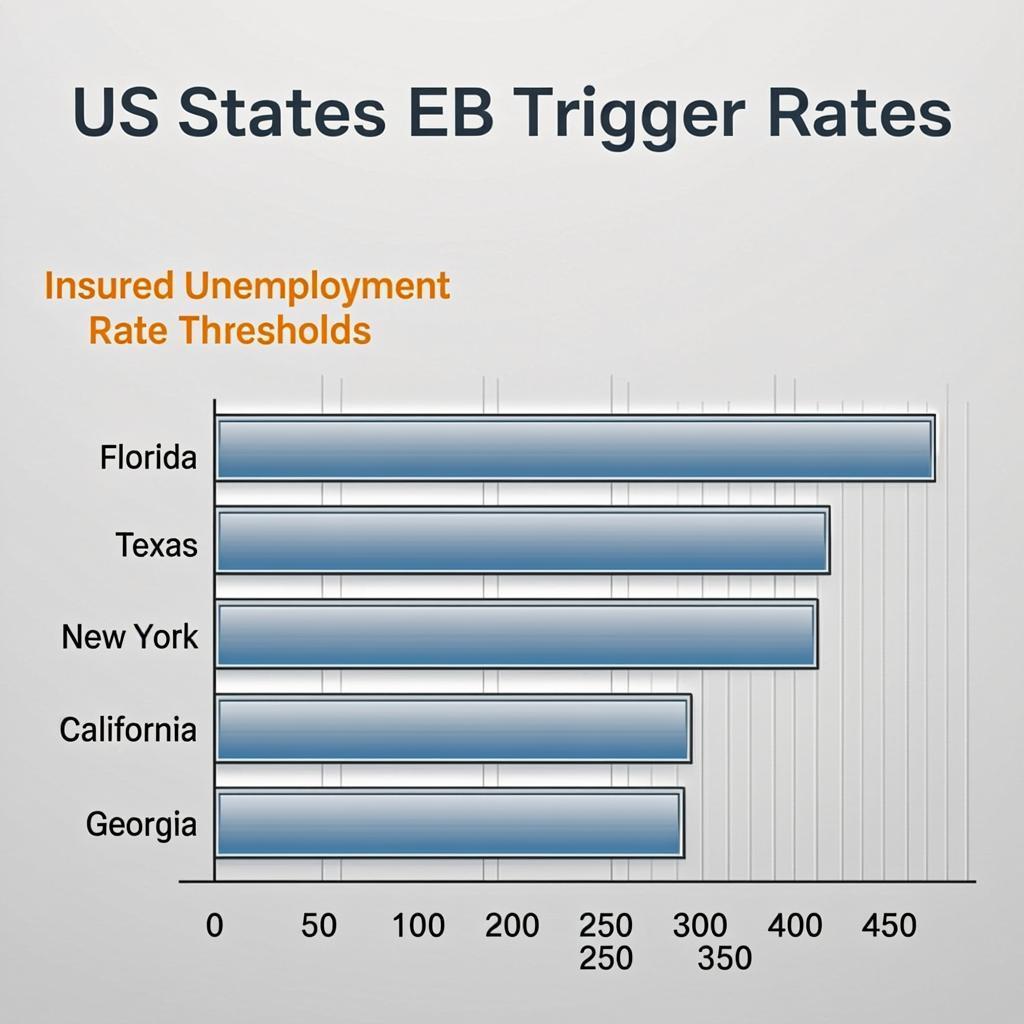
EB availability is a moving target. The Department of Labor publishes a weekly trigger notice that lists which states are currently offering EB, and this list can change from one week to the next. During strong economic periods, the list may be empty — no state triggers EB, and no additional weeks are available anywhere. During recessions, dozens of states can trigger simultaneously. As of mid-2026, the economic recovery from the pandemic-era disruptions has left most states with unemployment rates below the trigger thresholds, so EB is currently available in only a handful of states with elevated unemployment.
The states most likely to trigger EB in any given period are those with economies dependent on industries that experience sharp cyclical swings — manufacturing, energy extraction, and tourism-dependent regions. Alaska, for example, frequently triggers EB because of its seasonal employment patterns. States in the Rust Belt may trigger during manufacturing downturns. The key point is that you cannot assume EB will be available just because you are struggling to find work. EB is driven by state-level economic data, not your personal circumstances. You can check the current EB status for your state on the Department of Labor's Employment and Training Administration website, which updates the trigger notice every week. If EB is not available and your benefits are ending, our guide on what happens when benefits run out covers your other options.
How EB Weeks Are Calculated
The number of EB weeks you can receive depends on which trigger activated EB in your state and how severe the unemployment situation is. Under the standard 5/120 percent IUR trigger, EB provides up to 13 weeks of additional benefits, which is half the maximum regular benefit duration of 26 weeks. Under the optional TUR trigger at 6.5 percent, the same 13-week maximum applies. But there is a higher tier available when unemployment is truly severe.
When a state's IUR reaches 8 percent or higher under the standard trigger, or when the TUR averages 8 percent or more under the optional trigger, EB can provide up to 20 weeks of additional benefits instead of 13. This higher tier is rare — it requires genuinely extreme unemployment conditions — but it has been triggered in multiple states during severe recessions. The 20-week tier effectively gives claimants nearly a full year of combined regular and extended benefits, since 26 regular weeks plus 20 EB weeks equals 46 weeks of total coverage.
It is important to understand that EB weeks are not added on top of any unused regular weeks. You must first exhaust all of your regular state benefits before EB kicks in. If your state provides 26 weeks of regular benefits and you only used 20 before finding a job, you would not be eligible for EB — you still have 6 regular weeks remaining. EB only begins after the last regular week has been paid. If you are wondering how your weekly payment is determined during EB, the answer is simple: it stays the same. Your weekly benefit amount calculation does not change during EB — you receive the same dollar amount per week that you received during regular benefits.
What Happens When EB Triggers On or Off Mid-Claim
One of the most anxiety-inducing aspects of EB is that it can turn off while you are still receiving it. If your state's unemployment rate drops below the trigger threshold, EB ends — even if you have only used 5 of your 13 EB weeks. This is not a glitch or an administrative error. It is how the program was designed. EB is contingent on economic conditions, not on how many weeks you have left. When the trigger threshold is no longer met, the program shuts off for everyone in the state, and no new EB weeks are paid.
The good news is that there is usually a buffer period. The Department of Labor does not check the trigger every single day. Trigger determinations are typically made on a 13-week rolling average, which smooths out short-term fluctuations. This means a single month of improving unemployment data will not immediately kill EB. But if the trend holds for a full quarter, EB will be deactivated. When this happens, your state unemployment office will send you a notice informing you that EB has ended and your last payment date. You will not be required to repay any EB weeks you already received — those are yours to keep.
The reverse situation can also happen: EB can trigger on while you are still receiving regular benefits. When this occurs, the extra weeks are simply added to the end of your claim. You will not receive EB payments immediately — you will continue receiving regular benefits until those run out, and then EB kicks in automatically. Most states handle this transition seamlessly, but some states send a formal notice explaining that you are now eligible for additional weeks. If you are confused about the transition, our extension programs overview explains how the handoff between regular benefits and EB works.
Eligibility Differences During EB vs. Regular Benefits
Receiving EB is not just more of the same as regular benefits. The eligibility requirements tighten during extension periods, and failing to meet the stricter standards can cost you your remaining weeks. The biggest change involves work search requirements. During regular benefits, most states require you to make at least two job contacts per week and keep a record of your search activities. During EB, many states increase this to three or more contacts per week. Some states also require you to register with the state job bank, attend reemployment workshops, or participate in skills assessments.
The definition of "suitable work" also narrows during EB. During regular benefits, you can refuse a job that pays significantly less than your previous position and still maintain eligibility. During EB, you may be required to accept any work that pays at least the minimum wage or the prevailing wage for that occupation in your area, whichever is lower. This means you could be expected to take a job that pays far less than what you were earning before. Refusing such an offer during EB can result in a denial of benefits for that week or longer.
You must also continue certifying on time every week during EB, just as you did during regular benefits. Missing a certification week can create a gap that is difficult or impossible to fix. The certification questions may be the same, but the stakes are higher because the work search requirements are stricter. If you are not sure how to handle your weekly certification, our certification guide walks through the process step by step. And if you are juggling part-time work with your EB claim, remember that the same earnings test applies — our part-time work reduction guide explains how earnings affect your payment.

How to Check If Your State Currently Offers EB
The most reliable way to check EB status is the Department of Labor's Employment and Training Administration trigger notice, which is published weekly. This document lists every state along with its current trigger status — whether EB is on, off, or in a transitional period. The trigger notice is available on the DOL website and is typically updated every Sunday. You can also call your state unemployment agency directly and ask whether EB is currently available. Most state websites have a benefits calculator or FAQ section that includes current EB information.
Be careful about relying on third-party websites, social media posts, or even news articles for EB status information. These sources are frequently outdated or incorrect. EB status can change from one week to the next, and a blog post from two months ago may no longer reflect reality. The only sources you should trust are the DOL trigger notice, your state workforce agency, and official government websites. If someone in an online forum says EB is available in your state, verify it before making financial plans based on that information.
If you discover that EB is not currently triggered in your state, do not give up entirely. Economic conditions can change, and a sudden uptick in layoffs could push your state over the threshold. Keep checking the trigger notice weekly, continue your job search, and maintain your certification records so that you are prepared if EB does activate. If you have already exhausted your regular benefits and EB is not available, you should also explore other forms of assistance, including SNAP benefits, housing assistance, and emergency rental programs. When benefits run out and no extensions exist, knowing your alternatives becomes critical.
Historical EB Trigger Data
Looking at the historical record helps you understand how EB behaves over time and what to expect in future downturns. During the Great Recession of 2008-2009, EB triggered in nearly every state as unemployment soared. At the peak in 2010, the national unemployment rate hit 9.8 percent, and the insured unemployment rate was well above the 5 percent threshold in the vast majority of states. Many states triggered both the 13-week and the 20-week EB tiers. Combined with the federal Emergency Unemployment Compensation program, some claimants received up to 99 weeks of total benefits during this period.
As the economy recovered between 2012 and 2015, EB gradually turned off state by state. The last state to deactivate EB after the Great Recession was Nevada, which did not fall below the trigger threshold until late 2014. After that, EB was essentially dormant nationwide for several years. Then the COVID-19 pandemic hit in 2020, and EB triggered again in most states within weeks. The pandemic triggered EB faster than the Great Recession because the TUR trigger — which many states had adopted in the intervening years — responded more quickly than the IUR trigger. EB deactivated again in 2021 and 2022 as the labor market recovered at an unusually rapid pace.
The historical pattern reveals an important lesson: EB is most useful during the early and peak stages of a recession, but it tends to turn off before the labor market has fully recovered. This creates a coverage gap where the economy is still struggling but no longer bad enough to trigger extensions. If you want to understand how job search obligations change as the economy shifts, our job search requirements guide details what is expected of you in different economic conditions.
Common Questions About the EB Trigger
One question that comes up frequently is whether you need to apply separately for EB. In most states, the answer is no. The transition from regular benefits to EB is handled automatically by the state unemployment system. When you exhaust your regular benefits and EB is triggered, your claim is extended without any action on your part. However, if your benefit year has expired — the 12-month period from your initial filing — you may need to file a new claim. If you are eligible for a new regular claim based on recent wages, that new claim takes priority over EB on your old claim. If you are not eligible for a new regular claim, EB on your prior claim may still be available.
Another common question is whether EB payments are taxed the same as regular benefits. Yes, they are. Unemployment benefits of any kind — regular, EB, or federal extensions — are considered taxable income by the IRS. You can choose to have federal income tax withheld from your EB payments using Form W-4V, just as you did with your regular benefits. If you did not elect withholding during regular benefits, you can start withholding when EB begins by submitting the form to your state unemployment office. Failing to account for taxes on EB can create an unpleasant surprise at tax time, especially if you were not expecting to receive the extra weeks.
A third question involves part-time work during EB. Can you work part-time and still receive EB? Yes, the same earnings disregard rules apply during EB as during regular benefits. If you earn less than your weekly benefit amount plus any earnings disregard your state allows, you will receive a partial payment. If your earnings exceed the threshold, you receive nothing for that week but your EB claim stays open. However, because the work search requirements are stricter during EB, you need to make sure your part-time work does not interfere with your ability to meet the higher job contact requirements. If you are considering part-time work, understanding how it affects your benefits is essential before you start.
Finally, many claimants ask whether they can be disqualified from EB even if they qualified for regular benefits. The answer is yes. Because the eligibility standards are stricter during EB, you can lose your extension benefits for reasons that would not have affected your regular claim. For example, if you refuse a job offer during EB that you could have legally refused during regular benefits because the wage was too low, that refusal can disqualify you. If you want to understand all the ways a claimant can lose eligibility, our disqualification guide covers every scenario in detail.
Disclaimer:This article provides general information about the Extended Benefits trigger mechanism and state EB availability. EB trigger thresholds, eligibility requirements, and available weeks vary by state and are subject to change based on economic conditions and federal or state legislation. Always verify current EB status with your state's unemployment agency or the U.S. Department of Labor. If you need personalized advice, consult a qualified legal or financial professional.