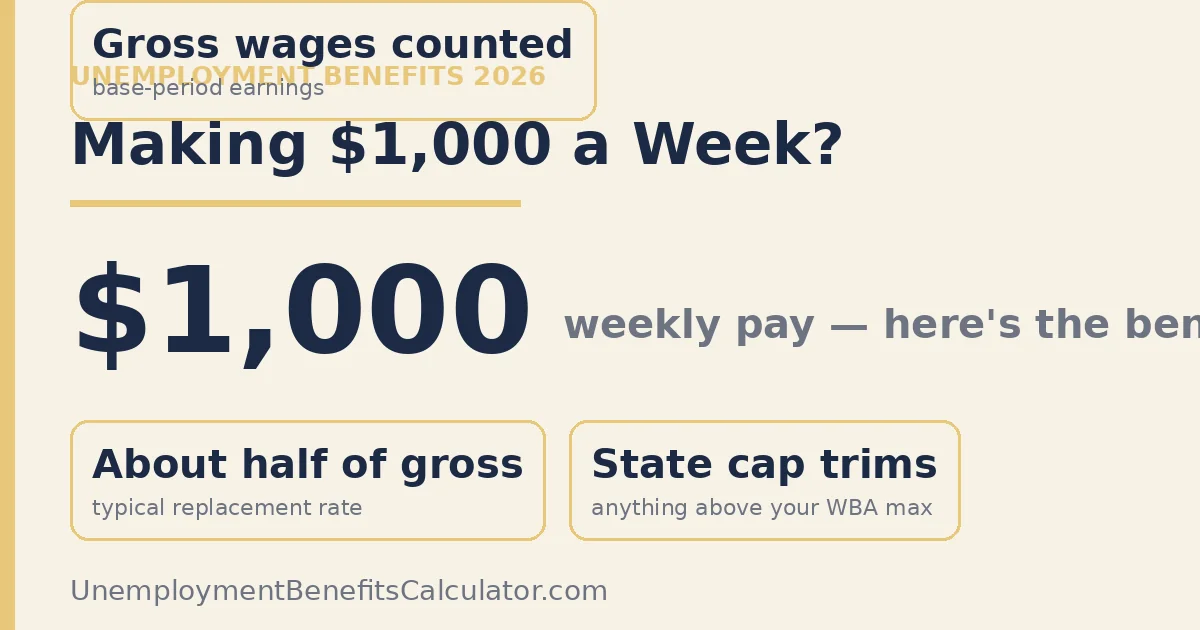
Short answer: if you make $1,000 a week, most states will pay you roughly $400 to $500 per week in unemployment benefits — but only up to your state's maximum cap, and only if your recent work history supports it. Some states cap weekly benefits below $400, which means a high earner in Florida and a high earner in Minnesota can make the same salary and receive very different checks. The honest way to think about it: unemployment replaces about half of your recent wages, then the state's cap trims whatever sticks out above the ceiling.
This guide shows the exact math agencies use, a salary ladder from $400 to $3,000 a week, two worked examples with real numbers, and the reasons your actual payment will differ from any estimate. If you want the number for your own situation, the unemployment calculator for your state applies your state's formula and cap in one step.
The $1,000-a-Week Estimate at a Glance
If your gross pay is $1,000/week ($52,000/year), your estimated benefit:
≈ $500/week typical · range $275–$780 by state
Half of gross wages is the common formula. Your state's weekly maximum caps the final number — several states cap below $500.
How Agencies Turn Your Salary Into a Weekly Benefit
Unemployment does not look at your current salary. It looks backward at a window called the base period — usually the first four of the last five completed calendar quarters before you filed. The agency pulls your employer-reported wages from those quarters and runs one of two common formulas.
The most widespread approach takes your highest quarter of earnings, divides by 26 to get a weekly figure, or divides your total base-period wages by a fixed divisor such as 52 or 78. A second group of states divides your highest quarter by a state-specific number — Arizona's divide-by-25 rule is the best known. Either way, the destination is similar: your weekly benefit lands near half of what you were grossing, before the cap.
If your hours were cut recently, remember the base period may not even include your latest months. That cuts both ways — a recent raise may not lift your benefit, but a recent slowdown may not lower it either. Our weekly benefit amount breakdown walks the formula state by state.
Salary Ladder: What Weekly Pay Turns Into
The table below applies the common half-of-gross estimate to weekly salaries, then flags where caps typically bite. Treat the middle column as the starting point and the right column as the reality check, because caps do most of the trimming above roughly $800 a week in wages.
Where the cap lands is a state-by-state decision — the Ohio unemployment calculator tops out at $842 a week, while a handful of high-cap states clear $850.
| Gross weekly pay | Typical estimate (≈50%) | What you'll likely actually receive |
|---|---|---|
| $400 | $200 | $200 or slightly less — very few caps interfere |
| $500 | $250 | $250 in most states; a few low-cap states trim slightly |
| $600 | $300 | $300 in many states; some low-cap states pay the cap instead |
| $800 | $400 | $400 in about half of states; low-cap states pay their maximum |
| $1,000 | $500 | $400–$500 where caps allow; below-cap states pay their max |
| $1,500 | $750 | $500–$750; caps now bind in a majority of states |
| $2,000 | $1,000 | $500–$800; high-cap states only |
| $2,500 | $1,250 | $700–$900; only the highest-cap states approach this |
| $3,000 | $1,500 | $800–$1,000; no state pays beyond its maximum |
Estimates as of October 2026 use the common half-of-gross pattern. Every state's formula and maximum differs — the maximum benefits by state table shows each ceiling, and your state's calculator applies it exactly.
Worked Examples: Real Math, Two Earners
Example 1 — steady salary. Maya earned $1,000 a week, every week, for the last 18 months. Her highest base-period quarter holds $13,000. Dividing by 26 gives $500. Her state's cap sits at $587, so nothing is trimmed: her weekly benefit check is $500 before taxes. With no dependents and no deductions, that is her number, full stop.
Example 2 — uneven year. Dev also averaged $1,000 a week, but he was laid off from a seasonal job, worked two slow months at $400, then jumped to $1,200 for a quarter before the layoff. His highest quarter is $15,600 — the $1,200 stretch. Dividing by 26 gives $600, not $500, because the agency uses the strongest quarter rather than the average. Dev's irregular year actually helped him. The opposite happens too: if your high earnings sit just outside the base period window, they count for nothing.
Why Your Number Will Differ From Any Estimate
The cap. Roughly half the states cap weekly benefits between $400 and $600, and a $1,000-a-week salary floats above that ceiling in many of them. The estimate says $500; the cap says $430; the cap wins. This single line explains most surprises.
Dependents. More than a dozen states add a weekly allowance for children — typically $10 to $75 per dependent, with limits. A $1,000-a-week parent of three in one of those states can out-earn the estimate even after the cap.
The base-period window. Benefits ride on employer-reported wages in a specific window, not your current offer letter. A recent promotion, a recent raise, or a stretch of unpaid leave changes the math in ways flat estimates cannot see.
Partial earnings. If you pick up gig or part-time work while claiming, most states let you keep a slice — often the greater of $25–$150 or 25–50% of those earnings — before deducting dollar-for-dollar. Reporting honestly every week is what keeps that arrangement safe; our part-time work guide covers the rules.
Gross, Not Net: What "$1,000 a Week" Actually Means Here
Every number in this guide uses gross wages — the amount before taxes and deductions — because that is what employers report to the state each quarter. If your $1,000 is a take-home figure, your gross is likely $1,250 to $1,400 depending on your tax setup, which pushes the rough estimate to $600 or more before any cap. Mixing the two is one of the most common self-estimate errors, and it always points the same wrong direction: down.
The same gross rule applies on the benefit side. A $500 weekly benefit is a gross amount; taxes only leave it if you file the federal withholding form, and state tax treatment varies widely. Compare gross-to-gross when you sanity-check any estimate you see, including ours.
The Base Period, Mapped Onto a Real Calendar
Abstract quarters confuse people, so here is the timeline for a claim filed in October 2026. The last five completed quarters run from July 2025 through September 2026. The base period is the first four of those — July 2025 through June 2026 — and the most recent quarter, July through September 2026, sits out entirely.
That structure produces a quirk worth knowing: wages you earned this summer may not count toward an October claim, but they will count toward a claim filed in January, when a new alternate period rolls in. Some states offer an alternate base period — the last four completed quarters instead of the first four — for claimants whose standard window undersells them. If your salary jumped recently, ask the agency whether your state offers one before accepting a lower number.
If Your $1,000 Paycheck Came From More Than One State
Remote work and relocations make this common: you worked in Texas for part of the base period and in New York for the rest, both at roughly $1,000 a week. You generally file in only one state — usually the one where you worked most recently or the highest-earning one — and that state pulls the other states' wage records through a combined wage claim. Done right, all covered wages feed one benefit calculation, so your quarter stays strong.
The trap is filing in the wrong state first and getting a weak determination. The multi-state unemployment guide walks through which state to pick when the work spans two or more.
When New York ends up the higher-wage state, its single-quarter formula pays differently from the multi-quarter averages — run the claim through the New York unemployment calculator before you choose where to file.
Five Mistakes That Shrink a $1,000-a-Week Claim
1. Filing late. Your benefit start date locks to your filing date, not your last day worked. A $500 weekly benefit filed three weeks late is $1,500 already gone, permanently.
2. Skipping the dependents question. The allowance only applies if you answer the dependent section completely. More than a dozen states pay $10 to $75 extra per child, and the agency will not chase you for it.
3. Letting a payroll error slide. If an employer reported wages late or under the wrong EIN, those quarters can look empty. Request your wage transcript from the agency the moment your determination looks too low.
4. Confusing this year's salary with base-period wages. A raise to $1,100 this month does nothing for a claim built on last year's quarters. Check which quarters actually drive your claim before assuming the raise helps.
5. Under-reporting part-time earnings. The earnings-disregard rules are generous in most states, but the penalty for misreporting is not — an overpayment notice plus fraud review. Report honestly and keep the disregard.
How to Get Your Exact Number in Two Minutes
Estimates get you in the neighborhood; your state's formula gets you to the dollar. The state unemployment calculator applies your state's divisor, dependents allowance, and current cap to your real wage history, then shows the weekly amount and duration side by side. It takes roughly two minutes and mirrors what the agency will compute from the same wage records.
Have these ready: gross earnings by quarter for the last 18 months, your state of residence and work location (they can differ), and the number of dependents you will claim. That is the entire list — no Social Security number, no employer login, nothing stored.
Once you file, the agency confirms the same math against employer wage records and mails a determination letter with your weekly benefit, your duration, and the reason behind each number. If the determination comes back lower than the calculator predicted, that letter tells you which quarter it used — and that is your cue to check for wage-record errors or to ask about the alternate base period.
Frequently Asked Questions
Is unemployment really half your salary?
Close — half of gross wages is the common pattern because most states divide your highest quarter by 26. The result then runs through your state's maximum cap and, in some states, gets a dependents allowance added. Net-net, expect roughly 40–50% of your recent gross pay, capped.
How does unemployment calculate my benefit from my paycheck?
It uses employer-reported quarterly wages from your base period, not your paycheck directly. The agency takes your highest quarter (or total base wages), applies a state divisor such as 26 or 25, and caps the result. Your actual check reflects those wage records, so a payroll error on the employer side can distort your claim.
I made $1,000 a week but only part of the year. Does that still count?
Only the quarters inside your base period count, and only your highest quarter drives most formulas. If the $1,000 stretch fills your highest quarter, your benefit rises accordingly; if it falls outside the window entirely, the agency never sees it. Alternate base periods exist in many states for exactly this situation.
Do overtime and bonuses count toward the calculation?
Yes — any wages your employer reported to the state UI program count, including overtime and bonuses, because they appear in the quarterly wage records. Under-the-table or 1099 income generally does not appear and therefore adds nothing unless you paid into the program through a covered arrangement.
Why is my state's payment lower than the $500 estimate?
Almost always the cap. States set a maximum weekly benefit — several between $275 and $430 — and a $1,000 salary outruns that ceiling. Deductions for earnings from part-time work, or a base period weaker than you assumed, trim the rest.
What is the most unemployment can pay per week?
Depends entirely on the state: from roughly $275 in the lowest-cap states to over $1,000 in the highest-cap ones for standard claims. Dependents allowances can push a few states higher. The state-by-state maximum table lists every 2026 ceiling in one place.
If I made $1,000 a week, how many weeks can I collect?
Duration follows a separate rule from the amount — typically 12 to 26 weeks based on total base-period earnings, not your weekly salary. High earners usually qualify for the full duration in states that scale weeks with wages, but check your state's schedule to be sure.
Is the $1,000-a-week estimate before or after taxes?
The $500-style estimate is a gross benefit. Federal income tax is withheld only if you request it on Form W-4V, but state tax rules vary, and some states tax benefits while others do not. Plan around roughly 80–90% of the gross arriving in most no-withholding scenarios.
The Bottom Line
A $1,000 weekly salary translates to a realistic unemployment check of about $400 to $500 a week in much of the country — half of gross, trimmed by your state's cap, nudged up by dependents where allowed. The formula is public, the wage records already exist, and the only unknown in your case is your state's exact divisor and ceiling. Run your numbers through the calculator for your state, then file promptly: your benefit start date locks to your filing date, not to when your salary stopped.
Frequently Asked Questions
Is unemployment really half your salary?
Close — half of gross wages is the common pattern because most states divide your highest quarter by 26. The result then runs through your state's maximum cap and, in some states, gets a dependents allowance added. Net-net, expect roughly 40–50% of your recent gross pay, capped.
How does unemployment calculate my benefit from my paycheck?
It uses employer-reported quarterly wages from your base period, not your paycheck directly. The agency takes your highest quarter (or total base wages), applies a state divisor such as 26 or 25, and caps the result. Your actual check reflects those wage records, so a payroll error on the employer side can distort your claim.
I made $1,000 a week but only part of the year. Does that still count?
Only the quarters inside your base period count, and only your highest quarter drives most formulas. If the $1,000 stretch fills your highest quarter, your benefit rises accordingly; if it falls outside the window entirely, the agency never sees it. Alternate base periods exist in many states for exactly this situation.
Do overtime and bonuses count toward the calculation?
Yes — any wages your employer reported to the state UI program count, including overtime and bonuses, because they appear in the quarterly wage records. Under-the-table or 1099 income generally does not appear and therefore adds nothing unless you paid into the program through a covered arrangement.
Why is my state's payment lower than the $500 estimate?
Almost always the cap. States set a maximum weekly benefit — several between $275 and $430 — and a $1,000 salary outruns that ceiling. Deductions for earnings from part-time work, or a base period weaker than you assumed, trim the rest.
What is the most unemployment can pay per week?
Depends entirely on the state: from roughly $275 in the lowest-cap states to over $1,000 in the highest-cap ones for standard claims. Dependents allowances can push a few states higher. The state-by-state maximum table lists every 2026 ceiling in one place.
If I made $1,000 a week, how many weeks can I collect?
Duration follows a separate rule from the amount — typically 12 to 26 weeks based on total base-period earnings, not your weekly salary. High earners usually qualify for the full duration in states that scale weeks with wages, but check your state's schedule to be sure.
Is the $1,000-a-week estimate before or after taxes?
The $500-style estimate is a gross benefit. Federal income tax is withheld only if you request it on Form W-4V, but state tax rules vary, and some states tax benefits while others do not. Plan around roughly 80–90% of the gross arriving in most no-withholding scenarios.