
College students and student workers occupy a unique space in the American workforce. Millions of young adults work part-time jobs, participate in federal work-study programs, or hold campus positions while pursuing their degrees. When these jobs end — whether at the conclusion of a semester, due to a campus closure, or because of an unexpected termination — many students wonder if they can turn to unemployment benefits for financial support.
The short answer is that student workers can qualify for unemployment benefits, but the eligibility requirements create significant hurdles that many students cannot clear. Understanding these requirements, how they apply to different types of student employment, and what alternatives exist is essential for any college student who depends on their job income.
Can Student Workers Qualify for Unemployment?
There is no automatic disqualification for student workers in the unemployment system. If you meet the standard eligibility requirements — sufficient earnings history, unemployed through no fault of your own, and available for work — you can receive benefits regardless of your student status. However, the specific circumstances of student employment often make it difficult to satisfy all three requirements simultaneously.
The most common obstacle is the earnings requirement. Unemployment benefits are based on your base period earnings — typically the first four of the last five completed calendar quarters. Many student workers earn too little during their base period to qualify, especially if they only work during the academic year and have minimal or no summer employment.
Work-Study Jobs and Unemployment
Federal Work-Study (FWS) positions present a particularly complex situation for unemployment claims. These jobs are subsidized by the federal government as part of financial aid packages, and they have unique characteristics that affect benefit eligibility.
Why Work-Study Usually Disqualifies You
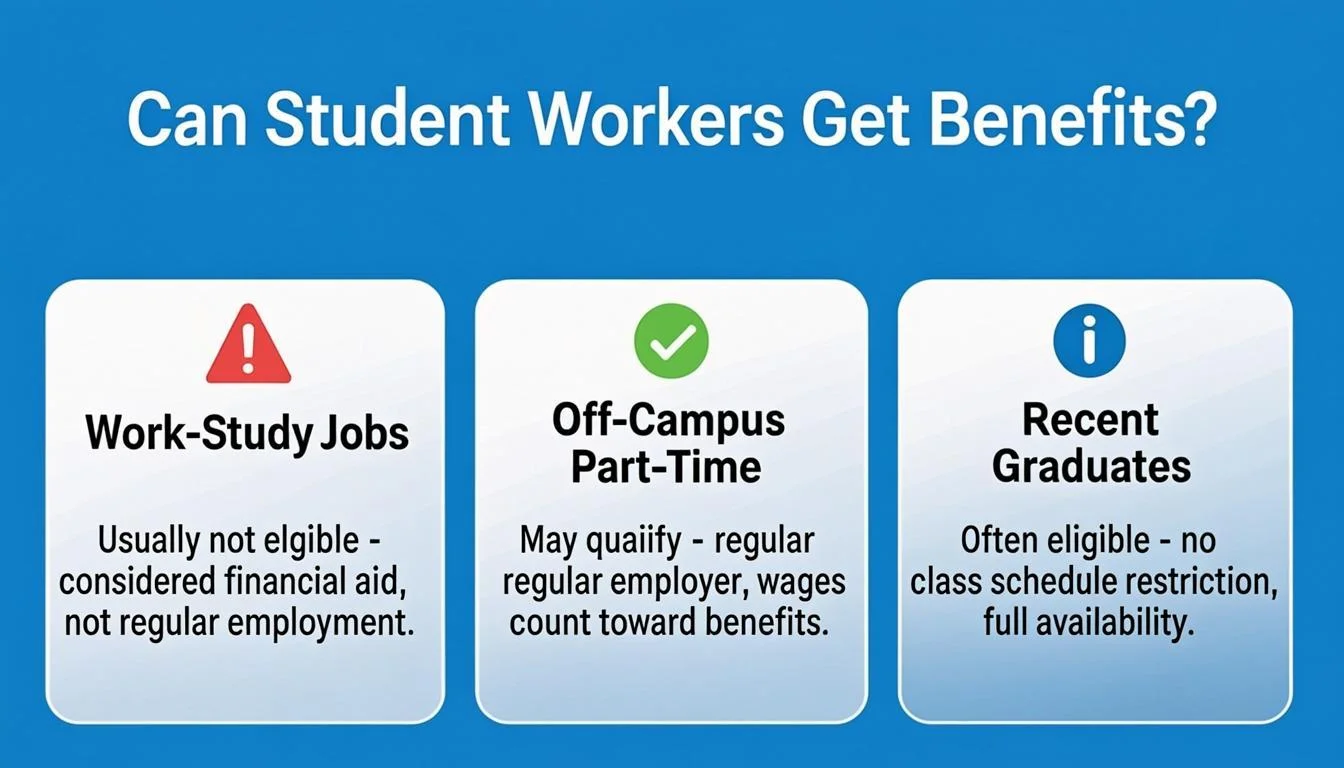
Most states consider work-study positions to be conditional employment — the job exists only as long as you remain eligible for the financial aid program and are enrolled in classes. When the semester ends or your financial aid changes, the position naturally ends. States typically view this as a foreseeable termination, not an involuntary layoff, which means you would be disqualified from receiving benefits.
Additionally, work-study earnings may not count toward the earnings threshold for unemployment eligibility. Because work-study is considered a form of financial aid rather than traditional employment, some states do not include these earnings when calculating your base period wages. This creates a double barrier — the job type disqualifies you, and the earnings may not even count.
When Work-Study Might Qualify
There are limited circumstances where work-study employment could support an unemployment claim. If your work-study position was terminated before the end of the award period for reasons unrelated to your student status — for example, if the department lost funding or eliminated the position entirely — you might have a case. However, these situations are rare, and you would still need to meet all other eligibility requirements.
Part-Time Student Workers and Benefits
Students who work regular part-time jobs — not work-study positions — have a stronger basis for unemployment claims. If you work at a restaurant, retail store, or off-campus employer and lose your job through no fault of your own, you may qualify for benefits just like any other part-time worker.
The key advantage of non-work-study employment is that your earnings are treated the same as any other worker. Your employer pays unemployment taxes on your behalf, and your wages count toward the base period calculation. If you earned enough during your base period, you could receive partial or full unemployment benefits while continuing your studies.
The Availability Requirement Challenge
Even if you earn enough to qualify financially, student workers face another hurdle: the availability requirement. To receive unemployment benefits, you must be able, available, and actively seeking full-time work. If your class schedule restricts your availability to specific hours, the unemployment agency may determine you are not genuinely available for work.
This is not a blanket disqualification — you can still receive benefits if you can demonstrate that your school schedule does not prevent you from accepting suitable employment. Many students attend evening or online classes that allow full-time daytime work. The critical factor is whether you could accept a job offer if one came along, not whether you are currently attending school.
Recent Graduates and Unemployment
One of the most common questions from the college community comes from recent graduates who cannot find work in their field. If you just graduated and your part-time campus job ended, can you collect benefits while searching for a professional position?
The answer depends on whether you earned enough during your base period to qualify. Many graduating seniors do qualify, especially those who worked steadily throughout college at non-work-study jobs. Once you have your degree and are no longer constrained by a class schedule, the availability requirement becomes much easier to satisfy — you are fully available for work.
Recent graduates should file for benefits as soon as their employment ends. Do not wait until your job search has been underway for weeks or months. Filing promptly ensures you do not lose potential benefits during the waiting period, and it establishes your claim early in case your search takes longer than expected.
Campus Employment vs. Off-Campus Employment
The type of employer matters significantly in determining whether student workers can receive unemployment benefits.
University Employers
Jobs at the university itself — dining services, library assistant, residence hall staff — are often treated similarly to work-study positions by state unemployment agencies. Many states have specific provisions for educational institution employees that disqualify them during breaks between academic terms. This is the same rule that affects teachers and school employees who are effectively laid off each summer.
If your campus job ends between semesters with a reasonable assurance of returning to work when the next term begins, you will likely be denied benefits. The unemployment system views this as a temporary suspension of work, not a true separation from employment.
Off-Campus Employers
Students working for private, off-campus employers have the same rights as any other employee of those businesses. If the restaurant where you work closes, if the retail store lays off part-time staff, or if your employer goes out of business, you can file for benefits using the same process as any other worker.
Your student status does not disqualify you from receiving benefits from an off-campus employer. The only question is whether you meet the standard requirements — earnings, reason for separation, and availability for work.
How Much Can Student Workers Expect to Receive?
Because most student workers earn relatively low wages and work limited hours, their weekly benefit amounts tend to be modest. Benefits are calculated as a percentage of your earnings during the base period, subject to state minimums and maximums.
For example, a student who earned $8,000 over the past year at a part-time job might receive a weekly benefit of around $150 to $200, depending on the state. While this is not enough to fully replace lost income, it can provide a meaningful financial bridge while you search for new employment. Understanding how your benefit amount is calculated helps set realistic expectations.
Filing Tips for Student Workers
If you are a student worker considering filing for unemployment, these tips can improve your chances of a successful claim.
- Know your employer type: Work-study and campus jobs face different rules than off-campus employment. Determine which category your job falls into before filing.
- Check your earnings history: Request your wage transcript from your state unemployment agency to verify you have sufficient base period earnings. This avoids filing a claim that is guaranteed to be denied.
- Demonstrate availability: Be prepared to show that your class schedule allows you to accept work. Having a flexible schedule, online classes, or evening-only courses strengthens your case.
- File immediately after job loss: Do not delay. The waiting week begins when you file, not when you lose your job.
- Keep detailed records: Save pay stubs, employment letters, and any communications about your termination. Strong documentation supports your work search activities and your claim.
- Understand partial benefits: If you find part-time work while receiving benefits, you may still qualify for reduced payments. Do not assume you must choose between benefits and any work at all.
Alternatives When Unemployment Is Not Available
For student workers who cannot qualify for unemployment benefits, several alternative resources may be available. Your college financial aid office can sometimes adjust your aid package when you lose a job, increasing grants or loan eligibility. Emergency funds are available at many institutions for students facing unexpected financial hardship.
The Supplemental Nutrition Assistance Program (SNAP) may be available to students who meet specific criteria, including working at least 20 hours per week or qualifying for an exemption. Campus food pantries have become increasingly common and can provide immediate relief while you explore longer-term solutions.
Finally, focusing on finding new employment quickly is often the most practical path. Campus career centers, online job boards, and networking through your academic department can help you locate positions that fit your schedule and financial needs. Being proactive about your next steps after job loss — whether or not benefits are available — is always the best approach.