What Happens After You File for Unemployment? Timeline & Next Steps

You just submitted your unemployment claim. The confirmation screen told you your application was received. But now you are staring at the screen wondering — what actually happens next? How long until someone reviews your claim? When will your first payment arrive? And what should you be doing while you wait? These questions matter because the unemployment system does not move on its own. If you miss a step, forget to certify, or ignore a letter from your state agency, your claim can stall for weeks or get denied entirely. This guide walks you through the entire post-filing process from day one through your first deposit, so you never feel like you are waiting in the dark.
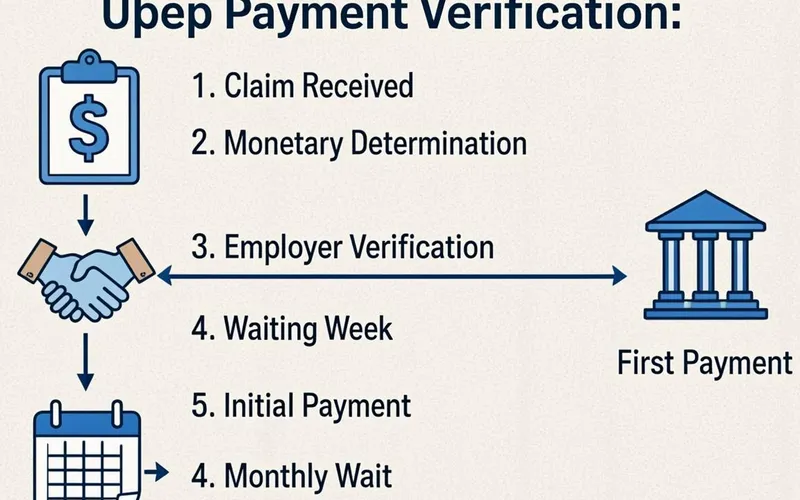
Before diving into each step, it helps to understand the big picture. After you file, your claim enters a multi-step review pipeline. Your state workforce agency assigns a claims examiner, contacts your former employer, verifies your earnings history, and makes a formal determination on whether you qualify. Meanwhile, you must begin certifying for benefits on a weekly or biweekly schedule. Only after the determination is approved and your waiting week is satisfied does your first payment get released. If you want a detailed breakdown of how long it takes to get your first unemployment check, we cover the exact timing by state in a separate guide.
📝 Step 1: Your Claim Is Received and Assigned
When you hit submit on your unemployment application, your state workforce agency receives your claim immediately. The system logs your personal information, employment history, and reason for separation. Within the first 24 to 48 hours, your claim gets assigned a unique claim number — this is the reference number you will use every time you contact the agency. Keep this number somewhere safe, because you will need it for phone calls, online portals, and any correspondence.
A claims examiner is then assigned to your case. In states with high unemployment volumes — like California, New York, and Texas during peak periods — this assignment can take several days. The examiner is the person responsible for reviewing your eligibility, contacting your employer, and issuing your monetary and non-monetary determinations. You will not usually speak with your examiner directly, but their name or ID may appear on letters you receive.
This is also when you should double-check that your initial application was complete and accurate. Small mistakes on your filing — a wrong Social Security number digit, incorrect employer address, or misreported wages — can delay your claim by weeks. If you suspect something was wrong on your application, review our guide on unemployment application mistakes that delay your claim so you can identify and fix issues before they snowball.
🔍 Step 2: Monetary Determination — Your Benefit Amount
The first official decision on your claim is called the monetary determination. This is not about whether you qualify — it is strictly about how much you would receive if you do qualify. The examiner pulls your wage records from the base period, which is typically the first four of the last five completed calendar quarters. They calculate your weekly benefit amount and your maximum benefit amount based on those earnings.
In most states, your weekly benefit amount equals roughly 50 percent of your average weekly wage during the base period, subject to a state maximum. For example, in Florida the maximum weekly benefit is $275, while in Massachusetts it can reach up to $1,033. If you want to know the specific formula for your state, our guide on how much unemployment you will get breaks down every state's calculation method and maximum caps.
You will receive your monetary determination by mail or through your online portal, usually within 7 to 10 days of filing. Read it carefully. If the wages listed are wrong or missing a quarter where you earned significant income, you can request a redetermination. This is common for people who worked multiple jobs during the base period, because the state may only pull records from one employer. Attach pay stubs or W-2 forms as proof, and the examiner will recalculate your amount.
🏛️ Step 3: Employer Verification and the Non-Monetary Determination
After your benefit amount is calculated, the agency contacts your most recent employer. This step is called employer verification, and it is where many claims hit their first real slowdown. Your former employer receives a separation notice asking them to confirm your dates of employment, reason for leaving, and whether they contest your claim. The employer typically has 10 to 14 days to respond. If they do not respond, most states proceed with the information you provided on your application.
However, if your employer contests your claim — saying you were fired for misconduct, quit without good cause, or voluntarily resigned — your case shifts into a more complex review. The examiner must weigh both sides and issue a non-monetary determination, which decides whether you are eligible to receive benefits at all. This process can take an additional 2 to 4 weeks, depending on the complexity of the separation issue. States like Pennsylvania and Ohio are known for thorough employer investigations that can extend this timeline. If you are unsure whether your separation reason might disqualify you, read our article on what can disqualify you from unemployment benefits to understand the most common denial reasons.
⏰ Step 4: The Waiting Week
Most states require a one-week waiting period before your first payable week kicks in. This waiting week is the first week you certify for benefits after filing, but you do not receive a payment for it. Think of it as a deductible on your claim — the state uses it to confirm your eligibility and set up your payment schedule before money starts flowing. As of 2026, states like California, New York, and Illinois enforce this waiting week, while a handful of states including Wisconsin have waived it in recent legislative changes.
During your waiting week, you must still certify. That means answering all certification questions honestly, reporting any part-time earnings, and confirming you are able and available for work. If you skip certification during the waiting week, your claim may not activate properly, and subsequent payable weeks could be affected. Our step-by-step certification guide walks you through exactly what questions to expect and how to answer them correctly every time.
Some claimants get confused and think the waiting week means they should do nothing. That is wrong. You must certify, perform job search activities, and meet all the same requirements you would during any payable week. The only difference is that the dollar amount on your payment statement will show $0 for that first week. If your state's online portal shows your waiting week as "processed" with a zero balance, that is actually a good sign — it means your claim is active and working correctly.
🔄 Step 5: Weekly or Biweekly Certification Begins
After your waiting week, you enter the regular certification cycle. In most states, you certify every two weeks. Some states — like Florida and North Carolina — require weekly certification. The certification process is where you confirm to the state that you still meet all eligibility conditions: you are unemployed or underemployed, you are actively seeking work, you are able and available to accept a suitable job, and you are reporting any income you earned during the claim period.
You can certify online through your state's portal, by phone using the automated TeleCert system, or in some states by mailing a paper continued claim form. Online certification is the fastest and least error-prone method, and it gives you immediate confirmation that your claim was processed. If you have not yet set up your online account, our step-by-step guide for applying online in every state includes instructions for creating your state portal access after filing.
Each certification asks roughly the same five to seven questions across all states. Did you work any days during the claim period? Did you earn any money? Were you able and available for work? Did you refuse any job offers? Did you attend school or training? Did you participate in required job search activities? Answering honestly is critical. Even small misreports — like forgetting to mention a single day of part-time work — can trigger an overpayment notice months later that demands you repay benefits with penalties.

💰 Step 6: Your First Payment Arrives
Assuming your claim is approved, your employer did not contest, and you have completed your waiting week plus at least one payable certification, your first payment is released. The timing depends on two things: how fast your state processes claims, and how you chose to receive payments. Direct deposit is the fastest route — most states release funds within 1 to 3 business days after your payable certification is processed. Paper checks take 5 to 7 additional business days because they must be printed and mailed. Some states also offer prepaid debit cards, which are loaded within 1 to 2 business days.
State processing speeds vary widely. In Texas, a straightforward claim with no employer contest can produce a first payment within 14 days. In California, even clean claims often take 3 to 4 weeks because of the sheer volume of applications the EDD handles. Michigan and Washington typically fall in the middle range, around 2 to 3 weeks. If your claim involves an employer contest or a separation issue that requires fact-finding, expect an additional 2 to 4 weeks beyond these baseline timelines.
📋 What You Should Be Doing While You Wait
The period between filing your claim and receiving your first payment is not passive. There are several actions you should take immediately to keep your claim moving and avoid problems down the line. First, set up your online portal account if you have not already. Most states send a PIN or activation code by mail within a few days of filing. Once you log in, you can check your claim status, view your monetary determination, and start certifying online — all of which are faster than phone or mail methods.
Second, start your job search activities right away. Nearly every state requires you to perform a minimum number of work search activities each week — typically two to three — and document them. Applications submitted, interviews attended, networking events, resume submissions to employers — all of these count. Our unemployment job search requirements guide details what counts as a valid activity in each state and how to keep proper records. Do not wait for your first payment to begin searching. If the agency audits your claim and finds zero job search activity during your first weeks, they can deny benefits retroactively.
Third, gather and organize your documentation. Keep your pay stubs from your most recent employer, your separation letter or termination notice, any communications from HR, and records of your job search activities. Store them in a folder — physical or digital — so you can respond quickly if the examiner requests additional information. Many claimants who already read our guide on what information you need before filing will have most of these documents assembled, but it pays to keep them accessible throughout the entire claim period, not just at the filing stage.
📞 Common Issues That Stall Your Claim After Filing
Even after you file correctly, several common problems can freeze your claim for weeks. Understanding what they are helps you spot them early and respond before they cause serious delays.
Identity Verification Holds
Many states — including New York, Florida, and California — have implemented identity verification checks to combat fraud. If your identity cannot be verified automatically through the system, your claim is placed on hold. You will receive a letter or email asking you to verify your identity through ID.me, a video call, or by submitting identity documents. Complete this step as fast as possible. Identity holds can delay your claim by 2 to 6 weeks if you do not respond promptly, and some states will close your claim entirely if you ignore the verification request.
Wage Discrepancies
If the wages your state pulls from its database do not match what you reported on your application, the examiner must resolve the discrepancy before issuing your monetary determination. This is especially common for people who worked in multiple states, earned income through gig platforms like Uber or DoorDash, or had employers who misreported wages to the state. You can speed up resolution by submitting W-2 forms, pay stubs, or tax transcripts as proof of your actual earnings. Do not wait for the examiner to contact you — proactively upload or mail supporting documents as soon as you spot a mismatch.
Partial Claims and Part-Time Work
If you are working part-time while claiming unemployment, you must report your earnings during every certification. States calculate partial benefits by deducting a portion of your earnings from your weekly benefit amount. In most states, you can earn up to roughly 25 to 30 percent of your weekly benefit amount without any reduction, and benefits are reduced proportionally above that threshold until they reach zero. Understanding how this works is essential, and our guide on working part-time while receiving unemployment explains the exact formulas for partial benefit calculations in each state. Failing to report part-time earnings is one of the top reasons claimants receive overpayment notices.
🎯 How to Check Your Claim Status
Waiting without information is frustrating. Fortunately, every state provides at least one way to check your claim status after filing. Here are the three main methods and when to use each one.
Online Portal
Your state's unemployment website is the best starting point. Log in to your account and look for a "Claim Status" or "Claim Summary" section. Most portals show your current claim phase — whether it is pending, under review, approved, or denied — along with your monetary determination details and any pending actions you need to complete. Check your portal at least once a week, even if you have not received any new mail or emails. Sometimes the portal updates before physical notices arrive.
Phone System
If your online portal is vague or not showing enough detail, call your state's unemployment hotline. Be prepared for long wait times — especially in states like California and New York, where callers routinely wait 30 to 60 minutes. Call early in the morning or late in the afternoon for shorter queues. When you reach a representative, provide your claim number and ask specifically: what is my current claim status? Is there a pending action? Has my employer responded to the separation notice? Are there any holds or issues I need to resolve?
Mail and Email Notifications
States still send formal determinations and action requests by mail. Some also use email, but mail remains the official communication channel for most agencies. Check your mailbox daily, and do not ignore any envelope from your workforce agency — even if it looks like routine correspondence. A fact-finding interview notice, an identity verification request, or a determination letter all arrive by mail, and each one has a response deadline. Missing a deadline can pause or kill your claim.
💡 What to Do If Your Claim Is Denied
If your non-monetary determination comes back as a denial, you are not out of options. Every state provides an appeals process, and a significant percentage of first-time denials get reversed on appeal — especially when the claimant provides thorough documentation and testimony. The denial letter will include a deadline for filing your appeal, typically 15 to 30 days from the date on the letter. File your appeal immediately. Do not wait until the last day, because processing times and mail delays can push you past the cutoff.
The appeal usually leads to a hearing before an administrative law judge, where both you and your employer can present evidence and testimony. Prepare for this hearing by gathering your termination letter, performance reviews, communications with your employer, and any witnesses who can support your version of events. The hearing is your best opportunity to explain why your separation qualifies you for benefits. For a full walkthrough of the hearing process, testimony tips, and what to expect, read our complete guide to appealing an unemployment denial.
One critical point: keep certifying during the appeals process. If your appeal succeeds, you will only receive retroactive payments for the weeks you certified. Skip certification during the appeal, and those weeks become permanently unrecoverable — even if the judge reverses the denial. This is one of the most costly mistakes claimants make, because nobody tells them to keep certifying while they wait for a hearing date.
🔄 If You Already Applied — What Comes Next
If you have already filed your initial claim and are reading this guide to figure out what comes next, here is a quick checklist to make sure you are on track.
If you have not yet filed your initial claim and are researching the process ahead of time, you will want to start by confirming your eligibility. Our complete eligibility guide on who qualifies for unemployment benefits covers the income thresholds, work history requirements, and separation conditions that determine whether your claim will be approved. Once you know you qualify, follow our step-by-step guide on how to apply for unemployment benefits to file your claim correctly the first time — because a clean initial filing is the single fastest path to getting your payments started without delays.
📋 State-by-State Processing Time Estimates
Processing times vary significantly by state, and understanding the typical timeline for your state helps you set realistic expectations. The table below shows estimated ranges for straightforward claims with no employer contest or identity verification issues. Claims involving complications can take 2 to 6 weeks longer than these estimates.
| State | Typical Processing Time | Waiting Week Required? | First Payment Timeline |
|---|---|---|---|
| California | 3–4 weeks | Yes | 4–5 weeks |
| New York | 2–3 weeks | Yes | 3–4 weeks |
| Texas | 1–2 weeks | Yes | 2–3 weeks |
| Florida | 2–3 weeks | Yes | 3–4 weeks |
| Illinois | 2–3 weeks | Yes | 3–4 weeks |
| Pennsylvania | 2–4 weeks | Yes | 3–5 weeks |
| Michigan | 2–3 weeks | Yes | 3–4 weeks |
| Massachusetts | 2–3 weeks | Yes | 3–4 weeks |
| Ohio | 2–3 weeks | Yes | 3–4 weeks |
| Washington | 2–3 weeks | Yes | 3–4 weeks |
Keep in mind that these are estimates for standard claims. During periods of high unemployment — recessions, seasonal layoffs, or pandemic surges — processing times can double. If your state is experiencing high volume, you may see longer wait times than the ranges listed above. The key is to stay proactive: certify on schedule, respond to all requests immediately, and check your claim status regularly.
🎯 Final Takeaways
Filing for unemployment is the starting line, not the finish. The process that follows — examiner review, employer verification, monetary and non-monetary determinations, waiting weeks, and ongoing certification — requires your active participation every single week. The claimants who receive their benefits fastest are the ones who certify on time, respond to agency requests within 24 hours, report all earnings honestly, and never let a deadline slip. The system is built to verify and validate before it pays, and your cooperation at each step is what keeps the pipeline moving.
If you have already filed, use the checklist above to confirm you are on track. If you are about to file, make sure your application is complete and accurate from the start — because the single biggest factor in how fast your claim processes is whether your initial filing contains correct information with no missing fields. And if you hit a problem along the way — an employer contest, an identity hold, or a denial letter — respond immediately and use the resources linked throughout this guide to navigate each obstacle. The unemployment system works for claimants who work with it, not around it.

Wasim Akram
Verified AuthorFounder & Lead Researcher, UnemploymentBenefitsCalculator.com
Wasim personally researches, writes, and reviews every article on this site. His expertise spans unemployment benefits policies across all 50 U.S. states, drawn from systematic research into state workforce agencies and Department of Labor guidelines.