
What Is an Earnings Disregard in Unemployment?
An earnings disregard is the slice of your part-time paycheck that your state ignores on purpose. The state leaves that slice out when it sizes your weekly unemployment check.
Your benefit does not drop dollar for dollar against every dollar you earn. The state subtracts only the amount above the disregard instead.
The result is a softer landing for every reduced schedule. You keep most of your benefit even while you pick up shifts or freelance gigs.

Every state runs some version of this rule, but the math differs more than most claimants expect. In some states you get to keep a flat dollar amount of your earnings. In others the rule is a percentage of what you make.
A handful of states instead ignore a percentage of your weekly benefit.
Knowing your state's exact formula decides whether the week pays well or not. It is the difference between a paycheck-plus-benefit week and a certification that shows zero.
This matters because partial unemployment is far more common than people realize. A large share of claimants are on reduced hours rather than fully laid off. The disregard formula decides whether their benefits are worth filing for at all.
The U.S. Department of Labor's unemployment insurance resources treat partial benefits as a core feature of every state program, not an exception.
Table of Contents
- What Is an Earnings Disregard?
- How the Partial Benefit Formula Works
- State Disregard Rules With Real Numbers
- A Worked Example: One Week, Two States
- When Partial Work Erases Your Check
- Reporting Part-Time Earnings the Right Way
- Common Disregard Mistakes
- Special Situations: Multiple Jobs, Standby, Shared Work
- Making the Disregard Work for You
How the Partial Benefit Formula Actually Works
The base formula across states follows one pattern. You report your gross earnings for the week you worked. The state subtracts its disregard from those earnings, and the remainder comes off your WBA.
Whatever is left of your WBA is what lands in your account for that week.
Written out, it looks like this: partial payment equals WBA minus gross earnings plus the disregard. The final number is capped at your weekly benefit amount.
If the math bottoms out at zero or below, the week pays nothing. Your claim itself remains active for future weeks.
States count the week in which you earned the money, not the week your employer paid it. That timing rule trips up plenty of workers with delayed paychecks.
One more rule applies almost everywhere: your gross earnings are what count, not your take-home pay. Taxes, insurance deductions, and retirement contributions do not shrink the number you report.
A $400 gross check with $320 deposited is still $400 for your certification. Understating it is one of the fastest routes to an overpayment notice.
State Disregard Rules: Real Numbers From Major States
The disregard is where states genuinely diverge, so it pays to see the spread side by side. The table below shows simplified partial-benefit rules for several large states using their published formulas. Always confirm the current figure with your state agency before you rely on it, because legislatures adjust these numbers regularly.
| State | How the disregard works | Max weekly benefit (2026) |
|---|---|---|
| California | Keeps the greater of $25 or 25% of gross earnings | $450 |
| New York | Ignores 25% of your gross earnings | $504 |
| Texas | Keeps the greater of $125 or 25% of gross earnings | $564 |
| Florida | Earnings up to $58 per week do not reduce benefits | $275 |
| Massachusetts | Keeps the greater of $75 or one-third of your WBA | $1,033 |
| Ohio | No disregard; benefits reduce dollar for dollar | $647 |
| Illinois | Ignores earnings up to half of your WBA | Varies by dependents |
| Pennsylvania | Partial benefit credit of about 30% of your WBA | $573 |
Read that table and the stakes become obvious. A Texas warehouse worker earning $300 gross per week keeps $125 of it under the disregard.
A $564 WBA still pays $388 for that reduced week. An Ohio worker with the same earnings and a similar WBA loses the full $300 and collects only the balance.
Same hours, same effort, wildly different checks.
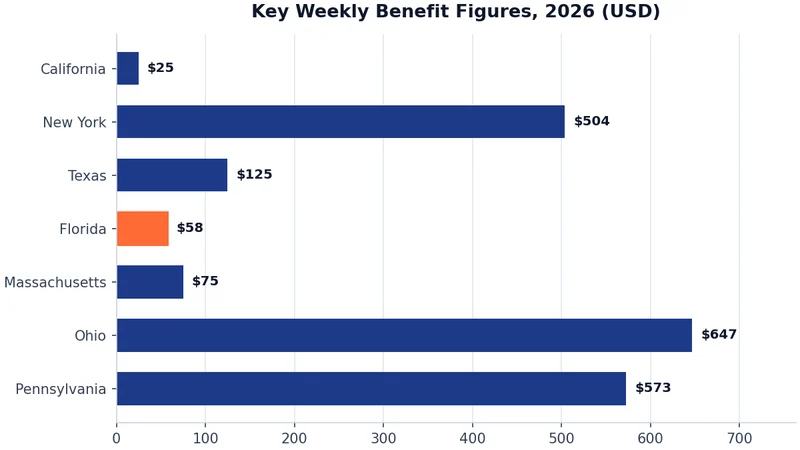
Washington deserves a special mention for an unusual structure. Its formula ignores a small flat amount plus a percentage of the WBA rather than the earnings. That structure quietly favors workers with larger benefit amounts.
The point is not to memorize fifty formulas. Check your own state's one line before you decide how many hours to accept.
A Worked Example: One Week, Two States
Let's follow Maria, a hotel front-desk clerk whose hours drop from five shifts to two. She grosses $280 in the reduced week, and her weekly benefit amount would be $380 if she were fully unemployed. Watch how the same week produces different payments in two different states.
In California, the state ignores the greater of $25 or 25% of her $280 earnings, which is $70. Her payment is $380 minus $280 plus $70, or $170. In Ohio, with no disregard, the state subtracts the full $280 and pays her $100.
Maria's certification answers are identical in both states; only the formula changes.
Now stretch that across a month. Four reduced weeks put roughly $680 extra in Maria's pocket under California's rule versus $400 under Ohio's.
That gap is why benefit counselors tell reduced-hours workers to run the exact math first. Never assume part-time wages and benefits simply do not mix.
Want to pressure-test your own numbers first? The weekly benefit estimator guide walks through the WBA side of the equation.
When Partial Work Erases Your Check Entirely
Every state has a cliff where earnings wipe out the week. Once your gross earnings cross your weekly benefit amount plus the disregard, the week pays zero.
In strict dollar-for-dollar states like Ohio, the cliff arrives even earlier. Any week where earnings meet or beat the WBA pays nothing there.
Landing on the cliff is not a catastrophe, but it does burn a week off your claim. Most states deduct the week from your remaining balance whether or not a check went out. An over-earnings week therefore costs you future coverage.
A few states waive the reduction if your earnings came from reserved vacation or holiday pay. Ask your agency before you assume the worst.
There is also a reporting cliff people create for themselves. If you answer no because the shift "didn't really count," the agency still checks. The wage cross-match against employer payroll records will find the work anyway.
The disqualification rules page explains how misstatements snowball into overpayments and potential fraud charges.
Reporting Part-Time Earnings the Right Way
Certifications fail on details more than on honesty. Report gross earnings for the week you earned them, not the week you were paid.
Include tips if you're a tipped worker and commissions if you're on sales pay. Add the gross value of any meals or housing your employer provides instead of wages.
A paycheck covering three weeks may arrive during one certification week. Report only the portion that belongs to each week worked, not the whole check.
Keep a simple earnings log as you go. The state's auditor sees clean employer payroll data months later. Your contemporaneous notes are your best defense in any dispute.
Claimants who maintain written records resolve overpayment matches far faster than those trying to reconstruct shifts from memory.
If you genuinely misreported a week, correct it through your state's amendment process right away. Do not wait around for the cross-match letter. Voluntary corrections read very differently from discovered concealment.
The certification reporting guide covers the week-by-week mechanics in detail.
Common Disregard Mistakes That Cost Claimants Money
The most expensive mistake is assuming the disregard applies automatically in your favor during the certification itself. In several states you must answer the work-and-wages questions exactly right for the formula to fire. A sloppy answer applies a zero-disregard default instead.
Read each question literally before you answer it. "Did you work" and "did you earn more than your weekly benefit" are separate tests.
Second is ignoring the distinction between gross and net pay. We covered it above, but it recurs in every overpayment case file.
Third is forgetting that paid time off converts into earnings. It counts the week you were scheduled, not the week the check cut.
Holiday pay, vacation payout, and sick leave all count as wages in most states. Any of them can silently zero out a week.
Finally, don't overlook the interaction between the disregard and your job search duties. Working part time does not suspend the full-time job search requirement in most states.
Skipping your weekly contacts while relying on the disregard is a classic two-for-one denial. The work search requirements guide explains how many contacts your state expects and what documentation survives an audit.
Special Situations: Multiple Jobs, Standby, and Shared Work
Multiple income sources create the most misreported weeks in the system. If you work a steady part-time job plus gig shifts, every dollar counts. Both sources are gross earnings for the week, and neither gets its own private disregard.
The math combines first, then the formula applies once.
Claimants who report each source to a different mental bucket routinely understate one of them.
Standby arrangements deserve their own attention. When an employer schedules you for on-call weeks with no guarantee of hours, states split the difference. They treat attached-and-available weeks differently from the weeks you actually worked.
If standby rules apply, the disregard may not even enter the picture. The state may treat an unused standby week as a full unemployment week instead.
Ask which classification your weeks fall under before your first certification, not after the determination arrives.
Shared work programs run by roughly half the states change the formula in your favor. Under a state shared work plan, your employer formally reduces hours across a department.
The state then replaces a defined slice of the lost wages. Its disregard rules are looser than the regular partial formula allows.
If your employer's slowdown looks permanent, suggest the shared work program to human resources. It is often the single most profitable move a reduced-hours worker can make.
The short-time compensation guide explains how employers enroll.
Seasonal schedules blend these rules in ways that surprise hospitality and retail workers. A school-year employee with irregular summer hours faces an extra layer. District workers may face base period wage tests on top of the weekly disregard math.
The seasonal workers guide maps those traps out in detail. Teachers have an additional off-season rule set covered in the school employees guide.
Making the Disregard Work for You
Treat the disregard as a planning tool rather than fine print. If your employer offers flexible reduced hours, look for the weekly earnings target. There is often a number that maximizes the combined wage-plus-benefit total without breaching your state's cliff.
Run the formula for a few different hour levels and compare the totals. You will usually find a sweet spot that a flat guess would have missed.
Remember that partial weeks also preserve your claim. Certifying consistently, even for zero-payment weeks, keeps your benefit year alive and your work-search record clean.
And if your hours later evaporate completely, your WBA does not change at all. The same disregard math simply drops out of the picture.
When in doubt, call your state unemployment office with a specific hypothetical rather than a vague question. Ask them to walk your exact numbers through the formula for one representative week.
Combined with the part-time work rules and the partial benefits calculator walkthrough, that one phone call removes every guess. Your certification routine becomes fully predictable from then on.
Frequently Asked Questions
How much can you earn and still get partial unemployment?
In most states you can earn up to your weekly benefit amount plus the state's earnings disregard before the week pays zero. Below that line, your state subtracts earnings above the disregard from your WBA. Because the formulas differ so much, check your state agency's partial benefits page before accepting extra hours.
What is the earnings disregard in simple terms?
It is the portion of your weekly wages your state ignores when calculating your partial unemployment payment. If your disregard is $50 and you earned $200, only $150 reduces your check. Not every state uses a flat dollar amount though; some use percentages of earnings or of your benefit.
Do I report gross or net income for unemployment?
Always report gross earnings, meaning the amount before taxes and deductions, for the week you earned the money. Net deposits understate your wages and create overpayment bills when the state matches employer payroll records. Tips, commissions, and the value of housing or meals paid instead of wages count too.
Which states have no earnings disregard for partial unemployment?
A few states reduce benefits dollar for dollar with little or no disregard, and Ohio is a well-known example, where any week your gross earnings meet or exceed your weekly benefit amount pays nothing. Several other states apply only token ignores. Confirm your state's current formula because rules change with legislative sessions.
Does working part time reduce my unemployment benefits forever?
No. Part-time earnings only reduce individual weekly payments while you work those weeks. Your weekly benefit amount and your remaining balance stay intact, and once your hours end, full payments resume as long as you remain eligible and within your benefit year.
What happens if I earn more than my weekly benefit amount in a week?
That week pays zero benefits because your wages exceeded the allowable threshold. Your claim usually stays active, but the week still counts against your remaining balance in most states. Keep certifying, report the earnings accurately, and return to full payments when your hours drop again.