
Table of Contents
- Why Tip Income Changes Your Benefit Math
- Which Tip Dollars Actually Count as Wages
- How States Turn Tips Into a Weekly Benefit
- A Worked Example: Server Benefit Amount
- Tip Credit, Reduced Hours, and Partial Checks
- Filing Tips for Tipped Workers
- Tip Pools, Tip-Outs, and Wage Records
- Delivery Apps, Gig Tips, and Third-Party Payroll
- Quick Checklist Before You File
Why Tip Income Changes Your Benefit Math
Tipped workers face a calculation puzzle that most claimants never see. The wages that build your unemployment claim are scattered across paychecks, tip reports, and cash pockets. Your weekly benefit amount is built from your base period wages.
For servers, bartenders, drivers, and hotel staff, the wages include more than the hourly rate. They also include the tips your employer reports for you. Get the tip picture wrong and your benefit amount lands far below what the law says you're owed.
The core principle is straightforward: tips count as wages. Under the Fair Labor Standards Act, your employer claims a tip credit against the minimum wage. That arrangement only works when your tips are real, reported income.
State unemployment agencies therefore treat reported tips exactly like base pay when they compute your weekly benefit amount.
Unreported cash tips were never taxed and never hit your employer's payroll records, so they build no claim.
This guide focuses on the calculation side: which tip dollars count and how states read them into your high quarter. It also shows what a realistic benefit looks like for restaurant and gig workers. If you're looking for the eligibility rules instead, the tipped employees eligibility guide covers disqualification risks and separation issues.
Which Tip Dollars Actually Count as Wages
Three categories of tip income exist, and only one of them matters for your claim. Charged tips that customers add to card payments flow through your employer's books automatically. Cash tips you report to your employer through daily or shift reports also become payroll wages.
Cash tips you keep quiet are invisible to the unemployment system. The agency reads your employer's quarterly wage reports, not your memories.
This creates an uncomfortable reality for workers whose industry runs on unreported cash. Your claim is only as strong as your documented wage history.
A bartender who reports $900 a month in tips builds a claim on exactly that figure. Actual tips may have run double that amount.
Some claimants discover this painful gap at filing time and assume the agency is cheating them. The agency is simply reading the same payroll data your W-2 came from.
Service charges complicate things further. A mandatory 18% service charge your employer distributes to staff is usually treated as wages. Voluntary tips remain tips under the same rules.
Pool distributions count when your employer runs the pool.
When in doubt, check which bucket your employer's payroll system uses, because that bucket determines your base period numbers.
How States Turn Tips Into a Weekly Benefit Amount
Every state builds your WBA from your highest quarter of wages in the base period. The way they process tip-heavy payrolls varies widely. In states that follow the wage reports literally, the math is simple.
Your high quarter is your hourly pay plus reported tips summed over 13 weeks. Other states apply minimum-wage floors or alternative formulas that can help workers with thin reported wages.
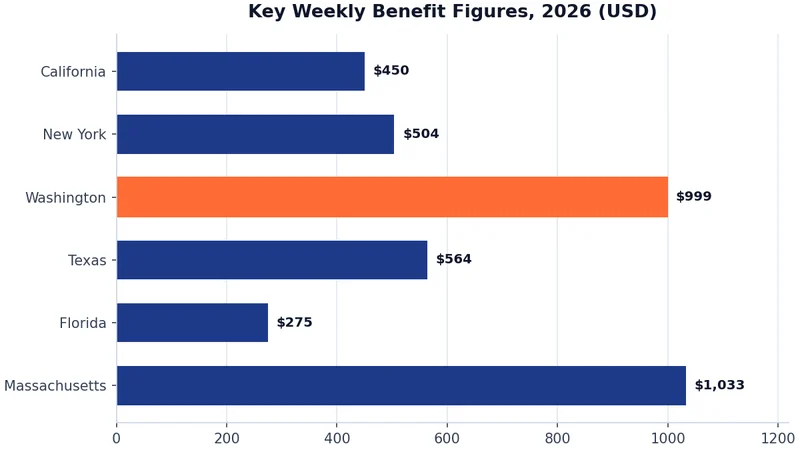
| State | How tip wages feed the WBA | Max weekly benefit (2026) |
|---|---|---|
| California | High quarter wages including reported tips; no separate tip adjustment | $450 |
| New York | High quarter including tips; claim built from payroll wage reports | $504 |
| Washington | High quarter wages including tips, among the highest replacement rates | $999 |
| Texas | High quarter wages including reported tips | $564 |
| Florida | High quarter wages; low wage base caps most restaurant claims | $275 |
| Massachusetts | High quarter including tips and reported gratuities | $1,033 |
Notice the pattern in the table: nowhere does a state exclude tips from the calculation. The differences come from each state's wage base, replacement rate, and formula, not from any special tip penalty.
Where tipped workers get hurt is in states with low maximums like Florida. Even a perfectly documented high quarter slams into the $275 ceiling there.
A Worked Example: Server Benefit Amount, Start to Finish
Take Dana, a full-time server in California earning $16 per hour plus reported tips averaging $950 a week in summer. Over a 13-week high quarter, her hourly wages total about $6,656.
Her reported tips add another $12,350, for a high quarter of roughly $19,000. California's formula replaces about half of a full-time week's wages, subject to the state maximum.
Dana's average weekly wage works out to about $1,460, so her WBA lands near the $450 state ceiling. Her tip reporting was the difference-maker in the end. Had she reported only half her tips, her computed WBA would have fallen well below the cap.
It would have stayed there for her entire benefit year. One year of honest tip reporting bought her roughly $100 more per week when she needed it most.
Compare that with Luis, a part-time bartender in Florida with a high quarter of $5,200 including tips. His computed weekly amount is modest, and Florida's $275 maximum does not save him. His formula amount sits below the cap anyway.
Luis's lesson is different in low-maximum states. The fight is not about tips but about the state's benefit structure, which no documentation can lift.
Tip Credit, Reduced Hours, and Partial Checks
Reduced schedules hit tipped workers in a double way. Fewer tables means fewer tip dollars in the week, and fewer scheduled hours means less hourly pay. A partial week can gut both halves of your income at once.
The earnings disregard softens the blow for reduced schedules. Tip workers must still report gross earnings including all tips every week. Count the week they were earned, not when the card batch settled.
Slow seasons create their own documentation trap. A server whose January tips collapse may see her certification weeks pay zero.
Her part-time earnings plus the disregard still exceed her WBA, even though her annual income cratered. Keep certifying anyway, because zero-payment weeks preserve your remaining balance and your eligibility chain stays intact.
If your employer illegally keeps a share of your tips, those stolen dollars are still wages you earned. They may appear on payroll reports even though you never touched them.
Wage theft claims run parallel to unemployment claims, and state labor departments handle both. Document what you were paid versus what customers left, because the two records tell different stories.
Filing Tips for Tipped Workers
Gather your last four to five quarters of pay stubs and tip reports before you file. The agency's wage record will drive its first decision. If your reported wages look wrong, most states let you correct the record.
Pay stubs, tip statements, and W-2s feed into a wage investigation. Acting before your first determination arrives saves weeks of back-and-forth.
Watch the base period clock if your tip-heavy season just ended. Claims look back at the first four of the last five completed quarters. A server laid off in early January builds her claim mostly on last winter and spring.
Workers whose strong season falls outside that window may qualify for an alternate base period calculation. In states that offer one, it can add thousands to a claim.
Finally, report every certification week's tips honestly, including the weeks you worked short shifts. The same payroll cross-match that validates your WBA also scans your weekly reports.
Tipped workers are among the most cross-matched occupations in the system. Accurate weekly reporting is what keeps a good claim from turning into an overpayment case.
Tip Pools, Tip-Outs, and What Reaches Your Wage Record
Most tipped workplaces distribute tips through some kind of pool. The pool's plumbing decides what the unemployment agency eventually sees. In a house-managed pool, the employer collects tips and redistributes them through payroll.
Every pooled dollar shows up on your wage record. In a self-run pool among servers, the dollars change hands in cash at the end of the night. They may only reach payroll through whatever each worker self-reports.
The federal rules tightened here in recent years. Under current Fair Labor Standards Act regulations, managers and supervisors cannot participate in mandatory tip pools. Employers who take tips outside a valid pool face liability.
For claim builders, pool distribution through payroll is the strongest possible documentation. The quarterly wage report then reflects your real earnings instead of a self-reported fraction of them.
Tip-outs to bussers, runners, and barbacks follow the same principle in reverse. The percentages you hand off are not your wages once they leave your hands through a structured system. Employers typically net them out of your reported tips.
If your employer instead reports your gross tips before tip-outs, your wage record slightly overstates your income. This is one of the rare reporting errors that runs in the worker's favor.
Either way, keep your own nightly log so you can reconcile against payroll at claim time.
Back-of-house workers have seen this world change the most. When kitchens join the pool, their base period wages swell beyond their hourly rate. Cooks who lose a job often qualify for larger benefits than their pay stubs alone would suggest.
The lesson cuts across every station: your claim lives and dies by what payroll captures. Ask your manager exactly how tips flow before you need the claim, not after.
Delivery Apps, Gig Tips, and Third-Party Payroll
Gig delivery work has added a fresh layer to tip calculations. The platform, not a restaurant, is usually the reporting employer. App-based delivery tips flow through the platform's payment system.
They land on your 1099 or payroll record depending on your classification. Workers classified as employees have those tips reported as wages.
Independent contractors have no wage record at all. This is why contractor claims follow entirely different rules covered in the ABC test guide.
For platform employees, the calculation is the same as any tipped job with one practical difference. The weekly breakdown of tips sits in the app's payment history.
Reconstructing a high quarter is dramatically easier than digging through paper tip reports. Export those statements before deactivating your account, because access usually ends when the work relationship does.
Mixed-income claimants have a W-2 tipped job plus gig work on the side. Only the employee-side wages build the claim. The gig earnings still count as current earnings during certification weeks if you continue doing them.
That surprises claimants who treat app income as hobby money. The state reads all work income the same way, regardless of the app it came from.
Quick Checklist Before You File
Run through this list and you'll catch nearly every tip-related calculation problem early. Confirm your employer's payroll includes your reported tips each quarter.
Pull your own 13-week high quarter math from pay stubs and tip reports. Check your state's maximum weekly benefit so you know your ceiling in advance.
Then verify your base period window against your best-earning quarters. Ask about an alternate base period if your strongest season sits outside it. For a full walkthrough of the estimation math, the benefit estimator guide shows the formula step by step.
Workers with other nonstandard pay arrangements can see how the minimum wage benefit calculation compares. Ten minutes of preparation here routinely changes weekly payments by real money for the next six months.
Frequently Asked Questions
Do tips count as wages for unemployment benefits?
Yes. Tips that you report to your employer are payroll wages and count fully toward your base period earnings, which builds your weekly benefit amount. Cash tips you never reported appear nowhere in the agency's wage records, so they add nothing to your claim.
How is unemployment calculated for tipped employees?
The state takes your highest quarter of wages in the base period, adds your hourly pay and reported tips together, and applies its standard weekly benefit formula. There is no separate tip penalty; tipped claims are computed exactly like any other wage claim, just from tip-inclusive payroll data.
What if my employer did not report my tips correctly?
Request a wage investigation when you file and submit pay stubs, tip reports, and W-2s showing the correct amounts. Most states can revise your wage record and recalculate your benefit. Fixing the record early prevents months of underpaid checks that are hard to retroactively correct.
Can I get unemployment if my tips were mostly cash and unreported?
You can file, but your claim will be built only on the wages your employer reported, which may be just your hourly pay. Unreported cash tips generate no payroll records and no taxable wage history, so they cannot be added retroactively. Your best evidence is whatever tips your employer documented.
Do I report tips on my weekly unemployment certification?
Yes. Gross earnings for the week include all reported tips you earned that week, not the week the card batch settled. Tipped workers are heavily cross-matched against employer payroll records, so accurate weekly tip reporting prevents overpayment notices.
Which states pay tipped workers the highest unemployment benefits?
Massachusetts leads with a maximum of $1,033 per week, followed by Washington at $999 and New York at $504, with all three including reported tips in the calculation. States with low maximums like Florida cap restaurant claims at $275 regardless of how strong your tip history was.