
Last updated: October 11, 2026. SEA program availability and classification rules change - confirm current rules with your state labor department before you file.
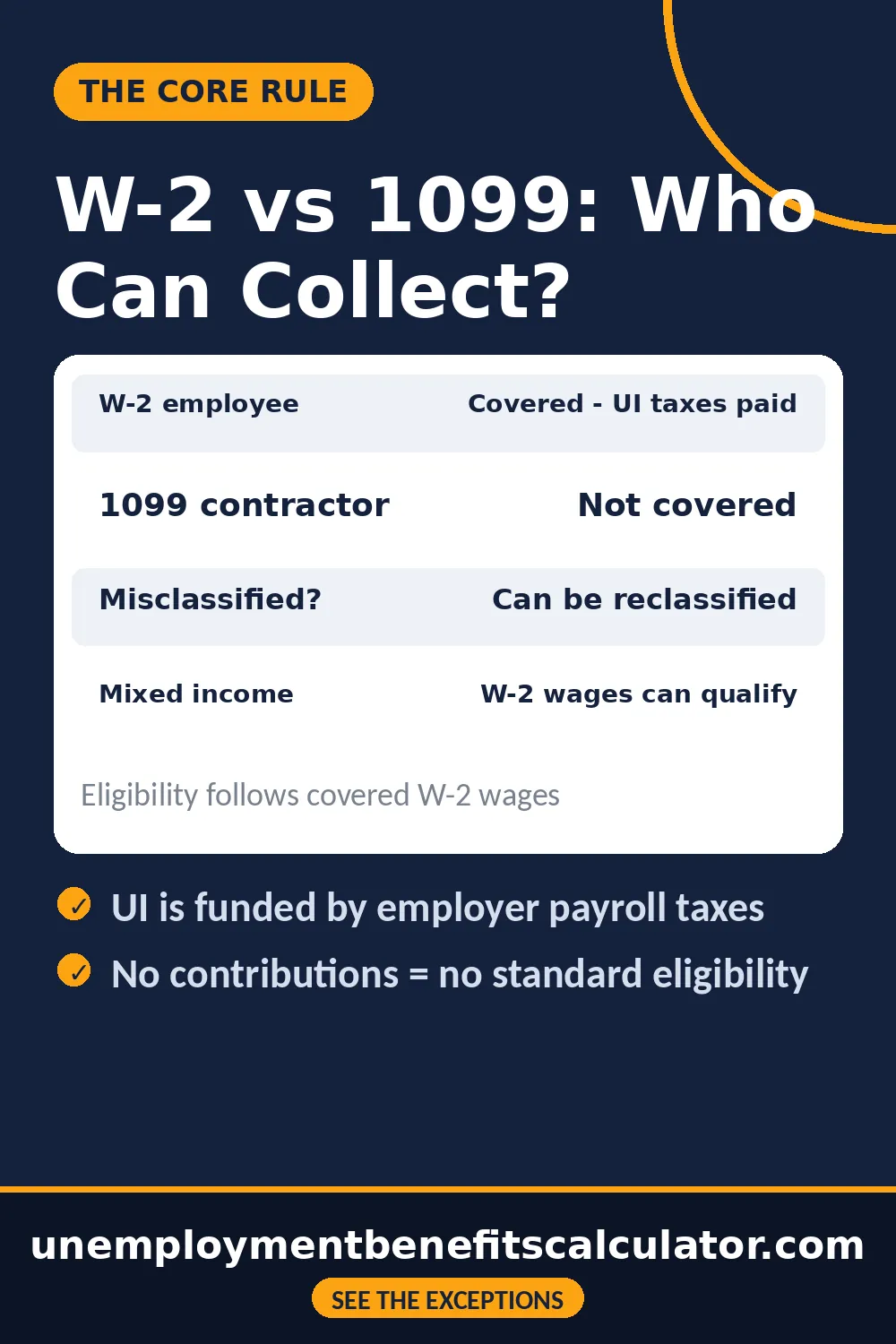
| Situation | Who can file? |
|---|---|
| W-2 employee | Covered - employer payroll taxes fund UI |
| 1099 contractor | Not covered - no UI taxes paid for you |
| Misclassified contractor | States can reclassify - retroactive benefits possible |
| Mixed W-2 + 1099 income | W-2 covered wages can qualify you |
If you earn your living as a freelancer, rideshare driver, delivery courier, independent contractor, or small business owner, you have probably wondered what happens if your income suddenly dries up. The short answer is frustrating: in most cases, self-employed workers do not qualify for standard unemployment benefits. The system was built around the W-2 employee model, and if you do not have an employer paying into the unemployment insurance fund on your behalf, the standard pipeline simply does not apply to you. But that is not the end of the story. There are exceptions, special programs, and situations where you might actually be eligible for benefits you never expected.
Why Self-Employed Workers Usually Do Not Qualify
Unemployment insurance in the United States is funded by payroll taxes that employers pay on behalf of their employees. Every time you get a W-2 paycheck, your employer is contributing to the state unemployment insurance fund behind the scenes. That contribution is what makes you eligible for benefits when you lose your job. Self-employed workers, on the other hand, do not have an employer making these contributions. No contributions means no eligibility — it is that straightforward under the standard system.
This applies to a wide range of workers. Freelance writers, graphic designers, consultants, rideshare drivers, food delivery couriers, handyman services, tutors, photographers, and countless other independent professionals all fall under the same basic rule. If you receive a 1099 form instead of a W-2, the unemployment insurance system generally treats you as self-employed, which means you are outside the standard coverage net.
Understanding what disqualifies you from unemployment benefits starts with understanding that your employment classification is the single most important factor. Even if you work full-time hours for a single client, if you are classified as a contractor, the standard unemployment door is closed to you.
The Big Exception: Worker Misclassification
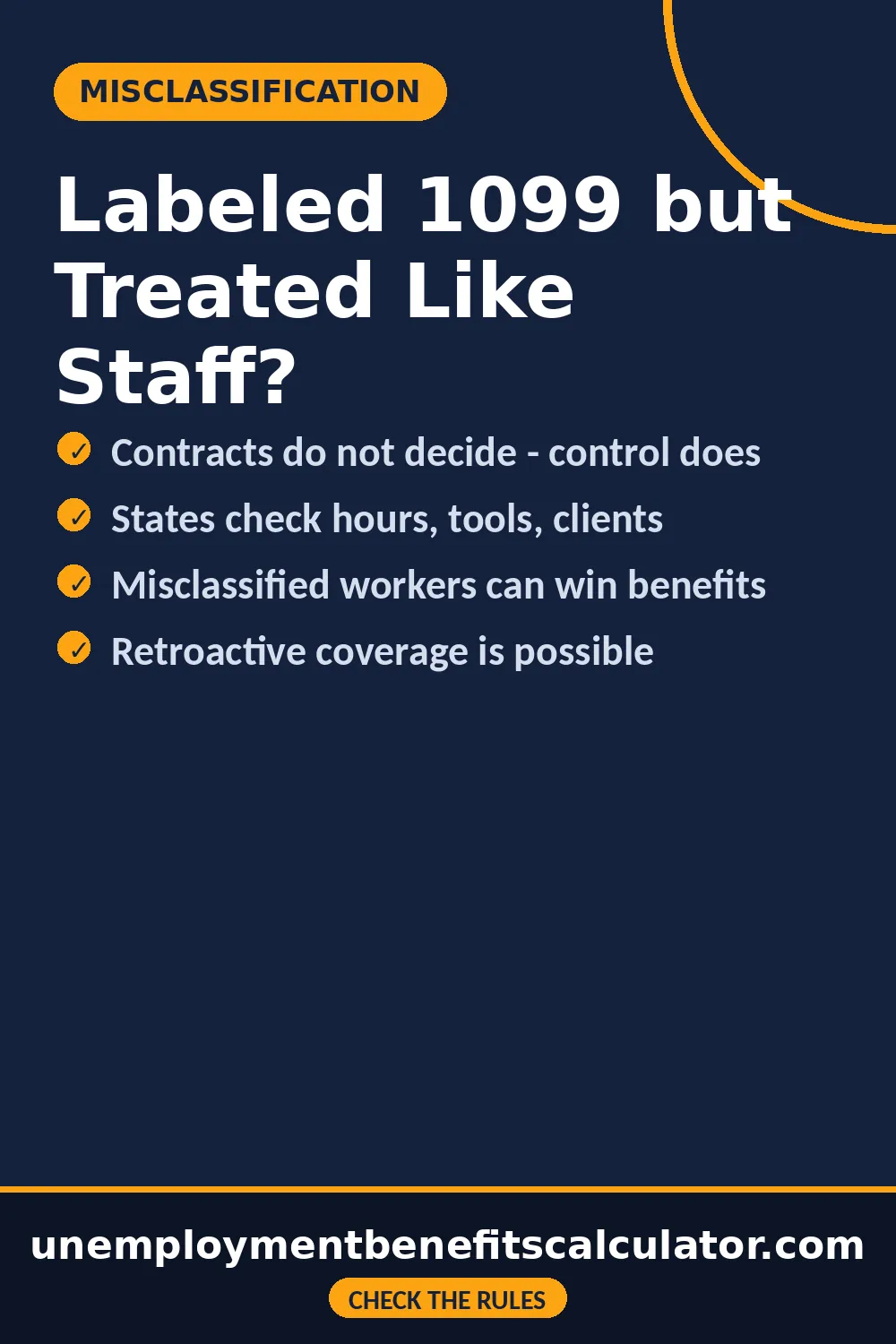
Here is where things get interesting. Many workers who are classified as independent contractors should actually be classified as employees under the law. This is called misclassification, and it is shockingly common. Employers sometimes label workers as contractors to avoid paying payroll taxes, workers compensation, and unemployment insurance. If you have been misclassified, you may be eligible for unemployment benefits retroactively.
The distinction between an employee and an independent contractor is not about what your contract says or what your employer calls you. It is about the nature of your working relationship. States use different tests to determine your true classification, but they generally look at who controls how you do your work, whether you can work for other clients, who provides your tools and equipment, and how integral your work is to the employer's business.
If your client dictates your schedule, provides your equipment, supervises your work, and you work exclusively for them, there is a strong chance you should be classified as an employee. Filing for unemployment in this situation forces the state to examine your classification, and if they determine you were misclassified, your claim can be approved. This is particularly relevant if you are wondering whether you can get unemployment after being let go from a position where you were called a contractor but treated like an employee.
The Self-Employment Assistance (SEA) Program
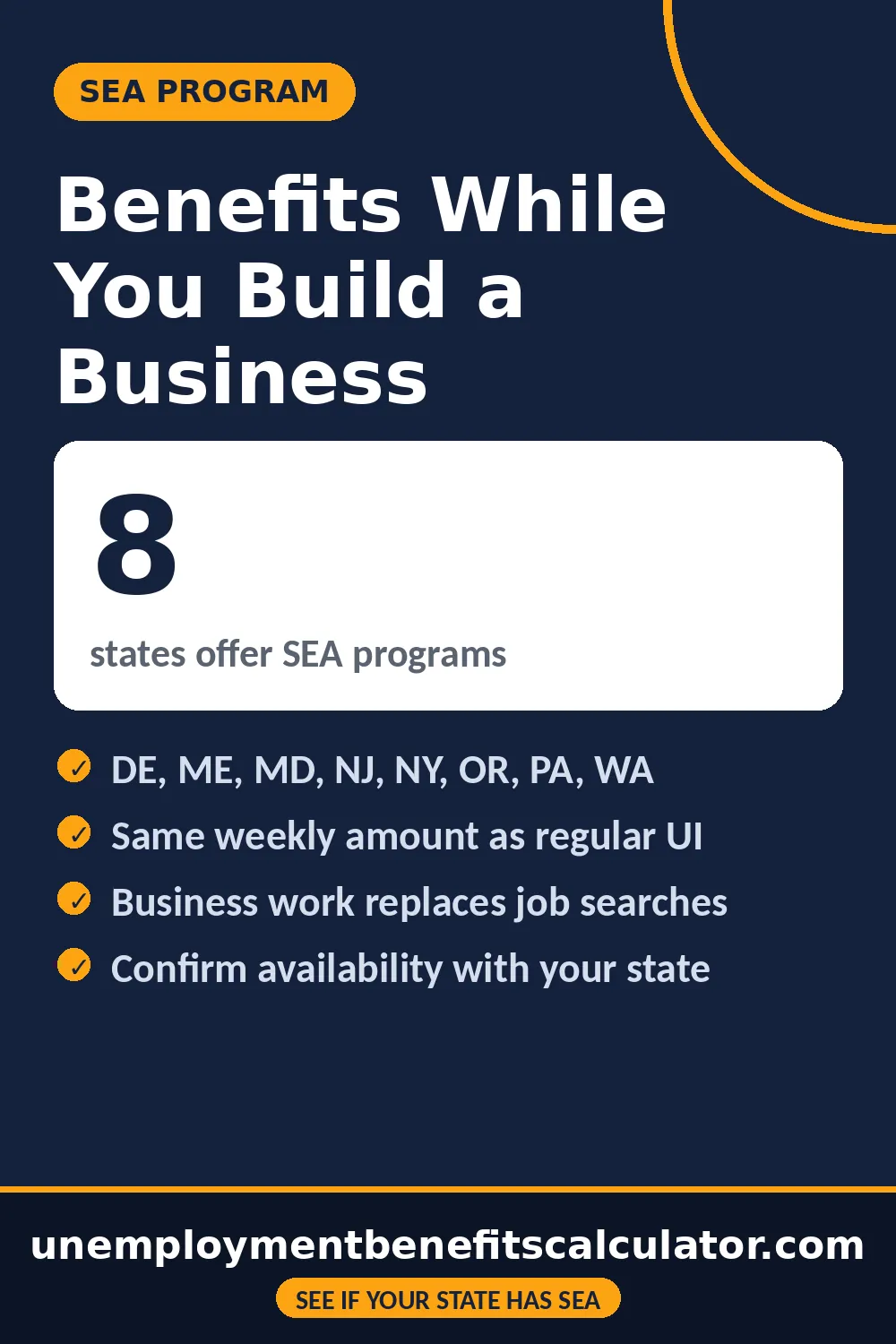
There is one program specifically designed for self-employed individuals who want to start their own business while receiving unemployment benefits. The Self-Employment Assistance program allows qualifying unemployed workers to pursue entrepreneurship full-time instead of meeting the usual job search requirements. Under SEA, you receive the same weekly benefit amount as regular unemployment, but instead of applying for jobs, you work on building your business.
The catch is that SEA is only available in a small number of states. As of 2026, states that have offered SEA programs include Delaware, Maine, Maryland, New Jersey, New York, Oregon, Pennsylvania, and Washington. However, program availability can change, and some states may have inactive programs even if legislation authorizes them. You must check with your state's labor department to confirm whether SEA is currently available where you live.
To qualify for SEA, you typically need to be eligible for regular unemployment benefits first. This means you must have lost a W-2 job through no fault of your own, be able and available to work, and meet the minimum earnings requirements. If you have never held a W-2 job and have only been self-employed, you generally cannot qualify for SEA because you were never paying into the unemployment system in the first place. The SEA program essentially redirects your existing unemployment benefits toward business development rather than job searching, which can be a game-changer for aspiring entrepreneurs.
Wondering how much each week is worth? Our free weekly benefit calculator estimates your check from your state's formula in under a minute.
What About Gig Workers on Platforms Like Uber, DoorDash, and Instacart?
Platform-based gig workers face a particularly frustrating situation. Companies like Uber, Lyft, DoorDash, Instacart, and TaskRabbit classify their workers as independent contractors, which means they do not pay unemployment insurance taxes on their behalf. This classification has been challenged repeatedly in courts and legislatures, with some states pushing to reclassify gig workers as employees. California's AB5 law, for example, was designed to do exactly that, though it was later modified by Proposition 22 to keep app-based drivers as contractors.
The practical reality for gig workers in 2026 is that standard unemployment benefits remain unavailable unless you also have W-2 income from another job. If you have a mix of W-2 wages and gig income, your W-2 earnings may qualify you for partial benefits. The state will look at your base period wages from covered employment — meaning jobs where your employer paid unemployment taxes — and calculate your benefit based on those earnings only. Your gig income does not count toward your benefit amount, but it also does not disqualify you from receiving benefits based on your W-2 work.
If your gig work is your only source of income and it disappears, your options are limited. You cannot file for standard unemployment because no employer has paid into the system on your behalf. Understanding how long you can collect unemployment benefits requires first understanding whether you qualify at all — and for most full-time gig workers, the answer under current law is no.
Mixed Income: When You Have Both W-2 and 1099 Earnings
Many workers have a combination of W-2 employment and self-employment income. Maybe you work part-time as an employee and freelance on the side, or perhaps you had a full-time job that ended and you picked up contract work while looking for a new position. In these situations, you may qualify for unemployment benefits based on your W-2 earnings, even though your self-employment income does not contribute to your benefit amount.
When you file a claim, the state unemployment agency examines your earnings history during what is called the base period. Only wages from covered employment — jobs where your employer paid unemployment insurance taxes — count toward your eligibility and benefit calculation. If your W-2 wages meet the minimum threshold, you can receive benefits. However, you still need to meet all the ongoing requirements, including being able and available for work and actively searching for a job.
This is where things get tricky for people with mixed income. While collecting unemployment based on your W-2 wages, you may also need to work part-time and still collect partial benefits. If your freelance or contract work generates income during a week you are claiming benefits, you must report it. Most states allow you to earn a small amount without reducing your benefit, but earnings above that threshold will reduce your weekly payment dollar for dollar or by a set percentage.
What Happened During the Pandemic — and Why It Is Not Coming Back
During the COVID-19 pandemic, the federal government created the Pandemic Unemployment Assistance program, which temporarily extended unemployment benefits to self-employed workers, gig workers, and independent contractors for the first time in history. PUA was an extraordinary measure that provided a lifeline to millions of workers who had never before been eligible for unemployment. If you received PUA benefits between 2020 and 2021, you know firsthand that the system can work for self-employed workers — but only when Congress authorizes a special program.
PUA expired in September 2021, and as of 2026, there is no similar federal program in place. No legislation is currently pending that would create a permanent unemployment benefit program for self-employed workers. Some advocacy groups continue to push for a permanent gig worker safety net, but progress has been slow. The political and economic debate centers on who should pay for such a program — should gig platforms contribute, should workers pay premiums, or should the federal government fund it entirely?
Understanding how much unemployment benefits you might receive is only useful if you qualify in the first place. For self-employed workers, that qualification hurdle remains the biggest obstacle, and until Congress acts, the standard system simply does not accommodate independent earners.
Can You Voluntarily Pay Into Unemployment Insurance?
Some self-employed workers wonder if they can simply opt into the unemployment insurance system by paying premiums themselves. The answer in most states is no. Standard unemployment insurance is an employer-funded program, and there is no mechanism for individuals to voluntarily contribute on their own behalf. The system is not designed to accept individual premium payments from self-employed workers.
However, there is a workaround that some self-employed individuals use. If you have set up your business as an S-Corporation or a C-Corporation and you are officially an employee of your own corporation, your corporation can pay unemployment insurance taxes on your wages. This means your business pays both the employer and employee portions of the tax, and if you lose your position — which can happen if the business closes — you may be eligible for benefits based on those wages.
This approach is not practical for most sole proprietors or single-member LLCs, because the cost of paying both sides of the unemployment tax often exceeds the benefit you would receive. It makes more sense for businesses with multiple employees where the corporate structure is already in place. Consult with a tax professional before pursuing this strategy, as the rules are complex and the tax implications go beyond just unemployment insurance. Also keep in mind that unemployment benefits affect your tax situation in ways you need to plan for.
Other Safety Net Programs for Self-Employed Workers
Just because standard unemployment is off the table does not mean you have no options when your income disappears. Several federal and state programs can provide financial support during tough times, even for self-employed workers. These programs have different eligibility criteria, but they do not require you to have paid into an unemployment insurance fund.
SNAP (food stamps) is available based on your income and household size, regardless of how you earned that income. Medicaid provides health coverage for low-income individuals and families. Housing assistance programs can help with rent or mortgage payments. The Small Business Administration offers disaster loans and economic injury loans for businesses affected by declared disasters. Each state also has its own emergency assistance programs that may provide cash grants for utilities, food, and other essentials.
If you are transitioning from self-employment to a traditional job, remember that you will need to meet job search requirements for unemployment once you start a new W-2 position and become eligible for future benefits. Building a safety net through covered employment is one of the most practical steps you can take.
What to Do Right Now If You Lost Your Self-Employment Income
If your freelance work has dried up or your gig platform hours have been cut, you need to act quickly to protect yourself financially. Start by filing an unemployment claim even if you think you will be denied. The filing process forces the state to review your work history and classification, and you might discover that you qualify based on a previous W-2 job you had forgotten about or that you were misclassified by a client. There is no penalty for filing a claim that gets denied.
While your claim is being processed, apply for every safety net program you might qualify for. SNAP benefits can be approved within a few days in emergency situations. Medicaid enrollment is often faster than people expect. Contact your local 211 helpline for a complete list of assistance programs in your area — this is a free service that connects you with local resources.
If you do have some W-2 income in your recent work history, make sure you understand the timeline for your claim. Knowing how long it takes to get your first unemployment check helps you plan your finances during the gap. Most states take two to three weeks from filing to first payment, and if there are classification questions about your work, it could take longer.
Finally, consider whether returning to W-2 employment makes sense for your situation, at least temporarily. Having covered employment gives you access to unemployment insurance in the future, along with other benefits like workers compensation and employer-sponsored health insurance. You can always return to self-employment later — but having the safety net in place first can make a tremendous difference when the unexpected happens. If you are transitioning from a job, remember that quitting without good cause eliminates your eligibility, so make any career moves carefully.
Keep reading: unemployment as a 1099 contractor, benefits when self-employment ends, and common disqualifiers to avoid.
Frequently Asked Questions
Can self-employed workers get unemployment benefits?
Under standard rules, no. Unemployment insurance is funded by payroll taxes employers pay for W-2 employees. If you receive a 1099 instead of a W-2, no contributions have been made on your behalf.
What if I was misclassified as a contractor?
You may qualify retroactively. States decide classification by the nature of the working relationship - who controls how you work, whether you can take other clients, who provides tools - not what your contract says.
What is Self-Employment Assistance (SEA)?
SEA lets qualifying unemployed workers build a business full-time instead of meeting job search requirements. You receive the same weekly benefit amount as regular unemployment while working on your venture.
Which states have SEA programs?
States that have offered SEA include Delaware, Maine, Maryland, New Jersey, New York, Oregon, Pennsylvania, and Washington. Availability changes - confirm with your state labor department before counting on it.
Can gig workers for Uber or DoorDash get unemployment?
Usually not - platforms classify drivers as independent contractors and pay no UI taxes. This classification has been challenged repeatedly; California's AB5 aimed to reclassify drivers before Proposition 22 kept them as contractors.
I earn both W-2 and 1099 income - can I qualify?
Yes, possibly. Only covered W-2 wages count toward eligibility and your benefit amount. If your W-2 earnings meet your state's minimums in the base period, you can file even with side freelance income.
Does freelance income count toward my benefit amount?
No. Only wages from covered employment - jobs where employer UI taxes were paid - count in the base period calculation. Self-employment income does not increase your weekly benefit.
How do states decide employee vs contractor?
They look at who controls how the work is done, whether you can work for other clients, who provides tools and equipment, and how integral your role is to the business - not your job title.