The shift to remote work has transformed the American employment landscape in ways nobody could have predicted just a few years ago. Millions of workers now perform their jobs from home offices, coffee shops, and co-working spaces across the country. But what happens when a remote worker loses their job? Can you still collect unemployment benefits if you were working remotely? The answer is yes — in most cases — but the process comes with some unique considerations that traditional office workers never face.
Remote workers have the same fundamental right to unemployment insurance as any other employee. If you were laid off, had your position eliminated, or lost your job through no fault of your own, your remote work arrangement does not disqualify you from receiving benefits. However, the specific rules around which state you file in, how your wages are reported, and what counts as being available for work can be more complex when your work has no fixed location.
How Unemployment Works for Remote Employees
Unemployment insurance in the United States is a joint federal-state program, which means each state administers its own system with its own rules. For traditional employees, the state where you physically work is typically the state where you file for unemployment. But for remote workers, the question of which state governs your claim can become complicated.
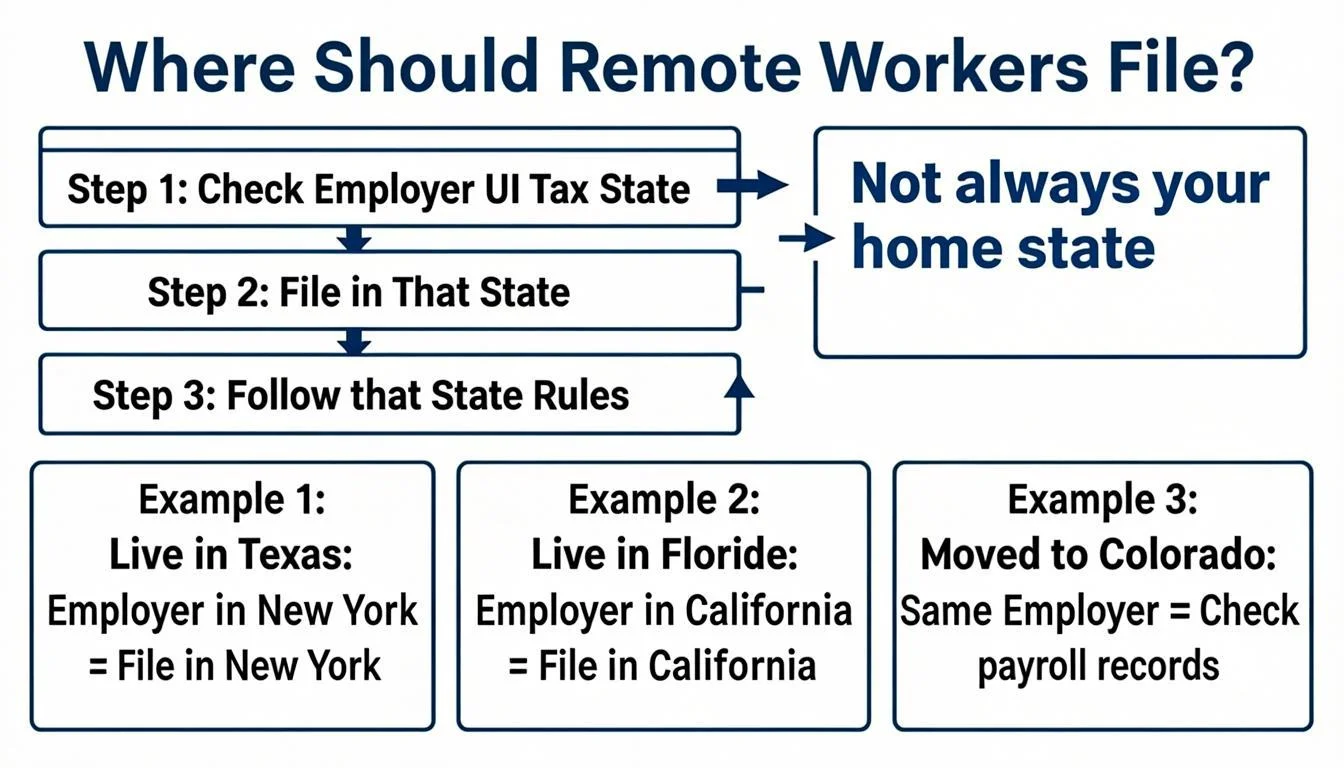
Generally, you file for unemployment in the state where your employer pays unemployment taxes on your behalf — not necessarily the state where you live or the state where your company is headquartered. Most employers pay unemployment taxes in the state where their business is registered, and that is the state whose rules will apply to your claim.
This distinction matters because benefit amounts, duration, and eligibility rules vary significantly from state to state. A remote worker living in Florida (which has no state income tax and relatively modest benefits) but whose employer pays into New York's unemployment system would file in New York and receive New York benefit amounts. Understanding how much you can expect to receive depends on identifying the correct state for your claim.
Which State Should Remote Workers File In?
Determining the correct state for your unemployment claim is one of the most important steps in the process. Filing in the wrong state can delay your benefits by weeks or even months. Here are the key factors that determine where you should file.
The State Where Your Employer Pays UI Taxes
The default rule is that you file in the state where your employer has registered and pays unemployment insurance taxes. For fully remote workers, this is often the state where the company's primary office is located or where the business was incorporated. Your employer's HR or payroll department can tell you which state they use for unemployment reporting.
If your company operates in multiple states and has registered in several, they may pay UI taxes in the state designated as your "work state" in their payroll system. This is something you should clarify before you need to file a claim — not after you have already lost your job.
Interstate Claims
If you live in one state but your employer pays UI taxes in another, you may need to file an interstate claim. This process allows you to file in the state where your wages were reported while living in a different state. Most states have agreements that make interstate filing relatively straightforward, but processing times can be longer than in-state claims.
When filing an interstate claim, the benefit rules of the state where you file will apply — including the weekly benefit amount, maximum duration, and eligibility requirements. Your home state's rules do not override the filing state's rules, even though you live there.
Remote Workers Who Relocated
One increasingly common scenario involves remote workers who moved to a different state while keeping the same job. If you started working in California, then moved to Texas while continuing to work remotely for the same employer, your UI taxes may still be paid in California unless your employer updated their payroll records. If you are considering a move, understanding how relocation affects unemployment is essential planning.
Eligibility Requirements for Remote Workers
Remote workers must meet the same basic eligibility requirements as any other applicant, but some of these requirements have unique implications for people who work from home.
You Must Have Earned Enough Wages
Like all claimants, remote workers must have earned sufficient wages during their base period to qualify for benefits. The base period is typically the first four of the last five completed calendar quarters before you file your claim. Your employer's quarterly wage reports — filed with the state unemployment agency — are what the system uses to determine if you meet the earnings threshold.
Remote workers sometimes run into issues if their employer failed to properly report wages to the correct state. If you suspect your wages were reported incorrectly, gather your W-2 forms and pay stubs before filing so you can provide evidence of your earnings.
You Must Be Able and Available to Work
One of the core eligibility requirements is that you must be able, available, and actively seeking work. For remote workers, this means you must be ready to accept suitable employment — whether remote or in-person — immediately. Being available for part-time or full-time work is sufficient; you do not need to limit yourself to only remote positions.
Some remote workers mistakenly believe they only need to search for remote jobs. This is not the case. Your work search must be genuine and reasonable, but it can include remote, hybrid, and in-person opportunities. The job search requirements vary by state, but most require a minimum number of work search activities per week.
You Must Be Unemployed Through No Fault of your Own
The reason for your job separation determines whether you qualify for benefits. If you were laid off due to company downsizing, a project ending, or financial difficulties at your employer, you should qualify. If you quit your remote job voluntarily, you will face a higher burden of proof to show you had good cause — just like any other worker who resigns.
Remote-specific situations that might constitute good cause for quitting include an employer unilaterally requiring a return to office when your original agreement was remote-only, significant changes to your compensation or working conditions, or unsafe working conditions that your employer refused to address. Each state evaluates these claims individually.
Common Challenges for Remote Workers Filing Claims
While remote workers are entitled to the same benefits as other employees, they face some challenges that can make the process more difficult.
State Confusion and Misfiling
The most common mistake remote workers make is filing in the wrong state. If you file in your home state but your employer paid UI taxes elsewhere, your claim will be denied or delayed while the agency sorts out the jurisdiction. Always confirm with your employer which state they use for unemployment reporting before filing.
Wage Reporting Issues
Some employers — particularly smaller companies new to remote work — may not properly report wages to any state unemployment system for their remote employees. This can create problems when you try to file a claim and the system shows no wages on record. If this happens, you will need to provide your W-2 and pay documentation to the agency, and in some cases, your employer may face penalties for non-compliance. Understanding common application mistakes can help you avoid these pitfalls.
Proving Availability for Work
Remote workers sometimes struggle to demonstrate they are available for work, especially if they live in a rural area with few local employers. The key is to document your remote job search thoroughly — include applications to companies that offer remote positions, records of virtual interviews attended, and networking activities. Maintaining a detailed job search log is essential.
Remote Contractors vs. Remote Employees
Not all remote workers are employees. Many are classified as independent contractors, freelancers, or gig workers — and this classification has major implications for unemployment eligibility.
Traditional W-2 employees have unemployment taxes withheld from their paychecks and are covered by their employer's UI insurance. Independent contractors (1099 workers) do not have these taxes withheld and are generally not eligible for state unemployment benefits. If you are unsure of your classification, check your tax forms — W-2 means employee, 1099 means contractor. This is a critical distinction explored in detail in our guide on self-employment and unemployment.
However, some contractors who are misclassified — meaning they should be employees based on their working relationship but are treated as contractors by their employer — may be able to challenge their classification and qualify for benefits. This process involves filing a claim and allowing the state to investigate your employment relationship.
Filing Tips Specifically for Remote Workers
If you are a remote worker preparing to file for unemployment, these tips can help streamline the process and avoid common problems.
- Confirm your filing state: Contact your employer's HR or payroll department to verify which state they use for unemployment reporting. File in that state, not necessarily your home state.
- Have your wage documentation ready: Gather your W-2, final pay stubs, and any employment agreements that specify your remote work arrangement. This protects you if your employer contests your claim.
- Document your job search broadly: Apply for both remote and in-person positions. Keep records of every application, interview, and networking contact. Many states accept networking and job fairs as valid work search activities.
- Understand your state's work search requirements: Some states require a specific number of job applications per week. Others accept a combination of activities including resume updates, skills training, and networking. Know what your filing state expects.
- File promptly: Do not delay filing because you are unsure about the process. Most states allow you to file online, and backdating your claim is possible but not guaranteed. File as soon as possible after losing your job.
What About Fully Distributed Companies?
Fully distributed companies — businesses with no physical office where all employees work remotely — present an interesting case for unemployment. These companies must still register for and pay unemployment taxes in at least one state, and typically in every state where they have employees.
If you work for a fully distributed company, your employer should be paying UI taxes in your state of residence or in a designated state in their payroll system. When in doubt, ask your employer directly. Companies are legally required to properly handle unemployment insurance for all their employees regardless of work location.
Hybrid Workers and Unemployment
Hybrid workers — those who split time between working remotely and working in an office — follow the same rules as fully remote workers for unemployment purposes. The key factor is still which state your employer pays UI taxes in, not where you physically perform your work on any given day.
For hybrid workers, the transition to full unemployment is sometimes smoother because they may have stronger local professional networks and easier access to in-person job opportunities. However, the eligibility requirements and benefit calculations are identical whether you were fully remote, hybrid, or fully in-office.
Your Rights as a Remote Worker
Remote workers have the same protections under unemployment insurance law as any other covered employee. You cannot be denied benefits simply because you worked remotely. Your employer cannot contest your claim solely on the basis of your remote work arrangement. And you have the right to appeal any denial through the same process available to all claimants.
If you believe you have been wrongly denied benefits because of your remote work status, contact your state's unemployment agency for guidance. Many states also offer free legal assistance through legal aid organizations that specialize in employment law. Understanding what actually disqualifies you — as opposed to what you might fear disqualifies you — is the first step toward a successful claim.
The growth of remote work has created new questions for the unemployment system, but the fundamental principles remain the same. If you lost your job through no fault of your own and you earned enough to qualify, you are entitled to benefits — whether your commute was five minutes or zero. Prepare carefully, file in the correct state, and document your work search, and you will be well positioned to receive the support you deserve during your transition back to employment.