
Arizona runs one of the simplest unemployment formulas in the country, and 2026 math works like this: take your single best-paid quarter, divide it by 25, and that is your weekly check, up to a hard ceiling of $320. Nothing about the calculation hides behind multipliers or averages across four quarters. The trade-off is that the program asks more of you after the filing button: a waiting week comes first, four documented work-search activities on four different days are due every week, and the state audits those logs for up to two years.
Arizona pays $200 to $320 per week in 2026, calculated by dividing your highest quarter of base-period wages by 25, for up to 24 weeks while the state unemployment rate sits below five percent. The first certified week serves as an unpaid waiting week, and the total pot can never exceed one-third of your base-period wages. (Arizona DES, checked October 26, 2026)
This guide walks the full 2026 system: the exact math DES applies, the eligibility gates, the filing sequence, the weekly certification rhythm, part-time earning rules, appeals, and the tax bill. Every number below was pulled from Arizona DES and the state statute in late October 2026, so you can plan with figures that match what a determination letter will actually say.
| Item | Arizona 2026 value |
|---|---|
| Maximum weekly benefit | $320 (reached at an $8,000 best quarter) |
| Practical floor | $236, set by the $5,900 best-quarter wage gate |
| Standard duration | 24 weeks at the current unemployment rate; statute allows 26 at 5% or higher |
| Waiting week | Yes, one unpaid week first |
| Work search requirement | 4 activities per week on 4 separate days, logged |
| Part-time earning cutoff | First $160 of weekly wages ignored |
| State tax on benefits | Yes, flat state rate with no withholding option |
The Arizona Math: One Quarter, Divided by 25
DES looks at your base period, takes your strongest quarter and divides that figure by 25. A warehouse loader in Phoenix who pulled in $7,500 between January and March gets $300 a week. A restaurant manager with a $6,200 best quarter gets $248. The division never changes, which makes your determination letter easy to check with a phone calculator before DES even mails it.
Two boundary rules shape the result. At the top, no weekly amount can pass $320, so every best quarter above $8,000 lands on the same ceiling; the extra wages buy duration, not a bigger check. At the bottom, the formula itself has no floor, but the monetary gate does: your best quarter must contain wages equal to at least 390 hours at state minimum wage, which works out to about $5,900 for 2026. Divide $5,900 by 25 and you can see why $236 shows up as the practical starting point on most Arizona determinations.
The 2022 reform is worth one glance because it reset both ends at once. Before July of that year the cap sat at $240 and part-time earnings were deducted more harshly; the rewrite lifted the ceiling to $320 and introduced the $160 weekly disregard that still defines part-time claiming today. Anyone quoting older Arizona numbers online is describing the pre-reform program, and the figures no longer match what DES pays.
Arizona's 2026 Benefit Table at a Glance
The table above compresses the whole program into seven rows, but three of them carry most of the weight in real claims. The $320 ceiling controls the top of the market and hits roughly one in five new claimants, since a $32,000 annual wage spread evenly produces a qualifying quarter. The $5,900 gate is where marginal claims fail, especially for workers with a short or seasonal history. Duration is the row people misread: the 24-week figure is current because the July 2026 unemployment rate came in at 4.9 percent, and the statute stretches to 26 weeks only when that rate crosses five percent.
There is also a brake on the total that rarely gets mentioned. Your lifetime pot under one claim can never exceed one-third of your base-period wages, regardless of how the weeks add up. A claimant maxing the weekly amount needs at least $23,040 in base wages to draw all 24 installments of $320. Lower-wage claimants clear this test easily because their weekly amounts shrink faster than their wage base does.
"I Only Worked Part of the Year": Base Period Rules That Decide Your Claim
Arizona reads your base period as the four most recently completed quarters, skipping the oldest of the last five. File in January through March 2027 and DES examines April 2025 through March 2026. The best-quarter rule makes this unusually forgiving for seasonal workers, because one strong summer or holiday quarter can carry an entire claim even if the other three quarters were thin.
Workers who miss the standard gate get one more shot through the alternate base period, the four most recently completed quarters at the time of filing. This rescue matters for anyone who worked steadily for years and then hit a long dry spell before filing. Our guide to base periods and how states read them maps the full calendar with worked filing dates.
One boundary deserves its own sentence: wages from federal employment, military service, or work in another state can sometimes be pulled into an Arizona claim through combined-wage rules, but they never feed the 1/25 division directly. The interstate claim guide explains when filing against Arizona still makes sense and when the other state's program pays better.
What Can You Earn and Still Get Paid?
The 2022 reform gave Arizona the most generous flat clearing in the region. The first $160 of gross wages in any week disappears from the math entirely, so a claimant earning $150 at a weekend catering job collects a full, undiminished check. Everything above $160 is subtracted dollar-for-dollar from the weekly amount, and a week whose earnings reach or pass the weekly benefit pays zero but still counts as a certified week if every other condition is met.
Run one concrete example. A line cook claiming $280 a week picks up two shifts that gross $300. The first $160 vanishes, leaving $140, which comes off the check: $280 minus $140 is $140 payable, plus the $300 in wages. The same cook grossing $280 from work would earn out of payment that week entirely, since earnings meet the benefit level. Either way the gross wages get reported during certification, in the week they were worked, not the week the paycheck lands. Our walkthrough of reporting part-time income covers the reporting traps that generate most Arizona overpayments.
File Through DES Without Losing Days
Arizona files fastest online through the DES portal, and the claim week you can reach runs Sunday through Saturday. Have the last 18 months of employer names, dates, and separation reasons ready before you start, because the application locks after submission and revisions delay the monetary determination. The pre-filing checklist lists every document the application asks for, and the state's own federal UI overview explains the program framework DES operates inside.
Speed matters in Arizona more than in most states for one reason: the waiting week. The unpaid first week is only payable-looking on paper if you certify it, and its clock starts at filing, not at your last shift. Filing the week you lose the job protects a full week of potential benefits that a delayed filing simply burns. Our application mistakes guide collects the filing-day errors that cost Arizona claimants real money, wrong employer details chief among them.
After the application, DES mails a monetary determination showing your base period, your best quarter, and the resulting weekly amount, typically within a couple of weeks. Read it the day it arrives. The appeal clock, the waiting-week sequencing, and the backdate question all hang off the dates printed on that letter, and a determination you dispute quietly for three weeks has already eaten half of some windows.
The Waiting Week Arizona Charges Everyone
Arizona's waiting week is a genuine cost, and it has two edges that surprise claimants. The first week that satisfies every eligibility rule pays nothing, and it cannot be a week in which you earned wages, so a partial first week does not convert into the waiting week and then pay the difference. The second edge: the clock only starts after you file, which is why the filing-day advice above keeps repeating. Someone who sits out three weeks after a layoff and then files has paid for the waiting week out of savings and starts collecting on week four at the earliest.
Our breakdown of how waiting weeks work across states puts Arizona in context: it sits in the middle of the pack, less punishing than the states that never refund the week, more demanding than neighbors that waive it when unemployment rises.
Four Activities, Four Days: The Work-Search Ledger
Each week you claim, Arizona expects at least four work-search activities spread across four different days. Applications, employer interviews, resume submissions, and job-board registrations all qualify, and DES wants each one logged with a date and employer contact in Arizona Job Connection, the state's job-matching system. Registration there is part of the claim itself, not an optional step.
The audit window is where casual claimants get burned. DES may review your records for up to two years after the claim begins, and a week it cannot verify becomes an overpayment notice plus potential fraud exposure. Keep the log current the same evening rather than reconstructing it from memory on Sunday. Our work-search log template shows the fields that satisfy DES reviewers, and the state-by-state work-search comparison shows how Arizona's four-contact rule compares with single-contact states next door.
Refusals interact with this rule too. A suitable job offer you turn down without good cause can end the claim outright, which is why Arizona pairs the search requirement with its own definition of acceptable work. The suitable-work guide walks through when declining is protected and when it is not.
What Happens When the Claim Goes Wrong?
A denial, a disputed separation, or an overpayment notice each carry the same response window in Arizona: 15 days, counted from when the determination went out. The appeal goes in writing through the DES appeal portal or by mail, and the case lands with an hearings office that reviews both sides. Employers who contest a claim trigger the same machinery in reverse, and Arizona schedules a fact-finding where your account competes with the employer's version.
Preparation beats passion in these sessions. Bring the separation paperwork, any termination letters, schedules, and messages that support your account, and treat the hearing like a job interview in tone. Our appeal guide paired with the hearing prep guide covers the evidence that moves decisions, and the employer-contest guide explains what happens when the former employer answers your claim first.
Money keeps or stops moving during the appeal depending on the issue. Continuing to certify every week during the process preserves your rights retroactively if you win; skipping certifications while waiting for a hearing date is the most expensive mistake in the Arizona appeals playbook.
How Long the Money Lasts
Twenty-four weeks is the operative maximum while Arizona's unemployment rate stays under five percent, and it has been the number to plan around since the duration schedule was rewritten. The statute stretches to 26 weeks if the rate reaches five percent or more for the relevant quarter, a threshold Arizona has brushed in recent downturns without holding for long. Since the July 2026 reading came in at 4.9 percent, treat 24 as the number until DES says otherwise.
The one-third pot brake from earlier interacts with duration in a way worth planning around. A $320-a-week claimant with $25,000 in base wages hits the $8,333 pot ceiling after 26 theoretical weeks, so the pot, not the calendar, ends the claim at week 26 minus rounding, right around the same place the 24-week cap lands. Lower weekly amounts can run out of weeks instead, which makes the benefit-period maximization guide useful reading before you file rather than after the letters start.
When the pot empties, federal extended benefits are the only automatic cushion, and those trigger only in high-unemployment periods. The extended-benefits trigger guide tracks which states currently qualify and what happens to a claim that exhausts mid-trigger.
Taxes: The Flat State Rate With No Withholding Switch
Arizona taxes unemployment benefits at its flat income tax rate, and unlike most states it offers no option to withhold state tax from your weekly checks; the state's share comes due when you file in April. Federal withholding is a different story: the application includes a 10 percent election, and claiming a $7,680 maximum pot with the election turned on sends $768 to the IRS during the benefit year. The state's share on that same pot runs about $192.
DES issues a 1099-G each January covering everything paid the previous year, and both the federal return and the Arizona return need that figure. Our unemployment tax guide covers the withholding math and the safe-harbor question, and the benefit-exhaustion guide explains how partial-year income shifts the picture.
Check Your Determination the Day It Lands
Every Arizona claim produces three documents worth same-day attention: the monetary determination, any separation adjudication notice, and the waiting-week confirmation. The monetary determination shows the best quarter DES used, the division result, and the duration granted, and all three are re-derivable from this guide's formula. A wrong best-quarter figure is the most common error, usually a missing employer in the wage record, and DES corrects wage-reporting mistakes on sight of a pay stub or W-2.
Separation adjudication notices deserve the same speed, since they carry their own response path and the employer's version of the separation often arrives attached. Claimants who answer with documents in the first week rarely see the extended timelines that quiet non-responses produce. The employer-contest guide and the pre-filing checklist together cover the paperwork trail from both ends.
Is Arizona's Package Actually Enough to Live On?
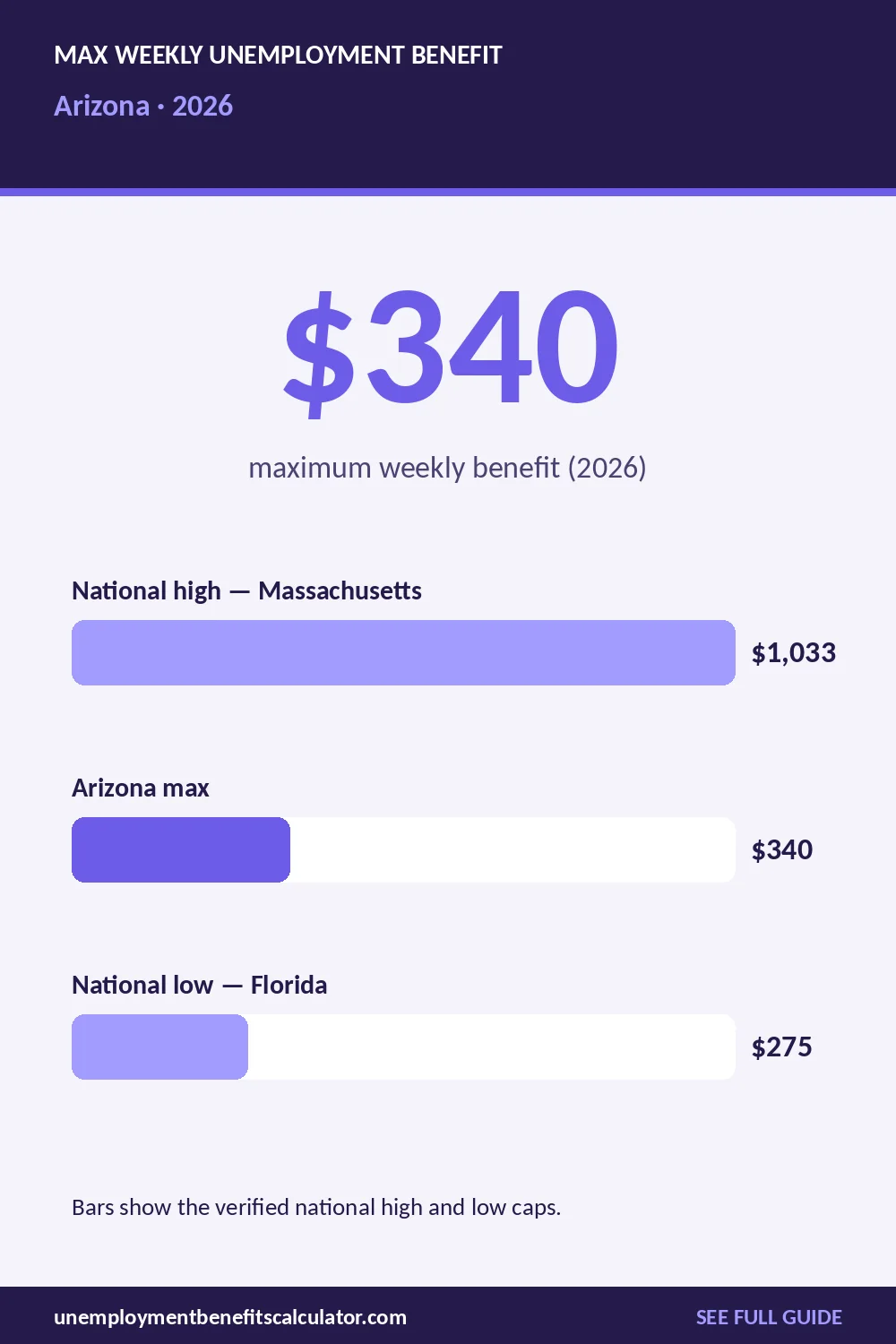
Honesty helps here. A $320 ceiling replaces roughly a third of a modest Phoenix paycheck and less of a Tucson one, and the national median weekly benefit sits higher than Arizona's. The program's real strengths are speed and predictability: the one-line formula, the online filing, and the $160 disregard make it unusually easy to run a part-time bridge while you search. The real weaknesses are the waiting week and the four-contact ledger, both of which punish disorganization more than they punish low wages.
Where Arizona sits in the national table, and how its 24-week duration compares with the 26-week majority, are both mapped in the state comparison guide. If your wages or your job search cross state lines, the interstate rules decide which state's formula, and its ceilings, apply to you.
One limit of this guide belongs on the record: separation adjudication, union contracts, federal-employee claims, and disaster programs each run their own rulebooks that no single guide can fully cover, and a DES caseworker's determination controls your specific case. Use the numbers here to plan and to check DES's work, not to predict an adjudicator's decision.
Two worked examples close the loop. A Tempe barista with a $6,200 best quarter lands at $248 a week, clear of the $5,900 gate with room to spare, and her $236-to-$320 arithmetic needs no DES phone call to verify. A flagging-economy construction worker with $9,600 in his best quarter divides to $384, hits the $320 ceiling anyway, and needs $23,040 of base wages to draw the full 24-week pot, which his $34,000 year clears comfortably. Same formula, two different bottlenecks: the barista's claim lives or dies on the wage gate, the construction worker's on the ceiling and the pot brake.
The math and the ledger are both manageable, but they only work together: the formula pays you fairly once, and the four-contact discipline keeps it flowing for all 24 weeks. File the week the job ends, register in Arizona Job Connection the same evening, and treat every determination letter as something to read on the day it arrives. The caveat worth carrying forward: Arizona's unemployment-rate trigger can stretch the calendar to 26 weeks, but no part of this program rewards waiting to find out.
Frequently Asked Questions
How much is unemployment in Arizona in 2026?
Weekly benefits run from about $236 at the practical floor to the $320 maximum. DES divides your single best quarter of base-period wages by 25, so an $8,000 quarter reaches the cap and a $5,900 quarter, the minimum-wage gate, lands near the bottom of the range. A claim filed in January reads a base period that can stretch back nearly two years, so gather wage records before you file rather than after.
How many weeks does Arizona unemployment pay?
Up to 24 weeks while the state unemployment rate stays below five percent, and the statute stretches to 26 weeks if the rate reaches five percent or higher. The July 2026 rate of 4.9 percent keeps 24 weeks as the working maximum, and the total pot can never pass one-third of your base-period wages.
What are the work search requirements in Arizona?
Four documented work-search activities per week, completed on four different days, logged with dates and employer contacts in Arizona Job Connection. DES can audit the records for up to two years after your claim begins, so keep the log current rather than rebuilding it from memory.
Does Arizona tax unemployment benefits?
Yes. Arizona applies its flat state income tax rate to benefits, and unlike most states it offers no option to withhold state tax during the year. Federal withholding is optional at 10 percent, elected when you file, and DES reports the total on a 1099-G every January. Between the flat rate and the missing withholding option, the practical move for most claimants is the 10 percent federal election plus a small quarterly set-aside.
What can you earn in a week and keep the check coming?
Yes. The first $160 of gross wages in a week is ignored entirely, so earnings under that line never reduce the check. Wages above $160 come off dollar-for-dollar, and a week whose earnings meet or pass your weekly benefit pays zero for the week yet still logs as a certified week.
What is the deadline to appeal an Arizona unemployment denial?
Fifteen days, counted from the mailing date printed on the notice. Appeals go in writing through the DES appeal portal or by mail, and keep certifying through the appeal, because certified weeks convert to retroactive payments if the decision flips.