
The oldest myth in Louisiana unemployment circles still gets repeated at every job fair from Shreveport to Houma: that the program pays a flat 26 weeks no matter what. That claim expired on January 5, 2025, when the state rewrote its duration rule, and the claimants who keep planning around the old number are budgeting for money that no longer exists. The 2026 program pays a weekly figure between $35 and $275, multiplies it by a week count the state sets between 12 and 20 from recent unemployment averages, and asks five documented work search activities a week from anyone filing this year.
Here is the 2026 reality in one paragraph. Louisiana computes your weekly benefit at one twenty-fifth of your highest base-period quarter, clamped between a $35 minimum and a $275 maximum. A claim filed on or after January 5, 2025 carries a maximum benefit amount equal to 12 to 20 times that weekly figure, set by the average of the three most recently published statewide unemployment rates. Work search now means five logged activities every week for claims filed on or after January 4, 2026, and every determination carries a 15-day appeal clock that skips weekends and holidays. (Louisiana Workforce Commission published FAQ, checked October 27, 2026)
This guide walks the claim in the order a Louisiana claimant actually lives it: the wage math before filing, the HiRE application, the first unpaid stretch, the weekly certification rhythm, the five-activity search log, the week-count math, part-time earnings, appeals, and the January tax paperwork. At each step the guide names the stale belief that costs the most at that stage, because most Louisiana claim mistakes in 2026 are versions of the same error, planning against a program that changed.
| Item | Louisiana 2026 value |
|---|---|
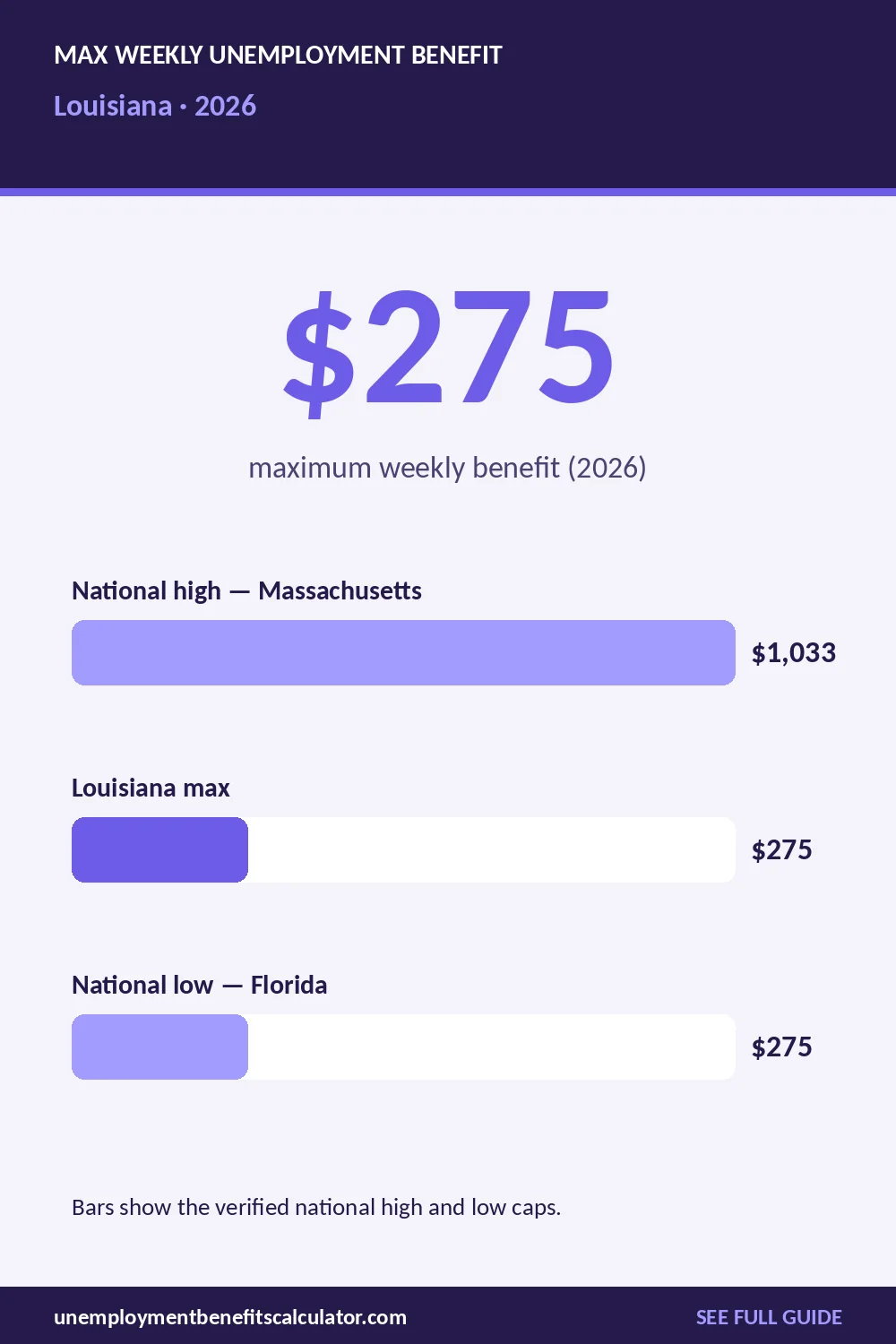
| Maximum weekly benefit | $275 per week |
| Minimum weekly benefit | $35 per week |
| Formula | One twenty-fifth of your highest quarter |
| Maximum benefit amount | 12 to 20 times your weekly figure (claims from Jan 5, 2025) |
| Work search requirement | Five documented activities per week (claims from Jan 4, 2026) |
| Appeal window | 15 days, excluding weekends and holidays |
| Where to file | HiRE at louisianaworks.net/HIRE, or 1-866-783-5567 |
Bust the Stale Myths Before They Cost Weeks
Three myths do the damage in Louisiana, and each has a date of death. The 26-week standard claim ended for new filings on January 5, 2025, when the maximum benefit amount became a multiple of your weekly figure instead of a fixed 26-week window. The three-contact work search rule ended for new filings on January 4, 2026, when the requirement rose to five documented activities. And the idea that the weekly amount reflects your whole salary ended long ago: the formula reads only the single best quarter, divided by 25, and nothing above $275 survives the cap.
The myths persist because the state's own older handbooks still circulate as PDFs on forums and in email threads, and because most claimants file once a decade and assume the rules froze. The state's published FAQ is the controlling text, and it states each current rule in a sentence or two, which makes the ten-minute read the cheapest insurance in the Louisiana system. Our duration guide tracks the week-count landscape across all 50 states as the same rewriting wave moves through the South.
One belief survives scrutiny: Louisiana really does remain one of the lowest-paying programs in the country, and the $275 ceiling is the whole ceiling regardless of a six-figure salary. The honest response is planning, not complaint, and the sections below build the plan on the numbers that actually exist.
What the $35 Floor and $275 Cap Actually Price
The division is straightforward. Take the highest-earning quarter of your base period, divide by 25, and clamp the result between $35 and $275. A refinery operator whose best quarter paid $6,875 hits the cap exactly. A hotel housekeeper whose best quarter paid $5,000 lands at $200. A part-time retail worker whose best quarter paid $700 prices at $28, and the $35 floor lifts the figure to the payable minimum, provided the rest of the monetary test holds.
The cap shapes Louisiana claims more than any other single rule, because the state's wages concentrate well below the salaries that other states' ceilings accommodate. A $100,000 salary and a $45,000 salary can produce the identical $275 check, which is why the payment-estimate guide starts from the wage record rather than the salary history. Claimants who want the national frame can compare the ceiling in the maximum-by-state table, where Louisiana sits near the bottom alongside its Gulf neighbors.
The floor matters for thin wage records. A best quarter below $875 would price below $35, and the minimum lifts those claims into a payable range when the broader wage test passes. The monetary-eligibility guide shows the full wage test, and the base-period explainer identifies which four quarters Louisiana reads for a filing made this month.
The HiRE Application, Step by Step
Louisiana runs its claims through HiRE, the online system at louisianaworks.net/HIRE, with a phone line at 1-866-783-5567 for claimants who cannot file online. The application gathers a year and a half of employer records with a separation reason for each, plus the wage questions behind the monetary determination, so the final pay stub, any separation paperwork, and the employer list belong on the desk before the session starts. The pre-filing checklist matches the HiRE screens item by item.
File in the week the job ends. The waiting period, the week count, and the wage record all anchor to dates the claim sets at filing, and every calendar week between the layoff and the filing date is a week no rule ever pays back. Claimants whose last employer sits in Texas or Mississippi should read the interstate guide first, because the wage record's location decides which state's program pays, and the neighboring programs differ enough to matter. Same-week filing is the one move no later fix replaces.
Answer the separation questions exactly. HiRE forwards your account to the employer for its version, and the gap between the two stories is what starts fact-finding, the delay factory behind most slow first payments. The application-mistakes guide ranks the errors by the time each adds, and a plainly told separation story stays out of most of them. Claimants who file by phone should expect the same questions read aloud in the same order.
The determination letter that follows states three numbers together, the weekly figure, the maximum benefit amount, and the week count the multiplier produced, and the after-filing guide maps the full sequence from submission to first deposit. Read all three the day the letter lands, because the budget plan and the appeal clock both start from that document.
Serve the Unpaid First Stretch With Eyes Open
Louisiana keeps an unpaid waiting period at the front of the claim, and the first payable week is therefore not the first certified week. The budget consequence lands on the calendar: a claimant who files the week the job ends sees the first deposit arrive on the far side of the waiting period plus the state's processing rhythm, which together push real money roughly two to three weeks past the filing date. The waiting-week guide compares that front-loaded cost across the states, several of which pay the first week outright.
The waiting period only counts when the weekly certification comes in on time, so the week costs money twice for claimants who skip it. Certify from the first eligible week even though the deposit column reads zero, on the rhythm the certification guide prescribes, and the served week costs exactly what it must and nothing more.
Build the month-one budget with the unpaid stretch inside the frame rather than discovered inside it. A claimant at the $275 cap drawing a 14-week multiplier carries $3,850 of benefits across a calendar that runs at least a week longer, and the rent due in week one comes from savings or the final paycheck either way. The first-payment timeline guide gives the honest calendar from filing to money.
Certify Weekly and Answer the Earnings Questions Cleanly
Weekly certification through HiRE asks the standard questions: whether you worked, how much you earned before deductions, whether you were able to work and reachable by employers, and whether your search activities are logged. The answers release the week's payment or start a review, so the weekly session belongs on the calendar like a shift, at the same time each week, with the confirmation number saved. The certification-questions guide previews every question and the answers that keep a claim clean.
Enter gross earnings in the week the hours happened; the check's clearing date changes nothing, and that habit alone prevents the most common overpayment the state issues. A wage report filed in the wrong week lets the state pay a full benefit once and recover it afterward with a notice attached, a cycle the certification-mistakes guide documents with the exact arithmetic. The wage-reporting guide covers the edge cases, from holiday pay to tip income.
Missed certifications have their own cost in Louisiana, because a skipped week leaves the week unserved and unpaid rather than recoverable later. The missed-deadline guide shows what the loss looks like, and the phone-certification guide covers the fallback when the internet or the device fails on a Sunday.
Log Five Work Search Activities Every Week
The January 2026 rewrite doubled down on the search requirement: claims filed on or after January 4, 2026 carry a five-activity weekly requirement, up from the three the prior generation of claimants ran. The activities live in HiRE's record system, and the audits that follow compare your log against employer reality, so the five entries need company names, dates, and outcomes that a third party could verify. The work-search requirements guide explains the activity types, and the documentation guide shows a log format that survives review.
Five real activities a week is a genuine workload, which is the policy point: the state is pricing idleness out of the program. Applications submitted through HiRE's job matching, interviews attended, reemployment workshops, and registered callbacks all build the week's record, and claimants who front-load the log on Monday find the rest of the week runs on responses rather than searching. The job-fair credit guide explains when an event counts, and the failed-search guide shows what a thin week costs, which is the week's payment and sometimes the claim.
Reconstructed logs fail audits in every state, and Louisiana's five-activity bar gives a reconstructed record five separate points to collapse instead of three, so the habit that survives an audit costs ten minutes on the day of each contact and cannot be substituted later. Keep the log current the day each activity happens.
How Does the 12-to-20 Multiplier Set Your Week Count?
The duration rule is the 2025 rewrite, and it works like this: for claims filed on or after January 5, 2025, the maximum benefit amount equals 12 to 20 times your weekly figure, with the exact multiplier set by the average of the three most recently published seasonally adjusted statewide unemployment rates. Strong economy, fewer weeks; weakening economy, more. The multiplier on your determination letter is the number that controls your claim, and the state's published range is the honest band for planning: at the $275 cap, the pot runs from $3,300 at the 12 multiplier to $5,500 at the 20.
Claims filed before January 5, 2025 keep the legacy 26-week window, which is why the old advice still works for a shrinking group of claimants and fails everyone else. The difference is not cosmetic: at the same weekly figure, the gap between a 12-multiplier claim and the old 26-week claim is more than half the money. The duration guide tracks where Louisiana's new band sits among the states that rewrote their week counts, and the extended-benefits guide covers what activates in a genuine downturn.
Approved training changes the picture where the state approves the program, converting the search requirement into class attendance and sometimes extending the runway. The school-while-claiming guide covers the approval sequence, which runs through the state before enrollment rather than after.
$275 Across the Window: The Budget Math
Concrete numbers make the multiplier real. A dishwasher at a $200 weekly figure with a 14 multiplier carries $2,800 for the benefit year. The refinery operator at the $275 cap with the same multiplier carries $3,850. Neither sum replaces a Louisiana paycheck for long, and both end on the state's schedule rather than the household's, which is why the budget conversation belongs in week one and not week ten. The exhaustion guide covers the transition planning that the week count makes necessary.
The multipliers reward the claimants who read their letters. Two claimants with identical wages filing two months apart can carry different week counts because the statewide average moved between their filings, so the neighbor's experience is not the plan, and the letter is. Claimants who want the mechanics behind the weekly figure itself can run the calculation guide against their own determination.
Dependents add nothing in Louisiana, a fact that surprises families moving from states with per-child allowances. The household budget builds from the bare weekly figure, and the dependent-allowance guide shows which states do pay the add-on for claimants weighing a move during the claim.
Run Part-Time Pay Alongside the Weekly Check
Part-time work coexists with a Louisiana claim when the certification reports every gross dollar for the week the hours happened. The state subtracts the earnings from the weekly figure, and a week whose earnings reach the weekly figure pays zero and still burns one of the multiplier's weeks, a trade the part-time claiming guide works through with real examples. The partial-benefit calculator prices any earnings figure against any weekly amount.
With the week count now as low as 12 in strong economies, the zero-week trap bites harder in Louisiana than in the 26-week states: a heavy part-time week that zeroes the check burns a multiplier week that never comes back. Modest hours that leave a partial check usually stretch the money further, and the earnings-disregard guide plus the reduction walkthrough show both paths week by week.
Suitable work rules apply to offers, not just searches, and a refusal of suitable employment can end the claim on its own track. The suitable-work guide explains when a refusal protects the claim, worth reading before the first offer lands rather than after the determination does.
Appeal Inside 15 Days, Weekends Excluded
Every determination carries a 15-day appeal window that excludes weekends and holidays from the count, which makes it slightly more forgiving than a raw calendar count and no less absolute. The window covers the monetary determination, the separation decision, and overpayment notices alike, and appeals run to a first-level hearing with a written decision after. Miss the window and the determination stands. The appeal walkthrough covers the filing mechanics, and the hearing-preparation guide covers the evidence that moves hearing officers.
The chronology of a Louisiana claim puts appeals in two places: early, when a monetary figure disagrees with your own division math, and late, when a separation dispute or an overpayment notice lands. Both moments run on the same clock and the same evidence discipline, documents over recollection, dates over summaries. Keep certifying through any appeal on the normal rhythm, because the weeks a favorable decision restores are only the weeks certified on time.
Overpayment notices deserve the same 15-day attention. A certification-error overpayment with a clean HiRE log often shrinks on appeal, while an ignored notice ages into refund intercepts. The overpayment response guide frames the choice inside the window.
Taxes: What January's 1099-G Sets Up
Federal income tax applies to every dollar of Louisiana benefits, and the optional 10 percent federal withholding election is the one prepayment lever the claim offers. On the $275 maximum, the election sets aside $27.50 a week, which across a 14-multiplier claim preps $385 toward an April bill that would otherwise arrive whole, a gap the unemployment tax guide works against the quarterly-estimate route.
The 1099-G arrives each January covering the prior calendar year, and its figure feeds the federal return and the Louisiana return's income base. Claimants who declined withholding should run the set-aside math in the fall, not in April, because a full run at the ceiling produces several thousand dollars of taxable income with nothing prepaid. A quick glance at the 1099-G for accuracy protects both returns from a mismatch that follows the filer for years.
Know What the 2026 Program Cannot Do
The honesty section, because the rewrite made some promises smaller: a Louisiana claim replaces a slice of a paycheck, not the paycheck, and the multiplier can end the money in 12 weeks during a strong economy regardless of how the search is going. Claimants separated for documented misconduct or a quit without good cause face adjudication questions no arithmetic settles, which the disqualification guide explains plainly. Severance can delay the claim's start, which the severance guide covers before a signature makes the delay a surprise.
One limit of this guide itself: the multiplier moves with the state's published unemployment averages, so a claim filed well after this October 2026 writing should re-check the week count on the determination letter, which controls over every guide ever written.
Run the Louisiana Checklist Before Week One Closes
- Compute your weekly figure from the best quarter, divided by 25, and check it against the $35-to-$275 band
- File through HiRE in the week the job ends, with a year and a half of employer records ready
- Certify from the first eligible week, on time, including the unpaid waiting stretch
- Log five verifiable work search activities every week, the day each one happens
- Enter gross earnings in the week the hours happen, never in the week the check clears
- Read the determination letter the day it lands and note your multiplier's week count
- Put the 15-day appeal window on the calendar beside every determination
- Elect the 10 percent federal withholding deliberately, or set the April money aside yourself
The checklist compresses everything the 2025 and 2026 rewrites changed into eight lines a claimant can run in an afternoon. Louisiana's program is now smaller and faster than the version most advice still describes, and the claimants who do best treat the determination letter as the plan, the HiRE log as the evidence, and the calendar as the referee. Run the list in order, and the program pays exactly what the current rules promise, for exactly as long as the multiplier says.
Frequently Asked Questions
How much is unemployment in Louisiana in 2026?
Between $35 and $275 per week. Louisiana divides your highest base-period quarter by 25 and clamps the result, so a $6,500 quarter prices at $260 and any history above a $6,875 quarter collects the $275 cap. The minimum rose to $35, which lifts very thin wage histories into a payable range when the rest of the test passes.
How many weeks does Louisiana unemployment pay?
For claims filed on or after January 5, 2025, the maximum benefit amount equals 12 to 20 times your weekly figure, with the multiplier set by the average of the three most recently published statewide unemployment rates. At the $275 cap that band runs $3,300 to $5,500. Claims filed before that date keep the legacy 26-week window.
Does Louisiana have a waiting week?
Yes, the claim carries an unpaid stretch at the front before the first payable week, so the first deposit lands on the far side of that week plus processing. Certify from the first eligible week anyway, because the waiting stretch only counts when the certification comes in on time and skipping it pushes the whole sequence back.
What are the work search requirements in Louisiana?
Claims filed on or after January 4, 2026 require five documented work search activities every week, up from the three the prior generation of claimants ran. Log each activity the day it happens with the company name, date, and outcome inside HiRE, because audits compare the record against employer reality and unverifiable weeks reverse with overpayments attached.
How do you file for unemployment in Louisiana?
Through HiRE, the online system at louisianaworks.net/HIRE, or by phone at 1-866-783-5567 for claimants who cannot file online. The application gathers a year and a half of employer records with a separation reason for each, and the determination letter states three numbers together: the weekly figure, the maximum benefit amount, and the multiplier's week count.
What is the deadline to appeal a Louisiana unemployment denial?
Fifteen days, excluding weekends and holidays, from the mail date on the determination. The window covers monetary decisions, separation disputes, and overpayment notices alike, first-level hearings run with a written decision after, and weeks certified on time during the appeal are the ones a favorable decision restores.