
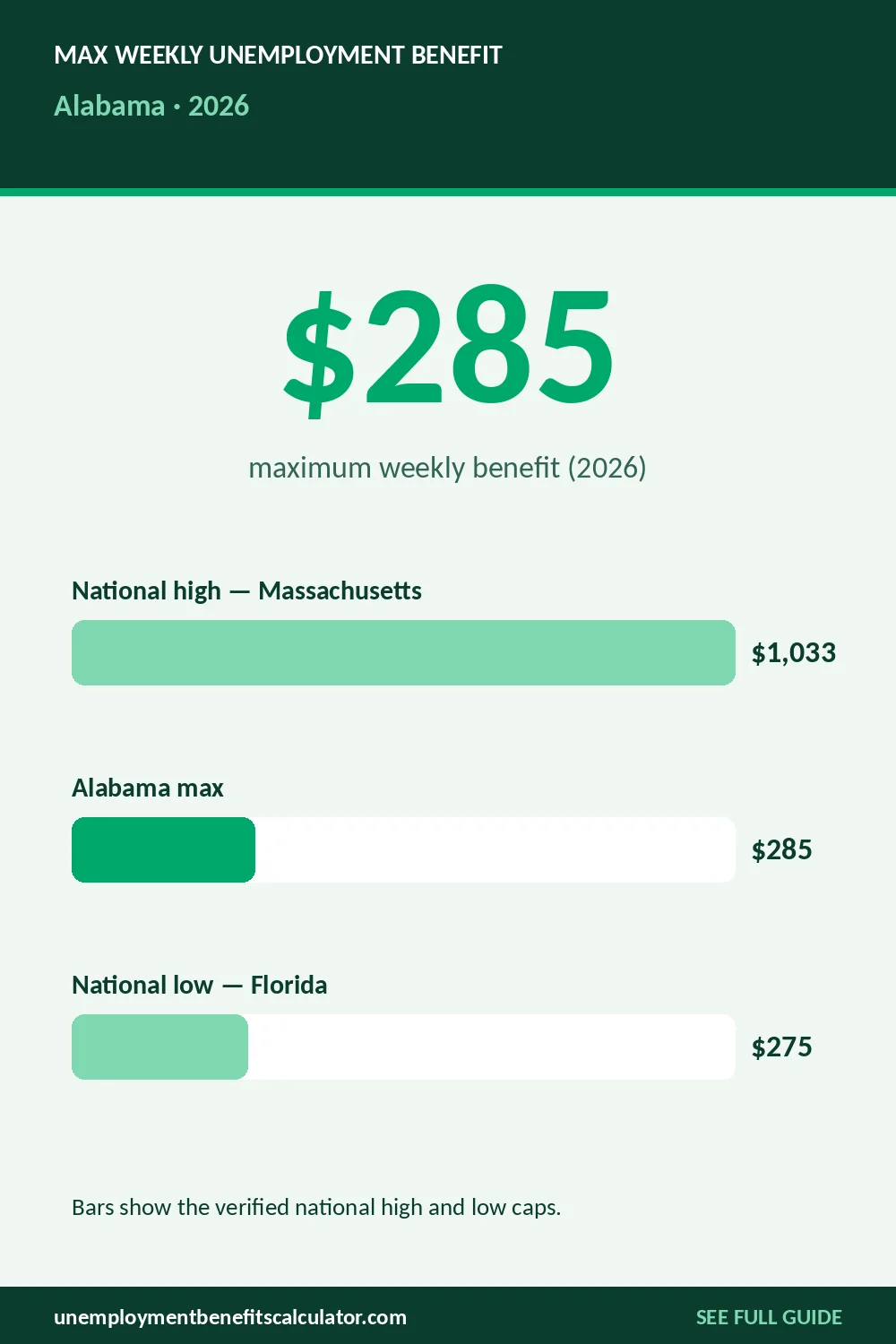
What does Alabama actually pay a laid-off machine operator in Decatur, and how many weeks does the check keep coming? Those two numbers drive every planning decision an Alabama claimant makes, and both sit lower than most neighboring states. The weekly ceiling runs $275, the floor sits at $45, and the standard runway starts at 14 weeks, stretching toward 20 only when Alabama's jobless level climbs past statutory triggers. This guide walks the full 2026 claim from the layoff notice through the final deposit, with the filing sequence, the waiting week, certification rhythm, work search records, and the 15-day appeal clock all mapped in order.
Alabama sets the weekly check at one twenty-fifth of your strongest quarter of base-period wages, bounded by the $45 minimum and the $275 maximum. A highest quarter of $6,250 prices out at $250 per week. The 14-week baseline makes duration the binding constraint for most claimants, since even the maximum check totals $3,850 across the standard window. (Alabama Department of Labor figures, as reflected October 2026)
Everything below follows the same sequence an Alabama claim lives through: the monetary math, the duration rule nobody outside the South expects, the filing steps, the waiting week, the weekly certification habit, the part-time earnings interaction, the regional comparison, appeals, and taxes. Each section names the mistake that costs the most at that stage, because Alabama's short runway turns small delays into real money.
| Item | Alabama 2026 value |
|---|---|
| Maximum weekly benefit | $275 per week |
| Minimum weekly benefit | $45 per week |
| Formula | One twenty-fifth of your highest quarter |
| Standard duration | 14 weeks, scaling up to 20 by statewide unemployment rate |
| Waiting week | One week, unpaid, before payments begin |
| Work search requirement | Documented employer contacts every certification week |
| Appeal window | 15 calendar days, counted from mailing |
What Does Alabama Actually Pay Per Week?
Two bounds frame every Alabama check. The law prices a claim at one twenty-fifth of the highest-earning quarter in your base period, then clamps the result between $45 and $275. A warehouse lead whose best quarter paid $6,875 hits the ceiling exactly. A line cook whose best quarter paid $5,000 lands at $200 per week, which is where a large share of Alabama claims settle, because the state's wage profile concentrates in the middle bands rather than at the cap.
The clamp matters as much as the formula. High earners discover that no amount of past salary pushes the weekly figure past $275, and very part-time histories discover that tiny quarters price below $45, where the minimum lifts them into a payable range or the claim fails the monetary test outright. Both edges get decided on the same determination letter, which arrives after you file and states the weekly figure, the maximum pot, and the week count together.
Run the arithmetic on your own pay stubs before filing, because the letter should match your math. Our benefit formula breakdown shows the same one-quarter division used across most Southern states, and the estimate walkthrough lets you test several wage scenarios in a few minutes. A claimant who predicts $250 and reads $250 on the letter knows the wage record came through clean, which is worth more than the ten minutes the check takes.
How Do Your Four Quarters Build the Number?
The base period reaches through the five most recent calendar quarters and reads the four oldest of them at your filing date, drawing on the wages employers reported into the system across that window. The single highest quarter drives the weekly amount, which makes Alabama one of the states where a strong final stretch before the layoff directly raises the check. Overtime concentrated in one quarter, a bonus paid mid-year, or a short stretch of double shifts all lift the twenty-fifth of the quarter that mattered.
Watch the two failure modes the quarter math creates. First, wages paid as contractor 1099 income sit outside the record entirely, because no UI tax accompanied them, and Alabama cannot count what no employer reported. Second, wages from an employer who filed under a different legal entity than the one you worked for can land in the wrong row until a wage protest corrects them. Our base period explainer maps the quarter windows against filing dates, and the high-quarter comparison shows why states that divide by the full year pay so differently from Alabama's approach.
Anyone whose record looks wrong, missing wages, a ghost employer, or quarters that understate reality, files a wage protest with pay stubs attached rather than appealing the monetary letter blind. The correction changes the input before the weekly amount ever gets contested, which is the cheaper path in every case.
Why Does Alabama's Clock Start at 14 Weeks?
Alabama shortened its maximum duration in 2019 and now ties the week count to the statewide unemployment rate. In normal conditions the program pays 14 weeks, among the shortest standard runways in the country, and the count climbs toward 20 only when Alabama's jobless rate crosses the triggers written into the statute. A claimant filing in a low-unemployment year should plan around 14 weeks and treat anything above it as a bonus that arrives only in a deteriorating economy.
The arithmetic consequence is harsher than the headline. Fourteen weeks at the $275 maximum totals $3,850 for a benefit year, and a $200 claim totals $2,800, sums that need to bridge rent, utilities, and food while the job search runs. Compare that with the 26-week standard most states still pay and the planning gap becomes obvious: Alabama claimants need income replacement to arrive faster, which pushes the job search tempo up from week one. Our duration guide ranks every state's week count side by side.
Two programs modify the clock. Approved training can extend eligibility when the state approves the program in advance, a path the school-while-claiming guide explains in detail. And when Congress or the state activates extended benefits in a genuine downturn, the extended-benefits trigger guide tracks which states turn on the extra weeks and when.
The Filing Sequence: From Pay Stub to Portal
Alabama runs its applications through the online portal at labor.alabama.gov, where a new claim takes most claimants 30 to 45 minutes. Have the final pay stub, the separation paperwork if the employer issued any, and a list of employers from the last 18 months on the desk first, because the application asks for each employer with dates and a separation reason. The pre-filing checklist matches what the form requests line by line.
Timing carries extra weight in Alabama for a reason specific to the short runway: the waiting week only counts once the claim is active, so every calendar week between the layoff and the filing date is a week that produces nothing and comes back for nobody. Filing on the Monday after the last shift keeps the idle gap at zero. Claimants who lost work in another state within the past 18 months should read the interstate-claim guide before choosing which state's program to file against, because the wage record location decides the answer.
Answer the separation questions exactly as the events unfolded. Alabama contacts the employer for its version of the separation, and when the two accounts disagree, fact-finding begins, which is the single biggest source of delayed first payments in every state. The application-mistakes guide catalogs the errors in order of how much time each one adds. A screenshot of the portal's confirmation page closes the loop.
Serve the Waiting Week Knowing What It Costs
Alabama keeps a one-week waiting period at the front of every new claim, and the week pays nothing. The mechanics are simple and the planning impact is real: the first check covers week two of the claim, so a claimant who files the week the job ends sees money start roughly two to three weeks later than the filing date, in line with the state's processing rhythm. The waiting-week guide compares how each state treats that first week, because a handful of neighbors waive it entirely.
The waiting week still counts as a served week even though it pays nothing, and it does not consume one of the 14 payable weeks. That distinction matters for the budget: the maximum pot in Alabama is the weekly figure multiplied by the payable weeks, and the waiting week sits outside that product. Claimants who budget from the determination letter's stated maximum already account for it correctly.
One adjacent rule protects the impatient: do not skip certifying during the waiting week. The week only counts as served when the weekly certification comes in on time, so certify from week one, every week, exactly as the certification guide prescribes.
Certify Every Week Like a Payroll Task
Weekly certification asks whether you worked, how much you earned before deductions, whether you were able to work, available for openings, and whether you made your required search contacts. Alabama pays on a weekly rhythm tied to the claims portal, and the answers either release the deposit or start a review, so treat the weekly session as a fixed calendar item rather than a chore that moves around. The certification-questions guide previews every question along with the answers that hold a file together.
Enter the week's gross pay under the week the hours actually happened; the date the paycheck clears carries no weight. This single habit prevents the most common overpayment in the system: wages slotted into the wrong week let the state pay a full benefit once and then recover it, notice attached. The wage-reporting guide walks the trickier wage cases, while the missed-deadline guide prices a late certification, which in Alabama is a whole week's check with no guarantee of recovery.
Keep the confirmation screen or reference number from every certification, because when a deposit goes missing the reference proves you filed on time. The delayed-payment guide lists the escalation order, and the claim-status guide shows where the portal displays what the state actually received.
Log Work Search Contacts That Survive an Audit
Alabama requires a genuine, documented search for work during every week you certify, and the state audits contact records against employer reality. Keep a dated log with the company name, the position, the method of contact, and the outcome for every application or interview, because when the audit letter arrives the log is the evidence that keeps weeks payable. The work-search requirements guide covers what states generally accept as a valid contact, and the documentation guide shows a log format that passes review.
Quality beats volume in the log's usefulness. Three contacts with real openings that match your trade survive an audit; twenty listings pasted from a board with no dates do not. The state can reverse weeks it cannot verify, with an overpayment riding along, which converts a sloppy log from a nuisance into a debt. Claimants who also attended a hiring event or a reemployment workshop can record those activities where the state's rules allow, and the job-fair credit guide explains when events count.
Combine Part-Time Pay With a Partial Check
Part-time work and an Alabama claim coexist when the weekly certification reports every dollar of gross earnings for the week the hours happened. The state subtracts those earnings from the weekly benefit, and a week whose earnings reach the weekly figure pays zero while still counting against the week count, which is the trap for claimants who take a heavy week and expect it to be free. The part-time claiming guide works through the tradeoff, and the partial-benefit calculator shows the reduced check for any earnings figure.
The strategic view in Alabama differs from longer-duration states: with 14 weeks on the clock, a claimant who strings together part-time weeks keeps the balance unburned only for weeks that paid nothing, so the income mix matters. Modest part-time pay that leaves a partial check stretching the runway usually wins; a full-time-equivalent week that zeroes the check while burning the week rarely does. Our earnings-disregard guide and the reduction walkthrough show the arithmetic both ways.
Refusing suitable work while claiming is its own disqualification path, and Alabama defines suitability around prior training, experience, and the wage the market pays for similar work. The suitable-work guide explains when a refusal protects the claim and when it ends it, which is worth reading before the first offer arrives rather than after.
$45 to $275: Where Alabama Sits in the Region
The regional picture frames what the ceiling means in practice. Georgia's higher ceiling pays noticeably more per week for identical wage histories, while Mississippi's program sits at the bottom of the national table, and Tennessee and Florida both land near Alabama's band with their own duration rules. A claimant near the state line with cross-border work history faces a genuine choice of program, which the state comparison and the maximum-by-state table lay out in full.
Inside Alabama, the $45 floor deserves attention from minimum-wage and near-part-time workers, because a small legal wage record can produce a payable check that still counts as real benefits. The minimum-wage claiming guide covers how the floor interacts with thin wage records, and the monetary-eligibility guide shows the two-quarter wage test that decides whether any check exists at all.
Dependents do not add money in Alabama, unlike the per-child allowances several larger states pay. Families planning around a benefit amount should compute from the bare formula and treat any dependent allowance as a state-specific bonus they will not see here, a rule the dependent-allowance guide maps across the states that do pay it.
Appeal a Denial Within 15 Calendar Days
Every determination letter, the monetary figure, the separation decision, an overpayment notice, carries a 15-calendar-day appeal window from the mailing date, and the window is unforgiving. The appeal files with the state's appeals office, first-level hearings run by phone with a hearing officer, and the written decision follows. Miss the 15 days and the determination stands final, which is why the letter gets read the day it arrives in this guide's sequence. The appeal walkthrough covers the filing mechanics and the hearing-preparation guide covers the evidence.
Documents win Alabama hearings more often than testimony does. Pay stubs that contradict the wage record, a layoff letter that contradicts the employer's misconduct story, schedules that contradict an availability allegation: each piece of paper answers one allegation completely. Keep certifying through the appeal on the normal weekly rhythm, because the weeks that come back retroactively are exactly the ones certified on time, a principle the appeal decision itself will restate.
Overpayment notices carry the same 15-day window and deserve the same treatment. A certification-error overpayment with a defensible record often shrinks or disappears on appeal, while an ignored notice ages into tax-refund intercepts. The overpayment response guide lays out the appeal-versus-repay decision before the deadline makes it for you.
Taxes on an Alabama Claim: Federal First
Federal income tax applies to every dollar of Alabama benefits, and the state offers an optional 10 percent federal withholding election at filing or later through the portal. On the $275 maximum, the election sets aside $27.50 weekly, the gap between a routine April and a four-figure surprise bill, a sum the unemployment tax guide measures against the safe-harbor rules and the quarterly-estimate alternative.
Alabama currently leaves unemployment compensation out of its state income tax base, so the 1099-G that arrives each January matters for the federal return first. Check the state's current tax-year instructions when filing, because the state tax treatment is a legislative choice that can change. The 1099-G itself is worth a glance for accuracy, since an inflated figure creates a mismatch that follows both returns.
Know What a 14-Week Claim Cannot Fix
Honesty section, because the short runway breeds false confidence: $275 a week is not replacement income for most Alabama households, and 14 weeks ends whether or not the search has landed anything. Claimants separated for documented misconduct or a quit without good cause face adjudication questions no math can settle, and the disqualification guide explains those tracks plainly. Severance packages can delay the claim's start entirely, which the severance guide covers before a signature turns the delay into a surprise.
One limit of this guide itself: Alabama ties the duration figure to the statewide rate and adjusts program parameters on the state's own cycle, so a claim filed well after this October 2026 writing should re-check the week count and ceiling against the determination letter, which always controls.
Read These Alabama Guides Next
The natural next reads depend on where your claim stands today. If the layoff just happened, start with the online filing guide and the first-payment timeline, because the two weeks you control are the filing date and the certification habit. If the number on your determination letter looks wrong, the calculation guide and the wage-protest path come first. If the clock is the worry, the runway-management guide shows how part-time mixes stretch a 14-week balance in practice.
Alabama's program rewards the same behavior every week: file fast, certify on time, log every contact, read every letter. The ceiling is fixed and the clock is short, which makes the claimant's own discipline the only variable that moves. Run the sequence in order and the system pays exactly what it promised, on the weeks it promised, with nothing left on the table at the end.
Frequently Asked Questions
How much is unemployment in Alabama in 2026?
Between $45 and $275 per week. Alabama divides your highest base-period quarter by 25 and clamps the result, so a $6,250 best quarter prices at $250 while any history above a $6,875 quarter collects the $275 cap. The determination letter states your exact figure along with the maximum pot and the week count.
How many weeks does Alabama unemployment pay?
The standard claim runs 14 weeks, and the count climbs toward 20 only when Alabama’s jobless rate crosses the triggers written into the statute. Plan around 14 weeks in a normal economy: at the $275 maximum that totals $3,850, which is why the filing date and the search tempo matter more here than in the 26-week states.
Does Alabama have a waiting week for unemployment?
Yes. The first week of the claim serves as an unpaid waiting period, and the first check covers week two. The waiting week does not consume one of the payable weeks, but it must be certified on time to count, so file the claim in the week the job ends and certify from the first eligible week.
Can you work part-time and still get unemployment in Alabama?
Yes. Report every gross dollar for the week the work happened, and Alabama reduces that week's benefit by the earnings. A week whose earnings reach the weekly figure pays nothing while still counting against the week count, so modest part-time hours that leave a partial check usually stretch the short runway further.
Does Alabama tax unemployment benefits?
Federal income tax applies to every dollar, with an optional 10 percent federal withholding election available on the claim. Alabama currently leaves unemployment compensation out of its state income tax base, so the January 1099-G matters for the federal return first, and the state's current-year instructions confirm the treatment each filing season.
What is the deadline to appeal an Alabama unemployment denial?
Fifteen calendar days from the mailing date on the determination, and the window covers monetary figures, separation decisions, and overpayment notices alike. First-level hearings run with a hearing officer, documents beat testimony in most outcomes, and weeks certified on time during the appeal are the ones a favorable decision pays retroactively.