
A restaurant manager in Greenville spent nine years building a $7,800 best quarter before the ownership group sold and the new operator cut her position. Her first calculation after the layoff took under a minute: South Carolina divides that highest quarter by 26, which priced her at $300 a week, and the state's table says the check can run as high as $350 for up to 20 weeks. What she could not see from the outside was the pair of rules that catch South Carolina claimants off guard more than any others, an unpaid first week and a 10-day appeal clock, and both are exactly the kind of detail this guide exists to settle before they cost money.
South Carolina pays between $42 and $350 per week in 2026, computed by dividing your highest base-period quarter by 26, with a maximum benefit amount that covers up to 20 weeks. The monetary gates sit at $1,092 in the highest quarter, $4,455 in total base wages, and total wages at least 1.5 times that best quarter. Every number here reads straight from the Department of Employment and Workforce's published pages, checked October 27, 2026.
The guide follows her claim from the sale notice through the last deposit, because her situation contains nearly every rule a South Carolina claimant meets: the division formula, the three-part wage test, the waiting week, MyBenefits filing, the two-search weekly habit, a contested separation, the 10-day appeal window, and the April tax election most filers discover only when choosing well is no longer possible.
| Item | South Carolina 2026 value |
|---|---|
| Maximum weekly benefit | $350 per week |
| Minimum weekly benefit | $42 per week |
| Formula | Highest quarter divided by 26 |
| Maximum benefit amount | Up to 20 weeks of your weekly figure |
| Waiting week | One unpaid week serves before payments begin |
| Work search requirement | Two searches per week through SC Works Online |
| Appeal window | 10 days to the Appellate Panel |
| State tax withholding | Optional 7 percent election, plus 10 percent federal |
The $350 Ceiling and the Division by 26
The formula is the cleanest in the country: take your single highest-earning quarter from the base period, divide by 26, and that is your weekly figure, clamped between $42 and $350. The manager's $7,800 quarter produced $300. A line supervisor at $9,100 hits the ceiling precisely, and a pharmacy tech at $5,200 lands at $200. Because the divisor is fixed, every South Carolina claimant can compute the exact weekly number from one pay stub per quarter, before the state ever sends a letter.
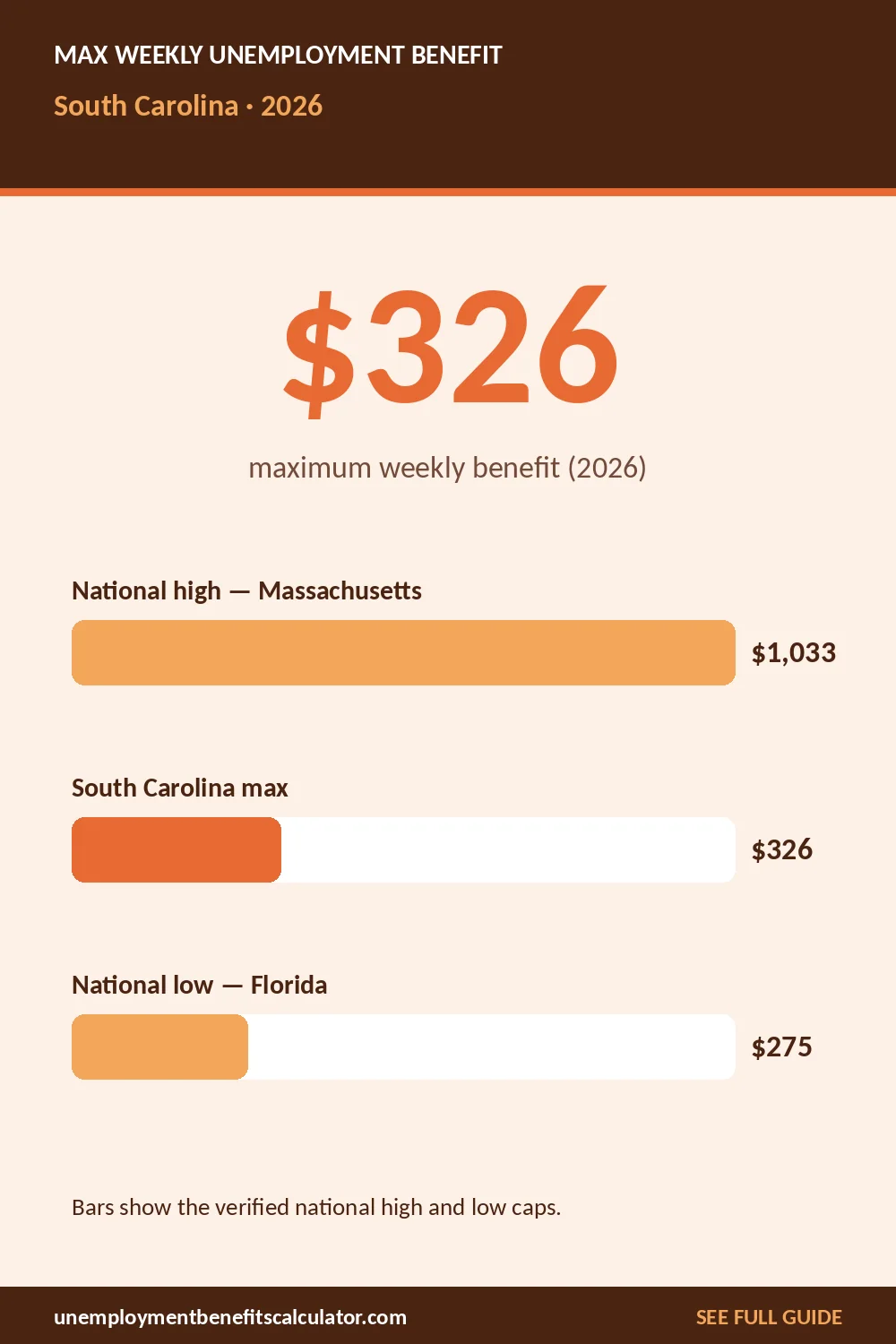
The ceiling binds harder than claimants expect. Any best quarter above $9,100 prices past $350 and gets trimmed to it, which covers a long list of Lowcountry and Upstate professional salaries, so a six-figure earner and a $35,000-a-year worker with one hot quarter can receive the same check. Our maximum-by-state table shows where that $350 ceiling ranks nationally, and the formula guide contrasts the division approach with states that average the full year.
Prediction is the habit that protects the wage record. Compute your own division before filing, and when the determination letter disagrees with your math, the error is usually in the wage rows, not the formula. The calculation guide shows how to read the letter line by line, and a wage protest with pay stubs attached fixes record errors before they harden into a year-long underpayment.
Why the Wage Test Reads 1,092, 4,455, and 1.5
Three monetary gates open a South Carolina claim, and all three read from the same base-period record. Your highest quarter must hold at least $1,092, your total base-period wages must reach $4,455, and the total has to reach one and a half times that best quarter. The numbers interlock: $1,092 is exactly 26 times the $42 minimum, which means a claimant who barely clears the high-quarter gate prices at the floor.
The 1.5-times rule is the one that surprises steady workers. A claimant whose entire history sits in one giant quarter, a seasonal build project, a single huge bonus, fails the test even with a high total, because the other three quarters hold too little. Spread work across quarters matters more in South Carolina than in states that only read the best quarter. The monetary-eligibility guide works the three-gate math against real wage patterns, and the base-period explainer shows which four quarters the state reads when you file.
Contractor income sits outside every gate. 1099 wages carry no UI tax, so they never enter the record, and a W-2 worker with a side gig should not expect the gig to help the claim. Mixed earners can read the 1099 guide for what those years actually qualify for, which in most cases is a different program entirely.
Serve the Waiting Week, Then Draw 20
South Carolina reinstated its unpaid waiting period for claim weeks ending June 19, 2021, and it has applied ever since: the first eligible week of the claim pays nothing, and benefits begin with the second week. The manager's first deposit therefore covered her second certified week, and her planning budget treated week one as a cost of the program rather than a processing delay, which is the correct mental model. The waiting-week guide tracks which states pay the first week and which keep the unpaid rule on the books.
The waiting week gets served through an on-time certification like any other week. Miss that first filing and the week is not erased; it simply stays unserved while the entire payment sequence slides back. Certify from the first eligible week even though the deposit column reads zero, following the certification routine from day one.
Budget across the full window with the waiting week inside the frame: 20 payable weeks at the manager's $300 figure totals $6,000, and the unpaid week in front stretches the calendar span to at least 21 weeks. Claimants who map their fixed bills against the deposit calendar, rather than the benefit year, plan with the right weeks, a margin the duration guide prices against the 26-week standard most of the country still runs.
File Through MyBenefits the Week You Lose Work
The application lives on the MyBenefits portal, and it takes most claimants about half an hour with documents in hand: final pay stub, separation notice if one exists, and 18 months of employer history with dates. File in the same week the job ends, because South Carolina's benefit year starts from the claim's effective date and every calendar week left idle before filing becomes a week the 20-week window never repays. The pre-filing checklist matches the portal's questions item by item.
The separation reason you enter matters more here than in most states, because the 10-day appeal clock starts from determinations that a vague answer helps nobody challenge well. State the facts plainly: the position was eliminated in a sale, the hours were cut, the termination followed an incident, whichever matches reality. The application-mistakes guide ranks the errors by how much time each adds, and mismatched separation stories top the list.
The determination letter arrives with three numbers that control the whole claim, the weekly figure, the maximum benefit amount, and the duration, and the after-filing guide maps the sequence from submission to first deposit. Read it the day it lands and run the division check against your best quarter, because the 10-day window that governs appeals starts from that letter's date, not from the day you got around to opening it.
Certify Weekly and Respect the 14-Day Rule
Weekly certification runs through MyBenefits, and South Carolina puts a hard edge on the timing: a claim week must be certified within 14 days of the week ending Saturday, or the week pays nothing. That is a longer leash than most states allow, but it is absolute, and claimants who batch certifications at the end of the month are the ones who learn the rule from a lost week rather than a paragraph. The missed-deadline guide shows what the loss looks like in practice.
The weekly questions run the familiar list: whether any hours happened, what the week paid before taxes, whether you could start a job and reach employers, and whether the two searches went in. Answer with the week's reality, not the month's average, and keep the confirmation number from every filing, which is the receipt that proves timeliness when a deposit goes astray. The certification-questions guide previews each question together with the answers that hold a file together.
Payments land up to three business days after a clean certification, usually by direct deposit or the state's debit card. The deposit-method comparison covers the tradeoffs, and the delayed-payment guide gives the escalation order when a clean certification produces silence instead of money.
Log Two SCWOS Searches Every Single Week
South Carolina counts its work search in a specific currency: at least two work searches each week you certify, registered through SC Works Online Services at jobs.scworks.org. Searches made outside the system, calls made, resumes emailed directly, do not carry the same proof value, so the habit that survives an audit is the one that runs through SCWOS from the start. The work-search requirements guide compares state systems, and the documentation guide shows a log format that stands up to review.
Treat the two-search floor as a minimum rather than a target. The manager logged four to six SCWOS applications weekly during her search, partly because the state's audit letters arrive without warning and partly because a real search in this market takes more than two swings. A week the state cannot verify gets reversed, and an overpayment lands alongside the reversal, which turns a thin log into a debt, a mechanism the failed-search guide documents with real timelines.
Job fairs, reemployment workshops, and SC Works center visits can carry credit under the state's rules, and claimants who mix in-person activity with portal applications should record both. The job-fair credit guide explains when an event counts as a search and how to capture it in the record.
What Happens When the Employer Contests?
The new owner contested her claim, arguing the separation was performance-based rather than an elimination, and the contest froze her payments the week the protest landed. That freeze is the standard mechanism: a disputed separation stops the deposit stream until a fact-finding interview resolves the two stories, which is why the first days after a contest matter more than the next two months. The employer-contest guide walks the freeze and its exits step by step.
Her file won the dispute because it was assembled before the contest existed: the sale announcement email, the org chart that removed her position, and the final schedule the new owner cut. Documents tied to dates beat recollection in every fact-finding, and claimants who keep the separation paperwork from day one borrow none of the panic. The hearing-preparation guide lists the evidence set that moves adjudicators.
Keep certifying through the freeze on the normal weekly rhythm. Weeks certified on time during a dispute are the weeks a favorable decision pays retroactively, and a missed certification during the freeze converts a win into a partial recovery. The backdating guide explains the narrow paths for repairing missed weeks, none of which are as good as certifying on time in the first place. The freeze rewards the claimant whose weekly rhythm never moved at all.
How Does the 10-Day Appeal Window Work?
Ten days from a determination's date is the entire window to appeal to the Appellate Panel, and it applies to monetary figures, separation decisions, and overpayment notices alike. The manager's route never needed it because the fact-finding went her way, but a denied claim in South Carolina runs on this clock, and the state counts the days from the determination date rather than from whenever the letter gets opened. The appeal walkthrough covers filing mechanics, and the panel hearing itself runs on evidence, which the hearing guide itemizes.
The short window changes the correct response to a bad determination from think-about-it to act-today. File the appeal in writing through the portal the day the decision reads wrong, then assemble the evidence while the hearing date gets scheduled, the reverse of the order most claimants attempt, because a late-filed appeal needs good cause for the delay, a standard the good-cause guide touches from the separation side.
Overpayment notices ride the same 10-day clock. A certification-error overpayment with a clean log often shrinks or vanishes on appeal, while an ignored notice ages into intercepts against state and federal refunds. The overpayment response guide frames the appeal-versus-repay decision inside the same window that governs everything else.
State Tax at 7 Percent: The April Decision
South Carolina benefits are taxable income in both places, and the Department of Employment and Workforce withholds nothing unless you elect it. The federal election runs 10 percent, the state election runs 7 percent, and both get chosen on the initial claim or changed later through MyBenefits. On the manager's $300 weekly figure, electing both sets aside $51 weekly, the gap between a normal April and a bill that eats the refund. The unemployment tax guide runs that same arithmetic against quarterly estimates.
The 1099-G arrives each January covering the prior calendar year, and both the federal and South Carolina returns take its figure. Claimants who declined withholding should run the safe-harbor math early, because a 20-week run at the ceiling produces $7,000 of taxable income with nothing prepaid. The estimation guide includes the tax-set-aside arithmetic that keeps the spring predictable.
Where $350 Ranks Against the Neighbors
The regional frame makes South Carolina's numbers concrete. North Carolina and Georgia both pay higher weekly ceilings for the same wage history, which matters along the Charlotte and Augusta corridors, while the 20-week window sits below the 26-week standard several neighbors keep. A claimant with quarters in two states faces a real program choice, and the state comparison plus the interstate guide settle which state's wages support the claim.
Dependents add nothing in South Carolina, so family budgets should build from the bare division figure rather than the per-child allowances states like Massachusetts pay. The dependent-allowance guide maps which states pay the add-on and how much, which is useful for claimants weighing a relocation during the claim, a topic the moving guide covers from the eligibility side.
The honest limit: $350 a week replaces roughly half of a $35,000 salary and far less of a professional one, and the 20-week window ends on schedule. Build the budget on the determination letter's figures, treat the unpaid first week and the 10-day clock as costs and deadlines that are already priced in, and act on both from the first week out.
Act on the Three Deadlines Before Week One Closes
Everything actionable in a South Carolina claim clusters into three moves, and the manager made all three in her first week out. First, file the MyBenefits claim the same week the job ends, with the separation story told plainly and the documents scanned. Second, set the certification habit for the whole benefit year, on time every week, with the two SCWOS searches logged before each filing. Third, elect the 10 percent federal and 7 percent state withholding deliberately rather than by default, then verify the first deposit against the determination letter's numbers.
The same three moves resolve the state's two traps automatically: certifying from week one serves the waiting week without thinking about it, and the read-the-letter habit catches any determination while the 10-day window is still open. South Carolina's program is arithmetic, and arithmetic rewards the claimants who run it early. Start with the filing guide today, not the week the savings account gets uncomfortable.
Frequently Asked Questions
How much is unemployment in South Carolina in 2026?
Between $42 and $350 per week. The Department of Employment and Workforce divides your highest base-period quarter by 26, so a $7,800 quarter prices at $300 and any best quarter above $9,100 collects the $350 cap. The same division runs on the determination letter, which states the weekly figure and the 20-week maximum together.
How many weeks does South Carolina unemployment pay?
Up to 20 weeks inside the benefit year. The maximum benefit amount covers 20 weeks of your weekly figure, so a $300 claim carries $6,000 across the window. Weeks you skip or work part-time do not burn the balance when certified honestly, and the claim cannot extend past the 20-week structure in normal conditions.
Does South Carolina have a waiting week?
Yes. An unpaid waiting period equal to one full week must be served before benefits begin, a rule the state reinstated for claim weeks ending June 19, 2021 and has kept since. Certify the first week on time even though it pays nothing, because the week only counts as served when the certification lands.
What are the work search requirements in South Carolina?
At least two work searches every week you certify, registered through SC Works Online Services at jobs.scworks.org. Searches made outside the system carry little audit value, so run the weekly pair through SCWOS, keep the records dated, and remember that a week the state cannot verify gets reversed, and an overpayment lands alongside the reversal.
Does South Carolina tax unemployment benefits?
Yes, in both places. The department starts from zero withholding: the 10 percent federal and 7 percent state elections are both opt-in, chosen on the initial claim or later through MyBenefits. The January 1099-G carries the year's total, and a full 20-week run at the $350 ceiling produces $7,000 of taxable income with nothing prepaid unless you elect.
What is the deadline to appeal a South Carolina unemployment denial?
Ten days, to the Appellate Panel, counted from the determination's date rather than the day you opened the letter. The window is among the shortest in the country, so a bad determination gets a written appeal the day it arrives, with the evidence file built while the hearing gets scheduled and certifications continuing throughout.