
Table of Contents
- Florida Reemployment Assistance at a Glance
- How Much You Can Get in Florida in 2026
- Who Qualifies for Florida Reemployment Assistance
- How to File Your Florida Claim, Step by Step
- Weekly Certification and the Five-Contact Rule
- How Long Florida Benefits Last
- Working Part Time While Claiming in Florida
- If Florida Denies Your Claim: Appeals in 20 Days
- Why Florida Claims Get Stuck, and How to Unstick Them
- Florida's Seasonal Economy and Your Claim Timing
- Payments, Direct Deposit, and the 1099-G in Florida
- Taxes on Florida Unemployment Benefits
Florida Reemployment Assistance at a Glance
Losing a job in Florida means filing a Reemployment Assistance claim. The state's name for unemployment insurance, through the CONNECT system run by the state's labor department. Florida runs one of the leanest programs in the country.
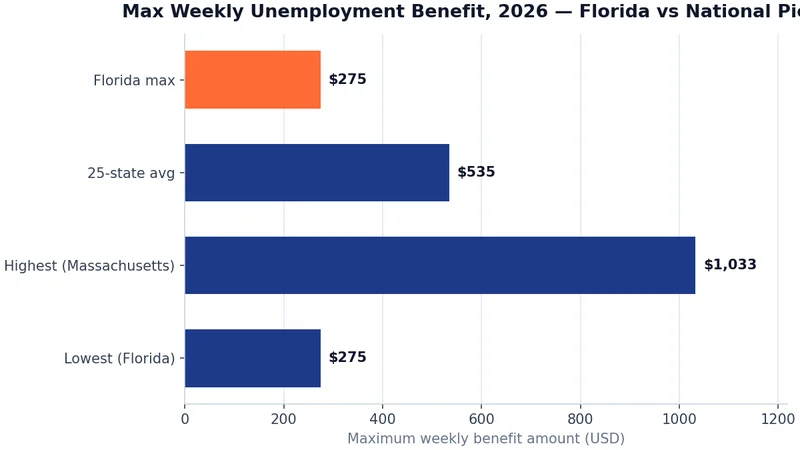
The maximum weekly benefit is $275, the standard duration is 12 weeks. The work search rules are among the strictest in the nation. Claimants who understand those three facts before filing almost always have a smoother experience than those who discover them mid-claim.

The lean structure makes strategy matter more in Florida than nearly anywhere else. A restaurant manager in Orlando and a warehouse selector in Jacksonville can have wildly different wage histories yet collect the same $275 ceiling. The question becomes whether you even reach the cap, how quickly you file.
How cleanly you satisfy the five-per-week work search requirement. This guide walks through the full Florida pipeline. Amounts, eligibility, the CONNECT filing process, weekly certifications, appeals, and the tax picture for 2026.
Florida is also a no-state-income-tax state, which softens the lean weekly amounts a bit at tax time. For a national perspective on how the state compares, the state-by-state comparison guide puts Florida's numbers next to its neighbors. If you're ready to run your own numbers, the Florida unemployment calculator estimates your weekly benefit from your wage history.
How Much You Can Get in Florida in 2026
Florida sets its weekly benefit amount from your highest quarter of wages in the base period. A minimum payment of $32 and a maximum of $275 per week. Because the ceiling sits far below the national average, most mid-wage Florida workers land on.
Near the maximum once their wage history clears the minimum thresholds. The formula rewards a single strong quarter more than a steady average, which matters for workers with seasonal spikes.
| Item | Florida 2026 value |
|---|---|
| Maximum weekly benefit | $275 |
| Minimum weekly benefit | $32 |
| Standard duration | 12 weeks (state law allows up to 23 in severe downturns) |
| Waiting week | One week (unpaid) before benefits begin |
| Work search requirement | 5 employer contacts per week |
| State tax on benefits | None (Florida has no state income tax) |
Twelve weeks is the number that surprises people most. It changes every piece of advice that assumes a 26-week runway. Florida's duration scales with the statewide unemployment rate under state law.
In normal economic conditions it sits at the 12-week floor, roughly half the 26-week standard most states offer. Plan your job search timeline around that reality rather than around the national norm.
The calendar moves fast once the waiting week passes. A casual first fortnight costs a sixth of the entire runway.
Extended Benefits, the federally triggered additional-weeks program that states activate during severe recessions. Can stretch Florida's duration when the state's unemployment rate crosses statutory thresholds.
In ordinary years it is dormant. The Extended Benefits guide explains the trigger math for readers who want the mechanics.
Who Qualifies for Florida Reemployment Assistance
Florida's monetary test looks at your base period. The first four of the last five completed calendar quarters when you file. You need wages in at least two quarters of that window, total base period wages at.
Above a statutory floor tied to your weekly rate. Highest-quarter wages at least 20 times your computed weekly amount.
In plain language: two quarters of real work history inside the lookback window. Enough of it in your best quarter to support a weekly rate above the $32 minimum.
Floridians who quit generally need good cause connected to the work. A compelling personal reason under Florida's specific list, which is narrower than many states. Workers fired for misconduct face disqualification under Florida's statutory definitions, which include attendance and performance categories.
Layoffs, hour reductions, and business closures remain the cleanest fact patterns. The good cause guide and the separation types guide explain how agencies read each scenario.
Non-monetary requirements continue every week you claim. You must be able to work, available for full-time work. Actively seeking it, with the state's five-contact rule documented in CONNECT each week.
Florida also requires online registration with its Employ Florida job-matching system as part of the claim process. It audits contact records aggressively relative to other states. The availability rules guide breaks down what "able and available" means in practice.
How to File Your Florida Claim, Step by Step
File as soon as your employment ends, because Florida pays no benefits for weeks before your application date. The filing channel is CONNECT, the state's online portal, available around the clock except during scheduled maintenance windows. Gather this package before you start, since the portal times out and restarting a half-completed application is a known frustration:
- Your Social Security number and a government photo ID
- Employment history for the last 18 months, with each employer's legal name, mailing address, phone, and dates of work
- Your last pay stub showing gross wages and the year-to-date figure
- Registration on Employ Florida and the account credentials for it
- Direct deposit details or your preferred payment card choice
The application itself walks through your separation reason, your wage history, and your availability questions. Answer the separation questions exactly as they happened.
Your employer receives notice of the claim and gets 21 days to respond with its own account of the separation. Conflicting accounts produce fact-finding questionnaires, which are normal and survivable, but they delay the first payment while they resolve.
After filing, watch for your determination notice in CONNECT and by mail. Complete any fact-finding questionnaire within the stated deadline. The state lists current processing timelines on its site, and first payments typically follow the waiting week once determinations clear.
The general application guide covers the universal preparation steps, and Florida-specific pages of the U.S. Department of Labor's CareerOneStop directory link the current state portal and phone numbers.
Weekly Certification and the Five-Contact Rule
Florida certifies weekly, and the certification asks whether you searched for work, how many employer contacts you made. Whether anything changed in your availability. The five-contact requirement is Florida's signature rule.
Five employer contacts per week, each reported with the employer name, contact method, and date. Contacts must be genuine attempts at jobs you are qualified for, and the state routinely samples records.
Build the log the way the audit reads it. Keep a simple list, five lines per week, with employer, method, date. Outcome, and match it to your CONNECT entries before submitting.
Claimants who treat the five contacts as paperwork theater get caught by the sample. Claimants who actually send five applications a week rarely think about the rule again. The work search log guide shows formats that survive review.
Report every dollar of gross earnings in the week earned, including tips and commissions. Florida's over-earnings threshold sits low against the $275 maximum. Any week where your gross earnings meet or exceed your weekly benefit amount pays zero.
Miss a certification and file it late through the backdating request process with a documented reason. Skipped weeks convert into eligibility gaps faster than most claimants expect.
How Long Florida Benefits Last
Your claim runs from the waiting week through up to 12 weeks of payable benefits at the standard rate. Bounded by your benefit year. The statutory sliding scale can raise the maximum duration toward 23 weeks only when Florida's statewide unemployment rate pushes past trigger thresholds.
Has historically required a severe and sustained downturn. In practical terms, plan on 12 weeks.
Because the runway is short, the sequencing of your job search matters more in Florida. Start substantive applications during your first payable week, not your last. Use the Employ Florida matching system seriously, since its registration is mandatory anyway.
Workers who exhaust Florida benefits still have options to explore: the benefits exhaustion guide lists realistic next steps. Workers with W-2 history in other states can read the interstate claims guide to see whether a second claim is possible elsewhere.
Working Part Time While Claiming in Florida
Florida allows part-time work during your claim, but its math punishes it relative to other states. The state sets your weekly earnings allowance at roughly the minimum wage multiplied by seven hours. An amount in the high $50s per week.
Every dollar above that reduces your check, and earnings at or above your weekly benefit amount zero the week out. At a $275 maximum, a $280 part-time week erases the entire check.
The earnings cliff makes hour-by-hour planning genuinely valuable in Florida. A worker deciding between 8 hours. 20 Hours at $15 an hour is choosing between a reduced check.
A zero-payment week that still burns a week off the 12-week balance. Run both scenarios through the formula before accepting the schedule.
The earnings disregard guide shows the arithmetic. The part-time rules guide covers the availability questions that ride along with reduced schedules.
If Florida Denies Your Claim: Appeals in 20 Days
Florida's determination letter states the reason for any denial. The appeal window is 20 calendar days from the date the determination was mailed. Appeals go to the Office of Appeals within the department, first-level hearings are held by phone.
The record matters more than rhetoric: separation documents, schedules, texts with your employer. Your work search log all enter evidence.
Employer disputes are the most common denial source in Florida, particularly misconduct allegations and voluntary-quit characterizations. Bring documents that anchor the timeline, and answer the referee's questions directly. Workers who miss the 20-day window can request a good-cause extension in writing.
The safer route is filing within days of receiving the determination. The appeal walkthrough and the hearing preparation guide cover the format and evidence list that win cases.
Common Florida-specific mistakes worth avoiding: skipping the Employ Florida registration. Understating gross earnings including tips, logging fewer than five real contacts. Missing fact-finding deadlines because mail went to an old address.
Update your mailing address in CONNECT the day you move. Read the application mistakes guide before filing to clear the rest of the checklist in one pass.
Why Florida Claims Get Stuck, and How to Unstick Them
Florida's most common denial pattern is not a hostile decision; it is an unanswered questionnaire. CONNECT correspondence lives inside the portal rather than only in your mailbox. Claimants who check nothing but their bank account discover the missing-response determination weeks after the deadline.
The habit that prevents nearly all of it: log into CONNECT at least twice a week. Read every message, because each one carries a clock.
The second pattern is the employer contest. Florida employers respond to claims at high rates, and vague separation narratives from either side produce fact-finding interviews. Your counter is documentation discipline: the final schedule showing your availability.
Any write-ups with your written response, texts that contradict the misconduct narrative. The exact words used in your separation conversation. The employer contest guide shows how the exchange works and what wins it.
The third pattern is the five-contact sample. Florida auditors pull certification weeks at random and ask for the employer contacts behind them. A week with four real contacts and one invented line fails the whole week.
Honest loggers survive samples; improvisers do not. If your log genuinely fell short one week, say so on the certification rather than backfilling fiction.
The penalty difference between a shortfall. A misstatement is the difference between a warning and a fraud referral, as the fraud penalties guide details.
Florida's Seasonal Economy and Your Claim Timing
Florida's employment rhythm runs on seasons: tourism peaks in winter, hospitality hiring surges before spring break. The late-summer months thin out across service industries. Claim timing interacts with that rhythm through the base period, which looks back at completed quarters.
A worker laid off in September builds a claim on last fall and winter. A worker laid off in March captures the strong winter season just ended.
Service workers with strong winter quarters should understand that the calendar already worked in their favor by the time they file in spring. The high quarter closed and posted. Workers laid off in the fall face the opposite math.
Should check whether wages from a second employer or a neighboring quarter lift the record. The monetary eligibility guide and the base period guide cover the mechanics. The seasonal certification rules guide explains the between-seasons availability questions.
Hurricane season adds a federal layer unique to Gulf and Atlantic coast states. When the president declares a disaster, Disaster Unemployment Assistance can cover workers whose jobs vanished in the storm. Including self-employed workers who normally fall outside regular benefits.
Florida claimants affected by a named storm should watch for the disaster assistance announcements that follow declarations. The exhaustion guide lists the fallback sequence when regular benefits run dry after a disaster season.
Payments, Direct Deposit, and the 1099-G in Florida
Florida pays weekly benefits by direct deposit or its state-issued debit card. The choice made at filing follows the claim for its life. Direct deposit is the faster and cleaner option for claimants with a bank account.
The card works for the unbanked but adds fee edges that the payment method guide maps out in full. Payment timing follows the certification: file on your assigned day. The deposit typically follows within two to three business days after processing.
The January 1099-G closes the annual loop. Reporting every dollar of benefits paid plus any federal withholding elected during the claim. Florida claimants get the simplest version of the tax picture since no state layer exists.
The tax guide covers the single federal line that matters. Keep the determination letters and the 1099-G together in one folder. Repayment adjustments and verification requests both read against them.
Taxes on Florida Unemployment Benefits
Florida levies no state income tax, so your only tax obligation on benefits is federal. Unemployment compensation is fully taxable federally, and Florida claimants receive a Form 1099-G each January showing total benefits paid. You can elect 10% federal withholding during your claim through CONNECT, which many claimants choose to avoid an April surprise.
The withholding decision is a genuine calculation rather than a default. With no state tax layer, 10% federal withholding often covers a moderate-income claimant's full liability. Higher-income workers with other household income may owe more regardless.
The unemployment tax guide walks through the return lines and the safe-harbor considerations. The payment method guide covers how the money itself arrives. Florida pays by direct deposit or its state debit card.
One practical note closes the loop: Florida's 1099-G also reports any overpayments the state later recovers. Repayment can adjust your taxable benefit figure.
If you repay benefits in a later tax year, the overpayment guide explains the offset rules on your federal return. Is the last piece of the Florida picture most claimants only discover in April.
Frequently Asked Questions
How much is unemployment in Florida in 2026?
Florida pays between $32 and $275 per week, computed from your highest quarter of base period wages. Because the maximum is well below the national average, most workers with solid wage histories land at or near the $275 ceiling.
How many weeks does Florida unemployment pay?
Florida's standard duration is 12 weeks, about half the 26-week norm in most states. State law allows up to 23 weeks only when the statewide unemployment rate crosses statutory trigger thresholds, which requires a severe downturn.
What are the work search requirements in Florida?
Florida requires five employer contacts per week, reported in CONNECT with employer names, contact methods, and dates. You must also register with the Employ Florida job-matching system. The state samples contact records, so keep a written log that matches your certifications.
How long does it take to get first unemployment payment in Florida?
Most Florida claimants receive their first payment two to four weeks after filing, following the one-week unpaid waiting week and any fact-finding delays. Your employer has 21 days to respond to the claim, and disputes pause the first payment while they resolve.
Does Florida tax unemployment benefits?
No. Florida has no state income tax, so only federal taxes apply to your benefits. You receive a Form 1099-G each January and can elect 10 percent federal withholding during your claim through the CONNECT portal.
Can I work part time and still get unemployment in Florida?
Yes, but the allowance is small. Florida lets you earn roughly seven hours of minimum-wage pay per week before reductions begin, and any week where gross earnings meet or exceed your weekly benefit amount pays zero while still counting against your 12-week balance.