
Table of Contents
- New York Unemployment Insurance at a Glance
- How Much You Can Get in New York in 2026
- Who Qualifies in New York
- Filing Your New York Claim, Step by Step
- Weekly Certification in New York
- How Long New York Benefits Last
- Part-Time Work and Partial Benefits in New York
- If New York Denies Your Claim: Appeals in 30 Days
- New York Industry Notes: Service, Construction, and the Gig Edge
- Shared Work and Retraining Options in New York
- A Short New York Checklist Before You File
- Payments, Direct Deposit, and the New York 1099-G
- Taxes on New York Unemployment Benefits
New York Unemployment Insurance at a Glance
New York's unemployment insurance system pays among the higher weekly checks in the country. Delivers them through a comparatively claimant-friendly rulebook. No waiting week, an alternate base period for workers with thin older wage histories, and a straightforward 26-week standard duration.
Claims run through the New York State Department of Labor. Mostly through its online portal with phone filing as the backup channel.

The state's wage replacement formula is generous enough that the question in New York is usually not "will I qualify". "Did the wage record capture everything." Service workers, gig-adjacent employees, and anyone paid bonuses should check their base period math carefully.
New York's benefit amount keys directly off your highest quarter. This guide covers the full 2026 picture: amounts, eligibility, the filing sequence, weekly certifications, part-time math, appeals, and taxes.
New York also taxes unemployment benefits at the state level, which changes the withholding math compared with zero-tax states. For a national frame of reference, the state comparison guide places New York against its neighbors. The New York unemployment calculator runs your own wage history into an estimate before you file.
How Much You Can Get in New York in 2026
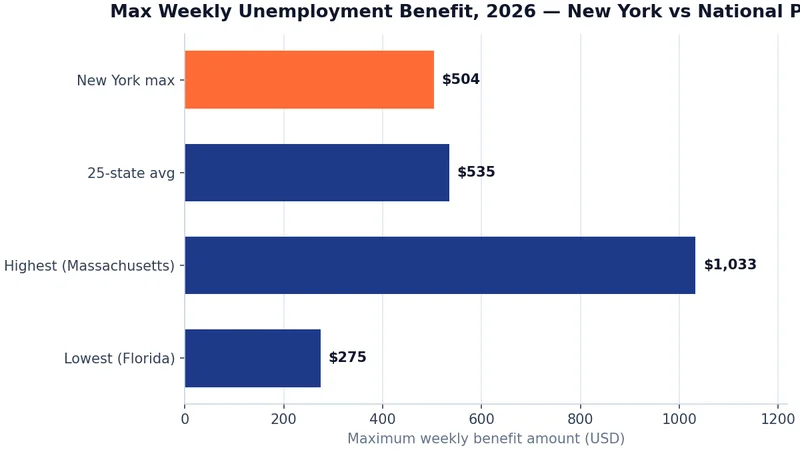
New York computes your weekly benefit as one twenty-fifth of your highest quarter of base period wages. Subject to a minimum around $100. A maximum of $504 per week.
The one-twenty-fifth formula is the whole story. To reach the $504 ceiling you need roughly $12,600 in a single quarter. A bar that full-time mid-wage workers clear routinely and part-time workers usually do not.
| Item | New York 2026 value |
|---|---|
| Maximum weekly benefit | $504 |
| Minimum weekly benefit | About $100 |
| Standard duration | 26 weeks |
| Waiting week | None (payable from the first week) |
| Work search requirement | 3 work search activities per week |
| Alternate base period | Available |
Two features in that table deserve emphasis. First, the absence of a waiting week means week one of your claim is a payable week. Effectively adds a check compared with states that still deduct one.
Second, New York's alternate base period lets the state slide the wage window forward when the standard lookback fails you. A lifeline for recent graduates, returning workers.
Anyone whose strong quarter is the most recent one. The base period guide explains the standard window and how the alternate version differs.
Extended Benefits can stretch New York's duration beyond 26 weeks when federal triggers activate during severe downturns. The program sits dormant in normal years. The Extended Benefits guide covers the trigger mechanics for readers who want the full timeline picture.
Who Qualifies in New York
The monetary test requires enough base period work to produce a weekly benefit above the minimum. Wages spread across at least two quarters of the lookback window.
Workers who fail the standard window should request the alternate base period calculation before giving up. The failure pattern usually concentrates exactly in the quarter the standard window ignores.
Separation rules follow the standard architecture. Layoffs and hour reductions qualify cleanly. Quits need good cause tied to the work or a pressing personal circumstance.
New York's precedent list is broader than most states, covering circumstances like a documented employer relocation that burdens your commute. A workplace condition a reasonable person would leave.
Discharges require the employer to prove misconduct connected with the work under New York's definitions. The good cause guide and the disqualification guide map both tests in detail.
Weekly eligibility adds the able-and-available layer. Physically able to work, available for a substantial number of hours in your usual occupation, and actively looking. New York's work search standard asks for three documented activities per week.
The state accepts a mix of applications, interviews, and job-center services toward the count. The availability guide explains how school schedules, childcare constraints, and physical limitations interact with the test.
Filing Your New York Claim, Step by Step
File in the first week your employment ends, because New York pays no benefits for weeks before your application. Gather the essentials first, since the online application moves quickly and timeouts lose work:
- Social Security number and driver license or non-driver ID
- Complete employer list for the last 18 months with mailing addresses, phone numbers, and employment dates
- Your most recent pay stub and your best guess of last year's gross wages
- Alien registration number if you are not a U.S. citizen
- Bank routing and account numbers for direct deposit
The application asks your separation reason, wage details, and availability questions, then issues a confirmation with your certification schedule. Your employer receives notice and can contest the claim, which triggers a fact-finding interview if the accounts conflict. Answer the interview notice within its deadline, because the determination rides on it.
New York publishes current processing times, and the U.S. Department of Labor's UI program page and CareerOneStop keep the state contact directory current.
Watch for the monetary determination letter, which states your weekly benefit and your maximum benefit amount for the year. If the number looks wrong against your pay stubs, request a wage review immediately with documentation attached. The recompute rules freeze your benefit for 52 weeks once the claim establishes.
Weekly Certification in New York
New York certifies weekly by phone. Online, asking the standard battery: did you work, how much did you earn before deductions, were you able and available. Did you complete your work search activities.
The three-activity standard is modest compared with some states. The state verifies records when auditors sample, so keep the log anyway.
Report gross earnings for the week earned, not the week paid. Include tips and commissions if those are part of your pay structure. New York's partial benefit formula ignores 25% of your gross earnings, which makes it one of the more work-friendly states.
A claimant with a $504 benefit can earn several hundred dollars in a week and still receive a partial check. The disregard guide runs the arithmetic, and the part-time rules guide covers the schedule questions.
Missing a certification window creates a gap week that needs a backdating explanation. New York's portal allows late certifications with a documented reason.
Accepted reasons include hospitalization, outage of the state system, and mailed notices that arrived late. The missed deadline guide walks the repair process step by step.
How Long New York Benefits Last
New York pays up to 26 weeks of regular benefits inside a 52-week benefit year. No waiting week consuming the front of the runway.
Your maximum benefit amount for the year equals roughly 26 times your weekly rate. Weeks with zero payments due to earnings still count against the total in most circumstances.
Because the runway is standard-length and the weekly checks are strong. New York claimants can afford a deliberate job search rather than a desperate one. Use the state's career center services, which also count toward your weekly activities.
Target applications toward your prior occupation first, since New York evaluates suitable work against your background. The suitable work guide explains when a lower-paying offer can be declined without penalty.
If benefits exhaust before the job market cooperates. New York's options include retraining programs and, in federally triggered downturns, Extended Benefits.
The exhaustion guide lays out the sequence. Workers with wage history in a second state can read the interstate claims guide to check for a better-priced claim elsewhere.
Part-Time Work and Partial Benefits in New York
New York's 25% earnings ignore makes it one of the best states for mixing part-time wages with benefits. The formula works like this: your partial payment equals your weekly benefit minus 75% of your gross earnings for the week. Earnings that reach four times your weekly benefit zero the week out entirely.
A worked example shows the generosity. A claimant with a $504 benefit who earns $300 gross in a part-time week receives $504 minus $225, or $279. The same week in a dollar-for-dollar state pays $204.
Over a 26-week claim with steady part-time hours. The New York formula leaves thousands of dollars more in the claimant's pocket. Is why reduced-hours workers in New York should file even when they expect to keep working.
The certification discipline stays the same despite the friendlier math: gross figures, week-earned timing, tips included, and honest hour counts. New York cross-matches employer payroll quarterly like every state. The certification reporting guide shows how experienced claimants structure the weekly numbers without creating overpayment risk.
If New York Denies Your Claim: Appeals in 30 Days
New York's initial determination states the decision and the reason. The appeal window is 30 calendar days from the mailing date.
First-level appeals go to an Administrative Law Judge hearing, conducted by phone, with a written decision following weeks later. The hearing record drives the outcome, so assemble separation documents, schedules, and correspondence before the date rather than improvising.
Employer misconduct allegations are the most frequent battleground. New York's misconduct standard requires a connection to the work and a deliberate or careless disregard of the employer's interest. Isolated good-faith errors usually fall short of that bar, which claimants should argue when the facts support it.
The appeal guide and the hearing preparation guide cover argument structure. The employer contest guide explains what the employer's side submits.
New York-specific traps worth naming: failing to request the alternate base period when the standard window fails. Ignoring the initial wage determination instead of requesting a wage review. Treating the three-activity work search loosely in a sample audit.
Each has a short repair window measured in days. The application mistakes guide collects the full checklist in one place.
New York Industry Notes: Service, Construction, and the Gig Edge
New York's claim mix leans heavily on industries with irregular pay structures, and the wage record bends accordingly. Restaurant and hotel workers across Manhattan and the boroughs should verify that reported tips actually reached their quarterly wage record. New York's one-twenty-fifth formula punishes missing tips more mechanically than any other factor.
A $2,500 tip discrepancy inside your high quarter costs roughly $100 per week for 26 weeks. Is $2,600 of coverage lost to a payroll gap.
Construction workers face the season-end pattern instead. Projects wrap, layoffs follow, and the base period usually contains strong quarters, so the monetary side rarely fails. What fails is the availability question when the union hall's dispatch system sits at the center of the job search: New York accepts union dispatch as work search activity.
The certification still requires the weekly answers. The union member guide covers the dispatch-and-benefits interaction in detail.
Gig-adjacent employment raises classification questions that New York has litigated more than most states. App-based workers who were treated as employees have wage records and file normally. Workers classified as contractors face the ABC test instead, and New York applies it strictly.
The ABC test guide explains when a so-called contractor is really an employee for unemployment purposes. Misclassified workers have won that argument in New York repeatedly with payroll evidence in hand.
Shared Work and Retraining Options in New York
New York runs a Shared Work program that lets employers cut hours across a unit instead of laying workers off. The state replacing a defined slice of the lost wages under friendlier rules than the regular partial formula. Employees on a Shared Work plan keep benefits that straight part-time reductions would shrink.
Makes the program worth raising with HR before a formal slowdown lands. The work sharing guide explains the enrollment mechanics from the employer side.
Retraining changes the availability rules for claimants who qualify. New York's training programs can relax the availability-for-prior-occupation requirement while you retrain into a growth occupation. Effectively converting your claim into funding for the transition period.
Approval happens before enrollment, not after. The sequence matters: talk to the career center first, get the training plan blessed, then adjust your certifications. The school-while-claiming guide covers the approval logic.
Both programs share one lesson about New York's system. The state rewards claimants who treat benefits as a bridge with structure rather than a waiting room. The workers who exhaust 26 weeks with the best outcomes are usually the ones who layered Shared Work, documented search.
Training into a coherent plan by mid-claim rather than scrambling at the end. The benefit period guide shows that sequencing in full.
A Short New York Checklist Before You File
Run this five-point pass before you submit. Confirm your highest quarter against pay stubs, check that reported tips reached the wage record. Register your three weekly work search activities from day one, decide on federal withholding while your income picture is fresh.
Calendar the 30-day appeal window before any determination arrives. The application mistakes guide expands each point. Ten minutes on this list prevents the delays that dominate New York's call volumes.
Payments, Direct Deposit, and the New York 1099-G
New York pays weekly benefits by direct deposit or its state debit card. Deposits typically landing two to three business days after a clean certification. The direct deposit route avoids the card's fee edges, which the payment method guide maps in detail.
Claimants who change banks mid-claim should update the banking details between certifications rather than during a pending week. Mid-cycle changes are the most common cause of delayed deposits.
Tax paperwork follows the combined federal-and-state picture. A January 1099-G reports the benefits, the optional 10% federal withholding shows on it.
The state tax layer lands on your April return because New York does not withhold it weekly. The unemployment tax guide covers both layers and the estimated-payment option. One number worth tracking: claimants at the $504 maximum for the full 26 weeks collect $13,104.
Both tax layers price against that figure, so a mid-claim withholding decision beats an April surprise. Pair that arithmetic with the filing-sequence tips from earlier in this guide. The New York system becomes one of the more navigable in the country despite its size.
Taxes on New York Unemployment Benefits
Both layers of tax apply in New York: the federal government taxes benefits fully. New York State taxes them as income on your state return. You can elect 10% federal withholding during the claim.
New York does not withhold state income tax from weekly benefits. Means state tax typically arrives as a line on your April return rather than as payroll withholding.
The combined treatment makes the April calculation genuinely worth doing mid-claim rather than at filing deadline. A claimant who collects the $504 maximum for 26 weeks receives $13,104 of taxable income on top of any earlier wages. The state tax layer is real money at New York rates.
The unemployment tax guide covers the federal lines. Quarterly estimated payments are the standard tool for claimants who skipped withholding and expect state liability.
The payment method guide covers how the weekly money arrives. In New York means direct deposit or the state's debit card.
Frequently Asked Questions
How much is unemployment in New York in 2026?
New York pays up to $504 per week, computed as one twenty-fifth of your highest quarter of base period wages. The minimum is about $100 per week, and reaching the $504 ceiling requires roughly $12,600 in a single quarter.
How many weeks does New York unemployment pay?
New York pays up to 26 weeks of regular benefits within a 52-week benefit year, with no waiting week consuming the start of the runway. Extended Benefits can add weeks only when federal recession triggers activate.
Does New York have a waiting week for unemployment?
No. New York eliminated its waiting week, so your first week of unemployment is a payable week. This effectively adds one check compared with states that still deduct an unpaid week before benefits begin.
What are the work search requirements in New York?
New York requires three documented work search activities per week, which can include job applications, interviews, and career center services. Keep a written log with dates and employer names, because the state audits records on a sampling basis.
Can I work part time and still get unemployment in New York?
Yes, and New York is one of the more work-friendly states: it ignores 25 percent of your gross weekly earnings before reducing your check. A $504 benefit holder earning $300 gross in a week still receives $279 in partial benefits.
Does New York tax unemployment benefits?
Yes, both federal and New York State taxes apply to unemployment benefits. Federal withholding of 10 percent is optional during the claim, but New York does not withhold state tax from weekly payments, so plan for the state tax on your April return.