
A hospital scheduler in Boston spent eleven years at $2,400 a week before the restructuring notice arrived. Her first question was the same one every Massachusetts claimant asks, and her answer came back better than she expected: half her wage, rounded against the state's ceiling, for up to 30 weeks. That combination of the country's longest standard runway with the second-highest weekly maximum is why Massachusetts claims work differently from the rest of New England, and why the details below matter more here than anywhere else.
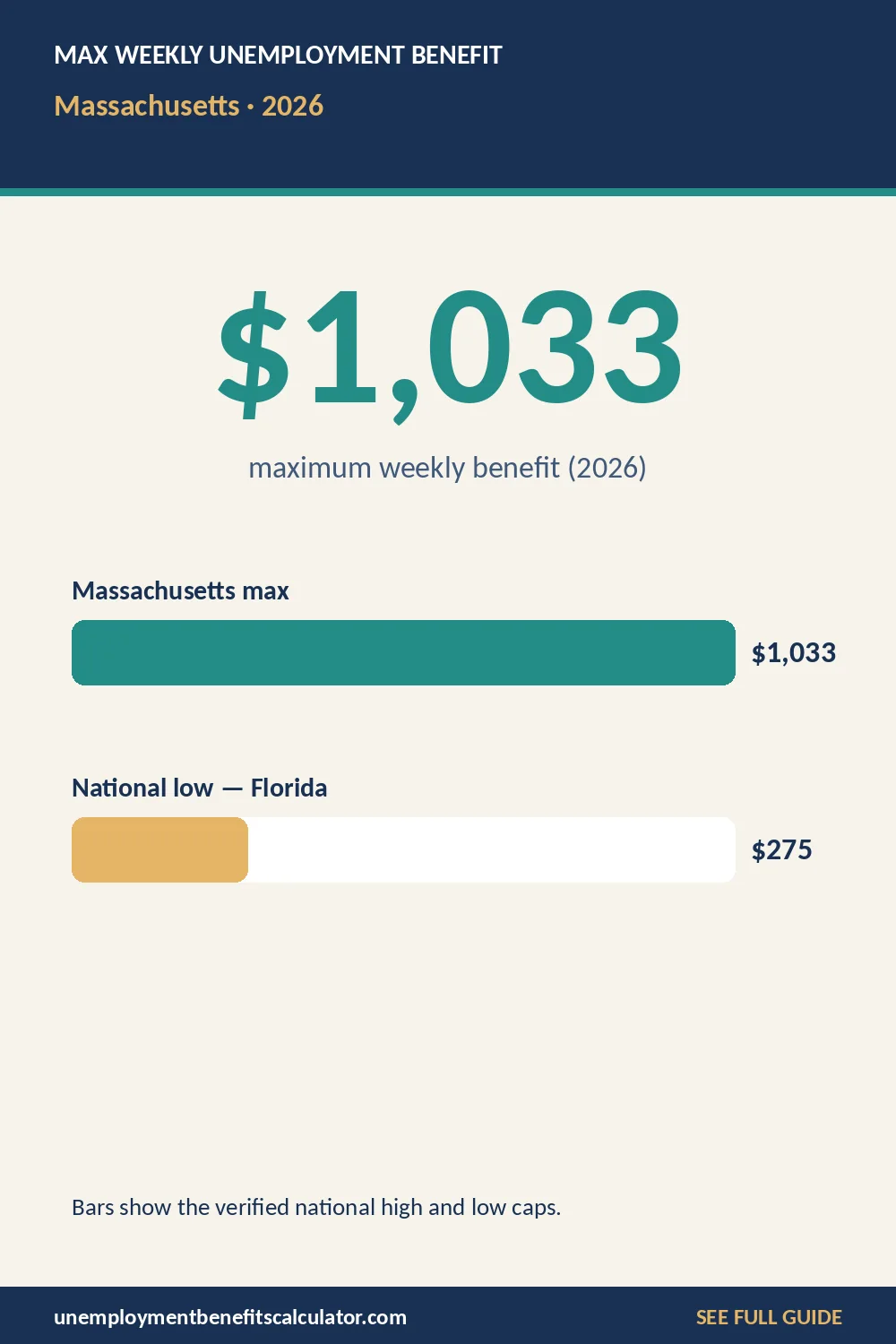
Massachusetts pays about 50 percent of your average weekly wage, up to $1,154 per week as of October 4, 2026, for a maximum of 30 weeks. You need $6,300 in earnings over the last 12 months to open a claim, dependents add $25 per week per child, and the first certified week pays with no waiting period. (Massachusetts DUA, checked October 26, 2026)
Everything below follows her claim from the layoff notice through the last deposit, with the 2026 rules at each step: the DUA formula, the wage floor, the dependent layer, the certification rhythm, the ten-day appeal clock, and the state tax election that surprises filers in April. Where a number changed this fall, the change is flagged directly.
| Item | Massachusetts 2026 value |
|---|---|
| Maximum weekly benefit | $1,154 (raised October 4, 2026) |
| Formula | About 50% of average weekly wage |
| Dependent additions | $25 per week per child, up to half your WBA |
| Standard duration | Up to 30 weeks, the longest in the country |
| Waiting week | None, the first certified week pays |
| Work search requirement | Active, documented weekly search |
| State tax on benefits | Yes, 5% withholding available on request |
Start With the Number DUA Actually Deposits
The Department of Unemployment Assistance builds your weekly amount from roughly half your typical weekly pay across the base period, and the October 4, 2026 adjustment set the ceiling at $1,154. For the scheduler above, half of $2,400 lands at $1,200, so the cap trims her check to $1,154. A claimant earning $1,600 a week keeps the uncapped half: about $800. Massachusetts claims at or near the ceiling are ordinary because the state's payroll runs high, and DUA's own estimate tool produces the same arithmetic before you ever file.
One structural note saves confusion later: the maximum moves every October, not January, because it tracks the state's average weekly wage with an autumn effective date. Anyone quoting $1,105 for 2026 is reading last cycle's figure. The 30-week duration is the other half of the headline: no other state pays a standard claim past 26 weeks, so a full Massachusetts run at the new maximum totals $34,620, a sum no other state's regular program approaches.
Where your wages sit against neighboring states, and what a $1,154 check buys in regional terms, are both mapped in the state-by-state comparison. The short version: Massachusetts pays more per week than any of its neighbors and keeps paying for at least four extra weeks.
Follow One Claim Through a 30-Week Massachusetts Year
The scheduler filed on the Monday after her last shift. Week one certified with no waiting-week deduction, and the first deposit arrived with her bank details attached through direct deposit. Her benefit year runs 52 weeks from the claim date, inside which the 30 payable weeks sit like an allowance she draws down only when certified and eligible. Take a temporary job for six weeks and those six weeks neither pay benefits nor consume them; the runway simply waits.
That structure rewards planning. A claimant who stretches certifications across seasonal gaps can hold the 30 weeks open deep into the following year, and our guide to stretching the benefit period walks the sequencing. The mirror risk runs the other way: weeks you skip, fail, or certify dishonestly vanish from the allowance without a refund, and the exhaustion guide explains what remains once the 30 weeks burn.
$6,300: The Twelve-Month Floor That Opens the Door
Massachusetts measures eligibility across the last 12 months rather than a classic four-quarter window alone, and the floor is $6,300 in total earnings during that stretch, all of it from employers who paid into the system. Freelance income, self-employment gigs, and cash work do not count toward the gate. The floor is low enough that most W-2 workers clear it in six weeks of full-time pay, which makes Massachusetts one of the easier states to qualify in monetarily.
Massachusetts also pays differently from its neighbors in one more respect worth noticing early. DUA calculates the maximum benefit credit against the claim itself, so the weekly amount and the total pot arrive together on the same determination letter.
The subtlety is the income DUA refuses to use. Some severance arrangements, certain pension offsets, and pay classified as contractor 1099 income all sit outside the calculation, and each has its own interaction rules. Our severance guide explains how a package can delay a claim's start date, the lump-sum guide covers vacation and bonus payouts that DUA spreads across weeks, and the base-period explainer shows which window your wages land in.
Add $25 Per Child, Up to Half Your Check
Each dependent child adds $25 to the weekly amount, and the additions stack until they reach half of your base weekly benefit. A $500 check with three children becomes $575. A $1,154 maximum claim hits the 50 percent wall after roughly twenty-three children's worth of additions, which is a mathematical way of saying the cap rarely binds; for a mid-wage claimant with two or three kids, the allowance is real money: $50 to $75 extra, every week, for up to 30 weeks.
Dependents count only when you provide more than half their support, and the question appears during the application rather than at certification. Our dependent-allowance guide covers the documentation DUA asks for and how the same $25-per-child structure compares with the flat allowances other states pay.
The First Days Out: Filing Through UI Online
The application runs through DUA's online system, takes most claimants 30 to 45 minutes, and asks for 18 months of employer history with separation reasons for each. The scheduler had her final pay stub, the restructuring letter, and her last two W-2s on the desk before she started, which is the right preparation level; the pre-filing document checklist matches what the application requests line by line.
Two timing rules shape the first days. File the week you lose the work, because Massachusetts pays no waiting week and every idle week before filing is a week of the 30 that produces nothing. And answer the employer-separation questions exactly, because DUA contacts the employer for its version, and mismatches between the two accounts are what trigger fact-finding. The application-mistakes guide catalogs the errors that add weeks to Massachusetts claims, with the wrong-reason-code error at the top.
DUA issues a determination letter stating the weekly amount, the maximum benefit credit, and the duration, usually within a few weeks of filing. Read the letter the moment it lands and run the half-your-wage check against it. The ten-day appeal window runs from the mailing date, and our first-payment timeline guide explains what the wait between filing and money normally looks like.
TeleCert or the App: The Weekly Certification Rhythm
Weekly certification asks the same core questions most states ask: did you work, did you earn, were you able and available, did you search. Massachusetts lets claimants answer through the online portal or the TeleCert phone line, and the certification questions guide previews each one with the answers that keep a claim clean. Certification opens Sunday and stays open through the week, but batching three weeks at once is how missed-deadline overpayments start, a pattern the missed-deadline guide documents in detail.
Part-time work coexists with a claim cleanly when reported accurately. Massachusetts reduces the week's benefit for earnings but rarely ends the claim outright at modest income levels, and the part-time claiming guide along with the earnings-disregard breakdown show the arithmetic week by week. The reporting rule to respect: gross wages go in the week the work happened, not the week the check cleared, and the reporting guide walks the edge cases.
Three Situations That Shrink a Massachusetts Check
First, employer contests. Massachusetts employers contest at high rates, especially in professional settings where separations come with paperwork, and a contest freezes payments until DUA's fact-finding resolves it. The scheduler's former employer raised a performance argument; she won it with the restructuring letter and six years of reviews, a sequence the employer-contest guide breaks down step by step. The freeze itself has a deadline structure, and responses filed in the first week keep the timeline measured in weeks rather than months.
Second, pensions and separation packages. A pension from the same employer that funded the claim reduces the weekly amount dollar-for-dollar in the week it pays, and some packages postpone the claim's start entirely. The pension-offset guide covers the arithmetic. Severance sits in the same family of rules, and Massachusetts spreads certain lump-sum payouts across weeks the way other states spread vacation pay, which is why the payout schedule matters as much as the payout size.
Third, overpayment notices from certification errors. DUA recalculates aggressively when a reported number looks wrong, and the overpayment response guide explains the repayment and appeal options before the notice ages into collections. Most Massachusetts overpayments trace to a single avoidable slip: gross earnings reported in the paycheck week rather than the week the hours happened, which the reporting guide fixes in one read.
What a Week's Payment Looks Like in Practice
Concrete numbers make the system easier to trust. The scheduler's weekly deposit runs $1,204: the $1,154 base plus $50 for her two children, with no waiting-week deduction anywhere in the sequence. A second example shows the other end of the wage scale. A Providence-line commuter earning $800 a week before the layoff clears the $6,300 floor easily and lands at roughly $400 of weekly benefits, and with one child the check reaches $425, which is where the 50-percent cap on dependent additions starts to matter for larger families.
Both claimants certify on the same Sunday schedule, and both report any part-time gross wages the same way. The difference is which rule binds: at the top, the ceiling trims; in the middle, nothing trims at all. That asymmetry is why DUA's own estimate tool matters before filing day, and why the calculation guide is worth ten minutes even for claimants who think their math is simple.
Shared Work and the Training Detour
Two state programs modify the standard claim in ways worth knowing before you need them. Shared-work plans let employers cut hours across a team instead of laying anyone off, with eligible employees collecting partial benefits for the reduced fraction; the arrangement keeps health insurance and seniority intact while the claim supplements the shorter paycheck, and the shared-work guide explains the employer-side setup.
Approved training changes the availability rules: claimants in approved programs can satisfy eligibility through the program itself rather than a daily job hunt, which converts the weekly search requirement into class attendance. Massachusetts treats the training route seriously, and the school-while-claiming guide covers which programs qualify and when enrollment needs DUA's sign-off first. School employees face separate between-term rules entirely, and the school-employee guide handles that calendar.
What Happens Inside the 10-Day Appeal Window?
Ten days from the mailing date is the whole window: shorter than most states, and long enough only if you treat the determination letter as an action item. Appeals go to a DUA hearing officer, by phone or in person, with both sides presenting. The scheduler filed her appeal on day three when the initial amount came back lower than her math, and the recalculation landed before the hearing date because the error was a wage-reporting mismatch her pay stubs fixed on sight.
Win rates at these hearings tilt toward claimants who bring documents rather than arguments, and the appeal guide and the hearing guide between them walk the evidence set: pay stubs, separation letters, schedules, and any written acknowledgment of the layoff. Keep certifying during the appeal either way, because the weeks only become payable retroactively if they were certified on time.
The 5 Percent State Tax Decision
Massachusetts benefits are taxable income in two places, and DUA withholds nothing automatically. The federal election runs 10 percent and the state election runs 5 percent, both available when you apply or later through the online dashboard. On a $1,154 maximum claim, electing both withholds about $173 a week, which is the difference between a manageable April and a four-figure bill. Our unemployment tax guide works the withholding math against the safe-harbor rules.
The 1099-G arrives in January covering the prior calendar year, and the federal plus Massachusetts returns each take its figure. Nonresidents who worked in Massachusetts owe the state tax on benefits tied to Massachusetts employment, a wrinkle the DOR states plainly for cross-border commuters.
Know What the 30-Week Runway Cannot Fix
Honesty section, because the generosity breeds a specific blind spot: a $1,154 check against Boston costs of living is real relief but not replacement income, and 30 weeks is a long runway that still ends. The program also will not run for claimants whose separation was for documented misconduct connected to work, or who quit without good cause attributable to the employer; those cases are adjudication questions, not math questions, and no guide can promise an outcome. School employees face their own between-term rules, covered separately in the school-employee guide.
One limit of this guide itself: DUA adjusts the maximum each October, the figure here is verified as of October 26, 2026, and a claim filed after next October's adjustment should re-check the ceiling before doing any planning math with it.
Run the Final Checklist Before Week One Closes
- File the week the job ends, with 18 months of employer history assembled first
- Read the determination letter the day it arrives and check it against half your average wage
- Elect federal and state withholding deliberately, 10 percent and 5 percent respectively
- Add every qualifying child to the application before submitting, not after
- Certify every Sunday without exception, reporting gross wages for the week worked
- Keep the work-search documentation current, dated, and verifiable
- Calendar the ten-day appeal window against every determination that arrives
The scheduler cleared all seven lines in her first week and never thought about the system again until the deposits started. Massachusetts rewards exactly that kind of early precision: the formula is fixed, the runway is the country's longest, and every deadline in the process gives enough room only to someone who moved in the first days. Run the checklist while the layoff is still fresh, because nothing in this program gets easier to manage from the back end.
Frequently Asked Questions
How much is unemployment in Massachusetts in 2026?
About half your average weekly wage, capped at $1,154 per week after the October 4, 2026 adjustment. Each dependent child adds $25 per week until the additions reach half of your base benefit, so family claims routinely clear $1,200 or more. The ceiling adjusts every October rather than January, so a claim filed after next October's reset should re-check the figure.
How many weeks does Massachusetts unemployment pay?
Up to 30 weeks within a 52-week benefit year, the longest standard duration in the country. Weeks you work or skip do not burn the allowance, so a claim that pauses for temporary work simply resumes when certification resumes. Temporary or part-time work reported honestly simply pauses the draw without consuming weeks, which is why the runway stretches so far for claimants who cycle between jobs.
Does Massachusetts tax unemployment benefits?
Yes, in two places. Benefits count in both federal and Massachusetts gross income. DUA withholds nothing automatically, but you can elect 10 percent federal and 5 percent state withholding in the application or later from your dashboard, and a 1099-G arrives every January.
What are the work search requirements in Massachusetts?
An active, documented job search every week you certify. Keep dated records of applications and contacts, because DUA can request the log at any point, and weeks it cannot verify can be reversed with an overpayment attached.
Does part-time work end a Massachusetts claim?
Yes. Report gross wages for the week the work happened, and DUA reduces that week's benefit rather than ending the claim. Moderate part-time income typically leaves a partial check payable, which is why so many Massachusetts claims run alongside reduced-hours jobs. DUA can request the log at any point in the claim, and weeks it cannot verify can be reversed with an overpayment attached, so date every entry the day it happens.
What is the deadline to appeal a Massachusetts unemployment denial?
Ten days from the date the determination was mailed, one of the shortest windows in the country. File in writing through DUA, keep certifying during the process, and bring documents rather than arguments to the hearing, since pay stubs and separation letters decide most cases.