
One number explains most of the Indiana system before a single form gets filled: $390. The maximum weekly benefit has not moved since 2012, which makes Indiana the rare state where a decade-old forum post is still factually correct on the ceiling and dangerously wrong on almost everything around it. The filing portal changed, the weekly voucher rhythm matters more than most states', and the ten-day appeal window runs shorter than nearly every state's. This guide walks an Indiana claim in the order the weeks actually happen.
Indiana pays up to $390 a week for a standard 26 weeks in 2026, with a $10,140 best-quarter wage record reaching the cap. Claims run through the Uplink portal with a weekly voucher, one unpaid waiting week comes first, one documented employer contact per week satisfies the search rule, and a dependent allowance adds to the check for qualifying families. (Indiana DWD, checked October 26, 2026)
The chronology below runs from the day of separation through the final payment, with the 2026 rules applying as the weeks pass and the deadlines that end claims quietly when nobody watches them.
| Item | Indiana 2026 value |
|---|---|
| Maximum weekly benefit | $390, unchanged since 2012 |
| Wages that reach the cap | $10,140 in your best quarter |
| Minimum weekly benefit | $50 |
| Dependent allowance | Roughly $100 more per week with qualifying children |
| Standard duration | 26 weeks |
| Waiting week | Yes, one week unpaid, then pay starts |
| Work search requirement | 1 documented employer contact per week |
| State tax on benefits | Yes, Indiana income tax applies |
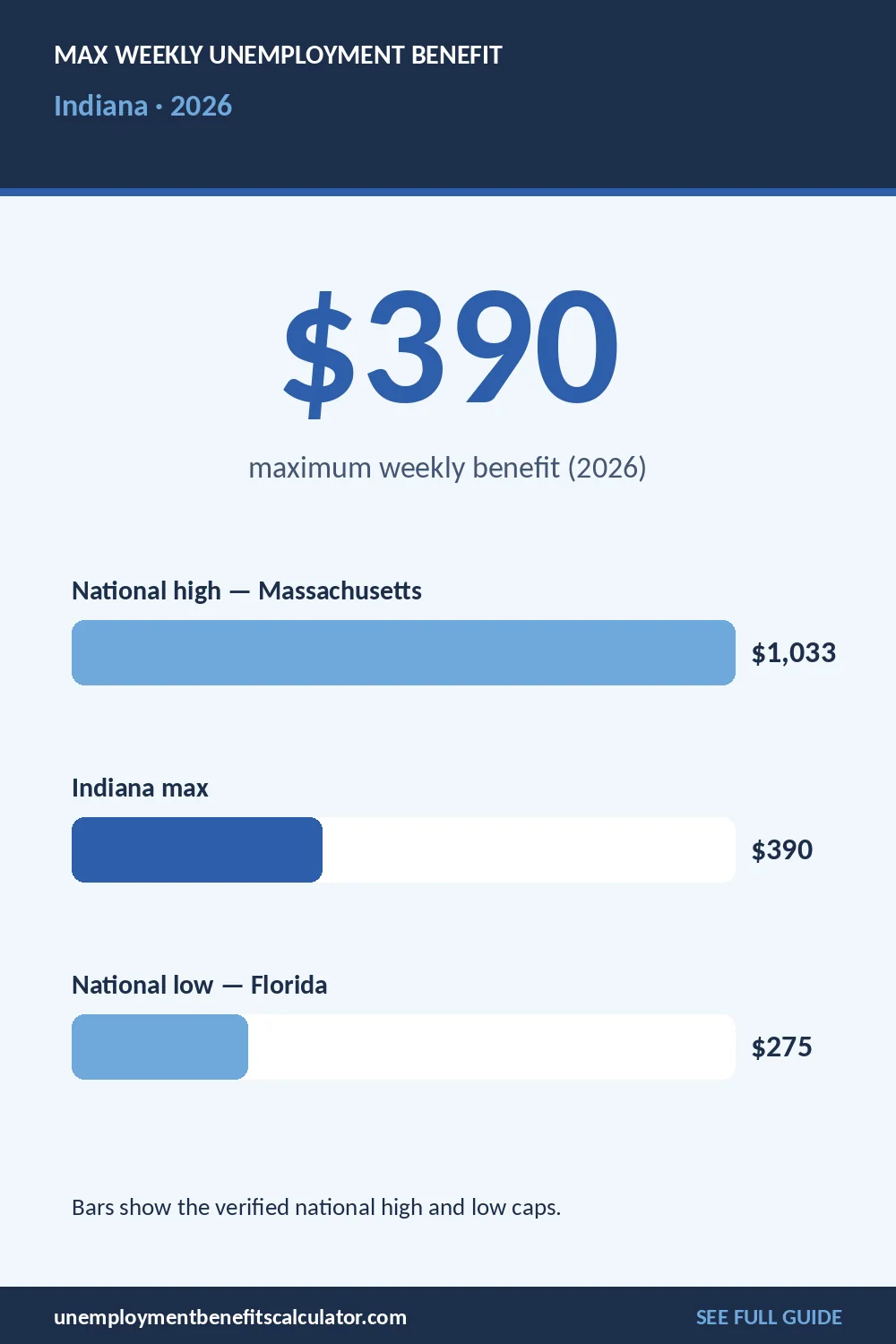
$390: The Cap That Has Not Moved Since 2012
Freeze a maximum benefit for over a decade and two things happen: the figure becomes easy to remember, and its real value quietly shrinks every year. A $390 check in 2026 buys what about $290 bought when the cap was set, and Indiana's own wage growth has left the ceiling well behind the regional median. Claimants feel it at the grocery level; the system reflects it in how few Indiana claims reach the cap at all, since $10,140 in a single quarter requires roughly $20.75 an hour at full-time hours.
The weekly amount itself derives from your best-quarter wages, scaled so that the $10,140 quarter produces the full $390 and lower quarters produce proportionally less, down to a $50 floor for the smallest qualifying wage records. Our WBA calculation guide shows the same scaling logic side by side with the states that average multiple quarters, and the state comparison table places Indiana's frozen cap against neighbors that revalue theirs annually.
Dependents bend the picture for families. Indiana adds a dependent allowance on top of the base amount, worth up to roughly $100 more per week with several qualifying children, and the dependent-allowance guide explains who counts and what documentation the application wants. For a capped claimant with two children, the effective weekly total pushes past $500, which narrows the real-world gap with higher-cap states considerably.
The frozen ceiling also changes the dependents question for families. With the base amount pinned, the dependent layer does a larger share of the work than it does in states that revalue their caps, so a family claim should always complete the dependent questions even when the wage record alone reaches the top.
Week 0: What Uplink Needs Before You File
Uplink, the state's claimant self-service portal, runs the entire Indiana claim from application to final voucher, and the filing session goes smoothly only with the inputs ready: employer names and addresses for the last 18 months, dates of employment, separation reasons, and the wage figures from your final pay stubs. Union members should have local details on hand as well, since apprenticeship and dispatch arrangements interact with availability questions; the union-member guide covers those interactions.
File in the week the work ends. Indiana's claim calendar, the waiting week, and the backdate question all key off the filing date, and every week spent deciding is a week the 26-week schedule can never pay for. The pre-filing checklist matches the Uplink screens line by line, and the application-mistakes guide collects the wrong-separation-code errors that turn into weeks of adjudication.
DWD says eligibility should be determined within 21 business days of filing, and most clean claims see the monetary determination well before that. Read the letter against your own math the day it posts to Uplink; the ten-day appeal clock described below runs from its mailing date, not from the day you find it.
Which Quarters Feed the Indiana Math?
Indiana reads the standard base period, four of the five most recently completed quarters with the oldest dropped, and runs the wage record through its eligibility tests. The best-quarter figure drives the weekly amount, the total base wages drive the maximum benefit pot, and the state's three wage tests together decide whether any claim exists at all. A worker with one strong quarter and three thin ones can pass in Indiana where an average-wage formula would fail them, and the monetary-eligibility guide walks each test with worked examples.
Filers who miss the standard window get the alternate base period review, and seasonal workers whose best quarters cluster in summer or December should check which filing month puts those quarters inside the window. The base-period calendar guide and the seasonal-worker guide both map the timing tricks that legal in-state timing allows.
Uplink itself deserves a setup paragraph, because claimant-side friction causes real delays. Create the account before the layoff paperwork piles up, confirm the email and phone on file, and learn where vouchers, determinations, and appeal notices post, since DWD sends almost nothing by paper anymore. A locked account during appeal week is a preventable disaster, and the claim-status guide shows the screens that matter when something looks stuck.
Weeks 1 and 2: The Waiting Week and the First Voucher
The first eligible week on an Indiana claim pays nothing. The waiting week is unpaid, and it clears only when you certify it like any other week: able, available, search contact logged. Skipping the first voucher because no money moved is the classic Indiana error, because the waiting week still occupies the schedule and the certification habit matters from day one.
Vouchers then go weekly through Uplink, and the discipline they demand is Indiana's real difficulty. Each voucher asks about work and earnings, availability, and the search contact, and the certification-questions guide previews every prompt. Miss the weekly window and the week needs a good-cause request to revive, a process the missed-deadline guide walks through before the letters get formal.
Wage errors surface in the letter more often than claimants expect, because employers file quarterly reports on their own schedule. A missing employer or a truncated quarter shows up as a smaller weekly amount, and DWD corrects both on sight of pay stubs or W-2s.
Every Week After: One Contact, One Voucher
Indiana runs the lightest work-search standard in its region: one documented employer contact per week. That single touch needs a date, an employer, and a method, recorded where you can produce it for review. Light does not mean optional; a week without the contact is a week DWD can reverse, and the log template guide shows the minimal record that satisfies reviewers.
Part-time earnings ride alongside the voucher with the same one-week-at-a-time reporting: gross wages, in the week worked. Indiana reduces the check for earnings and keeps the claim alive at moderate income levels, which the part-time guide and the reporting guide demonstrate week by week. Availability rules hold throughout: a voucher answered while genuinely unavailable for full-time work creates the exact overpayment pattern the available-for-work guide dissects.
The Three Wage Tests, With Numbers
Indiana gates a claim behind three separate wage measurements, and each one fails different workers. The total base-period wages test asks for a full year of meaningful work history. The high-quarter test requires enough earnings pooled in your strongest quarter to carry a weekly benefit. The third test compares your total wages against the weekly amount the formula produces, which blocks short, intense work bursts from generating long-running claims. A delivery driver with $21,000 spread across four solid quarters passes all three comfortably; a server with $11,000 earned mostly in two summer quarters can fail the third test even with a healthy weekly amount.
The practical consequence is that Indiana claims reward steady histories over spike histories, the opposite of best-quarter states like Arizona. Run all three tests before filing, because a failed test is not an appeal-able judgment call but a wage-record fact, and the fix is usually wages arriving in the record rather than an argument with DWD. The monetary-eligibility guide works through all three tests with numbers, and the pre-filing estimate guide shows which test your own record is closest to failing.
What Happens When the Employer Answers?
Indiana employers respond to claims at high volume, and a separation dispute routes the claim into fact-finding while payments pause. The adjudicator weighs the two accounts against the separation reason codes filed in week zero, which is why the original application's honesty matters even when the employer's version differs. Win or lose, the weeks you certified during the dispute are the ones an appeal can restore; the employer-contest guide explains the sequence, and the fired-for-cause guide shows why the misconduct burden sits on the employer, not on you.
Suitable-work refusals trigger the same machinery. Indiana expects acceptance of suitable offers, and declining one without good cause can disqualify the weeks that follow; the suitable-work guide draws the line between protected refusals and costly ones.
Who Counts as a Dependent in Indiana?
Declare dependents during the application, because the allowance attaches to the claim when it opens rather than mid-year. Children you claim on your tax return are the usual case, and the support test runs through the application's dependent questions rather than at certification. The layer survives the frozen-cap debate in Indiana's legislature year after year precisely because it targets the claims that need it most, and a family claim with the allowance active pays meaningfully more per week than the bare $390. Keep the support documentation from the application on file, since DWD audits dependent declarations the same way it audits wages, and the dependent-allowance guide compares Indiana's structure with the flat $25-per-child states around it.
Week 3 and Beyond: When the Money Actually Lands
DWD's own FAQ promises a first payment within three weeks of a clean claim, and reality holds close to that when no adjudication intervenes. Direct deposit moves fastest, and the payment-method comparison covers the debit-card alternative and its fee profile. Payments arrive weekly against the prior week's voucher, and the first-check timeline walks the full filing-to-deposit sequence with the delay causes that push week three to week six.
Mid-claim changes restart small clocks. A raise at a part-time job, a move within the state, or a training program each touch the voucher answers, and the recalculation guide explains when Indiana recomputes an amount and when it simply adjusts the week's payment.
Work Sharing and the Retraining Exit
Two alternatives modify the standard claim before it ever reaches the appeals stage. Indiana's shared-work plans let employers trim hours across a whole team rather than run layoffs, with affected employees collecting partial benefits for the lost fraction while keeping their jobs, benefits, and seniority; the shared-work guide explains the employer-side mechanics and why workers usually come out ahead of a layoff-and-rehire cycle.
Approved training changes the weekly obligations entirely for claimants who qualify. Enrolled participants can satisfy their availability through the program rather than a daily job hunt, and Indiana's retraining pathways connect to the state's workforce system rather than running as a separate benefit. The school-while-claiming guide covers which enrollments need pre-approval and what happens to the search rule while classes run.
What Can You Do When DWD Says No?
Ten calendar days, counted from the mailing date, is the whole appeal window, shorter than nearly every state allows, and it applies to monetary determinations, disqualifications, and overpayment notices alike. An Administrative Law Judge takes the appeal, usually by phone, and the written decision lands after the record closes. File the same day the notice posts, then assemble the evidence, and both the appeal guide and the hearing guide are built for exactly that rush.
The weeks you certified during any appeal are the weeks a win can pay retroactively, which is the same discipline as the waiting-week rule and the voucher rule: Indiana pays attention to what you did each week, not what you intended.
Plan the Indiana Tax Slice Before April
Indiana taxes benefits as income, and the state's withholding election appears alongside the federal 10 percent option during filing. A capped claim running all 26 weeks produces $10,140 of benefits, which is a four-figure tax event in most brackets if nothing was withheld; the unemployment tax guide runs the withholding math against the estimated-payment alternative. The January 1099-G carries the annual total to both the federal and Indiana returns.
One honesty note on the system's limits: the $390 ceiling will not stretch to replacement income for most Indiana paychecks, adjudication timelines can stretch past the 21-business-day target when employers contest, and school or federal-employee claims run their own rules that this guide does not cover. Plan with the numbers as verified for 2026, and re-check the cap each July, when Indiana's small statutory adjustments have historically appeared.
Two closing examples show the spread. An Indianapolis logistics coordinator with $10,500 in his best quarter divides to just over $400 and settles at the $390 cap, with the 26-week runway producing a $10,140 maximum year before any dependent layer. A Muncie part-time student with a $6,000 best quarter lands near $230 a week, and her claim's value comes from the full runway rather than the weekly figure, which is the trade Indiana has made since 2012. Same system, opposite bottlenecks: the coordinator's ceiling binds, the student's wage record does. Both claims live or die on the same four early actions, and neither one benefits from a fifth week of deciding whether to file.
The actions that decide an Indiana claim all sit early: file in week zero, certify the waiting week, hit the one contact every week, and answer every determination within ten days. Do those four things and the system runs itself for 26 weeks; skip any of them and the same system has a queue of letters ready. The cap may be frozen, but the discipline the state asks for has never been optional.
Frequently Asked Questions
How much is unemployment in Indiana in 2026?
Up to $390 per week, a ceiling unchanged since 2012, reached when your best quarter holds $10,140 in wages. The smallest qualifying records land at a $50 floor, and a dependent allowance adds more per week for families with qualifying children. The cap has survived every legislative session since 2012, so treat any article quoting a higher Indiana figure as describing a bill, not a law.
How many weeks does Indiana unemployment pay?
A standard 26 weeks within the benefit year, after one unpaid waiting week that you must certify like any other week. Weeks you work part time or skip do not consume the allowance, so the runway simply pauses and resumes. Indiana's 21-business-day determination target gives the portal time to run employer matching, which is why clean wage records in week zero matter so much.
What are the work search requirements in Indiana?
One documented employer contact per week, with a date, employer, and method you can produce on review. It is the lightest standard in the region, but a week missing the contact is a week DWD can reverse with an overpayment attached.
Does Indiana tax unemployment benefits?
Yes. Indiana counts benefits as income for state tax, and the filing application offers both the federal 10 percent election and a state withholding choice. DWD mails a 1099-G each January covering the prior year's total.
Can a part-time job run alongside an Indiana claim?
Yes. Report gross wages in the week the work happened, and Indiana reduces that week's payment rather than closing the claim. Moderate part-time income keeps a partial check flowing for the full 26-week runway. Availability rules hold during every certified week even with modest earnings, so keep the search contact alive while the part-time job runs.
What is the deadline to appeal an Indiana unemployment denial?
Ten calendar days, counted from the mailing date, and shorter than nearly every state allows. Appeals go to an Administrative Law Judge, mostly by phone, and the weeks you certified during the process are the ones a win pays retroactively.