
Table of Contents
- Illinois Unemployment Insurance at a Glance
- How Much You Can Get in Illinois in 2026
- Who Qualifies in Illinois
- Filing Your Illinois Claim, Step by Step
- Weekly Certification in Illinois
- How Long Illinois Benefits Last
- Part-Time Work and Partial Benefits in Illinois
- If Illinois Denies Your Claim: Appeals in 30 Days
- Inside IDES Adjudication: How the Queue Actually Moves
- Regional Notes: Chicago, the Collar Counties, and Downstate
- Disaster Assistance and the Federal Layer in Illinois
- Payments and the Illinois 1099-G
- Taxes on Illinois Unemployment Benefits
Illinois Unemployment Insurance at a Glance
Illinois runs one of the more generous unemployment programs in the Midwest through the Illinois Department of Employment Security, known as IDES. Weekly amounts key off your two highest quarters with dependent additions on top. The standard duration runs a full 26 weeks.
The state excludes unemployment benefits from its own income tax. The trade-off is a process that rewards documentation: IDES adjudication queues, employer contests. Work-search verification all move faster for claimants with organized records.

The system's center of gravity is the online IDES portal, which handles filing, certification, and correspondence. Chicago-area service workers, manufacturing workers across the I-80 corridor. Warehouse employees around Joliet and Aurora all file through the same machinery.
The wage record that drives every claim comes from employer quarterly reports. This guide covers amounts, eligibility, the filing sequence, weekly certifications, part-time math, appeals, and taxes for 2026.
For context before the numbers, Illinois sits near the top third of states for weekly benefits. In the middle of the pack for filing friction.
The state comparison guide shows where it lands nationally. The Illinois unemployment calculator estimates your weekly amount from your own wage history in about two minutes.
How Much You Can Get in Illinois in 2026
Illinois computes your weekly benefit as 47% of your average weekly wage. The average comes from your two highest quarters of base period wages divided by 26. The result is a formula that smooths across two quarters rather than rewarding a single spike.
Dependent additions stack on top: roughly $6 more per week per dependent for up to four dependents. The dependents' schedule lifting the ceiling further.
| Item | Illinois 2026 value |
|---|---|
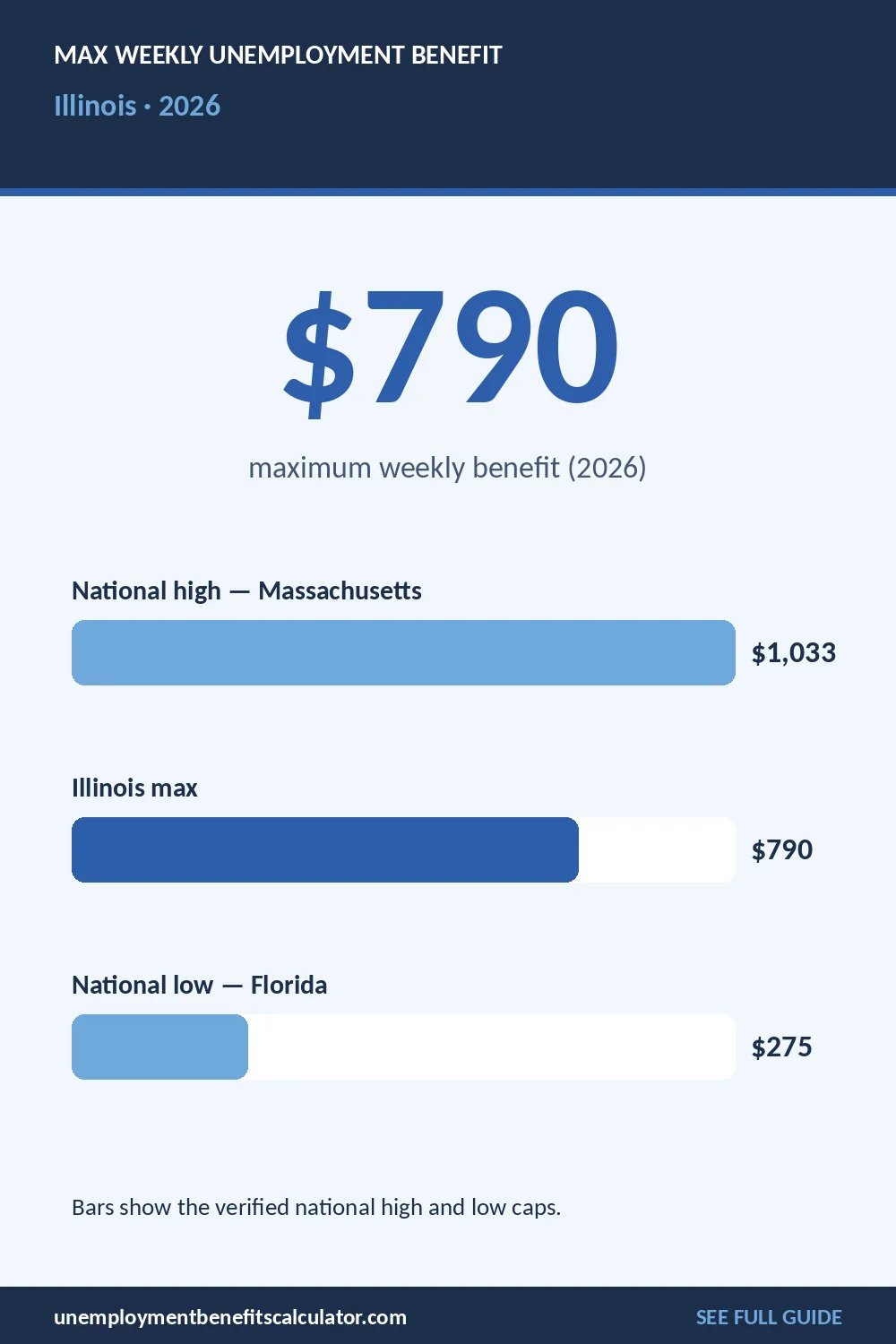
| Maximum weekly benefit (no dependents) | Around $790 |
| Maximum with dependent additions | Over $1,000 |
| Minimum weekly benefit | In the low $50s |
| Standard duration | 26 weeks |
| Waiting week | One week (unpaid) for most claims |
| State tax on benefits | None (Illinois does not tax UI benefits) |
That no-state-tax line matters more in Illinois than in most states. The weekly amounts run high enough that a state tax layer would be real money. A claimant at the $790 maximum for 26 weeks receives $20,540.
Every dollar of it stays out of Illinois taxable income. The unemployment tax guide covers the federal side, which always applies.
Illinois' two-quarter smoothing deserves a note for seasonal workers. A landscaper with a huge summer quarter. A thin winter quarter sees the two-quarter average lift the claim.
Compared with high-quarter-only states that ignore the second quarter entirely. Workers whose best season just ended can read the seasonal workers guide for the timing angles. The high quarter versus average quarter guide explains the formula families across states.
Who Qualifies in Illinois
The monetary test requires at least $1,600 in total base period wages, wages in at least two quarters. Highest-quarter wages at least $440 above your total wages outside the highest quarter. Those thresholds disqualify very thin work histories.
Workers who fail them should check whether an alternate base period request. Wages from a second state could complete the picture. The monetary eligibility guide explains how states read the wage record.
Separation law follows the familiar architecture with Illinois specifics. Layoffs qualify cleanly. Quits require good cause attributable to the employer or a compelling personal reason.
Illinois recognizes a narrower personal-circumstances list than its neighbors. Discharges shift the burden to the employer to prove misconduct connected with the work.
Illinois' misconduct standard excludes mere inefficiency or unsatisfactory performance. The good cause guide and the fired-for-cause guide map the evidence each side needs.
Weekly eligibility requires ability, availability, and job search. Illinois asks claimants to register with its job-matching site. To complete the work search activities their claim instructions specify, which vary by county and occupation.
Certification answers about ability and availability carry the same weight as the separation answers. The availability guide explains the practical standard.
Filing Your Illinois Claim, Step by Step
File the week your employment ends, because Illinois pays nothing for weeks before your application date. The IDES portal is the primary channel; the state's phone line handles filers who cannot use the portal comfortably. Before starting, assemble:
- Social Security number and driver license or state ID
- Employment history for the last 18 months, with employer names, mailing addresses, phone numbers, and dates
- Your last pay stub and the gross wage figure it shows
- Documentation of any separation paperwork you were given, such as a layoff letter or final write-up
- Direct deposit details for payment
The application captures your separation story and wage history, then assigns a certification schedule. Your employer receives notice and has time to respond, and conflicting accounts produce adjudication interviews. Treat the interview notice seriously: deadlines are measured in days.
The determination that follows is appealable but only within its window. Illinois posts current processing timelines, and the U.S. Department of Labor's UI program resources keep the official contact directory current.
Watch the monetary determination against your own math. If your computed benefit looks low against pay stubs, request a wage review immediately.
The freeze rules lock your weekly amount for the benefit year once the claim establishes. Wage investigations fix misfiled quarters, missing bonuses, and wages reported under the wrong state.
Weekly Certification in Illinois
Illinois certifies weekly through the portal. The automated phone line, asking whether you worked, your gross earnings. Whether you refused any work, and your work search activity.
The certification answers drive the weekly payment directly. Inconsistencies between weekly answers and employer payroll records surface in cross-matches one to three quarters later.
The earnings question deserves precision because Illinois' disregard is comparatively generous. The state ignores earnings up to half of your weekly benefit amount before reducing the check. A claimant with a $500 benefit can earn $250 gross in a part-time week and still receive the full $500.
Every dollar above that line reduces the payment. Earnings at or above roughly your benefit plus the disregard zero the week out. The disregard guide runs the scenarios, and the certification reporting guide shows how to structure weekly answers.
Refused-work answers need context. Illinois asks whether you refused work. The follow-up fact-finding decides whether the refusal was without good cause.
Suspends benefits until you return to work under Illinois rules. Before refusing any offer, read the suitable work guide, because suitability depends on wages, hours, distance. Your prior occupation, and the analysis is more claimant-friendly than most people assume.
How Long Illinois Benefits Last
Illinois pays a standard 26 weeks within your benefit year, one of the longer standard runways in the country. The one-week waiting period consumes the front edge of it.
Zero-payment weeks caused by earnings still count against the maximum in most scenarios. Makes hour planning part of runway planning for partial workers.
When benefits exhaust before employment resumes, Illinois' fallback options run through federal-state channels that activate in downturns. Plus state retraining programs for eligible occupations.
The exhaustion guide sequences the realistic steps. Workers with wage history in a neighboring state can check the interstate claims guide to see whether the other state's claim would price higher.
One duration note that surprises Illinois claimants: the benefit year and the 26 weeks are different clocks. You can certify for up to 52 weeks inside the benefit year as long as you have balance remaining. A claimant who returns to work for four months.
Is laid off again can resume certifications on the original claim without filing fresh. The claim reopening guide covers the mechanics.
Part-Time Work and Partial Benefits in Illinois
Illinois' half-of-benefit disregard makes it one of the better states for combining part-time hours with a claim. The weekly math: full payment while gross earnings stay under half your benefit. Then dollar-for-dollar reduction above that line until earnings approach the benefit-plus-disregard ceiling where the week pays zero.
The dependent additions complicate planning slightly, because a claimant with dependents has a higher effective ceiling before the zero-week line. Report gross earnings including tips and commissions for the week earned.
Remember that holiday pay, vacation payout, and bonus allocations all count as earnings in their assigned weeks. The lump-sum guide and the overtime guide cover the allocation questions that wreck certifications when guessed at.
Illinois also runs a Short-Time Compensation program, sometimes called work sharing. Employers formally reduce hours across a unit. The state replaces a defined slice of lost wages with friendlier math than the regular partial formula.
Workers whose employer is considering slowdowns should point HR at the program. The work sharing guide explains how enrollment protects both the schedule and the benefits.
If Illinois Denies Your Claim: Appeals in 30 Days
IDES determinations arrive in the portal and by mail. The appeal window is 30 calendar days from the mailing date. First-level appeals go to a IDES hearing referee, conducted by phone.
The agency's file and both sides' exhibits in the record. The referee's decision is the one that governs unless a party carries it further, and most disputes end here.
Illinois' adjudication questions are written and mailed before the hearing. Gives claimants a genuine chance to assemble evidence: schedules, texts, write-ups, separation letters. Wage records all belong in the bundle.
Misconduct allegations fail when the employer cannot show a deliberate or willful disregard of standards. Isolated performance complaints usually fall short. The appeal guide and the hearing preparation guide cover the structure that wins.
Illinois-specific pitfalls worth naming: missing the fact-finding questionnaire deadline because portal mail went unread. Certifying before completing the required job-site registration.
Guessing at weekly earnings rather than using pay stubs. Each repair window is short, and the application mistakes guide collects the checklist before filing instead of after.
Inside IDES Adjudication: How the Queue Actually Moves
IDES adjudication is where most Illinois delay lives, and understanding its mechanics changes how you interact with the process. When your account and your employer's differ on why the job ended. A claims adjudicator opens a fact-finding file, mails a questionnaire to both sides.
Waits for responses before issuing a determination. The queue moves on response speed more than on complexity. Is why claimants who answer within two days routinely cut weeks off the timeline.
The questionnaire itself deserves careful reading rather than quick typing. IDES asks for dates, reasons, and documents. The answers become the record the referee reads if the case ever appeals.
Write dates exactly, attach the separation letter or write-up you hold. Resist the urge to argue the employer's version in narrative form; documents carry the file. The employer contest guide shows a full exchange from notice to determination.
Call volumes are Illinois' other structural bottleneck. The portal's message center is the reliable channel while phone queues run long. IDES posts current processing times, and the U.S.
Department of Labor's UI program page keeps the official contact directory current. Claimants with pending first payments should read the first payment timeline guide to separate normal processing from a stuck file that needs escalation.
Regional Notes: Chicago, the Collar Counties, and Downstate
Illinois' wage record varies sharply by region, and so does the practical claim picture. Chicago and the collar counties carry high wages that push claimants toward or past the formula maximum. Means the working question downtown is usually documentation rather than eligibility.
A service worker with a strong reported-tip history prices at the ceiling. The same worker with thin tip reporting prices well below it, and the difference is fixed for the benefit year. The tipped wage guide shows how tip reporting builds the record.
Manufacturing and logistics corridors from Joliet to Rockford see layoffs that arrive in waves rather than individual separations. Wave layoffs trigger different paperwork, including possible WARN Act notices for large reductions.
Claimants should attach any WARN documentation to their claims. The bankruptcy guide and the exhaustion guide cover the scenarios where the employer's own finances shape the claim.
Downstate agricultural and seasonal employers create the opposite pattern: strong harvest and festival quarters inside a thin annual record. Illinois' two-quarter smoothing actually helps these workers. A second decent quarter props up the average that a high-quarter-only state would ignore.
Workers whose income is seasonal should also read the seasonal workers guide. The seasonal certification rules for the between-seasons availability questions.
Disaster Assistance and the Federal Layer in Illinois
Federal programs arrive in Illinois through two doors: recession triggers and disaster declarations. Extended Benefits can add weeks beyond 26 when the state's unemployment rate crosses federal thresholds.
While the program rests in normal years, its trigger mechanics matter to anyone planning a long search. The Extended Benefits guide explains the math in plain terms.
Disaster Unemployment Assistance activates after presidential disaster declarations, covering workers whose employment vanished in the event, including self-employed. Gig workers who normally fall outside the regular program. Illinois has activated it for flooding and storm events.
Claimants affected by a named disaster should watch for the state's application windows, which open and close on deadlines. The exhaustion guide sequences the fallback options when regular benefits end mid-search.
The federal layer's most practical lesson is administrative: federal-state programs run on documentation. The claimants who keep their 1099-Gs, determination letters, and work search logs organized move through every layer faster.
The overpayment guide and the tax guide cover the end-of-year paperwork that federal programs add. Is the last mile most claimants only discover in April.
Payments and the Illinois 1099-G
Illinois pays by direct deposit or its state debit card. Deposits typically landing two to three business days after a processed certification.
Direct deposit avoids the card's fee schedule, which the payment method guide details. Bank changes belong between certification weeks rather than during them.
January brings the 1099-G with total benefits paid and any elected federal withholding. Illinois' no-state-tax rule keeps the form simple: one federal layer, one decision.
The tax guide covers the withholding math. Claimants who later repay benefits should read the overpayment guide for the tax adjustments that repayment triggers on the federal return.
Taxes on Illinois Unemployment Benefits
Illinois does not tax unemployment benefits at the state level. Distinguishes it from most large states and simplifies the April math considerably.
Federal tax applies in full: benefits are taxable income, the state issues a 1099-G each January. Optional 10% federal withholding is available during the claim through IDES.
The federal layer is the whole tax story for Illinois claimants, so the withholding decision deserves a deliberate answer. A claimant with other household income may owe more than 10% at filing time. A lower-income year may owe little or nothing.
The unemployment tax guide covers the return lines and safe-harbor options. The payment method guide explains how the weekly money arrives. In Illinois is direct deposit or the state's prepaid card.
One closing note ties the guide together: because Illinois benefits carry no state tax. Run up to 26 weeks at strong weekly amounts. The after-tax value of an Illinois claim rivals any state in the region.
Filing early, documenting the separation, and certifying precisely are the three levers that convert that paper generosity into actual money. The first payment timeline guide sets expectations for the weeks between filing and the first deposit.
Frequently Asked Questions
How much is unemployment in Illinois in 2026?
Illinois pays up to roughly $790 per week without dependents, and dependent additions of about $6 per dependent can push the maximum above $1,000. The formula uses 47 percent of your average weekly wage from your two highest quarters, with a minimum in the low $50s.
How many weeks does Illinois unemployment pay?
Illinois pays up to 26 weeks within a 52-week benefit year, one of the longest standard durations in the country. A one-week unpaid waiting period applies to most claims, and weeks with zero payment due to earnings still count against the maximum.
Does Illinois tax unemployment benefits?
No. Illinois does not include unemployment benefits in state taxable income, so only federal tax applies. You receive a Form 1099-G each January, and you can elect 10 percent federal withholding through IDES during your claim.
What are the work search requirements in Illinois?
Illinois requires registration with its job-matching site and completion of the weekly work search activities specified in your claim instructions, which vary by county and occupation. Keep a written log of applications and contacts in case IDES audits your record.
Can I work part time and still get unemployment in Illinois?
Yes. Illinois ignores earnings up to half of your weekly benefit amount before reducing the check, which is one of the more generous disregards in the country. A claimant with a $500 benefit can earn $250 gross in a week and still receive the full payment.
Why is my Illinois unemployment claim still in adjudication?
Adjudication typically means IDES is resolving a separation question, usually a conflict between your account and your employer's response. Respond to any fact-finding questionnaire within its deadline, attach documents like schedules or separation letters, and monitor portal messages daily, because unanswered questionnaires are the most common source of long delays.