
A marine-electronics technician in Baltimore spent nine years wiring yacht systems at $38 an hour before the marina's winter restructure cut his crew. His cousin, a help-desk lead across the Potomac in Northern Virginia, got her notice the same month, and the two claims ended up illustrating exactly why Maryland and its neighbors should never be planned with the same napkin math. His Maryland check landed at $430 a week for 26 weeks; hers priced out lower per week in Virginia, and a former colleague who drove north to Pennsylvania filings had watched $605 a week checks there.
The direct answer for Maryland: the state pays between $50 and $430 per week, runs a standard 26-week claim inside a benefit year of 52 weeks, adds $8 a week for each qualifying dependent, makes you serve one unpaid waiting week, and gives you 15 days to appeal anything you disagree with. Benefits count as taxable income for Maryland and for the IRS, and the state does not withhold automatically. (Maryland Department of Labor, checked October 27, 2026)
That combination, a middling ceiling with a full-length runway and a low barrier to qualify, is what makes Maryland claims behave differently from the higher-ceiling states nearby. Everything below walks the technician's claim from the layoff letter through the final deposit, the 2026 rules attached at each step along the way.
| Item | Maryland 2026 value |
|---|---|
| Maximum weekly benefit | $430 per week |
| Minimum weekly benefit | $50 per week |
| Dependent addition | $8 per week, per qualifying child |
| Standard duration | Up to 26 weeks in a 52-week benefit year |
| Waiting week | Yes, one unpaid week you still must certify |
| Filing system | BEACON, with Maryland Workforce Exchange registration |
| Appeal window | 15 calendar days from the mailing date |
| State tax on benefits | Yes, Maryland income tax applies; no automatic withholding |
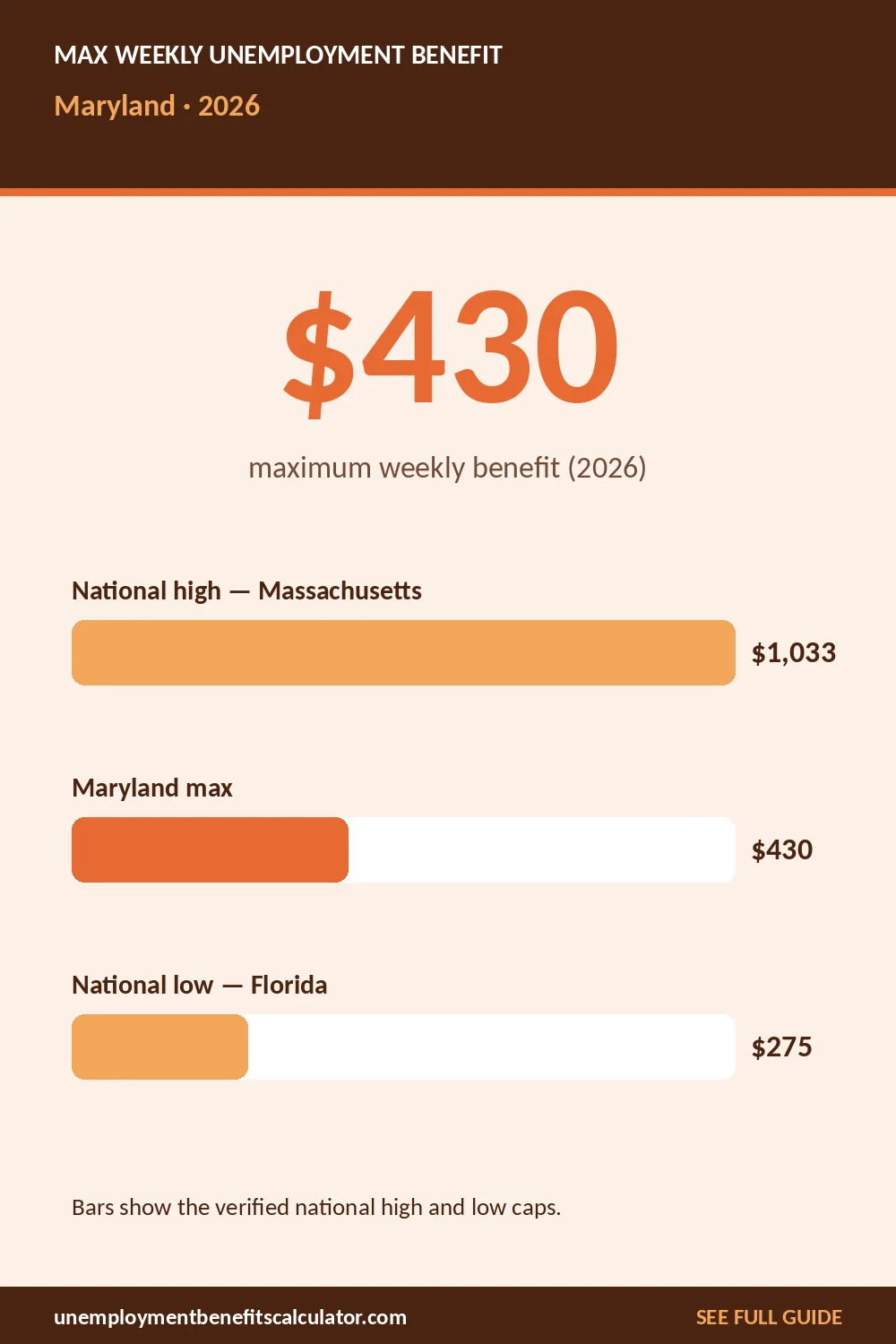
The $430 Answer, Straight
Maryland builds the weekly number from your base-period wages and clamps the result between a $50 floor and the $430 ceiling. The technician's $38-an-hour history priced near the top of that band, so his determination letter read $430 with no surprises. A part-time bookseller earning a quarter of his wages clears the floor easily and sees a smaller but still payable figure. Most full-time claims at a typical Maryland wage price in the mid $300s, which is why the ceiling matters most to skilled trades and federal-adjacent contractors around the Beltway.
Where the number comes from matters as much as the number itself. Maryland reads the wages employers reported during the base period, which usually means four of the most recent five finished calendar quarters, and our base-period explainer shows why a January layoff prices differently from a September one. If the determination letter looks wrong against your own math, the wage-error appeal inside the 15-day window is the fix, not a refiling.
Anyone who wants the estimate before the letter arrives can run the weekly benefit calculation walkthrough in ten minutes, then compare it against the state's own projection when BEACON issues it. Agreement between the two is the green light; disagreement is the first thing to raise on the phone line.
Who Clears Maryland's Monetary Test?
The monetary test asks for base-period wages spread across at least two quarters, enough total earnings to produce a weekly amount above the $50 minimum. That is a low bar by national standards. A worker who grossed $2,600 a week for a single quarter and nothing else can still open a payable claim, which is why seasonal crab-house and holiday-retail workers file successfully in the off-season here more often than in stricter states.
The wages that count are covered employment wages, meaning employers who paid Maryland unemployment insurance taxes on them. Freelance 1099 income, cash gigs, and self-employment do not feed the calculation, and the monetary eligibility breakdown lists which wage types the agency keeps and which it ignores. Workers whose last job was contractor-only should read the self-employment eligibility guide before expecting a payable claim. Bonus checks and retroactive raises land in the quarter where the work happened, and a misallocated payment is worth correcting with the employer before the claim prices it wrong.
Two timing notes protect thin claims. First, the alternate base period can rescue claimants whose most recent quarter was weak, so never accept a denial based on the standard window without asking about it. Second, wages from neighboring states can be pulled into the Maryland claim when the work happened for a covered Maryland employer, and the interstate-claim guide covers how combining wages changes the math.
One Certified Check: What the Waiting Week Costs
Maryland charges every new benefit year one waiting week, an unpaid week you still certify like any other. The technician filed the Monday after his last shift, certified that first week on schedule, and received nothing for it, which is exactly how the rule is supposed to work. The week is not lost labor, it is the program's deductible, and skipping it is the single most common reason new Maryland claimants panic in week one.
The practical consequence is timing. A claim filed the week you lose the work burns its waiting week immediately and starts paying in week two, while a claim filed three weeks late burns the same week but starts everything else later. Our waiting-week guide compares how states apply the deductible and why filing date, not eligibility date, sets the clock. Certify the waiting week accurately even though it pays nothing, because the record it creates anchors the rest of the claim.
$8 a Week per Dependent, Up to Five
Each qualifying child adds $8 to the weekly payment, and the allowance recognizes up to five dependents, so the largest family addition is $40. On a $300 base check with three children, the weekly total becomes $324. The additions are small next to states that pay half the base benefit per child, but over 26 weeks a three-child household collects an extra $624, real money at the floor end of the wage scale.
Qualification turns on support, not residence alone. The children must rely on the claimant for more than half their support, and the application asks for the details up front. The dependent-allowance guide explains the documentation the agency requests and how Maryland's flat $8 compares with the percentage-based structures nearby, so families can plan the real weekly number before the first determination letter lands. Update the count if circumstances change mid-claim, because the allowance follows the application rather than the certification, and a support change is an application edit rather than a phone note.
File Through BEACON Without Stalls
The application runs through BEACON, the state's online portal, and takes most claimants under an hour with the right papers on the desk: eighteen months of employer names, addresses, and dates, the separation reasons, and that final pay stub. The technician had all three ready, which is why his claim never touched a fact-finding queue. The pre-filing checklist matches the BEACON screens line by line and takes five minutes to gather.
Registration is the step people miss. Maryland requires claimants to register with the Maryland Workforce Exchange, the state job-matching system, and BEACON ties that record to the claim, so do it the same day you file. Skipping the registration stalls the claim for weeks and is the error most cited in Maryland delay complaints, a pattern the application-mistakes catalog documents with the fixes.
After filing, the determination letter states the weekly amount, the maximum total, and the reason codes the employer reported. Read it the day it arrives. Errors in wage credits or separation codes are far easier to correct inside the first week, and the post-filing timeline guide sets expectations for how long each stage normally runs.
What Does Sunday Certification Ask?
Weekly certification in BEACON asks whether you worked, how much you grossed, whether you were able and available, and whether you completed your work-search duties. Maryland lets you file the weekly claim any day after the week ends, but a fixed rhythm, the same morning every week, is what keeps claims clean. The certification questions preview walks each screen with the answer patterns that avoid flags. The portal also stores every determination and notice, which makes it the single inbox that matters while the claim runs.
Gross pay gets entered for the week the hours were performed, and BEACON's audit matches employer wage reports against your answers. The technician picked up two days of marina-side contract work in week six, reported the gross amount, and saw a reduced check that week with the claim intact. The reporting guide covers the edge cases that trip seasonal workers, and the missed-deadline guide explains why a skipped certification costs a week outright rather than delaying it.
How Much Part-Time Pay Can a Maryland Claim Absorb?
Part-time work coexists with a Maryland claim, and the arithmetic is forgiving at modest incomes. The state ignores a portion of weekly earnings before touching the benefit, so small shifts leave most of the check payable, while weeks that gross near or above the weekly amount zero out entirely. At the $430 ceiling, a $440 part-time week erases the payment, which is why high-hour temp assignments and claiming the same week rarely mix.
The structural detail worth learning early: reduced weeks still count as certified weeks, but they do not consume the 26-week allowance the way skipped weeks do, so cycling between partial work and claims stretches the runway. The part-time claiming guide and the earnings-disregard breakdown both walk the week-by-week math with Maryland-sized numbers, and the reduction guide shows what a specific paycheck does to a specific check.
Three Ways a Maryland Check Shrinks
First, employer contests. Separations with any ambiguity, performance exits, attendance disputes, negotiated resignations, invite the employer's version of events, and the claim freezes until adjudication sorts the accounts. The technician's restructure was clean, so his claim never paused; a colleague whose exit was labeled misconduct spent five weeks frozen before winning on the paper trail. The employer-contest guide explains the freeze and the evidence that resolves it fastest.
Second, offsets from other income. Pensions from base-period employers reduce the weekly amount dollar-for-dollar in the weeks they pay, and severance packages can push the claim's start date back entirely. Maryland treats severance allocation seriously, and the severance guide plus the pension-offset guide cover both interactions with the arithmetic claimants actually face.
Third, certification errors that harden into overpayments. A misreported week becomes an overpayment notice once the wage match lands, and the agency pursues those notices to collections when ignored. The overpayment response guide lays out repayment schedules and the appeal route, and speed matters because early responses keep the matter at the negotiation stage.
The 15-Day Clock After a Denial
Maryland allows 15 calendar days measured from the postmark on a determination, and few windows anywhere run this tight. The appeal lands with an Administrative Law Judge, normally over the phone, and the employer joins when the case is contested. The technician never needed one, but the colleague who beat a misconduct label filed on day four, assembled six years of reviews and the written restructure notice, and won without drama. The appeal walkthrough and the hearing-preparation guide describe the evidence set that decides most Maryland hearings.
Keep certifying while any appeal is pending, because weeks are only payable retroactively if they were certified on time, and a won appeal pays the backlog while a skipped week stays gone. The disqualification guide previews which separations need which evidence, so the appeal is assembled once rather than patched three times.
How Does Maryland Tax the Benefits?
Benefits are taxable income twice over: the IRS counts them, and Maryland counts them as state taxable income. The agency withholds nothing automatically, and the optional 10 percent federal election covers only the federal layer, so Maryland's tax arrives with the April return. The technician banked his checks untaxed and set aside roughly a tenth himself, which is one way to do it; the deliberate alternative is taking the federal election and budgeting for the state bill separately.
January's 1099-G reports the year's benefits total, and both returns consume the same figure. Our unemployment tax guide runs the withholding arithmetic beside the safe-harbor thresholds and shows what a full 26-week run at $430, roughly $11,180 of taxable income, does to a Maryland filer's April.
Where $430 Stands in the Region
Set against its neighbors, Maryland's program is a mid-pack ceiling with a full-length runway. Pennsylvania pays $605 a week, Virginia $378, West Virginia more per week than Maryland in recent years, and Delaware sits close to the $430 line. The technician's cousin in Virginia cleared the same monthly total only because her claim ran longer in practice, and the regional trade-off, weekly size against duration, is exactly what the state-by-state comparison and the maximum-benefits table quantify for every border state.
The practical read for commuters: the claim follows the state where the work occurred, regardless of where you sleep, which is why District-based Marylanders with Virginia employers end up on Virginia's rules. Run the comparison before you file, because the same layoff prices differently on each side of the line.
What Maryland's Program Cannot Fix
Honesty section, because the low barrier breeds a specific blind spot. A $430 check against Baltimore and close-in-suburb rents is partial relief, not replacement income, and the 26-week runway ends whether or not the job search has landed. The program likewise refuses claimants separated for provable misconduct tied to the job, or who walked out without good cause belonging to the employer, and those cases are adjudication questions that no amount of filing precision changes. The exhaustion guide maps what remains when the 26 weeks close, and the quit-eligibility guide previews which resignations survive review.
One limit of this guide itself: the ceiling has sat at $430 for years and can move with legislation at any session, the figures here are verified as of October 27, 2026, and a claim filed after any future adjustment should re-check the band before doing planning math with it.
The Checklist Before Week One Closes
- File through BEACON during the week employment stops, carrying eighteen months of employer records
- Register on the Maryland Workforce Exchange the same day you file
- Certify the unpaid waiting week on schedule so the claim record starts clean
- Add every qualifying dependent to the application, $8 each, up to five
- Log the gross figure under the week the hours were worked, every week, without exception
- Keep the work-search log dated and verifiable, because BEACON audits match employer reports
- Calendar the 15-day appeal window against every determination the agency mails
The technician cleared all seven lines in his first week and never touched the system again until the deposits stopped on schedule at week 26. Maryland rewards that kind of early precision more than it rewards anything else: the band is fixed, the deadlines are short, and the claim that starts accurate stays accurate. Run the checklist while the layoff is fresh, because nothing here gets easier from the back end, and the federal UI directory is the right cross-check whenever a rule seems to have moved.
Frequently Asked Questions
How much is unemployment in Maryland in 2026?
Between $50 and $430 per week, set by your base-period wages, for up to 26 weeks. Each qualifying child adds $8 to the weekly payment, up to five children. Most full-time claims at a typical Maryland wage price in the mid $300s, and the ceiling has held steady for years, though legislation can move it.
Does Maryland have a waiting week for unemployment?
Yes. Every new benefit year carries one unpaid waiting week that you must still certify on schedule. The claim filed the week you lose the work starts paying in week two, while a late filing burns the same week but delays everything after it, which is why the filing date matters more than most claimants expect.
How long does Maryland unemployment last?
Up to 26 payable weeks in a benefit year that runs 52. Weeks you work part-time and certify still count as reduced weeks rather than skipped ones, so cycling between partial work and certification stretches the runway, while weeks you fail or skip outright vanish from the allowance without a refund.
What are Maryland's work search requirements?
Register with the Maryland Workforce Exchange when you file and keep a documented weekly search going for every certified week. BEACON ties the registration to your claim, and an unregistered claim stalls for weeks. Keep the search log dated and verifiable, because the agency audits it against employer reports.
Does Maryland tax unemployment benefits?
Yes, at both levels. The IRS counts benefits as income and Maryland counts them as state taxable income, and the agency withholds nothing automatically. The optional 10 percent federal election covers only the federal layer, so the Maryland tax lands with your April return, and the 1099-G arrives each January with the annual figure.
How many days do you have to appeal a Maryland denial?
15 calendar days counted from the determination's postmark, a tighter window than nearly every state allows. The appeal is heard by an Administrative Law Judge, normally over the phone, and paper-backed claims outnumber argument-backed wins. Keep certifying throughout, because only weeks certified on time can be paid retroactively after a win.