
Most of what job boards "know" about Tennessee unemployment is a 2019 fact sheet wearing a 2026 header. The cap is not $275 anymore. The duration is not fixed. The formula does not even use your best quarter the way most states do. Tennessee rebuilt its program in pieces over the past few years, and claimants who plan around the old numbers either overestimate what they will receive or file in the wrong week entirely.
Tennessee pays between roughly $36 and $325 per week in 2026, computed by averaging your two highest base-period quarters and dividing by 22, for a standard 12 weeks that stretches toward 20 as the statewide unemployment rate climbs. One unpaid waiting week comes first, three documented work-search activities are due weekly through Jobs4TN, and the state adds no income tax on top. (Tennessee Department of Labor and Workforce Development, checked October 26, 2026)
The sections below take the five myths that cost Tennessee claimants the most money and hold each one against the 2026 rules, with the neighboring-state comparisons that show where the program genuinely lands. Numbers come from the state's own pages as of late October 2026.
| Item | Tennessee 2026 value |
|---|---|
| Maximum weekly benefit | $325 (reached at a $7,150.01 two-quarter average) |
| Practical floor | About $36 (the $780.01 two-quarter gate) |
| Formula | Average of two highest quarters, divided by 22 |
| Standard duration | 12 weeks, scaling toward 20 with the unemployment rate |
| Waiting week | Yes, one unpaid week up front |
| Work search requirement | 3 documented activities per week via Jobs4TN |
| State tax on benefits | None, Tennessee has no wage income tax |
Myth: Tennessee's Low Cap Makes the Program Pointless
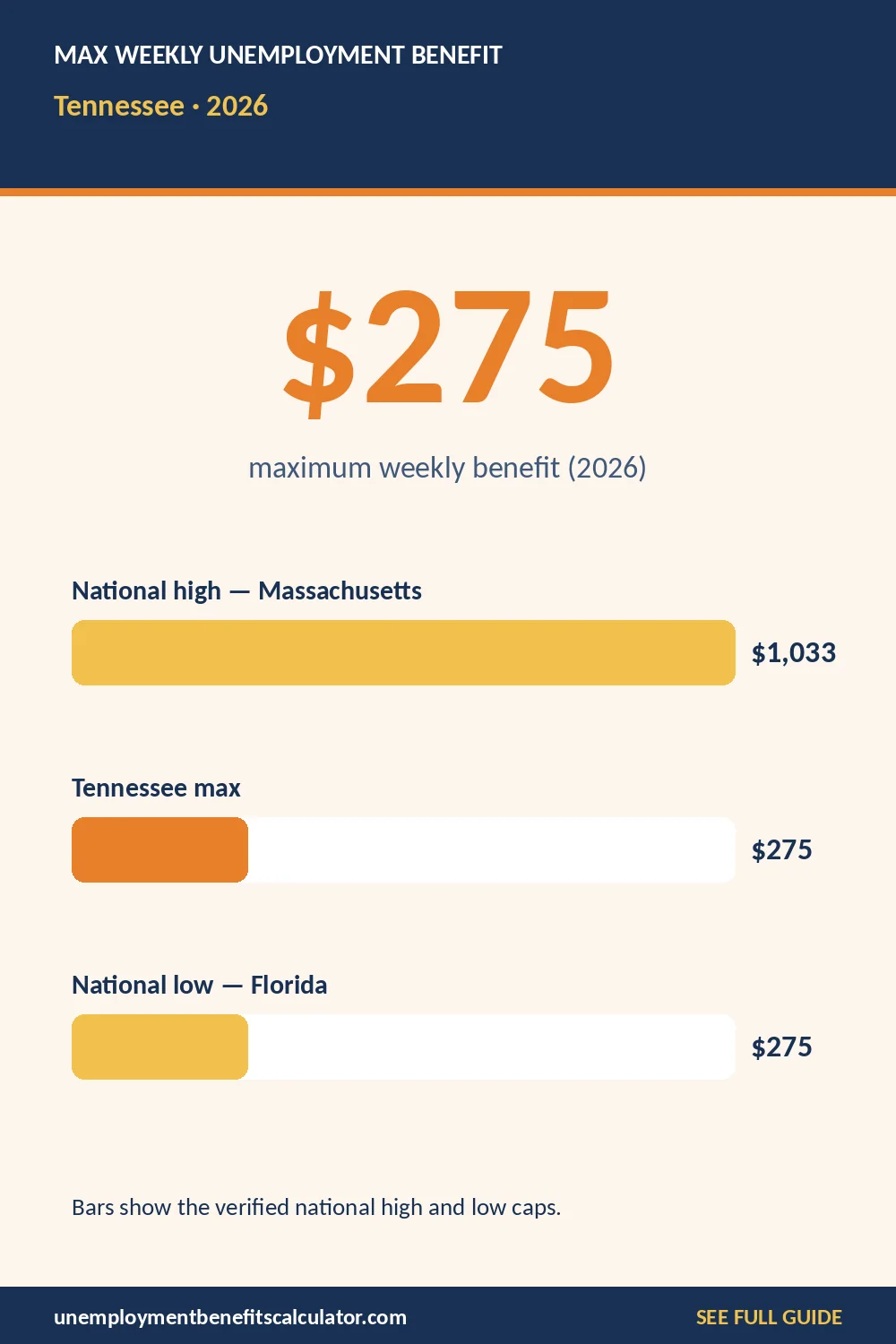
The $325 ceiling sits near the bottom of the national table, and no amount of framing turns it into a generous number. But pointless and lean are different claims. For a Tennessee worker whose gross wages averaged $650 a week before the layoff, a $325 check replaces half of exactly what disappeared, which is the same replacement rate Massachusetts advertises at eight times the ceiling. The program's design philosophy is small weekly amounts with few frictions: no state tax slice, a light three-activity search standard, and a formula that treats two good quarters as sufficient history.
The regional comparison sharpens the picture. Kentucky next door pays a mid-range weekly amount for a longer standard runway, while Mississippi's ceiling lands even lower than Tennessee's. Against that border set, the $325 cap plus the no-tax rule keeps a Tennessee check competitive per hour of paperwork, even when it loses per dollar. Arkansas trades a lower ceiling for a simpler claim path, Virginia posts higher weekly amounts with a similar duration band, and Georgia's 14-to-23-week schedule makes the weeks column worth checking before anyone calls Tennessee short. The full 50-state spread is laid out in the state comparison guide for anyone deciding whether a move or an interstate claim changes the math.
Local wages decide whether that matters. Tennessee's median weekly paycheck sits low enough that a $250 check covers more of a Chattanooga rent than a $400 check covers in Boston, which is the comparison that actually runs through claimants' heads. The formula's 22-part divisor keeps the check proportional to local reality, whatever the national ranking says. That proportionality, not the headline ceiling, is what Tennessee's defenders actually mean when they call the program honest.
$325 Against Its Neighbors: Where Tennessee Actually Ranks
Rank three or four in its own neighborhood, is the honest answer. Virginia and Georgia both post higher ceilings, Arkansas posts a lower one, and the duration schedules differ so much across those states that weekly comparisons mislead without the weeks column attached. What Tennessee uniquely offers is the scaling duration: when the state unemployment rate rises, the 12-week base climbs toward 20 without any legislative session, which is a flexibility most fixed-duration states lack.
For seasonal and tourism workers in Gatlinburg, Memphis logistics, or Nashville hospitality, that scaling matters less than the formula does. The two-quarter average means one spectacular quarter cannot carry a claim alone the way it can in best-quarter states, and one terrible quarter cannot sink it the way it can in average-wage states. The base-period guide shows which calendar window feeds the average for any filing month.
Myth: Everyone Gets 12 Weeks No Matter What
Twelve weeks is the floor of a sliding schedule, not a fixed sentence. Tennessee indexes the maximum duration to the statewide average unemployment rate, stretching the runway in measured steps as the labor market loosens, with 20 weeks as the top of the band. In the labor market of late 2026 the operative number sits at the low end, which is precisely why planning around 12 weeks is the right instinct right now, and why the same claim filed in a recession could run two-thirds longer.
Duration planning in Tennessee also means watching the rate announcement each month. The trigger reads the statewide average, publishes with the monthly jobs data, and applies to new claims without retroactivity.
The interaction with the waiting week compounds the sting. One unpaid week comes before the first payable check, so a 12-week schedule delivers money for 11 certified weeks at full duration. Our waiting-week guide compares that structure with the states that waive the week or credit it back, and the duration guide maps how the sliding bands work in practice.
The Two-Quarter Formula, and Why $780 Decides Everything
Tennessee averages your two highest base-period quarters and divides by 22. Cross a $7,150.01 average and you reach the $325 ceiling; fall below a $780.01 average in each of those two quarters and the claim fails the monetary test outright. Between those poles the arithmetic runs linearly, so a $4,000 two-quarter average produces about $181 a week and a $6,000 average produces about $272.
The eligibility rules around the formula carry two extra tests that surprise claimants. Wages outside your highest quarter must reach the lesser of $900 or six times your weekly amount, and total base-period wages must exceed forty times the weekly amount. Both exist to block claims built almost entirely on one short burst of income. A worker whose two qualifying quarters came from one two-month contract needs the rest of the base period to show real wages too, and the monetary-eligibility guide runs the numbers test by test.
Where the two quarters come from also matters for part-year workers. The seasonal-worker guide covers the between-season filing questions that Tennessee's hospitality belt raises every winter.
Myth: No Income Tax Means No Paperwork
Tennessee levies no wage income tax, so a benefit check arrives whole and stays whole at the state level; there is no state withholding election to make and no state return line waiting in April. The federal government still taxes every dollar, and the Tennessee 1099-G that lands each January goes straight onto the federal return. The federal withholding election, 10 percent, appears during the application, and our unemployment tax guide runs the numbers on taking it versus setting the money aside.
The paperwork that does exist hides in certification. Each weekly claim asks for gross earnings, and Tennessee audits the answers against employer filings; mismatches generate overpayment notices that the overpayment guide helps answer. Clean certification is the whole game in a no-tax state: the money never shrinks on its own, so the only way to lose it is a reporting error or a missed week.
One Waiting Week Before the First Dollar
The waiting week is unpaid and unavoidable, and it applies to every new benefit year. Claimants who certify it correctly preserve the week inside their schedule; claimants who skip certifying because no money moved lose the structure. The practical playbook: file the week the job ends, certify every week from the first one, and expect the first deposit after the second certified week. The first-payment timeline explains the full sequence, and the payment-method guide covers how the money actually arrives.
Myth: Part-Time Work Ends the Check
Tennessee's partial-benefit rule leaves a slice of earnings untouched before reductions begin: the greater of $50 or 25 percent of your weekly amount. A $240-a-week claimant can earn $60 in a week without any reduction at all, and earnings past that line reduce the check dollar-for-dollar rather than zeroing it. Earnings that meet the whole weekly amount stop that week's payment while the week itself still counts as certified when the other conditions hold.
The reporting discipline is identical to every other state's: gross wages, in the week worked, every week, no exceptions for delayed paychecks. The part-time claiming guide pairs with the weekly reporting guide to cover the scenarios that trip up gig and shift workers, and the disregard guide shows how Tennessee's rule compares with the flat $160 cutoffs some states now use.
Three Activities a Week Through Jobs4TN
Every week you claim, Tennessee expects three documented work-search or reemployment activities, and the record lives in the Jobs4TN system where the claim itself runs. Applications, resume submissions, interviews, job-fair attendance, and career-center services all count. The log needs dates and employer details, and Tennessee asks for it on request, which is why reconstructing three weeks of searches from memory during an audit never goes well. The log template guide shows the fields reviewers look for, and the state requirements comparison places Tennessee's three-activity rule against the one-contact and four-contact states around it.
Training and reemployment services count alongside employer contacts, which gives the three-activity rule a second gear. A claimant attending a career-center workshop satisfies the week with that activity alone, and Tennessee treats resume clinics, skills assessments, and job-fair attendance as first-class searches rather than make-work. The distinction matters for laid-off manufacturing and healthcare support workers, whose realistic search weeks often revolve around credentials rather than applications, and the job-fair and networking guide shows exactly which events log cleanly.
Suitable work ties into the same system. A job the state considers suitable, refused without good cause, can disqualify the claim, and Tennessee's definitions lean on wage-and-hours comparisons with your prior position. The suitable-work guide and the good-cause guide both matter reading before any refusal or resignation decision, and the fired-for-cause guide explains the burden structure: the employer must prove misconduct connected to work, and simple inability to do the job does not meet that bar.
Two Nashville Claims, Worked End to End
Numbers land better with names attached, so take two. A Nashville hotel front-desk supervisor earned $7,800 and $7,300 in her two best quarters, averaging $7,550. Divide by 22 and the weekly amount comes to $343, which the $325 ceiling trims to the cap; her claim runs 12 weeks at the current duration, one of them the unpaid waiting week, for a real take of roughly $3,575. A kitchen worker across town with $4,400 and $4,000 as his top two quarters averages $4,200 and lands at $190 a week, under every cap, with the same 11 paid weeks, for about $2,090.
Same city, same 12-week schedule, and the difference between them is entirely the two-quarter average. The supervisor's claim clears the $780.01 monetary gate on both quarters with room to spare; the kitchen worker clears it too, but he sits closer to the wage-outside-the-highest-quarter test, which his steadier full-year record satisfies. Run your own two quarters through the division before filing, because the answer decides whether Tennessee's program is worth a week of paperwork for your specific history, and the estimate guide handles the arithmetic if the quarters are uneven.
Certification Answers That Keep the Money Flowing
Tennessee's weekly certification is short, and every question on it maps to a disqualification if answered carelessly. The work question takes gross earnings for the week the hours happened, not the paycheck week, and the reporting guide walks the shift-worker edge cases. The availability question expects a genuine full-time search posture even while working part time, a distinction the availability guide untangles. The search question presumes the Jobs4TN log is current, because the certification and the log are two views of the same week.
The mistakes that generate overpayments cluster in three spots, and the certification-mistakes guide covers each: earnings rounded down to zero for a slow week that still paid something, weeks missed entirely and certified late without a good-cause note, and search activities logged in batches after the fact. Tennessee reconciles certification answers against employer wage reports every quarter, so a pattern of loose answers tends to surface months later with interest attached rather than immediately.
Myth: A Denial Is Final
Denials, amount disputes, and disqualifications all share one 15-day window, counted from the day the determination went out. First-level appeals land with an Administrative Judge, typically on a phone hearing, and a written decision follows once the record closes. Filing the same day the letter arrives, then assembling evidence, is the sequence that works, and the appeal guide plus the hearing-preparation guide cover both halves.
Employer contests run through the same machinery in reverse, and Tennessee's employer-contest rate is high enough that claimants should expect one as a default rather than a surprise. Certify every week while any appeal pends: the weeks are only recoverable retroactively if they were certified on time, a rule the employer-contest guide explains in detail.
The Seasonal Worker's Schedule Trap
Tennessee's tourism and agriculture cycles produce claims that straddle seasons, and the trap is the between-season gap. A worker laid off in November who waits for a March reopening before filing has burned the winter weeks, and the waiting week, out of a 12-week schedule designed for exactly that gap. Filing in the week of separation, certifying through the winter, and letting the seasonal recall end the claim naturally preserves both the money and the eligibility record.
The honest limits of the program deserve a line here too: the $325 ceiling will not cover a Nashville cost of living on its own, the sliding duration only stretches when the statewide rate moves, and school employees, federal workers, and disaster-affected claimants each run separate rulebooks. For a worker whose plan survives those limits, the next questions are usually about neighboring states and the extension ladder, and both are covered in the regional comparison and the extended-benefits trigger guide.
Plan the claim around the real 2026 numbers: $325 at the top, 12 weeks at the floor duration, one unpaid week up front, three logged activities per week, and a federal tax bill with no state tax beside it. File fast, certify clean, and let the formula's two-quarter logic shape which weeks of work history you gather before applying. The myth that costs the most is still the oldest one: that Tennessee's program is too small to bother getting right.
Frequently Asked Questions
How much is unemployment in Tennessee in 2026?
Between about $36 and $325 per week. Tennessee averages your two highest base-period quarters and divides by 22, so a $7,150.01 two-quarter average reaches the ceiling while anything under a $780.01 average fails the monetary gate entirely. Two quarters of wages feed the whole calculation, so which calendar window your best months fall into matters as much as the total earned.
How many weeks does Tennessee unemployment pay?
A standard 12 weeks, scaling in steps toward 20 as the statewide unemployment rate rises. One unpaid waiting week comes first, so a full 12-week schedule delivers 11 weeks of actual payments at the current duration. The rate trigger reads the statewide average unemployment rate, so the same claim filed during a downturn could run two-thirds longer than the 12-week floor.
Does Tennessee tax unemployment benefits?
No state tax applies, because Tennessee has no wage income tax at all. The IRS still taxes every dollar federally, the 10 percent withholding election appears during the application, and the January 1099-G feeds the federal return. The 1099-G arrives in January, and nothing on it changes the state-side picture because no Tennessee return line exists for benefits.
What are the work search requirements in Tennessee?
Three documented work-search or reemployment activities per week, recorded through the Jobs4TN system where the claim runs. Applications, interviews, job fairs, and career-center services all qualify, and the log needs dates and employer details you can produce on request.
Does working part time end a Tennessee claim?
Yes. Tennessee ignores the greater of $50 or 25 percent of your weekly benefit before reductions start, and earnings above that line reduce the check dollar-for-dollar. Gross wages get reported in the week the work happened, every single week, no exceptions. A week whose earnings reach the full weekly amount pays nothing but still counts as a certified week when the other conditions hold.
What is the deadline to appeal a Tennessee unemployment denial?
Fifteen days, counted from the date the determination went out. First-level appeals go to an Administrative Judge, usually by phone, and certifying through the appeal keeps those weeks recoverable retroactively if the decision changes. Filing the same day the letter arrives, with evidence assembled right behind it, is the sequence that works, because the written record decides most outcomes before anyone speaks.