
What does Missouri actually pay a laid-off worker, and what does the state want back in exchange? The first answer is arithmetic: 4 percent of the average of your two best quarters, up to $320 a week, for up to 20 weeks. The second answer is a short list of weekly obligations: one documented search activity, one honest certification, and one waiting week before the money starts. Missouri keeps both sides of that bargain simple, which is exactly why the small mistakes here are so preventable.
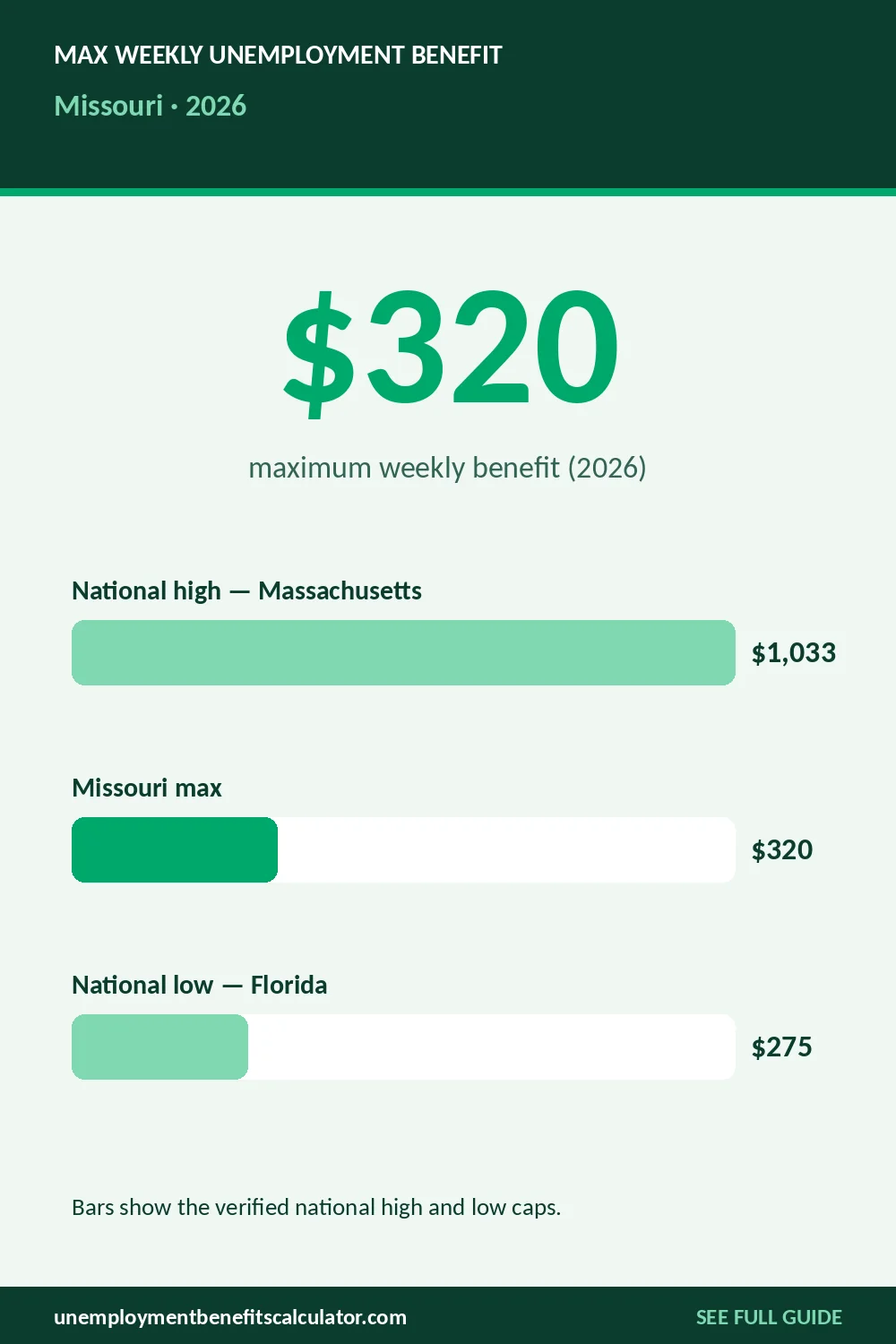
Missouri pays $44 to $320 per week in 2026, computed as 4 percent of the average of your two highest base-period quarters, for up to 20 weeks. Qualifying takes $2,250 in total base wages with at least $1,500 in one quarter, one unpaid waiting week comes first, and appeals run on a 30-day window. (Missouri Department of Labor, checked October 26, 2026)
The sequence below runs a Missouri claim step by step, from the wage tests through the tribunal, with the border-state questions that Kansas City and St. Louis claimants ask most.
| Item | Missouri 2026 value |
|---|---|
| Formula | 4% of the average of your two highest quarters |
| Maximum weekly benefit | $320 |
| Minimum weekly benefit | $44 |
| Wage gate | $2,250 total, $1,500 in one quarter, $750 beyond it |
| Standard duration | Up to 20 weeks |
| Waiting week | Yes, one week unpaid at the start |
| Work search requirement | 1 documented activity per week |
| State tax on benefits | Yes, Missouri income tax applies |
Average Your Two Best Quarters, Then Take 4 Percent
Missouri's formula looks at your base period, picks the two quarters where you earned the most, averages them, and takes 4 percent of that figure. A Kansas City warehouse lead with $9,800 and $9,200 as his top two quarters averages $9,500, and 4 percent of that is $380, which the $320 ceiling then trims. A St. Louis line cook with $5,600 and $5,200 averages $5,400 and lands at $216 with no cap in sight. The math runs linearly between the $44 floor and the $320 top, which makes every determination letter checkable with a calculator before it arrives.
The two-quarter average is a middle path between the best-quarter states and the full-history averagers. One spectacular quarter cannot carry a claim alone, and one dead quarter cannot sink it. Our WBA formula guide compares that structure with the other architectures states use, and the high-quarter versus average-quarter guide shows which wage histories win and lose under each.
Reaching the ceiling takes a $16,000 two-quarter average, which is why so few Missouri claims touch $320: it requires about $32,000 of concentrated annual earnings. The bulk of Missouri checks land between $150 and $300, and the state comparison table shows how that band stacks against the region.
Clear the $2,250 Wage Test Before Anything Else
Missouri's monetary gate has three prongs, and all three must hold: at least $2,250 of total base-period wages, at least $1,500 of it in a single quarter, and at least $750 in the wages that fall outside your highest quarter. The third prong is the one that quietly kills claims from short-term workers whose income concentrated in one burst. A temp who earned $3,100, all in one quarter, fails the $750-outside test despite clearing the total, and the monetary-eligibility guide walks each prong with worked examples.
The base period follows the standard four-of-last-five-quarters calendar, so the filing month decides which window reads your wages. Workers with rising or falling earnings curves can shift the two-quarter average by weeks just by filing at the right time, and the base-period calendar guide shows which months move which quarters in and out. The alternate base period exists as a second look when the standard window misses, and the backdating guide covers how late filings interact with the whole calendar.
One more number belongs in the planning: the total pot. Missouri caps the lifetime maximum benefit at a figure derived from your wages, so the weekly amount and the duration multiply toward a firm limit that the determination letter states explicitly.
The Filing Week: UInteract From End to End
UInteract, the state's online portal, handles the application, the weekly certifications, and every notice in between. The application wants 18 months of employer history with separation reasons, and the pre-filing checklist matches its screens. Filing in the week of separation matters for the usual reason, the waiting week and the 20-week schedule both key off the claim date, and for a Missouri-specific one: the state's fall and winter seasonal cycles, described below, punish late filings harder than most states' do.
The determination letter states the weekly amount and the maximum pot. Read it against your own 4 percent math the day it lands, because the 30-day appeal window, the longest in this region, still closes faster than most people expect. The application-mistakes guide covers the wrong-separation-code errors that turn into adjudication delays.
Serve the Waiting Week Without Losing a Week
One unpaid waiting week starts every benefit year, and it only counts if you certify it: able, available, search activity logged, zero earnings beyond what you report. Skipping the first certification because no money moved costs the structure the week was supposed to build, and the waiting-week guide compares Missouri's version with the states that waive or refund theirs.
The waiting week also interacts with the seasonal calendar more than claimants expect. A November layoff in the Ozarks tourism belt that waits three weeks before filing starts collecting in early December with the waiting week already burned, while the same worker filing the week of separation keeps all 20 weeks available against the winter gap.
After the waiting week, the first deposit lands against the following week's certification, typically inside the first three weeks of the claim for clean filings. The first-payment timeline and the payment-method guide cover the deposit mechanics, which in Missouri run fastest through direct deposit.
Log One Search Activity and Certify Weekly
The weekly search standard is one documented activity, among the lightest in the Midwest: an application, an employer contact, a job-fair visit, or a career-center service, each with a date and a name you can produce later. Certification happens weekly through UInteract, asking about work, gross earnings, availability, and the search. The certification-questions guide previews every prompt, and the certification-mistakes guide catalogs the small reporting errors that become overpayment letters, the most common being earnings reported for the week the paycheck arrived instead of the week the hours were worked.
Availability holds all week even with the light search rule. A voucher answered while out of state for two weeks, or while a training schedule made you unavailable, creates exactly the retroactive mess the availability guide untangles, and moving across state lines mid-claim raises questions the moving guide answers before the benefits office does.
Can Part-Time Work Ride Along?
Yes, with accurate reporting. Missouri trims the weekly payment once earnings pass the state's disregard, and a moderate part-time income leaves the claim running, and even a week whose earnings meet the whole weekly amount stays on the books as a certified week. The part-time claiming guide and the weekly reporting guide walk the arithmetic, and shift workers with variable hours should read the overtime and bonus guide before a heavy-earnings week hits the voucher.
One worked week shows the mechanics. A $240-a-week claimant who picks up a $150 weekend shift reports the full $150 on the voucher, Missouri subtracts its disregard from the earnings rather than the benefit, and the check arrives reduced by the difference while the claim stays alive. The same claimant earning $240 from work would see no payment that week yet keep the week on the books, which matters when the seasonal calendar gets tallied. Neither scenario requires a phone call to the benefits office, which is the quiet virtue of a formula the claimant can run at the kitchen table.
Employers offering reduced hours instead of layoffs should ask about shared-work plans, which keep staff attached at partial benefits without a full claim; the shared-work guide covers the program Missouri runs alongside regular UI.
What Happens Inside an Employer Contest?
Missouri employers contest separations at a steady clip, and a contest pauses payments while an adjudicator weighs the two accounts. The separation reason you filed in week zero frames the whole review, so mismatches between your account and the employer's get resolved by documents: schedules, messages, termination letters, and reviews. The employer-contest guide lays out the sequence, and the fired-for-cause guide details why the misconduct burden falls on the employer while the good-cause burden for quits falls on you, a split the good-cause guide maps out.
What Happens at the Appeals Tribunal?
Any determination you disagree with, ineligibility, a disqualification, or the amount itself, goes to appeal within 30 days of the mailing date, landing with the Appeals Tribunal where an Administrative Law Judge reviews the record, usually by phone. Thirty days is generous by national standards, but the weeks you certified during the pendency are the ones a win restores, so the same-day filing habit still rules. The appeal guide and the hearing-preparation guide cover the evidence set that moves Tribunal decisions.
Overpayment notices follow their own reply path, with repayment plans and waiver questions handled before the debt ages into offsets; the overpayment guide lays out the options while the window is still open.
The pot limit deserves its own example because it works opposite to most states. Missouri derives the maximum total benefit from the wage record, so a claimant with modest base wages hits the pot ceiling before the 20 weeks run out, while a high-wage claimant simply stops at the calendar. Neither outcome is a penalty; both are printed on the determination letter, and both are predictable from the wage record before filing.
Run the Formula on Two Real Wage Records
Two Springfield claims show the range. A hospital tech with $11,800 and $10,400 as her two best quarters averages $11,100; 4 percent of that is $444, and the $320 ceiling trims it. Her 20-week schedule pays at most $6,400, and the one-third brake never comes close to binding because her base wages run far past three times her pot. A retail stocker with $5,900 and $4,700 averages $5,300 and lands at $212 a week, uncapped, with the same 20-week top and a $4,240 potential total.
Both clear the three-prong gate without drama, and both should verify the arithmetic against their determination letters, because Missouri's formula is checkable in one line. The cases the gate rejects look different: a W-2 worker with $2,400 total but $2,000 concentrated in one quarter fails the $750-outside test, and a claimant whose best quarters sit outside the standard window can sometimes fix everything by filing a month later. The backdating guide and the pre-filing estimate guide cover both timing plays.
Certification Answers That Prevent Overpayments
Missouri's weekly certification is short, and every overpayment case in the state starts with one of a handful of answers. Earnings go in for the week the hours happened, gross, no rounding down for a slow week. Availability means genuinely ready for full-time work that week, which trips returning students and traveling claimants more than anyone; the availability guide draws the line. The search-activity answer presumes the log exists, because one activity per week is easy to keep current and equally easy to reconstruct unconvincingly after an audit letter arrives.
The state reconciles certifications against employer wage reports quarterly, so errors surface with a lag, with an overpayment notice attached, and sometimes with a fraud flag if the pattern looks deliberate. The overpayment guide covers the response options while the notice is fresh, and the certification-mistakes guide prevents the notice from ever arriving.
What the 20-Week Schedule Cannot Cover
Honesty before the border question: a $320 ceiling against a Missouri mid-career paycheck is partial relief, and 20 weeks is a fixed top that does not stretch when the economy sours, because Missouri's duration is not rate-triggered the way Tennessee's or Arizona's is. Seasonal swings in the Ozarks and the agriculture belt produce claims that outrun the schedule by design, and the seasonal-worker guide covers the between-cycle filing tactics. Federal extended benefits remain the only automatic extension, and the trigger guide tracks when that ladder actually appears.
This guide's own limits deserve a line: separation adjudication, union disputes, and disaster claims run their own rulebooks, and the numbers here were verified in late October 2026 against the department's own pages. A determination letter always outranks a guide, including this one.
Plan the Missouri Tax Slice on Every Check
Missouri taxes benefits as income, and the application offers a state withholding election beside the federal 10 percent option. On a full $320-a-week claim, the annual total reaches $6,400 across 20 weeks, a number that changes some filers' bracket math; the unemployment tax guide runs the withholding-versus-estimated-payment comparison, and the January 1099-G carries the totals to both returns.
The practical advice for metro claimants is short. Gather wage records from every employer in the base period before filing, note which state each employer paid taxes in, and let the interstate rules sort the base claim rather than guessing. The wrong guess costs weeks, and the right one costs nothing extra.
The Border-Metro Question: Kansas or Missouri?
Kansas City and St. Louis claimants live where two systems touch, and the rule is residency-plus-claim-location, not preference. Workers who lived in Kansas but worked for Missouri employers generally file against Missouri wages through the interstate rules, and vice versa, with the wage record and the ceilings following the taxing state. The interstate claim guide walks the base-state decision, and the regional comparison shows how Missouri's $320 cap and 20-week schedule actually stack against Kansas, Illinois, and the other neighbors before anyone commits to a filing state.
The decision summary for a Missouri claim fits on a card: clear the three wage prongs, file the week the job ends, certify the waiting week, log the one activity, report every dollar in the week worked, and answer any determination within 30 days. Do the six steps and the formula pays what the wage record supports for up to 20 weeks; miss any of them and the same simplicity works against you. Missouri does not hide the ball, which is why the claims that fail here are almost always the ones that never started on time.
Frequently Asked Questions
How much is unemployment in Missouri in 2026?
Between $44 and $320 per week. Missouri takes 4 percent of the average of your two highest base-period quarters, so a $16,000 two-quarter average reaches the ceiling while the smallest qualifying records start near the $44 floor. The two-quarter average rewards steady histories, so a single strong quarter cannot rescue three thin ones the way it can in best-quarter states.
How many weeks does Missouri unemployment pay?
Up to 20 weeks within the benefit year, following one unpaid waiting week that needs certifying like any other. The schedule is fixed rather than tied to the unemployment rate, so plan around 20 as the hard top. Missouri's duration is fixed rather than rate-triggered, which makes the 20-week top a planning constant rather than a moving target.
What are the work search requirements in Missouri?
One documented search activity per week, such as an application, an employer contact, or a career-center visit, each recorded with a date you can produce on review. Certification happens weekly through UInteract with gross earnings reported in the week the hours were worked. Applications, employer contacts, job-fair visits, and career-center services all satisfy the standard, provided each entry carries a date and a name you can produce later.
Does Missouri tax unemployment benefits?
Yes. Missouri counts benefits as state income, and the application includes a state withholding election alongside the federal 10 percent option. The January 1099-G reports the year's total to both the federal and Missouri returns.
Does working part time stop Missouri benefits?
Yes. Gross wages go in for the week the hours happened and Missouri trims that week's payment rather than ending the claim, and even a week whose earnings match the full amount stays on the books as certified.
How long do you have to appeal a Missouri decision?
Thirty days after the determination's mailing date, generous against most states. Appeals land with the Appeals Tribunal, usually by phone, and the weeks you certified while the appeal pends are the ones a win pays retroactively. Thirty days is generous by national standards, but the weeks you certified while the appeal pends are the ones a win restores, so file the same day the letter lands.