
A banquet captain at a Denver hotel spent six years running a 40-person floor team before the ownership group sold the property and cut the event staff in half. Her separation notice arrived the last week of June, which mattered more than she knew: her claim would price off the base period Colorado assigns filers in her window, and the CDLE estimator she checked before filing quoted the current ceiling, $884 a week, against wages that came nowhere near it. Her claim became the calendar this guide follows.
The direct answer for Colorado in 2026: the state pays between $25 and $884 per week, caps a full claim at 26 times the weekly amount, charges no waiting week, demands five documented work-search activities every certified week, and gives 20 days to appeal a denial. Benefits are taxable income for Colorado as well as the IRS. (Colorado Department of Labor and Employment estimator, checked October 27, 2026)
Colorado pairs one of the country's stronger ceilings with one of its stricter weekly compliance routines, which is a trade most claimants accept happily once they see the arithmetic. Below, her claim runs from the sale notice through the final deposit in order, and every deadline shows up on the week it actually hit.
| Item | Colorado 2026 value |
|---|---|
| Maximum weekly benefit | $884 per week |
| Minimum weekly benefit | $25 per week |
| Maximum total per claim | Lesser of 26 times the weekly amount, or one-third of base-period wages |
| Standard duration | Up to 26 weeks in a 52-week benefit year |
| Waiting week | None, the first eligible week pays |
| Work search | 5 documented activities per week, logged in MyUI+ |
| Appeal window | 20 calendar days from the mailing date |
| State tax on benefits | Yes, Colorado taxable income; no automatic withholding |
Read the $884 Ceiling and the $25 Floor First
Colorado computes the weekly amount from your strongest quarter, roughly half its weekly average under the state's alternative-formula law, then clamps the result between $25 and $884. The banquet captain's $1,100-a-week average priced at about $550. Reaching the $884 ceiling takes a high-quarter average above roughly $1,770, which Denver-metro professional and tech wages clear routinely and hospitality wages rarely do. The calculation walkthrough reproduces the state's method step by step.
The second cap is the one people miss: the total claim cannot exceed the lesser of 26 weeks of your weekly amount or one-third of everything you earned in the base period. A claimant with thin total earnings but one explosive quarter can hit the pot limit well before 26 weeks, which is why the estimator's number and the max-total line deserve equal attention. Our high-quarter explainer shows how single-quarter spikes interact with that rule.
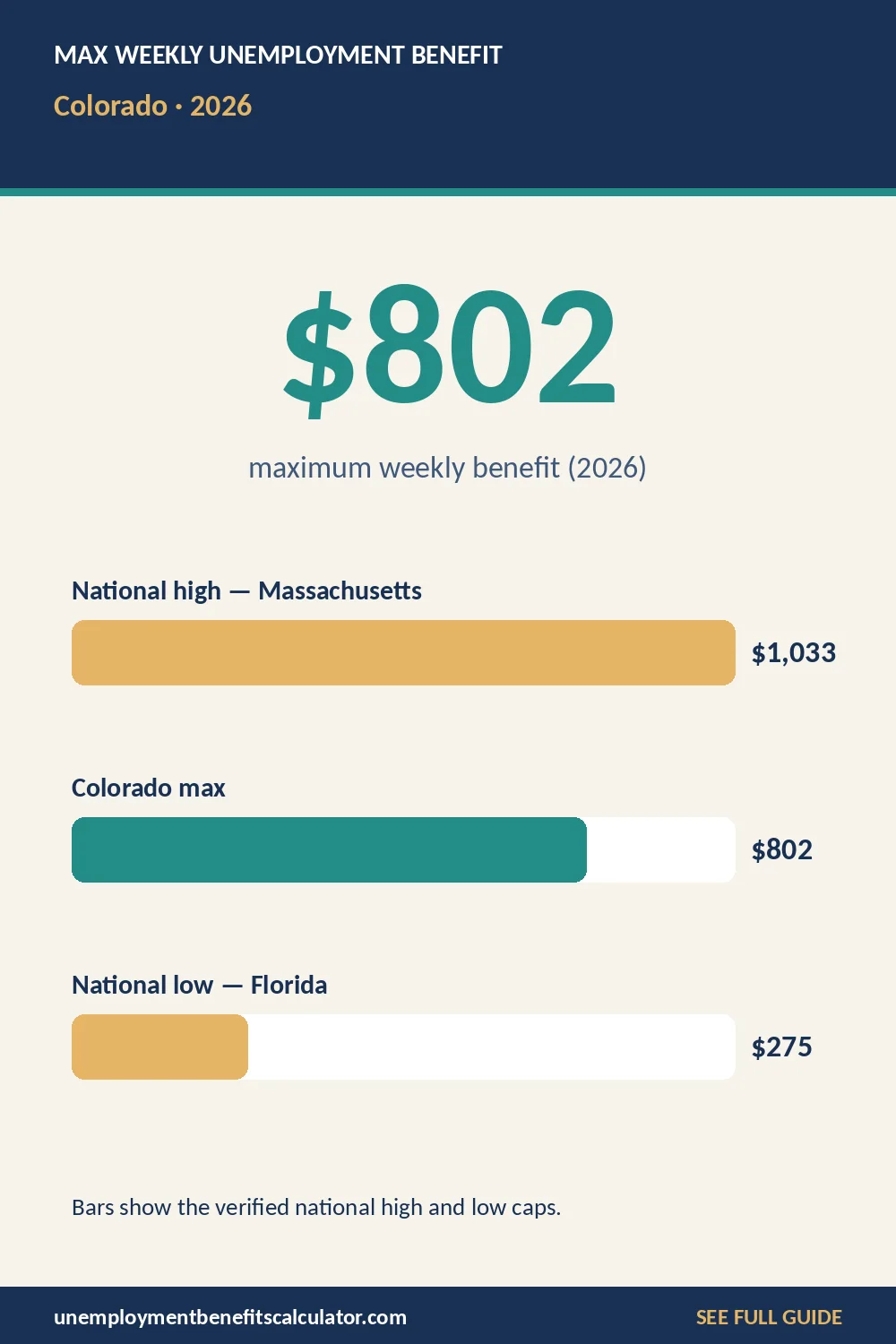
Colorado adjusts the ceiling every July, and anyone quoting $802 or $844 is reading an earlier cycle. The figure above is verified against CDLE's own estimator during the October 2026 filing window, and claims filed after next July's reset should re-check it before doing any planning math.
Does the One-Third Cap Bite Your Claim?
The estimator states the second cap on the same screen as the weekly amount, and it deserves its own arithmetic. A Denver cook with one exceptional quarter, a bonus-heavy year in software sales, or a commission spike can carry a weekly amount the wage pot cannot fund for 26 weeks. Colorado funds the full claim only when one-third of total base-period wages covers 26 times the weekly figure, so a claimant at $600 a week needs $46,800 of base-period earnings to run the full distance.
When the pot binds, the claim ends early even though the weekly checks were correct, and the pattern confuses claimants who planned against the duration alone. Our duration guide shows how the two limits interact, and the high-quarter explainer shows which wage shapes hit the cap. The banquet captain's pot comfortably funded her run, which is the normal case for steady wage histories.
File in Week One Through MyUI+
She filed the Monday after her last shift through MyUI+, the state's online claim system, with 18 months of employer history and the separation letter at hand. The application took about 40 minutes. Colorado charges no waiting week, so her first certified week was payable, and the waiting-week comparison shows why that front-loads Colorado claims relative to Wisconsin or Oregon filings.
Two details protect the filing. Report every employer that paid you in the base period, including the second job you forgot about, because wage mismatches are the top reason Colorado claims stall into fact-finding. And answer the separation questions exactly as the notice words them, since CDLE contacts the employer for its version and the application-mistakes catalog shows how small mismatches add weeks. The pre-filing checklist matches the MyUI+ screens line by line.
The determination letter arrived inside two weeks with the weekly amount, the maximum pot, and the base-period wages CDLE used. She checked it against her own math the same day, which is the habit the post-filing guide recommends, because errors caught in week one are corrections while errors caught in week ten are appeals.
Week Two Onward: The Five-Activity Rule
Colorado's work-search requirement is the strictest part of the program: five documented activities every certified week, logged in MyUI+ where the agency can see them. Approved activities span employer applications, interviews, workshops, and reemployment-services appointments, and the log needs dates and contacts. The captain built a Monday-through-Friday routine, one application block per morning, and never thought about it again, which is the point of a routine.
Weeks where the log cannot back the certification answers get reversed with overpayments attached, so the discipline is about money, not bureaucracy. The log-format guide shows what survives an audit, and the failed-search guide explains the reversal mechanics. Networking counts in Colorado when it is structured, and the networking-activities guide lists which events qualify toward the five. The log field in MyUI+ takes free text, but the reviewers match it against calendar reality, so a workshop you attended twice should say so.
Read the Training Option Before You Need It
Approved training changes the weekly duty in a way worth knowing before the schedule tightens. Enrolled claimants can meet the weekly duty through the program itself instead of a five-activity hunt, which turns the search log into class attendance and keeps checks running through a retrain. Colorado treats the route seriously, and the sign-off needs to happen before the enrollment, not after a denial arrives.
The school-while-claiming guide lists which programs qualify and where the agency's sign-off needs to happen first. Two of the captain's former banquet staff used it for a culinary certification, and both finished their retrain inside the 26-week frame, which is the intended design.
Sunday Certification and Part-Time Math
Weekly certification asks the standard questions: work, gross earnings, ability, availability, search. She certified every Sunday afternoon and reported the catering shift she picked up in week four, gross $180, which left her weekly check reduced but very much alive. Colorado disregards half your weekly benefit amount before touching the payment, one of the friendlier part-time structures anywhere: at an $884 claim, roughly $442 of weekly earnings costs nothing at all.
The cliff arrives lower down the wage scale. A $300 claim tolerates about $150 of weekly earnings before the reduction starts, and a week that grosses above the weekly amount pays nothing while still counting as certified. The part-time guide, the disregard breakdown, and the reporting guide between them cover every case a Colorado claimant will meet, and the gross-versus-net reporting distinction is the one the wage audit actually enforces.
When Does the First Payment Actually Land?
Colorado's first payment follows a rhythm the banquet captain learned by watching the portal rather than the mailbox. The claim was filed Monday, the wage processing ran its course, and the first deposit landed early in week three, which is the normal shape for a clean claim with no waiting week in front of it. Payments arrive by direct deposit or the state's prepaid card, the choice made inside the application, and the payment-method guide compares the two on fees and timing.
What stretches the wait is almost always a fixable input: a wage record that does not match the pay stubs, a separation reason the employer coded differently, or an identity-verification step left pending. The delayed-payment guide sorts those causes in order, and the difference between acting in week two and acting in week five is usually the difference between one delayed check and three.
What Paused This Claim Once, in Week Nine
The hotel's new owners contested her claim in week nine, arguing the separation was voluntary. Payments froze for three weeks while adjudication compared the reduction letter with the employer's account, and her documentation, the notice, the final schedule, and a text from the floor manager, ended it. Contested claims resolve on paper, and the employer-contest guide explains the freeze, the response clock, and the packet that wins.
Offsets stayed out of her claim but belong in this guide. Pensions from base-period employers reduce Colorado checks dollar-for-dollar in the weeks they pay, severance packages can push the claim's start date, and certain lump-sum payouts spread across weeks. The severance guide, the pension-offset guide, and the lump-sum guide cover each with the allocation arithmetic.
Keep the Team Whole With Shared-Work Plans
Colorado's shared-work program runs the same play the hotel ownership group declined: cut hours across the roster instead of cutting people, and the affected employees collect partial benefits for the lost fraction. Health coverage holds, seniority holds, and the reunion after the slow season is with the same crew. The captain had watched a competitor hotel use it through two soft quarters, and the staff never touched the claim system at all.
Employers set the plan up with CDLE, and the shared-work guide covers both sides of the arrangement. Workers offered a reduced schedule instead of a layoff should read the reduced-schedule guide before refusing hours, because the refusal can read as a voluntary quit at adjudication.
What If CDLE Says No? The 20-Day Clock
Colorado allows 20 calendar days from the mailing date to appeal any determination, and the first review runs with an administrative law judge, heard by phone. Her contest resolved before she needed one, but the path is the same either way: file inside the window, keep certifying, assemble evidence rather than narrative. The appeal walkthrough and the hearing-preparation guide describe both, and the disqualification guide previews which separations carry which burden.
Timing note worth internalizing: the 20 days run from the mailing date printed on the notice, not the date you read it, and Colorado determinations arrive both by mail and in the MyUI+ message center. Checking the message center twice a week is the cheap way to never discover a determination at day 19.
How Does Colorado Tax the Money?
Colorado treats benefits as taxable income. The IRS takes its layer, Colorado taxes the same money as state income, and CDLE withholds nothing automatically. Her full 26-week run at $550 produced about $14,300 of taxable income across both layers, which she covered by taking the 10 percent federal election and reserving an additional share manually. The unemployment tax guide runs the withholding arithmetic beside the safe-harbor thresholds, and January's 1099-G feeds both returns.
Nonresidents take note: benefits tied to Colorado wages are Colorado-source income even for filers who live elsewhere, so a Utah resident laid off from a Vail employer owes the state layer on the same checks. Border commuters should read the sourcing rules before assuming their home state covers it.
What Happens to a Claim if You Move?
Moving mid-claim does not end it, but it changes the weekly answers. A Colorado claim continues on Colorado rules after a relocation, provided availability and search continue in the new location, and the notification duty runs through MyUI+ rather than a phone call. The relocation guide covers the sequence, and the certification questions surface the change either way, so reporting it first is the cheaper path.
Seasonal relocation, the ski-town pattern of working two resort towns in one year, needs the wage-combination rules from the interstate guide, because split histories can combine or compete depending on which state's wages anchor the claim.
$22,984: What a Full Ceiling Run Produces
A complete 26-week claim at the $884 maximum totals $22,984, which is the number that makes Colorado's compliance routine feel cheap. The captain's actual run came in lower, around $14,300, because her weeks four and nine were reduced or frozen, and real claims always finish below the paper maximum. The duration guide explains which weeks consume the allowance and which do not, and the stretching guide shows how partial work extends a claim across seasonal gaps.
Against the neighbors, the ceiling holds up: Kansas pays up to $663, Nebraska $582, and Utah's program sits well below the $884 line, while Arizona and New Mexico price lower still. Only Washington, among the western states, prices meaningfully higher. The maximums table ranks every state, and the comparison guide turns the rankings into weekly and total dollar differences for the same wage history.
When Do the 26 Weeks Close?
Her benefit year started with the June filing date and runs 52 weeks; the 26 payable weeks inside it closed in December, on schedule, with a job search that had gone quiet over the holidays. What remains after exhaustion is a defined set of options: reopen within the benefit year if wages return, extended programs if triggers activate, and the reemployment services CDLE refers claimants into. The exhaustion guide and the extended-benefits trigger guide cover both paths, and the reopening guide explains the wage-refresh rule.
Seasonal workers face the between-seasons question earlier than most, and the seasonal-claims guide explains how Colorado reads off-season availability for resort and hospitality filers, the group this story started with.
The next read depends on where a claim sits today. Before filing, run the estimator against the base-period rules. Mid-claim, the certification and reporting guides above are the operating manual. After a denial, start at the appeal walkthrough and move fast, because 20 days is shorter than it reads.
One habit covers all three stages: cross-check any figure that seems to have moved against the federal UI directory before planning around it. Colorado's numbers change each July, and the estimator stays the source of record between those dates.
Frequently Asked Questions
How much is unemployment in Colorado in 2026?
Between $25 and $884 per week, computed from your strongest quarter and capped at 26 times the weekly amount or one-third of base-period wages, whichever is less. The ceiling adjusts every July, and the $884 figure is verified against CDLE's own estimator for the current filing window; older quotes of $802 or $844 read stale cycles.
Does Colorado have a waiting week?
No. Colorado pays from the first eligible certified week with no unpaid week at the front, which front-loads claims relative to states like Wisconsin or Oregon. The first payment still takes two to three weeks of processing, but none of that wait is a designed deduction from the 26-week allowance.
What are Colorado's work search requirements?
Five documented work-search activities every certified week, logged in MyUI+ where CDLE can review them. Approved activities include employer applications, interviews, workshops, and reemployment appointments. Weeks the log cannot support get reversed with overpayments attached, so a dated weekly routine is what actually protects the money.
How much can I earn and still get Colorado unemployment?
Colorado ignores half of the weekly figure before the check feels anything, so an $884 claim tolerates about $442 of weekly earnings untouched. Weeks that gross above your weekly amount pay nothing but still count as certified. Enter gross pay under the week the shifts happened, not the week the paycheck cleared.
Does Colorado tax unemployment benefits?
Yes, twice. The IRS counts benefits as income and Colorado taxes the same money as state income, with no automatic withholding from CDLE. The optional 10 percent federal election covers only the federal layer, so reserve for the Colorado layer manually, and expect the January 1099-G to feed both returns.
How many days to appeal a Colorado unemployment denial?
20 calendar days from the mailing date printed on the determination, which also lands in the MyUI+ message center. The first review runs before an administrative law judge, heard by phone. Keep certifying throughout, because a won appeal pays the certified backlog while weeks you skipped stay gone no matter the outcome.