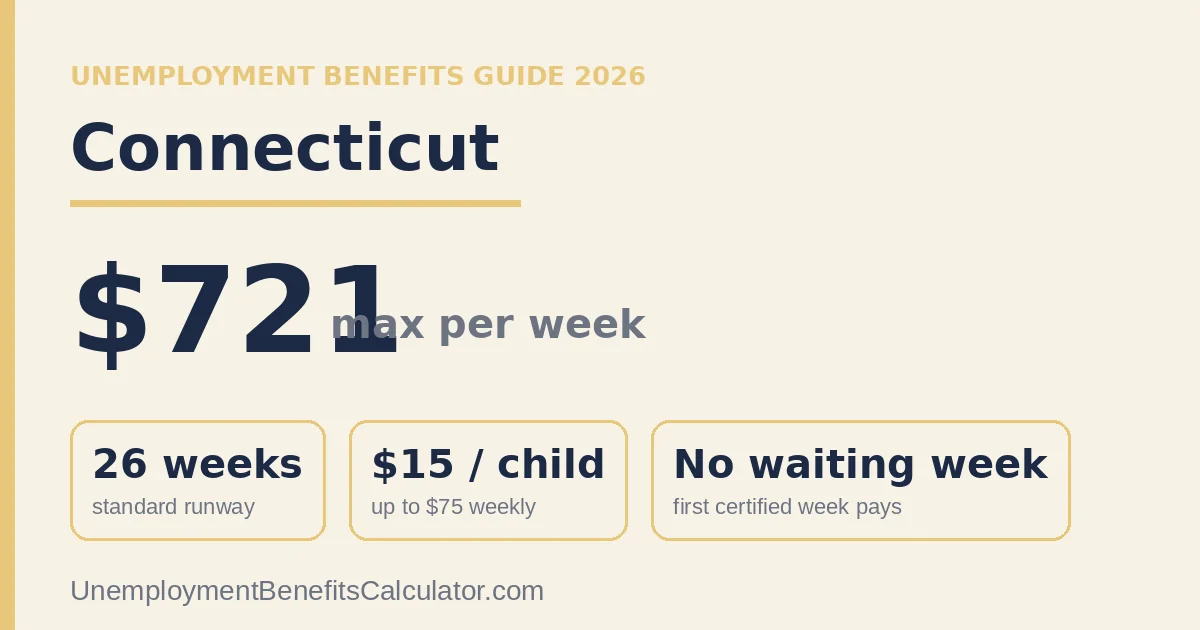
Connecticut pays half of the average weekly wage your two strongest quarters produced, up to $721 a week, for up to 26 weeks, and it starts paying the first certified week with no waiting period anywhere in the rules. Set that against the map and the package is unusual in three directions at once: the ceiling outruns every neighbor except Massachusetts, the runway matches the longest standard duration most states still offer, and the missing waiting week front-loads money in a way almost no nearby program does. This guide builds a 2026 Connecticut claim around those three facts, from the formula through the 21-day appeal clock.
The weekly benefit rate comes from your two highest-earning quarters: add them, divide by 26, and take half the result, clamped between $44 and $721. Each dependent child adds $15 per week up to a $75 cap, and the maximum benefit amount multiplies the weekly rate by up to 26 weeks. Every figure here reads from the state's published 2026 rates, cross-checked against the site's Connecticut register, as of October 27, 2026.
The comparison frame drives the whole guide, because Connecticut's numbers only make sense against its neighbors: the ceiling that beats New York's on most wage histories, the 26 weeks that double the shorter runways in the South, and the first-week payment that quietly adds roughly $700 to $7,200 of real value per claim. Where a rival state pays more or lasts longer, the guide says so plainly, and the internal links carry the full cross-state tables.
| Item | Connecticut 2026 value |
|---|---|
| Maximum weekly benefit | $721 per week |
| Minimum weekly benefit | $44 per week |
| Formula | Half the average weekly wage of your two highest quarters |
| Dependent additions | $15 per week per child, capped at $75 |
| Standard duration | Up to 26 weeks |
| Waiting week | None at all, week one pays |
| Appeal window | 21 days from the fact-finder's written decision |
$721 a Week, 26 Weeks: The Answer First
The direct answer to the question every Connecticut filer asks: half the average weekly wage from your two best quarters, capped at $721, payable up to 26 weeks, with the first certified week paying from day one. A Hartford analyst whose two best quarters totaled $37,492 sits exactly at the ceiling, because that input is the one the cap corresponds to. A New Haven machinist whose two best quarters totaled $26,000 prices at $500 per week, and with two children the check becomes $530, payable for up to 26 weeks before any deduction.
Three structural facts follow from the answer and shape everything below. The formula reads the two best quarters rather than the single best quarter or the whole year, which makes Connecticut friendlier to workers with one spectacular stretch than the whole-year states and friendlier to steady workers than the single-quarter states. The ceiling froze at $721 under the schedule the state set for the mid-decade years, so 2026 planning can treat the cap as stable rather than waiting for an autumn jump. And the dependent layer stacks on top of the formula rather than trading against it, which matters for the family budgets in the middle sections.
Run your own version of the arithmetic before filing: add the two best quarters, divide by 26, halve it, and compare against the letter the state sends. The calculation guide shows the letter's lines one by one, and the estimate walkthrough prices several wage histories in advance.
How Do the Two Best Quarters Build the Check?
The base period follows the standard window, the four oldest of the past five calendar quarters, and Connecticut reads the wages employers reported into the system across it. Take the two highest-earning quarters, add them, divide the sum by 26, and halve the result: that is the weekly benefit rate before the clamps and the dependent layer. The arithmetic averages your best six months of work rather than your best quarter or your full year, which is why a year with a weak first half can still price a strong check in Connecticut.
Worked examples fix the method. Two best quarters at $18,720 total divide to $720 a week of average wage, and half lands at $360. Two best quarters at $26,000 divide to $1,000, and half is $500. The ceiling's input, $37,492 across the two quarters, divides to roughly $1,442 and half reaches $721, which is where the cap catches the state's highest wage histories. Our formula guide contrasts this two-quarter method with the single-quarter states to the south, and the base-period explainer shows which four quarters a filing made this month reads.
The input the formula ignores matters as much as the input it reads. Contractor 1099 wages carry no UI tax and never enter the record, so a W-2 worker with a side business should not expect the side income to lift the check. Severance, vacation payouts, and bonus timing interact with the wage record differently, and the severance guide alongside the lump-sum guide both walk the cases that most often surprise professional claimants.
$44 Floor and the Ceiling Input: The Formula's Edges
Two edges frame every Connecticut claim. At the bottom, the $44 minimum lifts very thin wage histories into a payable range when the broader monetary test passes, and the minimum-wage claiming guide shows how thin records interact with the floor. At the top, wage histories whose two best quarters total more than $37,492 price past the cap and collect $721, which covers a long list of Fairfield County professional salaries and makes Connecticut one of the states where the ceiling regularly binds.
The frozen ceiling deserves its own planning note. The state scheduled the maximum rate's freeze across the mid-decade years, so a 2026 claim plans against $721 without the October jumps other states build in, and the freeze also holds the dependent cap and the maximum pot steady. Claimants filing in later years should re-check the published rate table, because a freeze is a legislative choice with an end date, and the determination letter always controls.
The edges meet in the monetary test itself: wages showing up in two or more separate quarters of covered work, enough total earnings for the formula to price a payable rate, and the standard able-and-available conditions behind every claim. The monetary-eligibility guide walks the full test, and the qualification guide covers the separation-side conditions the wage math never touches.
Add $15 a Week Per Dependent Child
Each dependent child adds $15 to the weekly rate, and the additions stack until they reach $75, which is five children's worth. A $500 base rate with three children becomes $545, and the full $721 ceiling with two children reaches $751 per week. The additions ride the whole claim, every payable week, which at a 26-week runway turns a two-child family's $30 weekly bump into $780 of extra benefits over the claim's life.
The dependent question runs on support, not custody alone: the claimant must provide the majority of the child's support, and the state can ask for the documentation at the application stage. Claimants who share support arrangements should read the dependent-allowance guide, which maps how Connecticut's $15-per-child structure compares with the percentage-based allowances and flat sums other states attach, and which states pay nothing at all.
Plan the layer before filing rather than after, because the additions belong on the application where the state prices them into the determination letter. A family budget built from the bare formula understates a Connecticut claim by up to $75 a week, which is a planning error in the household's favor but still an error the first deposit will correct.
What the No-Waiting-Week Rule Actually Saves
Connecticut imposes no unpaid waiting week, and the first certified week pays. The saving is concrete: in waiting-week states the front week of every claim converts to zero, which at Connecticut's wage levels means $300 to $721 of benefits that a neighboring program would simply erase. Across a full 26-week runway, the missing waiting week is worth up to $18,746 in gross terms for a maximum-claim household, and even a mid-wage claim keeps roughly a week of ordinary expenses covered that a Massachusetts-to-Connecticut comparison would otherwise drop.
The rule changes the filing calculus in a specific way: there is no front-week cost to recover, so the only idle weeks that lose money are the calendar weeks between the layoff and the filing date. File the week the job ends and the program wastes nothing; wait a month and the program still owes every payable week, but the household carried the month without them. The waiting-week guide tracks which states keep the unpaid week and which, like Connecticut, dropped it.
The no-waiting-week rule also removes a classic paperwork trap: in waiting-week states the first certification must be filed for a week that pays nothing, and skipped first certifications delay the whole sequence. Connecticut's first certification is a paid week's certification, so the habit starts with money attached, and the certification guide builds it from week one.
26 Weeks: The Runway That Doubles the South's
Connecticut's standard duration runs up to 26 weeks inside the 52-week benefit year, matching the longest standard runway most states maintain and doubling the 12-to-14-week programs several Southern states now run. The pot at the ceiling is therefore $18,746 for the benefit year, and a mid-wage $500 claim carries $13,000 across the same window. Those totals are the planning numbers for a state where the cost of living spends them faster than the week count suggests.
The runway's management matters as much as its length. Weeks worked or skipped inside the benefit year neither pay nor consume the allowance, which is why a claimant who takes ten weeks of temp work resumes the remaining balance afterward, a sequencing trick the runway guide develops in detail. The opposite risk points the same direction: weeks certified dishonestly, or failed for search or availability, vanish with overpayment notices attached, which the certification-mistakes guide documents.
Approved training and the state's reemployment programs can interact with the runway's end, and the school-while-claiming guide covers when class attendance satisfies the weekly conditions. Claimants approaching exhaustion should read the exhaustion guide early enough for the transition to matter.
File Through ReEmployCT the Week the Job Ends
Connecticut runs its claims through the ReEmployCT portal, and the application collects employer history, separation reasons, and the dependent information that feeds the $15 additions. The session takes most claimants 30 to 45 minutes with the final pay stub, the separation paperwork, and 18 months of employer dates on the desk. The pre-filing checklist matches the portal's screens item by item.
File in the week the job ends. Connecticut's no-waiting-week structure pays the first eligible certified week, so the gap between the layoff and the filing date is the only stretch the program never repays, and claimants who wait a month to file donate the month to nobody. Claimants with wages in New York or Massachusetts should read the interstate guide before choosing the program, because the wage record's location controls and the neighbors' formulas differ enough to move the check by hundreds.
The determination letter arrives with the weekly rate, the dependent layer, and the maximum benefit amount, and it gets read the day it lands, because the appeal structure runs on 21-day clocks described below. Answer the separation questions with plain facts, since Connecticut's fact-finding compares your account with the employer's, and mismatched stories are the delay factory behind slow first payments. Photograph or save the letter the same day it arrives. The after-filing guide maps the sequence from submission to money.
Certify Weekly and Report Every Gross Dollar
Weekly certification runs through the portal on the recurring set: employment, gross pay, ability, availability, and the search record. Connecticut pays weekly, and a clean certification releases the deposit within the state's processing rhythm, usually within a few business days. The certification-questions guide previews every question, and the claim-status guide shows where the portal displays what the state received.
Gross pay sits with the week the hours happened, and the paycheck's clearing date changes nothing, the habit that prevents the most common overpayment in every state's books. A mis-timed report pays a full benefit for one week and claws it back later with a notice, a cycle the mistakes guide prices out. The wage-reporting guide covers the edge cases from tips to holiday pay.
Part-time work coexists with the claim when reported accurately: Connecticut reduces the week's payment for earnings rather than ending the claim, and a week whose earnings reach the weekly rate pays nothing while the 26-week window continues to tick only on payable weeks. The part-time claiming guide and the partial-benefit calculator price the trade, and the earnings-disregard guide shows where the disregard rules do the work.
Where Does Connecticut Rank Against Its Neighbors?
The regional table makes the $721 concrete. Massachusetts pays more per week, $1,154 after its most recent October adjustment, and runs a 30-week runway, which keeps the Bay State at the top of every national table. New York's program pays a lower ceiling for most professional wage histories despite its half-wage formula. Rhode Island and the mid-Atlantic states cluster below Connecticut's line, and the Southern programs trail by hundreds per week with shorter runways. The state comparison and the maximum-by-state table hold the full ranking.
For cross-border workers the comparison is a planning tool, not trivia. A claimant with quarters in Connecticut and Massachusetts files where the wage record supports the claim, and the two programs' ceilings and durations both enter the choice. A claimant with Connecticut wages against a New York offer faces the reverse calculation. The interstate guide works the determination rules that decide which state's program pays.
Against the national frame, Connecticut's package lands in the top tier on every dimension this guide measures: ceiling, duration, dependent layer, and the missing waiting week. The state's cost of living spends the advantage faster than a national ranking suggests, which is why the budget sections above insist on the letter's numbers rather than the rankings.
The 21-Day Clock After Fact-Finding
Connecticut resolves disputed claims through a fact-finding stage first, and the written fact-finder's decision opens a 21-day appeal window to the next level. The window covers separation disputes, monetary corrections, and the downstream referee process, and it runs from the decision's date with the appeal filed online through the state's appeals portal. Miss the 21 days and the decision stands, which is why the guide's sequence reads every determination the day it arrives. The appeal walkthrough covers the mechanics and the hearing-preparation guide covers the evidence.
The fact-finding stage rewards the same discipline the filing stage does: documents with dates beat recollection, and the claimant who kept the layoff email, the final schedule, and the pay stubs borrows none of the panic. Keep certifying through the dispute on the normal rhythm, because only weeks certified on time come back retroactively when a decision reverses. The employer-contest guide walks the freeze-and-resume cycle.
Overpayment notices carry their own 21-day window, and a certification-error overpayment with a clean record often shrinks or disappears on appeal while an ignored notice ages into intercepts. The overpayment response guide frames the choice inside the window.
Taxes and the 1099-G in Connecticut
Federal income tax applies to every dollar of benefits, and the state's portal offers the standard optional federal election of 10 percent, which on the $721 ceiling sets aside $72.10 a week. The 1099-G arrives each January covering the prior calendar year, and its figure feeds the federal return and the Connecticut return's income base under the state's current tax-year rules. The unemployment tax guide runs that arithmetic against quarterly estimates, and claimants who declined the election should run the set-aside math in the fall rather than April.
Check the state's current-year instructions when filing, because the state tax treatment of benefits is a legislative choice that has moved in several states recently, and the 1099-G figure deserves a glance for accuracy either way, since an inflated number creates a mismatch that follows both returns. The estimation guide includes the set-aside math for any weekly figure.
Know What $721 Cannot Replace
The honesty section, because the region's strongest package still has edges: $721 a week replaces half of a $74,000 salary and a third of a six-figure one, and 26 weeks ends on the state's schedule regardless of the search. Claimants separated for documented misconduct or a quit without good cause face adjudication tracks no arithmetic settles, which the disqualification guide explains plainly. School employees run on between-term calendars with their own rules, which the school-employee guide covers separately.
One limit of this guide itself: the frozen ceiling is a legislative schedule with an end date, and a claim filed in a later benefit year should re-check the published rate table before running any planning math, because the determination letter always controls.
Run the Connecticut Checklist Before Week One Closes
- Add your two best quarters, divide by 26, halve it, and predict the weekly rate against the $44-to-$721 band
- Count your dependent children and add $15 per child to the plan, up to $75
- File through ReEmployCT in the week the job ends, with employer history and separation documents ready
- Certify from the first eligible week, on time, because the first week pays and none comes back for lateness
- Log the week's gross earnings when the hours happen, never when the check clears
- Keep dated work search records the portal can verify on request
- Calendar the 21-day window against every fact-finder's decision that arrives
- Elect the 10 percent federal withholding deliberately or set the April money aside yourself
The checklist compresses the state's three structural advantages, the two-quarter formula, the 26-week runway, and the missing waiting week, into eight moves a claimant can run in an afternoon. Connecticut pays its ceiling to the claimants whose paperwork is clean and whose calendars start the week the job ends, and the filing guide carries the mechanics from here. The comparison map favors Connecticut in 2026; the claimant's own discipline decides whether the map's promise arrives as deposits.
Frequently Asked Questions
How much is unemployment in Connecticut in 2026?
Between $44 and $721 per week. Connecticut takes your two highest base-period quarters, divides the sum by 26, and pays half the result, so two best quarters totaling $26,000 price at $500 and any history above the $37,492 input collects the $721 cap. Each dependent child adds $15 a week until the additions reach $75.
How many weeks does Connecticut unemployment pay?
Up to 26 weeks inside the 52-week benefit year, matching the longest standard runway most states maintain. A maximum claim carries $18,746 across the window, and weeks worked or skipped inside the benefit year do not consume the allowance, which is why a claim that takes ten weeks of temp work resumes the remaining balance afterward.
Does Connecticut have a waiting week?
No. Connecticut does not impose an unpaid waiting week, and the first certified week pays from day one. That is worth up to $721 compared with waiting-week states, and it removes the classic trap where the first certification covers a week that pays nothing, so the filing habit starts with money attached.
Can you work part-time and still get unemployment in Connecticut?
Yes. Report every gross dollar under the week the hours happened, and Connecticut reduces that week's payment rather than ending the claim. A week whose earnings reach the weekly rate pays nothing while the 26-week structure runs on, so modest part-time hours that leave a partial check stretch the runway further.
Does Connecticut tax unemployment benefits?
Federal income tax applies to every dollar, with the standard optional 10 percent federal withholding election available on the claim, worth $72.10 a week at the ceiling. The January 1099-G carries the year's total for the federal return and the Connecticut return's income base, and the state's current-year instructions confirm the state treatment each filing season.
What is the deadline to appeal a Connecticut unemployment denial?
Twenty-one days from the date the fact-finder's written decision issues, with the appeal filed online. Keep certifying every week while the appeal runs, because a reversal pays the preserved weeks and a lapsed claim cannot be back-filled. Documents with dates beat recollection at every level of the state's appeal structure.