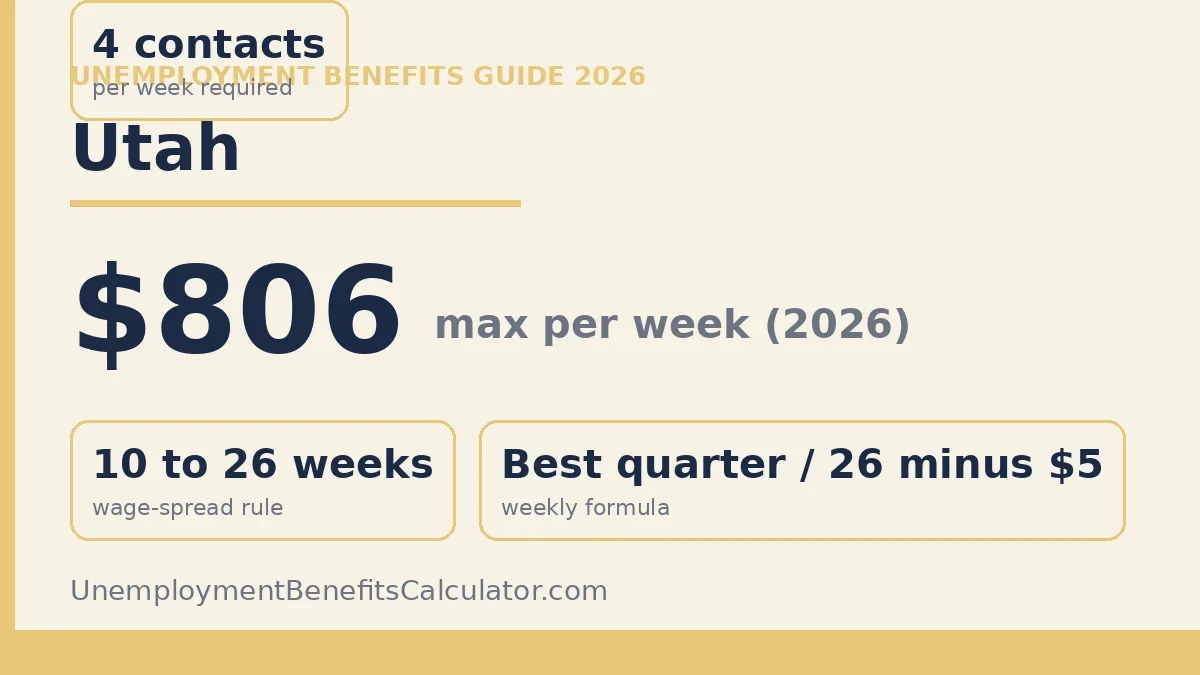
Quick Answer: Utah divides your highest base-period quarter by 26, subtracts $5, and pays up to $806 per week for 2026 claims, with a $20,956 maximum per claim. Duration runs 10 to 26 weeks under the wage-spread rule. One unpaid waiting week precedes payable weeks.
Utah prices a weekly unemployment check at one twenty-sixth of your highest base-period quarter, minus $5. The 2026 ceiling is $806 per week, and the claim maximum is $20,956.
Duration is the twist. Claims run 10 to 26 weeks depending on how evenly wages spread. One unpaid waiting week precedes the first check.
The sections below walk a claim from separation to tax bill. Figures read from the Utah Department of Workforce Services 2026 benefit schedule, checked as of October 28, 2026. Start with the estimator math in the benefit estimation guide.
| Item | Utah 2026 value |
|---|---|
| Weekly formula | Highest quarter divided by 26, minus $5 |
| Maximum weekly benefit | $806 (claims effective Jan 1 - Dec 31, 2026) |
| Maximum benefit amount | $20,956 |
| Monetary test | $5,500 total base wages at 1.5 times the highest quarter |
| Duration | 10 to 26 weeks by the wage-spread rule |
| Waiting week | One unpaid week per benefit year |
| Work search | Four new employer contacts per week |
| Appeal window | 10 days from the determination's mail date |
$806 a Week, $20,956 a Claim: The Direct Answer
The check is one twenty-sixth of your best quarter with $5 off, capped at $806. The claim itself stops at $20,956.
Estimate Your Exact Weekly Benefit
State formulas use base-period wages, not your last paycheck. Your rate depends on your high quarter and the state cap.
Open the Free Utah Calculator →Take a Salt Lake construction supervisor with a $15,000 top quarter: $571 per week. A Provo lab technician with a $6,500 quarter prices at $245.
The cap engages once the quarter exceeds $21,086, so claimants below it get the raw formula. Both figures reset each January, so a 2027 claim reads the 2027 table.
The Formula Behind the $806 Week
One number drives the whole formula: your highest base-period quarter divided by 26, minus $5.
The Utah Employment Security Act writes the formula into statute. Claims filed January through March read wages from the prior October through September. Each later quarter shifts the same window forward.
Only covered employment counts, and self-employment earnings stay out of the formula, as the self-employment guide explains for gig workers.
Workers whose best quarter came three jobs ago should check which quarters sit in the window. The base period explainer shows how to run that check.
Claimants with a strong most-recent quarter can price the alternate window instead. The alternate window uses your four freshest completed quarters and switches on automatically when requested.
The request belongs in the first days of the claim. The high-quarter versus averaging trade-off is drawn in full in the formula comparison guide.
Do Your Wages Clear the $5,500 and 1.5x Tests?
Two tests gate the claim. The base period needs $5,500 in total wages, and the total must reach one and one-half times your highest quarter.
The second prong binds seasonal workers. A $9,000 peak quarter demands $13,500 across the window, so the remaining quarters must supply $4,500 between them.
Claimants who miss the standard test fall back to the alternate base period. That window covers the four most recently completed quarters, and the department applies it for the whole claim.
Run the arithmetic before filing, not after a denial, with the worksheet logic in the earnings requirements guide.
Part-year workers and students with summer-heavy records hit the 1.5-times prong hardest. The strategies in the seasonal workers guide time filing to the friendliest window.
A too-thin record is covered in the no-work-history guide, and the low-wage benefits guide covers the minimum-wage floor scenarios.
File the Week You Stop Working
File the week work stops. The claim takes effect on the Sunday of the filing week, and the first 7 days after separation are the filing window.
Utah opens claims online only and takes none by phone. Set up the account at jobs.utah.gov with your driver license or state ID plus Social Security number.
Add employer details for the last two years: names, addresses, dates, and the reason each job ended. Military claimants add the DD214.
Answer the separation reason exactly as events unfolded, consistent with what the employer reports. A mismatch is the most common trigger for the reviews in the post-filing timeline.
Filing before the last day actually worked is covered in the early filing rules.
Claimants who quit should review the quit rules and the good cause standards before intake.
Save the confirmation screen the same day, because the file number drives every later conversation. The setup sequence in the application guide covers each step.
Read the Determination Before Week Two
The monetary determination prints your weekly figure, your top benefit amount, and the wage record every employer contributed. A transposed wage figure locked in week one becomes a 10-day appeal problem.
Read it against your own pay records in the first days of the claim.
The determination also states the waiting week obligation. Read that sentence as an instruction with a date attached.
Week one of any Utah claim is the waiting week: one unpaid week per benefit year that you still certify for on schedule. The cross-state mechanics are in the waiting week guide.
The planning impact: 26 potential weeks deliver at most 25 checks. Uncertified weeks are not rehabilitated retroactively. The overpayment-notice triggers are listed in the certification mistakes guide.
Serve the Waiting Week and Start the Cycle
After the waiting week, the claim settles into a weekly rhythm with fixed deadlines. Certify once the week has ended, and report every dollar earned regardless of when paid. The earnings math ignores the first 30 percent of your weekly benefit.
Answer the availability questions truthfully, because the answers feed the mid-claim eligibility reviews. The mechanics are in the certification guide, and the phone alternative in the phone certification rules.
Pick one channel and stick with it. Switching methods mid-claim is where deadlines get missed.
Earnings above that 30 percent band deduct dollar for dollar. Once earnings reach 130 percent of the weekly figure, no payment issues for that week. A $400 week keeps the first $120 of earnings untouched.
The disregard explainer contrasts that structure with the flat-deduction states.
Report hours honestly in every scenario, because the fraud framework in the disqualification overview applies to misreported weeks with real penalties.
10 Weeks or 26: How Long Does the Claim Run?
The claim lasts roughly as many weeks as 27 percent of your total base-period wages divided by your weekly benefit, floored at 10 weeks and capped at 26.
Earnings concentrated in one or two quarters push the result toward 10, while wages spread evenly across four quarters push it toward 26.
Two claimants with identical $600 checks can hold runways that differ by four months.
Plan the job search against your actual runway, not the state maximum. A concentrated earner at 10 weeks has half the calendar of the even-earner at 26.
That changes the calculus on training programs in the school rules.
Extended-benefit triggers are covered in the EB trigger map.
Claimants near the end of their runway should read the exhaustion guide and the stretch strategies in the benefit period guide.
What Does Part-Time Work Pay Under the 30 Percent Rule?
Work 10 hours at $20 per hour while pricing at $450 per week, and the first $90 of earnings stays yours. The next $110 deducts from the check.
That week delivers $340 of benefits plus $200 of wages.
The 30 percent disregard makes Utah one of the better states for bridge income. Zero-disregard states net benefits minus every dollar earned from the same week.
The part-time reduction comparison and the part-time eligibility guide quantify that difference state by state.
Earnings at or above 130 percent of the weekly figure zero the check for the week. Full-time hours end eligibility for the week entirely, regardless of pay.
Refusing suitable part-time or full-time offers carries its own consequences, described in the refusal guide.
Claimants earning freelance income should check the business rules before they invoice, since self-employment hours and earnings report differently than wages.
Log Four New Contacts Every Week
Utah's work search standard asks for 4 new employer contacts for full-time work each week, registered through the state's workforce system with the weekly filing. The positions must be ones you are genuinely seeking.
Contacts mean conversations or applications with a real employer, logged with dates and outcomes. The documentation formats that survive audits are sketched in the search log guide.
The legal summary in the requirements overview pairs with those formats.
Two carve-outs soften the rule. Workers on temporary layoff with a definite recall date can have searching suspended, and union hiring halls satisfy the standard through dispatch rules.
That pattern gets a dedicated walk-through in the union guide.
Everyone else should treat the four-contact standard as a weekly floor. Failure arrives as a denial of the weeks in question, previewed in the failed search guide.
Networking can supplement rather than replace employer contacts per the networking rules.
The 10-Day Appeal Clock After a Denial
The statute allows 10 days from a determination's mailing date to file an appeal, and the clock does not pause for reading time.
The determination letter carries the appeal instructions, and the preparation sequence in the denial appeal guide starts the day the letter arrives.
Hearings run before administrative law judges with both parties on a formal record. Keep certifying throughout the appeal, because the weeks you certify are the weeks a successful appeal pays.
Build the appeal around evidence rather than narrative. Gather separation documents, messages, payroll records, and witness names, organized the way the hearing preparation guide recommends.
Employers contest claims on their own timelines. Their burden on misconduct separations is mapped in the employer contest guide, and the fired guide holds the misconduct definitions.
Constructive-discharge and pressure-resignation scenarios have their own evidentiary patterns in the constructive discharge guide.
What Taxes Take From an $806 Week?
Benefits are taxable income on the federal return, and you can elect 10 percent federal withholding. Utah itself takes no state income tax out of the weekly checks.
The state's tax on benefits lands at filing season, out of pocket, so the withholding election is a cash-flow decision.
The annual total arrives on the 1099-G. Filing mechanics for both returns are in the tax guide. Print the determination alongside the return.
Unwithheld checks become April problems when pensions also reduce weekly benefits under the offset rules in the pension guide.
Claimants repaying overpayments face their own documentation questions, handled in the overpayment playbook.
Payment runs through direct deposit or the U.S. Bank Reliacard, set out in the payment methods guide. The card versus deposit choice is reversible, but the withholding election follows the calendar year.
Where a Utah Claim Goes From Here
The path ends in full-time work or at the end of a 10-to-26-week runway. Below, the reading list closes the gaps this guide flagged.
Start with the formula side by side in the state comparison table and the ceiling rankings in the maximums ranking.
Then handle your claim's specific wrinkles: the filing-day sequence in the application walkthrough, the status checks in the claim status guide, or the delayed-payment triage in the payment delay guide.
Claimants crossing state lines should read the interstate rules and the moving rules before the address changes.
The severance overlap in the severance guide belongs on the same list for anyone leaving with a package.
Run the quarter, check the spread, and file the week work stops. The 10-to-26-week question then answers itself from your own wage record.
Check Your Utah Estimate in 2 Minutes
Enter your quarterly wages to see your estimated weekly benefit, your maximum duration, and where the cap applies.
Calculate Your Benefits Now →Frequently Asked Questions
How much is unemployment in Utah in 2026?
Your weekly benefit is your highest base-period quarter divided by 26, minus $5. The 2026 ceiling is $806 per week, and the maximum benefit amount is $20,956. A $10,000 quarter prices at $379 per week.
How long does Utah unemployment last?
Claims run 10 to 26 weeks under the wage-spread rule. Weeks track roughly 27 percent of total base-period wages divided by the weekly benefit. Concentrated earnings push the count toward 10, spread wages toward 26.
Is there a waiting week for Utah unemployment?
Yes. One unpaid waiting week per benefit year precedes payable weeks, and you certify for it like any other week. It converts to payable only on exhaustion, so a 26-week claim delivers at most 25 checks.
What wages qualify for Utah unemployment?
The base period needs $5,500 in total wages and at least one and one-half times your highest quarter. Claimants who miss that test qualify on the alternate base period of the four most recently completed quarters.
Can I work part-time and collect Utah unemployment?
Yes. The first 30 percent of your weekly benefit is disregarded entirely. Earnings above that deduct dollar for dollar, and earnings at 130 percent of the weekly figure zero the check. Full-time hours end that week's eligibility.
How do I appeal a Utah unemployment denial?
File within 10 days of the determination's mail date, using the instructions on the letter. Hearings run before administrative law judges on a formal record. Keep certifying weekly, because certified weeks are the weeks a winning appeal pays.
How does the $5 deduction work in Utah's formula?
The formula subtracts $5 from one twenty-sixth of your highest quarter. A $10,000 quarter prices at $379 per week. The subtraction weighs hardest on small checks, and the cap requires $21,086 in a single quarter.
How do I report part-time earnings when I certify?
Certify once the week has ended and report every dollar earned during that week, regardless of when it was paid. Report gross earnings, not take-home. Certify every week including the waiting week, because uncertified weeks are not rehabilitated retroactively.