
Table of Contents
- Georgia Unemployment Insurance at a Glance
- How Much You Can Get in Georgia in 2026
- Who Qualifies in Georgia
- Filing Your Georgia Claim, Step by Step
- Weekly Certification and the Three-Contact Rule
- How Long Georgia Benefits Last
- Part-Time Work and Partial Benefits in Georgia
- If Georgia Denies Your Claim: Appeals in 20 Days
- Industry Notes: Logistics, Film, and the Georgia Service Economy
- Work Sharing, Training, and the Georgia Fallback Ladder
- Georgia Fact-Finding: How the Exchange Actually Works
- Payments and the Georgia 1099-G
- A Short Georgia Checklist Before You File
- Atlanta Metro Versus Rural Georgia: Same Rules, Different Games
- Taxes on Georgia Unemployment Benefits
Georgia Unemployment Insurance at a Glance
Georgia's unemployment program runs through the Georgia Department of Labor. Its headline numbers require planning: a maximum of $375 per week. A duration that scales with the state's unemployment rate, starting at 14 weeks when the economy is healthy.
The system files through the GDOL portal, certifies weekly. Enforces a three-contact work search requirement that claimants must document from the first week.

The lean benefit structure makes Georgia a state where filing speed and record-keeping separate smooth claims from painful ones. Payments are modest relative to Southeastern neighbors with higher caps, so weeks lost to paperwork errors hurt proportionally more.
This guide covers the full 2026 picture. Amounts, eligibility, the filing sequence, certifications, part-time math, appeals, and taxes for Georgia workers.
Nationally, Georgia sits at the lower end for weekly amounts and duration. The state comparison guide frames that context. The Georgia unemployment calculator estimates your weekly amount from your own wage history before you file.
How Much You Can Get in Georgia in 2026
Georgia computes your weekly benefit from your two highest quarters of base period wages. A minimum of $55 and a maximum of $375 per week. The two-quarter smoothing means a single spike quarter doesn't carry the claim; steady employment history prices better than seasonal surges.
Full-time workers at the state's median wage typically land in the low-to-mid $300s, below the ceiling. Surprises claimants who expected the maximum.
| Item | Georgia 2026 value |
|---|---|
| Maximum weekly benefit | $375 |
| Minimum weekly benefit | $55 |
| Standard duration | 14 weeks, scaling up to as much as 20+ by state unemployment rate |
| Waiting week | One week (unpaid) before benefits begin |
| Work search requirement | 3 employer contacts per week |
| State tax on benefits | Yes (Georgia income tax applies) |
The sliding duration deserves attention because it moves with the statewide rate rather than your personal circumstances. Georgia's scale starts at 14 weeks in strong economies. Extends when unemployment worsens, a design intended to spend less during good times.
Plan your job search runway around 14 weeks unless the state announces an extension. Read the Extended Benefits guide for the federal layer that activates in severe downturns.
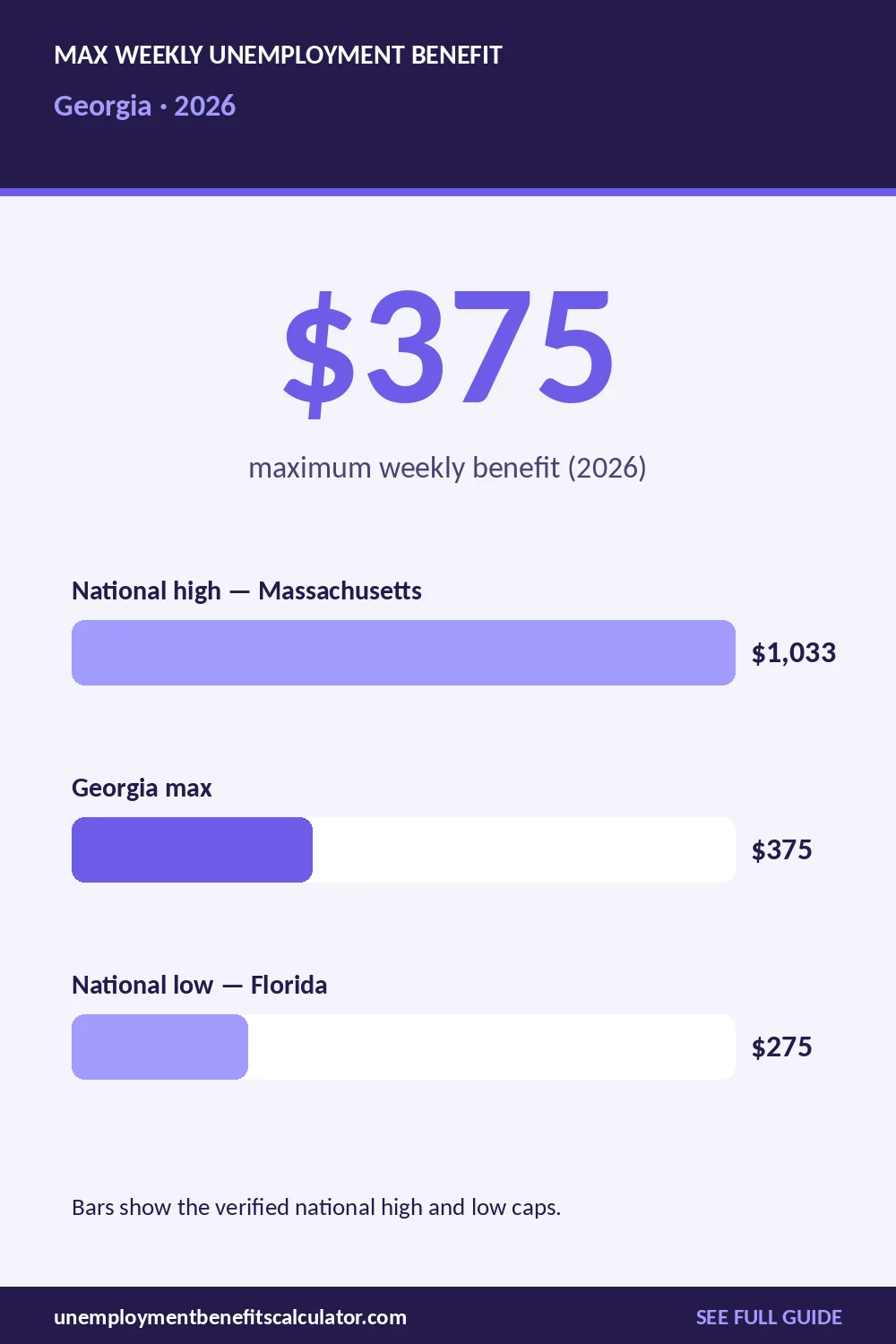
The $375 ceiling also interacts with base period strategy. Claimants whose best quarters are recent should verify the wage window before filing. The base period rules determine which quarters feed the two-quarter formula.
A missing quarter can quietly drop the weekly amount. The recompute rules freeze it for the benefit year once the claim establishes.
Who Qualifies in Georgia
The monetary test requires base period wages in at least two quarters, total wages above a statutory floor. Highest-quarter wages sufficient to produce a weekly rate above the $55 minimum.
Georgia also applies a specific wage-spread requirement across the two highest quarters, so very lopsided histories get scrutiny. The monetary eligibility guide explains how states read the wage record line by line.
Separation rules follow the national architecture with Georgia's enforcement flavor. Layoffs and closures qualify cleanly. Quits need good cause attributable to the employer or documented legal necessity, and Georgia's precedent applies that standard narrowly.
Discharges put the burden on the employer to prove misconduct, and Georgia's definitions exclude simple inability to meet production standards. The good cause guide and the fired-for-cause guide map both tests in practice.
Weekly eligibility requires ability, availability, and three documented employer contacts per week. Registered through Employ Georgia as part of the claim setup.
Georgia samples contact records the way Florida does, and fabricated lines fail whole weeks. The availability guide covers the able-and-available standard, and the log format guide shows records that survive an audit.
Filing Your Georgia Claim, Step by Step
File the week your employment ends, because Georgia pays nothing for weeks before your application. The GDOL portal handles filing, and the state's career centers assist claimants who prefer in-person help. Before starting, assemble:
- Social Security number and a government photo ID
- Employment history for the last 18 months with employer names, addresses, phone numbers, and dates
- Your most recent pay stub with gross wages
- Your Employ Georgia registration details, which the claim process requires
- Banking details for direct deposit or your payment card choice
The application captures your separation story and wage history, then schedules your weekly certifications. Employers receive notice and can contest, and conflicting accounts route into fact-finding with short response windows.
Georgia posts current processing information, and the U.S. Department of Labor's UI resources keep the official contact directory current for both the agency and career centers.
Check the monetary determination against your own math the day it arrives. Georgia's two-quarter formula is sensitive to missing quarters.
A wage investigation with pay stub evidence fixes misfiled wages before the WBA formula locks the number for a year. Claimants with wait-time questions can read the first payment timeline guide to separate normal processing from a stuck file.
Weekly Certification and the Three-Contact Rule
Georgia certifies weekly through the portal. Its automated line, asking whether you worked, gross earnings, availability, and your three employer contacts. The contact standard is heavier than most Southeastern states but lighter than Florida's five.
The same logging discipline applies: employer name, contact method, date. Outcome for each line, matching what you enter in certification.
Report gross earnings for the week earned, including tips and commissions. Georgia reduces payments dollar for dollar above a modest partial-benefit allowance. Earnings that meet or exceed your weekly benefit zero the week out.
With Georgia's low maximum, part-time service workers hit that line faster than they expect. The disregard guide runs the scenarios, and the certification reporting guide covers the weekly mechanics.
Missed certifications create gap weeks needing backdating requests with documented reasons, and Georgia's repair windows are short. The missed deadline guide walks the process. The certification questions guide previews the full weekly screen so no answer surprises you.
How Long Georgia Benefits Last
Your claim runs from the waiting week through up to 14 payable weeks in normal conditions. Bounded by your benefit year. The statutory scale extending duration only when Georgia's unemployment rate rises past defined triggers.
Zero-payment weeks caused by earnings count against the balance in most cases. Makes the 14-week budget tighter than it looks on paper.
The short runway changes job search strategy. Substantive applications should start in the first payable week rather than the last. Employ Georgia's matching system doubles as both a requirement and a genuine channel.
Claimants who exhaust benefits can read the exhaustion guide for the fallback sequence. Workers with wage history in another state can check the interstate claims guide to see whether the other state's formula would pay more per week and for longer.
Part-Time Work and Partial Benefits in Georgia
Georgia allows part-time work during a claim, and its partial formula includes a small earnings allowance before reductions begin. The allowance is modest relative to the $375 maximum, so a $300 part-time week can zero out most claims entirely.
Workers choosing between hour levels should run both through the formula before accepting. A zero-payment week still burns the 14-week balance.
The planning math pairs naturally with Georgia's seasonal employment patterns. Hospitality workers along the coast and in Atlanta's convention economy see quarter-level swings. The seasonal workers guide covers the between-seasons availability questions.
Workers facing formal hour reductions can also point employers at Georgia's work sharing framework. The work sharing guide explains from the employer side.
If Georgia Denies Your Claim: Appeals in 20 Days
Georgia's determination states the decision and the reason, and the appeal window is 20 calendar days from the mailing date. First-level appeals go to an Administrative Hearing for an Appeals Tribunal, held by phone.
The written file and both sides' exhibits in the record. The tribunal's decision governs unless a party carries it further, and most disputes end at this level.
Employer contests in Georgia most often allege misconduct or characterize separations as voluntary. Georgia's misconduct standard requires a connection to the work and a willful or deliberate violation. Good-faith performance failures usually fall short.
Bring schedules, write-ups, and correspondence rather than summaries, because tribunal referees weigh documents over adjectives. The appeal guide, the hearing preparation guide, and the employer contest guide cover the sequence.
Georgia-specific traps worth naming: skipping Employ Georgia registration, logging fewer than three genuine contacts. Missing fact-finding deadlines because portal messages went unread. Each repair window is measured in days, and the application mistakes guide collects the full checklist before filing.
Industry Notes: Logistics, Film, and the Georgia Service Economy
Georgia's claim mix runs through three engines with distinct claim patterns. Logistics and warehouse workers along the I-75. I-85 corridors see layoffs that arrive in distribution shifts rather than individual separations.
The wage record often spans multiple staffing agencies feeding the same warehouse. Split wage records depress any single quarter until investigations merge them. The recompute guide explains the freeze that makes early requests urgent.
Film and production workers face the project-end pattern: productions wrap, crews release, and the between-project availability question decides certifications. Georgia accepts industry-standard job search through its production networks, but the weekly three-contact requirement still applies. The seasonal workers guide covers the project-cycle availability questions that film crews and convention staff both face.
Atlanta's hospitality corridor produces the tipped-wage claim pattern, where reported tips either build or shrink the wage record permanently. Servers at the ceiling of the market lose real money when tips go unreported. Georgia's two-quarter formula prices the record as filed.
The tipped wage guide shows the mechanics. Workers at Hartsfield-Jackson's airport economy face the same tipped-plus-hourly mix on a bigger scale.
Work Sharing, Training, and the Georgia Fallback Ladder
Georgia operates a state work sharing framework that lets employers cut hours across a unit instead of laying off. The state replacing a defined slice of lost wages under rules friendlier than the regular partial formula. Workers seeing formal slowdowns should raise the program with management before the cuts land.
Enrollment happens at the employer level. The work sharing guide explains the mechanics from both sides.
Retraining changes the availability rules for approved claimants. Georgia's workforce system can bless retraining plans that relax the prior-occupation search requirement while you train into growth fields. Effectively converting benefit weeks into funded transition time.
Approval precedes enrollment, and the sequence matters: career center, plan, then certification changes. The school-while-claiming guide covers the approval logic.
Georgia's short 14-week runway makes both programs more valuable than their equivalents in longer-duration states. The bridge period is compressed and the fallback window closes fast.
The benefit period guide shows the sequencing. Claimants near exhaustion should read the exhaustion guide before the final week rather than after it.
Georgia Fact-Finding: How the Exchange Actually Works
Georgia's fact-finding questionnaire is the pivot point of most contested claims, and the mechanics reward speed and precision. After your employer responds to the claim with a different story. GDOL mails both sides a questionnaire with dates, reasons, and document requests.
The determination rides on the written record more than on any phone conversation. Surprises claimants expecting a judge-style interview at this stage.
Answer the questionnaire within two days, attach the documents you hold, and write dates exactly. Narrative argument belongs at the tribunal if the case gets there; the fact-finding stage reads documents.
Claimants who treat it casually produce the delay they fear, because unanswered questionnaires convert into denials by default. The employer contest guide shows a full exchange, and the first payment guide separates normal processing from a stuck file.
Payments and the Georgia 1099-G
Georgia pays weekly benefits by direct deposit or its state debit card. Deposits typically landing two to three business days after a processed certification.
Direct deposit avoids the card's fee edges, which the payment method guide maps in detail. Bank changes belong between certification weeks rather than during a pending one.
The January 1099-G reports total benefits and any elected federal withholding. Georgia's state tax layer lands on your April return because the state does not withhold weekly.
The tax guide covers both layers and the estimated-payment option. Claimants who later repay benefits should read the overpayment guide for the tax adjustments that repayment triggers on the same paperwork.
A Short Georgia Checklist Before You File
Five checks fit Georgia's system: verify your two highest quarters against pay stubs before trusting any estimate. Complete the Employ Georgia registration before certifying.
Plan the three weekly contacts into your routine from the first certification. Decide on federal withholding knowing it covers only the federal layer. Calendar the 20-day appeal window the day any determination arrives.
The application mistakes guide expands the list. With a 14-week runway the checklist habit matters double. Every avoidable delay consumes a larger share of the total coverage than in any neighboring state.
Atlanta Metro Versus Rural Georgia: Same Rules, Different Games
Georgia's single statewide benefit schedule produces two very different claim experiences inside one state. In metro Atlanta, mid-wage workers routinely clear the $375 ceiling.
The working questions are documentation and the three-contact rule in a job market where three applications a week is a light Tuesday. The wage-record questions concentrate in tipped and staffing-agency employment, and the fixes arrive through the investigations this guide covered.
In rural Georgia, the ceiling rarely binds. The monetary test itself is the live question: seasonal agriculture, food processing. Small-manufacturing wages can sit near the minimum thresholds, where one missing quarter changes eligibility entirely.
Workers with thin records should check whether the alternate base period or an adjacent state's wages complete the picture. The interstate guide covers the border questions for workers whose employers sit across the Alabama, South Carolina, or Tennessee lines.
The shared lesson is that Georgia's lean numbers make the margins the whole game. Metro claimants protect high weekly amounts by documenting the record; rural claimants protect eligibility itself. Both run the same portal, the same three-contact rule.
The same 14-week clock, which is why the checklist habits from earlier in this guide transfer unchanged from Buford to Bainbridge. Why the application mistakes guide reads identically well in both places.
Taxes on Georgia Unemployment Benefits
Georgia taxes unemployment benefits as state income in addition to the federal layer. The state does not withhold tax from weekly payments, so the liability lands on your April return. The optional 10% federal withholding during the claim covers only the federal piece, which claimants sometimes misread as covering everything.
The combined estimate deserves a mid-claim calculation rather than an April surprise. Benefits are fully taxable federally, the 1099-G reports the total each January. Georgia's state rates apply on top.
The unemployment tax guide covers both layers. The estimated-payment option, the payment method guide explains how the weekly money arrives. The overpayment guide closes the loop on the repayment adjustments that touch the same paperwork.
Frequently Asked Questions
How much is unemployment in Georgia in 2026?
Georgia pays between $55 and $375 per week, computed from your two highest quarters of base period wages. Full-time workers at the state's median wage typically land in the low-to-mid $300s rather than at the ceiling.
How many weeks does Georgia unemployment pay?
Georgia pays 14 weeks when the state unemployment rate is low, with the duration scaling upward under state law when unemployment worsens. The one-week waiting period consumes the front edge, and earnings-heavy weeks count against the balance.
What are the work search requirements in Georgia?
Georgia requires three documented employer contacts per week, reported with employer names, methods, and dates, plus registration with Employ Georgia as part of the claim. The state samples records, and weeks with fabricated or short contacts fail audits.
How long does it take to get first unemployment payment in Georgia?
Most Georgia claimants see their first payment two to four weeks after filing, following the unpaid waiting week and any fact-finding delays. Employer contests pause the first payment while adjudication resolves, so complete questionnaires within days.
Does Georgia tax unemployment benefits?
Yes. Georgia applies state income tax to unemployment benefits in addition to federal tax, and the state does not withhold from weekly payments. The optional 10 percent federal withholding covers only the federal layer, so plan for Georgia's piece on your April return.
Can I work part time and still get unemployment in Georgia?
Yes, with a modest earnings allowance before reductions begin. Georgia reduces payments dollar for dollar above the allowance, and earnings that meet or exceed your weekly benefit amount zero the week while still counting against the 14-week balance.